
 100% FREE ACCESS
12th Standard Syllabus & Materials
12th Standard
TN 12th Computer Applications மின்னணு தரவு பரிமாற்றம் Sample Question Papers Study Material - QB365 Set A
NEW12th Standard
TN 12th Computer Applications மின் - வணிக பாதுகாப்பு அமைப்புகள் Sample Question Papers Study Material - QB365 Set A
NEW12th Standard
TN 12th Computer Applications மின்னணு செலுத்தல் முறைகள் Sample Question Papers Study Material - QB365 Set A
NEW12th Standard
TN 12th Computer Applications மின் - வணிகம் Sample Question Papers Study Material - QB365 Set A
NEW12th Standard
TN 12th Computer Applications திறந்த மூல கருத்துருக்கள் Sample Question Papers Study Material - QB365 Set A
NEW12th Standard
TN 12th Computer Applications வலையமைப்பு வடமிடல் Sample Question Papers Study Material - QB365 Set A

Published on: 13/02/2020
12th Standard Economics public model Question paper IV - 2019-2020
Download Tamil Nadu 12th Standard Economics question papers, model tests, one-mark questions, important questions, and public exam papers in PDF format. Free study materials and answer keys for TN State Board students.
Questions + Answers key
Take MCQ Economics Test
1.
Expand the term ECM
European Common Market
Equal Common Market
East Asian Common Market
England Custom Market
2.
Trace the author of following statement “Economic Planning in the widest sense is the deliberate direction by persons incharge of large resources of economic activity towards chosen ends”
Dalton
Arthur Lewis
Arthur Schumpeter
None of the above
3.
Expand the term MOSPI.
The Ministry of Statistics and Programme Implementation
The Ministry of Statistics and Probability Implementation
The Ministry of Statistical and Programme Improvements
None of the above
4.
(i) Firms, (ii) Households, (iii) Government, (iv) Rest of the world and (v) Capital sector are different elements of _________?
social accounting method
private accounting method
public accounting method
social accounting model
5.
| 1 | EcoSystem | i. | The presence of harmful or objectionable material to damage water quality. |
| 2 | Pollution | ii. | The increase in temperature of the Earth’s surface, due to greenhouse gases. |
| 3 | Water Pollution | iii. | Residual discharges of contaminants into the natural environment to the air or water |
| 4 | Global warming | iv. | The interacting system of a biological community and its nonliving environmental surroundings. |
(1) – (i) (2) – (ii) (3) – (iv) (4) – (iii)
(1) – (ii) (2) – (iii) (3) – (iv) (4) – (i)
(1) – (iv) (2) – (iii) (3) – (i) (4) – (ii)
(1) – (i) (2) – (ii) (3) – (iii) (4) – (iv)
6.
International trade forces domestic firms to become more competitive in terms of
The introduction of new products
Product design and quality
Product price
All of the above
7.
_________ cosists of capital receipts and capital expenditure.
Budge
Capital budget
Revenue
Supplementary budget
8.
Theory of ____________ states the effect of investment upon the level of income.
Multiplier
J.B. Say's Law of market theory
General theory
Classical theory of employment
9.
Capital stock and technological knowledge are given in the ______________
medium run
long run
short run
none of the above
10.
In addition to household and firms, inclusion of the government sector make this model a ________ model.
Single sector model
Two sector model
Three sector model
Four sector model
11.
12.
NITI Aayog is formed through_______
Presidential Ordiance
Allocation of business rules by President of India
Cabinet resolution
None of the above
13.
The process of nutrient enrichment is termed as
Eutrophication
Limiting nutrients
Enrichment
Schistosomiasis
14.
Methods of repayment of public debt is
Conversion
Sinking fund
Funded debt
All these
15.
Tourism and travel are classified in which of balance of payments accounts?
merchandise trade account
services account
unilateral transfers account
capital account
16.
Central bank is_____ authority of any country.
Monetary
Fiscal
Wage
National Income
17.
___________inflation occurs when general prices of commodities increases due to increase in production costs such as wages and raw materials.
Cost-push
demand pull
running
galloping
18.
If every able bodied person who is willing to work at the prevailing wage rate is employed called _______.
Full employment
Under employment
Unemployment
Employment opportunity
19.
The largest proportion of national income comes from___________
Private sector
Local sector
Public sector
None of the above
20.
A steady increase in general price level is termed as_____________.
wholesale price index
Business Cycle
Inflation
National Income
21.
Write a short note on TRIMs
22.
Draw the diagram of Fisher’s Quantity theory of money.
23.
Explain the uses of multiplier
24.
What is Per capita income?
25.
What are the six basic characteristics of under developed economy?
26.
What are the functions of Statistics?
27.
What is land pollution? Mention the causes of land pollution.
28.
Describe the subject matter of International Economics.
29.
30.
Indicate the demerits of socialism.
31.
Distinguish between Balanced and Unbalanced Budget.
32.
Distinguish between correlation and regression.
33.
Explain Measures to Control Inflation.
34.
Explain Adam Smith’s Theory of Absolute Cost Advantage.
35.
Explain non-economic factors determining development?
36.
Explain the importance of sustainable development and its goals.
37.
38.
Explain the objectives of IMF.
39.
Explain the types of Terms of Trade given by Viner.
40.
Explain the role of Commercial Banks in economic development.
41.
What are the differences between MEC and MEI.
42.
Describe the types of unemployment.
43.
44.
Compare the features of capitalism and socialism.
45.
Define a financial intermediary.
46.
What is the Meaning of Marginal Efficiency of Capital (MEC)?
47.
What is financial planning?
48.
What is Say's law of market?
49.
Write down the countries that have capitalistic, economy.
50.
Define Global warming.
51.
Write the meaning of Special Drawing rights.
52.
What is gold standard?
53.
What is the main feature of rural unemployment ?
54.
Define GDP deflator.
1.
(a)
European Common Market
2.
(a)
Dalton
3.
(a)
The Ministry of Statistics and Programme Implementation
4.
(a)
social accounting method
5.
(c)
(1) – (iv) (2) – (iii) (3) – (i) (4) – (ii)
6.
(d)
All of the above
7.
(b)
Capital budget
8.
(a)
Multiplier
9.
(c)
short run
10.
(c)
Three sector model
11.
(a)
12.
(c)
Cabinet resolution
13.
(a)
Eutrophication
14.
(d)
All these
15.
(b)
services account
16.
(a)
Monetary
17.
(a)
Cost-push
18.
(a)
Full employment
19.
(a)
Private sector
20.
(c)
Inflation
21.
Agreement on Trade Related Investment Measures (TRIMs)
(i) TRIMs are related to conditions or restrictions in respect of foreign investment in the country.
(ii) It calls for introducing equal treatment for foreign companies on par with national companies. TRIMs were widely employed by developing countries.
22.
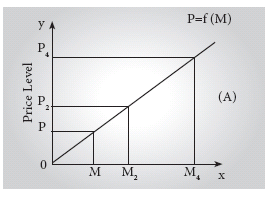
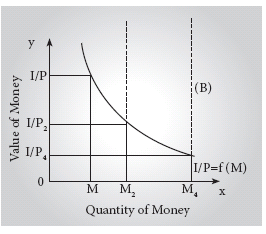
23.
(i) Multiplier highlights the importance of investment in income and employment theory.
(ii) The process throws light on the different stages of trade cycle.
(iii) It also helps in bringing the equality between S and I.
(iv) It helps to reduce unemployment and achieve full employment.
24.
(i) Per Capita income (or) output per person is an indicator to show the living standards of people in a country.
(ii) If real PCI increases.
(iii) It is considered to be an improvement in the overall living standard of people.
(iv) PCI is arrived at by dividing the GDP by the size of population.
(v) It is also arrived by making some adjustment with GDP
(vi) \(PCI=\frac { GDP }{ Total\ number\ of\ people\ in\ a\ country } \) (or)\(PCI=\frac { National\ Income }{ Total\ Population } \)
25.
(1) Primary production
(2) Population Pressures
(3) Underemployment
(4) Economic backwardness
(5) Capital deficiency
(6) Foreign trade orientation
26.
(I) Statistics presents facts in a definite form.
(ii) It simplifies mass of figures.
(iii) It facilitates comparison.
(iv) It helps in formulating and testing.
(v) It helps in prediction.
(vi) It helps in the formulation of suitable policies.
27.
(i) Land pollution is defined as, "the degradation of land because of the disposal of waste on the land".
(ii) Any substance that is discharged, emitted or deposited in the environment in such a way that it alters the environment causes land pollution.
Causes:
Deforestation and soil erosion:
(i) Deforestation carried out to create dry lands is one concern.
(ii) Land that is once converted into a dry land can never be made fertile again.
Agricultural activities:
(i) With growing human and pet animal population demand for food has increased.
(ii) Farmers use highly toxic fertilizers and pesticides which contaminates and poisons the land.
Mining activities:
(i) During extraction and mining, several land spaces are created beneath the surface.
Landfills:
(i) Garbage like plastic, paper, cloth, wood and hospital waste get accumulated.
(ii) Things that cannot be recycled become a part of the landfills that cause land pollution.
Industrialization:
(i) Due to increasing consumerism more industries are developed which lead to deforestation.
Construction activities:
(i) Due to urbanisation, large amount of construction activities are taking place.
(ii) Waste articles like wood, metal, bricks, are dumped at the outskirts of urban areas that lead to land pollution.
Nuclear waste:
(i) The leftover radioactive materials, harmful and toxic chemicals affect human health.
(ii) They are dumped beneath the earth to avoid any casualty.
28.
Pure Theory of Trade
(i) This component explains the causes for foreign trade, composition, direction and volume of trade, determination of the terms of trade and exchange rate, issues related to balance of trade and balance of payments.
Policy Issues
(i) Policy issues such as free trade vs. protection, methods of regulating trade, capital and technology flows, use of taxation, subsidies and dumping, exchange control and convertibility, foreign aid, external borrowings and foreign direct investment, measures of correcting disequilibrium in BoP are covered.
International Cartels and Trade Blocs
(i) Economic integration, cartels, customs unions, monetary unions, trade blocs, economic unions and multinational corporation are covered
International Financial and Trade Regulatory Institutions
(i) Financial institutions like IMF, IBRD, WTO are part of International Economics.
29.
30.
(i) Red tapism and bureaucracy since, approval of many officials is needed.
(ii) Absence of incentive and so productivity is less.
(iii) Limited freedom of choice in the consumption of goods and services.
(iv) The state takes all major decisions. There is concentration and misuse of power.
31.
| Balanced Budget | Unbalanced Budget |
| 1. In case of balanced budget, the proposed govt. expenditure is equal to the estimated govt. receipts in the budget year. | 1. In case of unbalanced budget, the proposed expenditure and the estimated receipt are unequal during the budget year. |
| 2. Balanced budget reduces unproductive and extravagant expenditure of the govt | 2. Unbalanced (deficit) budget helps the govt. to incur unproductive and extravagant expenditure. |
| 3. It is ineffective during economic instability. | 3. It is effective during economic instability (surplus during inflation and deficit during deflation). |
| 4. It fails to achieve full employment from under-employment equilibrium | 4. Unbalanced (deficit) budget is a powerful instrument to achieve full employment |
| 5. It cannot solve the problems of underdeveloped countries (UDCs). | 5. Unbalanced (deficit) budget is a powerful instrument of resource mobilisation for economic development of UDCs. |
32.
| S.No | Correlation | Regression |
| 1 | Correlation is the relationship between two or more variables, which vary with the other in the same or the opposite direction |
Regression means going back and it is a mathematical measure showing the average relationship between two variables |
| 2 | Both the variables X and Y are random variables |
Both the variables may be random variables |
| 3 | It finds out the degree of relationship between two variables and not the cause and effect relationship. |
It indicates the cause and effect relationship between the variables and establishes functional relationship. |
| 4 | It is used for testing and verifying the relation between two variables and gives limited information |
Besides verification it is used for the prediction of one value, in relation to the other given value. |
| 5 | The coefficient of correlation is a relative measure. The range of relationship lies between –1 and +1 |
Regression coefficient is an absolute figure. If we know the value of the independent variable, we can find the value of the dependent variable |
| 6 | There may be spurious correlation between two variables. |
In regression there is no such spurious regression |
| 7 | It has limited application, because it is confined only to linear relationship between the variables |
It has wider application, as it studies linear and nonlinear relationship between the variables |
| 8 | It is not very useful for further mathematical treatment. |
It is widely used for further mathematical treatment |
33.
Keynes and Milton Friedman together suggested three measures to prevent and control of inflation.
(1) Monetary measures,
(2) Fiscal measures (J.M. Keynes) and
(3) Other measures.
1. Monetary Measures:
These measures are adopted by the Central Bank of the country. They are
(i) Increase in Bankrate
(ii) Sale of Government Securities in the Open Market
(iii) Higher Cash Reserve Ratio (CRR) and Statutory Liquidity Ratio (SLR)
(iv) Consumer Credit Control and
(v) Higher margin requirements
(vi) Higher Repo Rate and Reverse Repo Rate.
2. Fiscal Measures:
Fiscal policy is now recognized as an important instrument to tackle an inflationary situation. The major anti-inflationary fiscal measures are the following: Reduction of Government Expenditure and Public Borrowing and Enhancing taxation.
3. Other Measures:
These measures can be divided broadly into short-term and longterm measures.
(i) Short-term measures can be in regard to public distribution of scarce essential commodities through fair price shops (Rationing). In India whenever shortage of basic goods has been felt, the government has resorted to import so that inflation may not get triggered.
(ii) Long-term measures will require accelerating economic growth especially of the wage goods which have a direct bearing on the general price and the cost of living. Some restrictions on present consumption may help in improving saving and investment which may be necessary for accelerating the rate of economic growth in the long run.
34.
Adam Smith argued that all nations can be benefitted when there is free trade and specialisation in terms of their absolute cost advantage
The Theory
(i) According to Adam Smith, the basis of international trade was absolute cost advantage.
(ii) Trade between two countries would be mutually beneficial when one country produces a commodity at an absolute cost advantage over the other country which in turn produces another commodity at an absolute cost advantage over the first country.
Assumptions
1. There are two countries and two commodities (2 x 2 model).
2. Labour is the only factor of production
3. Labour units are homogeneous
4. The cost or price of a commodity is measured by the amount of labour required to produce it.
5. There is no transport cost.
Illustration
Absolute cost advantage theory can be illustrated with the help of the following example.
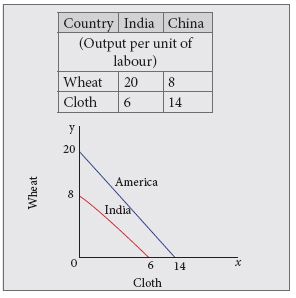
(iii) From the illustration, it is clear that India has an absolute advantage in the production of wheat over China and China has an absolute advantage in the production of cloth over India
(iv) Therefore, India should specialize in the production of wheat and import cloth from China. China should specialize in the production of cloth and import wheat from India
(v) This kind of trade would be mutually beneficial to both India and China.
35.
1. Human Resources
(i) Human resource is named as human capital because of its power to increase productivity and thereby national income. There is a circular relationship between human development and economic growth.
(ii) If labour is efficient and skilled, its capacity to contribute to growth will be high. For example Japan and China.
2. Technical Know-how: As the scientific and technological knowledge advances, more and more sophisticated techniques steadily raise the productivity levels in all sectors.
3. Political freedom: The process of development is linked with the political freedom.
4. Social organization: People show interest in the development activity only when they feel that the fruits of development will be fairly distributed. Mass participation in development programs is a pre-condition for accelerating the development process.
5. Corruption free administration:
Corruption is a negative factor in the growth process. Unless the countries rootout corruption in their administrative system, the crony capitalists and traders will continue to exploit national resources. The tax evasion tends to breed corruption and hamper economic progress.
6. Desire for development:
The pace of economic growth in any country depends to a great extent on people's desire for development.
7. Moral, ethics and social values:
(i) These determine the efficiency of the market.
(ii) If people are not honest, market cannot function.
8. Casino Capitalism:
If People spend larger proportion of their income and time on entertainment liquor and other illegal activities, productive activities may suffer.
9. Patrimonial Capitalism:
If the assets are simply passed on to children from their parents, the children would not work hard, because the children do not know the value of the assets. Hence productivity will be low.
36.
Introduction:
(i) Sustainable development is concerned with the welfare of the present and future generation.
(ii) It aims at satisfying the luxury wants of the rich and the basic necessities of the poor.
Definition:
(i) Sustainable development is development that meets the needs of the present without compromising the ability of future generations to meet their own needs.
Goals:
(i) It is crucial to harmonize three core elements such as economic growth, social inclusion and environmental protection.
(ii) A set of 17 goals for the world's future can be achieved before 2030 with three unanimous principles fixed by United Nations such as Universality, Integration and Transformation.
1) End poverty in all its forms everywhere.
2) End hunger, achieve food security and improved nutrition and promote sustainable agriculture.
3) Ensure healthy lives and promote wellbeing for all at all ages.
4) Ensure inclusive and quality education for all and promote lifelong learning.
5) Achieve gender equality and empower women and girls.
6) Ensure access to water and sanitation for all.
7) Ensure access to affordable, reliable, sustainable and modern energy for all.
8) Promote inclusive and sustainable economic growth, employment and decent work for all.
9) Build resilient infrastructure, promote, sustainable industrialization and foster innovation.
10) Reduce inequality within and among countries.
11) Make cities inclusive, safe, resilient and sustainable.
12) Ensure sustainable consumption and production pattern.
13) Take urgent action to combat climate change and its impacts
14) Conserve and sustainably use the oceans, seas and marine resources.
15) Sustainably manage forests, combat desertification, stop and reverse land degradation, stop biodiversity loss.
16) Promote just, peaceful and inclusive societies.
17) Revitalize the global partnership for sustainable development.
37.
38.
(i) To promote international monetary cooperation among the member nations.
(ii) To facilitate faster and balanced growth of international trade.
(iii) To ensure exchange rate stability by curbing competitive exchange depreciations.
(iv) To reduce exchange controls imposed by member nations.
(v) To establish multilateral trade and payment system in respect of current transactions.
(vi) To promote the flow of capital from developed to developing nations.
(vii) To solve the problem of international liquidity.
39.
Single Factoral Terms of Trade
(i) According to Viner, the single factoral terms of trade is an improvement over the commodity terms of trade.
(ii) It represents the ratio of export. price index to the import price index adjusted for changes in the productivity of factors in the production of exports.
\(\mathrm{T}_{\mathrm{f}}=\left(\mathrm{P}_{\mathrm{x}} / \mathrm{P}_{\mathrm{m}}\right) \mathrm{F}_{\mathrm{x}}\)
(iii) Tf is single factoral terms of trade index.
(iv) Fx is productivity in exports.
Double Factoral Terms of Trade
\(\mathrm{T}_{\mathrm{ff}}=\left(\mathrm{P}_{\mathrm{x}} / \mathrm{P}_{\mathrm{m}}\right)\left(\mathrm{F}_{\mathrm{x}} / \mathrm{F}_{\mathrm{m}}\right)\)
(i) It takes into account the productivity in country's exports and productivity of foreign factors.
(ii) Fm is import index (which is measured as index cost in terms of quantity of factors of production employed per unit) of imports.
40.
Introduction
(i) Commercial banks are institutions that conduct business with profit motive by accepting public deposits and lending loans.
Capital Formation
(i) Bank mobilize the small savings of the people scattered over a wide area through their network of branches and make it available for productive purposes.
(ii) Attractive schemes of the banks induce the people to save their money
Creation of Credit
(i) Credit creation leads to increased production, employment, sales and prices and thereby there is faster economic development.
Channelizing Funds towards Productive Investment
(i) Pooled savings is allocated to various sectors and productivity increases.
Encouraging Right Industries
(i) Banks give loan to right type of persons.
(ii) Banks grant loans and advances to manufacturers whose products are in great demand.
(iii) Manufacturers introduce new methods of production and assist in raising the national income of the country.
Banks Monetize Debt
(i) Banks transform the loan to be repaid after a certain period into cash, which can be immediately used for business activity.
(ii) Manufacturers and wholesale traders cannot increase their sales without selling goods on credit basis.
(iii) But credit sales may lead to locking up of capital.
(iv) So production is reduced.
(v) As banks are lending money by discounting bills of exchange, business concerns are able to carry out economic activities without gap.
Finance to Government
(i) Government needs finance for promoting industries.
(ii) Banks provide long-term credit to Government by investing their funds in Government securities and short-term finance by purchasing Treasury Bills.
(iii) RBI has given Rs.68,000 crores to the government of India in the year 2018-19.
Employment Generation
(i) Bank's branches are opened frequently and so new employment opportunities are created.
Banks Promote Entrepreneurship
(i) Banks induce new entrepreneurs to take up the well-formulated projects and provision of counseling services like technical and managerial guidance.
(ii) Conclusions Banks provide 100 % credit for worthwhile projects, which is also technically feasible and economically viable.
(iii) Thus commercial banks help for the development of entrepreneurship in the country.
41.
| S. No | Marginal Efficiency of Captial (MEC) | Marginal Efficiency of Investment (MEI) |
|---|---|---|
| 1. | It is based on given supply price for capital. | It is based on the induced change in the price due to change in the demand for capital. |
| 2. | It represents the rate of return on all successive unit of capital without regard to existing capital. | It shows the rate of return on just those units of capital over and above the existing capital stock |
| 3. | The capital stock is taken on the X axis of diagram. | The amount of investment is taken on the X axis of diagram. |
| 4. | It is a 'Stock' concept. | It is a 'Flow' concept. |
| 5. | It determines the optimum capital stock in an economy at each level of interest rate. | It determines the net investment of the economy at each interest rate given the capital stock. |
42.
Cyclical unemployment:
(i) During the downturn phase (recession and depression) of trade cycle, income and output fall leading to cyclical unemployment.
(ii) It is caused by deficiency of effective demand
Structural unemployment:
(i) Unemployment due to massive and deep rooted changes in economic structure leads to structural unemployment.
(ii) Lack of demand for the product or shift in demand to other products cause this type of unemployment.
(iii) (e.g.) rise in demand for mobile phones has adversely affected the demand for cameras, tape recorders
Disguised unemployment:
(i) It occurs in agriculture when more people are there than required. Even if some workers are withdrawn, production does not suffer.
Actual marginal productivity is zero, less or negative.
(i) Seasonal unemployment
1. In agriculture and agro based industries like sugar, production activities are carried out only in some seasons.
2. These industries offer employment only during that season in a year.
3. People remain unemployed during the off season.
4. Seasonal unemployment takes place from demand side also (eg) ice cream industry, holiday resorts
(ii) Frictional unemployment (Temporary unemployment)
1. It arises due to imbalance between supply of labour and demand for labour.
2. It is because of immobility of labour, lack of necessary skills, break down of machinery, shortage of raw materials.
3. The persons who lose jobs and in search of jobs also come under frictional unemployment
(iii) Educated unemployment
1. Educated people are underemployed or unemployed when qualification does not match the job.
2. Faulty education system, lack of employable skills, mass student turnout and preference for white collar jobs are highly responsible for educated unemployment.
43.
44.
1. Capitalism and socialism are two extreme and opposite approaches.
2. In capitalism, there is total freedom but in socialism, there is no freedom at all.
3. In capitalism, there is private ownership of means of production but there is public ownership of means of production in socialism.
4. Profit is the driving force behind all economic activities in capitalism but it is social welfare under socialism.
5. Capitalism enjoys free market but in socialism there is central planning.
6. There is unequal income distribution in capitalism but there is equal income distribution in socialism.
7. The major problem in capitalism is inequality but it is inefficiency in socialism.
45.
(i) A financial intermediary is a bank or other institution that serves as a link between lenders and borrowers.
(ii) They typically accept savings deposits from consumers and then lend money to consumers and businesses to finance purchases of goods and services or for investment purposes.
46.
The rate of discount which makes the discounted present value of expected income stream equal to the cost of capital.
47.
Financial planning is nothing but techniques of planning in which resources are allocated in terms of money
48.
J.B. Say enunciated the proposition that "Supply creates its own demand": Hence there cannot be general over production or the problem of unemployment in the economy.
49.
i) The USA
ii) West Germany
iii) Australia and
iv) Japan
50.
Global warming is the current increase in temperature of the earth's surface (both land and water) and its atmosphere.
51.
(i) Also called 'Paper Gold', SDR is a form of international reserves created by the IMF in 1969 to solve the problem of international liquidity.
(ii) They are allocated to IMF members in proportion to their quotas.
(iii) It is used as a means of payment to meet balance of payments deficits.
52.
(i) The value of the monetary unit is directly linked with a certain weight of gold.
(ii) The purchasing power of a unit of money is maintained equal to the value of a fixed weight of gold.
53.
The major feature of rural unemployment is the existence of unemployment in the form of disguised unemployment and seasonal unemployment.
54.
GDP deflator is an index of price changes of goods and services included in GDP.
\(\text{GDP deflator}=\frac { Nominal\ GDP }{ Real\ GDP } \times 100\)

12th Standard Syllabus & Materials
12th Standard
TN 12th Computer Applications களப்பெயர் முறைமை (DNS) Sample Question Papers Study Material - QB365 Set A
NEW12th Standard
TN 12th Computer Applications வலையமைப்பு எடுத்துக்காட்டுகள் மற்றும் நெறிமுறைகள் Sample Question Papers Study Material - QB365 Set A
NEW12th Standard
TN 12th Computer Applications கணினி வலையமைப்பு ஓர் அறிமுகம் Sample Question Papers Study Material - QB365 Set A
NEW12th Standard
TN 12th Computer Applications PHP-உடன் MySQL-ஐ இணைத்தல் Sample Question Papers Study Material - QB365 Set A



Tamilnadu Stateboard 12th Standard Subjects

Maths

Chemistry

Physics

Biology

Computer Science

Business Maths and Statistics
Economics

Commerce

Accountancy

History

Computer Applications
Biology
Computer Technology
Computer Applications
Computer Science
Business Maths and Statistics
Commerce
Economics
Maths
Chemistry
Physics
Computer Technology
History
Accountancy

Tamil

English

French
Tamilnadu Stateboard Standards
