
 100% FREE ACCESS
12th Standard Syllabus & Materials
12th Standard
TN 12th Computer Applications மின்னணு தரவு பரிமாற்றம் Sample Question Papers Study Material - QB365 Set A
NEW12th Standard
TN 12th Computer Applications மின் - வணிக பாதுகாப்பு அமைப்புகள் Sample Question Papers Study Material - QB365 Set A
NEW12th Standard
TN 12th Computer Applications மின்னணு செலுத்தல் முறைகள் Sample Question Papers Study Material - QB365 Set A
NEW12th Standard
TN 12th Computer Applications மின் - வணிகம் Sample Question Papers Study Material - QB365 Set A
NEW12th Standard
TN 12th Computer Applications திறந்த மூல கருத்துருக்கள் Sample Question Papers Study Material - QB365 Set A
NEW12th Standard
TN 12th Computer Applications வலையமைப்பு வடமிடல் Sample Question Papers Study Material - QB365 Set A

Published on: 13/02/2020
12th Standard Economics public model Question paper V - 2019-2020
Download Tamil Nadu 12th Standard Economics question papers, model tests, one-mark questions, important questions, and public exam papers in PDF format. Free study materials and answer keys for TN State Board students.
Questions + Answers key
Take MCQ Economics Test
1.
Which is not a type of Local Bodies?
Village Panchayats
District Boards or ZilaParishads
Municipal Wards
Municipal Corporations
2.
Assertion: IMF enforces the system of determination of par values of the currencies of the member countries
Reason: According to the Articles of Agreement of the IMF, every member nation should declare the par value of its currency in terms of gold or US dollars.
Both A and R are true and R is the correct explanation of A
Both A and R are true but R is not the correct explanation of A
A is true but R is false
A is false but R is true
3.
If the correlation coefficient is a positive value, then the slope of the regression line
must also be positive
can be either negative or positive
can be zero
can not be zero
4.
The missing part of the cycle
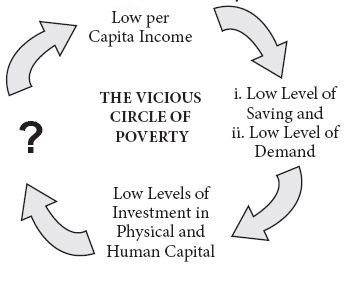
Low income
Low tax
Low productivity
Low investment
5.
GDP Deflator is also called as:
Implicit Cost Deflator
GDP at Factor Cost
Implicit Wage Deflator
Implicit Price Deflator
6.
All of the following are ways to cope with negative externalities except
public choice
obligatory controls
pollution taxes
creating new property forms
7.
Assertion: Consumption is influenced by demonstration effect.
Reason: The consumption standards of low income groups are influenced by the consumption standards of high income groups.
Both A and R are true and R is the correct explanation of A
Both A and R are true but R is not the correct explanation of A
A is true but R is false
A is false but R is true
8.
Find the odd one out
C + I
C + I + G + (X – M)
C + I + G
(X – M)
9.
There are _______ major exchange rate system
two
three
four
five
10.
_______________ refers to persuasion.
Growth rate
Minimization
Optimization
Moral Suasion
11.
Econometrics is the amalgamation of
3 subjects
4 subjects
2 subjects
5 subjects
12.
Which is not the feature of economic growth?
Concerned with developed nations
Gradual change
Concerned with quantitative aspect
Wider concept
13.
Primary cause of Soil pollution is ________
Pest control measures
Land reclamation
Agricultural runoff
Chemical fertilizer
14.
The modern state is
Laissez-faire state
Aristocratic state
Welfare state
Police state
15.
Which of the following factors influence trade?
The stage of development of a product
The relative price of factors of productions.
Government.
All of the above.
16.
Repo Rate means.
Rate at which the Commercial Banks are willing to lend to RBI
Rate at which the RBI is willing to lend to commercial banks
Exchange rate of the foreign bank
Growth rate of the economy
17.
Inflation means
Prices are rising
Prices are falling
Value of money is increasing
Prices are remaining the same
18.
Keynes theory emphasized on________ equilibrium
Very short run
Short run
Very long run
Long run
19.
Income method is measured by summing up of all forms of__________
Production
Taxes
expenditure
Income
20.
Indicate the fundamental economic activities of an economy
Production and Distribution
Production and Exchange
Production and Consumption
Production and Marketing
21.
Explain Effects on Production of Inflation.
22.
State Duesenberry hypothesis.
23.
Explain the achievements of WTO.
24.
What are the National Income identities?
25.
Distinguish between Economic Development and Growth. (Any Three Points).
26.
Mention the uses of Regression Analysis.
27.
State the meaning of e-waste.
28.
Describe the subject matter of International Economics.
29.
Write any five differences between classicism and Keynesianism.
30.
Outline the major merits of capitalism.
31.
List the Revenue of Union Sources.
32.
Find the Pearsonian correlation coefficient between sales (in thousand units) and expenses (in thousand rupees) of the following 10 firms:
| Firm | 1 | 2 | 3 | 4 | 5 | 6 | 7 | 8 | 9 | 10 |
| Sales: | 50 | 50 | 55 | 60 | 65 | 65 | 65 | 60 | 60 | 50 |
| Expenses: | 11 | 13 | 14 | 16 | 16 | 15 | 15 | 14 | 13 | 13 |
33.
Compare and contrast inflation and deflation.
34.
Explain the any two types of Exchange Rates.
35.
Explain non-economic factors determining development?
36.
Briefly explain the relationship between GDP growth and the quality of environment.
37.
Explain the principles of Federal Finance.
38.
Bring out the functions of World Bank.
39.
Discuss the various types of disequilibrium in the balance of payments.
40.
Elucidate the functions of Commercial Banks
41.
Illustrate the working of Multiplier.
42.
Describe the types of unemployment.
43.
Discuss the importance of social accounting in economic analysis.
44.
Compare the features among Capitalism, Secularism and Mixedism
45.
What are Demand Deposits?
46.
Draw the The Vicious Circle of Poverty
47.
What is Definition of “The accelerator coefficient”?
48.
Why Keynes is considered as the father of modern macro economics?
49.
What are the assumptions of Say's Law of Market?
50.
What are environmental goods? Give examples
51.
Point out any two ways in which IBRD lends to member countries.
52.
What is plastic money? Give example.
53.
Give short note on frictional unemployment.
54.
What is the difference between NNP and NDP?
1.
(d)
Municipal Corporations
2.
(a)
Both A and R are true and R is the correct explanation of A
3.
(a)
must also be positive
4.
(c)
Low productivity
5.
(d)
Implicit Price Deflator
6.
(a)
public choice
7.
(a)
Both A and R are true and R is the correct explanation of A
8.
(d)
(X – M)
9.
(a)
two
10.
(d)
Moral Suasion
11.
(a)
3 subjects
12.
(d)
Wider concept
13.
(d)
Chemical fertilizer
14.
(c)
Welfare state
15.
(d)
All of the above.
16.
(b)
Rate at which the RBI is willing to lend to commercial banks
17.
(a)
Prices are rising
18.
(b)
Short run
19.
(d)
Income
20.
(c)
Production and Consumption
21.
When the inflation is very moderate, it acts as an incentive to traders and producers. The profit due to rising prices encourages and induces business class to increase their investments in production, leading to generation of employment and income.
(i) However, hyper-inflation results in a serious depreciation of the value of money and it discourages savings.
(ii) When the value of money undergoes considerable depreciation, this may even drain out the foreign capital.
(iii) With reduced capital accumulation, the investment will suffer a serious set-back which may have an adverse effect on the volume of production.
22.
Duesenberry has made two observations regarding the factors affecting consumption.
a) The consumption expenditure depends not only on his current income but also past income and standard of living. As the individuals are accustomed to a particular standard of living, they continue to spend the same amount on consumption even though the current income is reduced.
b) Consumption is influenced by demonstration effect. The consumption standards of low income groups are influenced by the consumption standards of high income groups. In other words, the poor people want to imitate the consumption pattern of rich. This results in spending beyond their income level.
23.
i) Use of restrictive measures for BoP problems has declined markedly.
ii) Services trade has been brought in to the multilateral system and many countries.
24.
The followings are some of the National Income Identities:
NNP = GNP - Depreciation
NNI = NNP - Indirect taxes
PI = NNI - Retained earnings, corporate taxes and interest on public debt
PDI = PI - Personal taxes
Where,
GNP = Gross National Product
NNP = Net National Product
NNI = Net National Income
PI = Personal Income
PDI = Personal Disposable Income
25.
| S.No | Economic Development | Economic Growth |
|---|---|---|
| (i) | Related to Underdeveloped Countries | Related to developed (or) advanced countries. |
| (ii) | Rising of income levels in poor countries. | Rising of income levels in rich countries |
| (iii) | It is discontinuous and spontaneous changes in the station if any state | It is gradual and steady changes in the long run. |
26.
(i) Besides verification it is used for the prediction of one value, in relation to the other given value.
(ii) Regression coefficient is an absolute figure. If we know the value of the independent variable, we can find the value of the dependent variable.
(iii) It has wider application, as it studies linear and nonlinear relationship between the variables.
(iv) It is widely used for further mathematical treatment.
27.
(i) Electronic waste is the new by product of the Info Tech society.
(ii) It includes a growing range of electronic devices from household appliances, such as refrigerators, air conditioners, cell phones, computers.
(iii) e-waste can be defined as the result when consumer, business and household devices are sent for re-cycling (e.g., television, computers, audio-equipments, VCR, DVD, telephone, Fax, Xerox machines, wireless devices, video games).
28.
Pure Theory of Trade
(i) This component explains the causes for foreign trade, composition, direction and volume of trade, determination of the terms of trade and exchange rate, issues related to balance of trade and balance of payments.
Policy Issues
(i) Policy issues such as free trade vs. protection, methods of regulating trade, capital and technology flows, use of taxation, subsidies and dumping, exchange control and convertibility, foreign aid, external borrowings and foreign direct investment, measures of correcting disequilibrium in BoP are covered.
International Cartels and Trade Blocs
(i) Economic integration, cartels, customs unions, monetary unions, trade blocs, economic unions and multinational corporation are covered
International Financial and Trade Regulatory Institutions
(i) Financial institutions like IMF, IBRD, WTO are part of International Economics.
29.
| S. No: | Keynesianism | Classicism |
| 1. | Short-run equilibrium | Long-run equilibrium |
| 2. | Saving is a vice | Saving is a social virtue. |
| 3. | Money functions as medium of exchange and store of value | Money acts as a medium of exchange |
| 4. | Macro approach to national problems | Micro approach to macro problems |
| 5. | State intervention is advocated | Favoured laissez-faire policy |
30.
(i) Automatic working without any government intervention.
(ii) Efficient use of resources.
(iii) Incentives for hard work.
(iv) Production and productivity are high, so there is economic progress.
(v) Consumers sovereignty exist.
(vi) Increased saving and investment leads to higher capital formation.
(vii) Development of new technology.
31.
1. Corporation tax.
2. Currency, coinage and legal tender, foreign exchange.
3. Duties of customs including export duties.
4. Duties of excise on tobacco and certain goods manufactured or produced in India.
5. Estate duty in respect of property other than agricultural land.
6. Fees in respect of any of the matters in the Union List, but not including any fees taken in any Court.
7. Foreign Loans.
8. Lotteries organized by the Government of India or the Government of a State.
9. Post Office Savings Bank.
10. Posts and Telegraphs, telephones, wireless, Broadcasting and other forms of communication.
11. Property of the Union.
12. Public Debt of the Union.
13. Railways.
14. Rates of stamp duty in respect of Bills of Exchange, Cheques, Promissory Notes, etc.
15. Reserve Bank of India.
16. Taxes on income other than agricultural income.
17. Taxes on the capital value of the assets, exclusive of agricultural land of individuals and companies.
18. Taxes other than stamp duties on transactions in stock exchanges and future markets.
19. Taxes on the sale or purchase of newspapers and on advertisements published therein.
20. Terminal taxes on goods or passengers, carried by railways, sea or air.
32.
Let sales of a firm be denoted by X and expenses be denoted by Y
Calculations for Coefficient of Correlation
| Form | X | Y | dx= (X- x̅) | dy=(y – y) | d2x | d2y | dxdy |
| 1 | 50 | 11 | -8 | -3 | 64 | 9 | 24 |
| 2 | 50 | 13 | -8 | -1 | 64 | 1 | 8 |
| 3 | 55 | 14 | -3 | 0 | 9 | 0 | 0 |
| 4 | 60 | 16 | 2 | 2 | 4 | 4 | 4 |
| 5 | 65 | 16 | 7 | 2 | 49 | 4 | 14 |
| 6 | 65 | 15 | 7 | 1 | 49 | 1 | 7 |
| 7 | 65 | 15 | 7 | 1 | 49 | 1 | 7 |
| 8 | 60 | 14 | 2 | 0 | 4 | 00 | 15 |
| 9 | 60 | 13 | 2 | -1 | 4 | 1 | -2 |
| 10 | 50 | 13 | -8 | -1 | 64 | 1 | 8 |
| ΣX | ΣY | 11 | Σd2x | Σd2y | Σdxdy | ||
| - | - | -360 | -22 | -70 | |||
| 580 | 140 | ||||||
\(\bar { X } =\frac { \sum { X } }{ N } =\frac { 580 }{ 10 } =58\ and\ \bar { Y } =\frac { \sum { Y } }{ N } =\frac { 140 }{ 10 } =14\)
Applying the Eq. (4.3a), we have, Pearsonian coefficient of correlation
\({ r }_{ xy }=\frac { { \sum { d } }_{ x }{ d }_{ y } }{ \sqrt { { \sum { d } }_{ x }{ ^{ 2 } }d_{ y }^{ 2 } } } \)
\({ r }_{ xy }=\frac { 70 }{ \sqrt { 360x22 } } \)
\({ r }_{ xy }=\frac { 70 }{ \sqrt { 7920 } } \)
\({ r }_{ xy }=0.78\)
The value of = 0.78 xyr , indicate a high degree of positive correlation between sales and expenses.
33.
| BASIS FOR COMPARISON | INFLATION | DEFLATION |
| Meaning | When the value of money decreases in the international market, then this situation is termed as inflation. | Deflation is a situation, when the value of money increases in the international market. |
| Effects | Increase in the general price level | Decrease in the general price level |
| National income | Does not declines | Declines |
| Gold price | Falls | Rises |
| Classification | Demand pull inflation, cost push inflation and stagflation. |
Debt deflation, money supply side deflation, credit deflation. |
| Good for | Producers | Consumers |
| Consequences | Unequal distribution of income. |
Rise in the level of unemployment. |
| Which is Good | A little bit of inflation is a symbol of economic growth of the country. | Deflation is not good for an economy. |
34.
Types of Exchange Rate:
(i) Nominal Exchange Rate
(ii) Real Exchange Rate
(iii) Nominal Effective Exchange Rate
(iv) Real Effective Exchange Rate If 1US Dollar = Rs.75
(i) Nominal Exchange Rate:
Nominal Exchange Rate =\(\cfrac { 75 }{ 1 } \)
This is the bilateral nominal exchange rate.
(ii) Real Exchange Rate:
(1) Real Exchange Rate = \(\cfrac { { eP }_{ r } }{ P } \)
P = Price level in India
PF = Price level in abroad (say US)
e = Nominal Exchange Rate
(2) If a pen costs Rs.50 in India and it costs 5 USD in the US.
\(\therefore \text {Real Exchange Rate}=\cfrac { 75\times 5 }{ 50 } =7.5\)
(3) If real exchange rate is equal to 1, the currencies are at purchasing power parity.
(4) If the price of the pen in US is 0:66 USD, then the real exchange rate
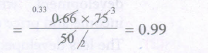
Then it could be said that the USD and Indian rupee are at purchasing power parity.
35.
1. Human Resources
(i) Human resource is named as human capital because of its power to increase productivity and thereby national income. There is a circular relationship between human development and economic growth.
(ii) If labour is efficient and skilled, its capacity to contribute to growth will be high. For example Japan and China.
2. Technical Know-how: As the scientific and technological knowledge advances, more and more sophisticated techniques steadily raise the productivity levels in all sectors.
3. Political freedom: The process of development is linked with the political freedom.
4. Social organization: People show interest in the development activity only when they feel that the fruits of development will be fairly distributed. Mass participation in development programs is a pre-condition for accelerating the development process.
5. Corruption free administration:
Corruption is a negative factor in the growth process. Unless the countries rootout corruption in their administrative system, the crony capitalists and traders will continue to exploit national resources. The tax evasion tends to breed corruption and hamper economic progress.
6. Desire for development:
The pace of economic growth in any country depends to a great extent on people's desire for development.
7. Moral, ethics and social values:
(i) These determine the efficiency of the market.
(ii) If people are not honest, market cannot function.
8. Casino Capitalism:
If People spend larger proportion of their income and time on entertainment liquor and other illegal activities, productive activities may suffer.
9. Patrimonial Capitalism:
If the assets are simply passed on to children from their parents, the children would not work hard, because the children do not know the value of the assets. Hence productivity will be low.
36.
(i) Strong economic growth or high GDP growth leads to excessive use of resources.
(ii) Natural resources are essential inputs for production in many sectors;
(iii) Production and consumption lead to pollution and other pressures on the environments.
(iv) Poor environmental quality affects economic growth and well being by lowering the quantity and quality of resources or due to health impact.
(v) There is the need to balance growth and the sustainability of eco system.
(vi) So we have to ensure our sustainable existence, consume less and curb economic growth.
37.
Principle of Independence
(i) A Government should be autonomous and free about the internal financial matters concerned.
(ii) Each Government should have separate sources of revenue, authority to levy taxes, to borrow money and to meet the expenditure.
Principle of Equity
(i) The resources should be distributed among the different states so that each state receives a fair share of revenue.
Principle of Uniformity
(i) Each state should contribute equal tax payments for federal finance.
Principle of Adequacy of Resources
(i) The resources of each Government should be adequate to carry out its functions effectively to meet current and future needs.
(ii) Resources should be elastic to meet the growing needs and unforeseen expenditure.
Principle of Fiscal Access
(i) The Central and State Governments must be able to develop new source of revenue.
Principle of Integration and coordination
(i) There should be perfect coordination among different layers of the financial system.
Principle of Efficiency
(i) The financial system should be well organized and efficiently administered.
(ii) There should be no scope for evasion and fraud.
(iii) Double taxation should be avoided.
Principle of Administrative
Economy
(i) The cost of collection should be at the minimum level and the major portion of revenue should be made available for the other expenditure outlays of the Governments.
Principle of Accountability
(i) Each Government should be accountable to its own legislature for its financial decisions.
38.
Investment for productive purposes
(i) World Bank helps in reconstruction and development of territories of member nations through investment for productive purposes.
(ii) It encourages the development of productive facilities and resources in less developed countries.
Balanced growth of international trade
(i) Promoting the long range balanced growth of trade at international level and the maintaining equilibrium in BoPs of member nations by encouraging international investment.
Provision of loans and guarantees
(i) Arranging the loans or providing guarantee on loans by various other channels and execute important projects.
Promotion of foreign private investment
(i) This is done by means of guarantees on loans and other investment made by private investors.
(ii) The Bank supplements private investment by providing finance for productive purpose out of its own resources or from borrowed funds.
Technical services
(i) The World Bank facilitates different kinds of technical services to the member countries through Staff College and experts.
39.
Cyclical Disequilibrium
Cyclical Disequilibrium occurs because of:
(i) Two countries may be passing through different phases of business cycle.
(ii) The elasticities of demand may differ between countries.
Secular Disequilibrium
(i) It occurs because of long-run and deep rooted changes in an economy as it advances from one stage of growth to another.
(ii) In the initial stages of development, domestic investment exceeded domestic savings and imports exceeded exports, as it happened in India since $1951.
Structural disequilibrium
(i) Structural changes in line economy may also cause BoP disequibrium
(ii) Structural changes include development of alternative sources of supply, development of better substitutes, exhaustion of protective resources or changes in transport routes and costs.
40.
Introduction
The functions of commercial banks are broadly classified into primary, and secondary functions
1) Primary Functions:
Accepting Deposits
Demand Deposits
1. It refers to deposits that can be withdrawn by individuals without any prior notice to the bank.
2. Depositors can withdraw money at any time by writing a withdrawal slip or a cheque or from ATM centres
Time Deposits
1. It refers to deposits that are made for certain committed period of time.
2. It has higher interest.
3. Deposits can be withdrawn only after a specific time period
Advancing Loans
1. Banks grant loans to individuals and businesses in the form of overdraft, cash credit and discounting bills of exchange.
2) Secondary Functions
Agency Functions
1. Commercial banks act as agents of customers by performing various functións.
Collecting Cheques
1. Banks collect cheques and bills of exchange on behalf of their customers through clearing house facilities provided by the central bank.
Collecting Income
1. Banks collect dividends, pension, salaries, rents and interests on investment on behalf of their customers.
2. A credit voucher is sent to customers for information when any income is collected by the bank.
Paying Expenses
1. Telephone bills, insurance premium, school fees and rents can be paid through banks.
2. A debit voucher is sent to customers for information when expenses are paid by the bank.
3) General Utility Functions
Providing Locker Facilities
1. Locker is provided for safe custody of jewellery, shares, debentures and other valuable items.
2. This minimizes the risk of loss due to theft at home.
Issuing Traveller's Cheques
1. Banks issue traveller's cheques to individuals for travelling outside the country.
2. These cheques are safe and easy way to protect money.
Dealing in Foreign Exchange
1. Banks provide foreign exchange to businessmen dealing in exports and imports.
2. But they need to take the permission of the Central Bank for dealing in foreign exchange.
4) Transferring Funds
1. Funds are transferred by means of draft, telephonic transfer and electronic transfer.
5) Letter of Credit
1. Commercial banks issue letters of credit to their customers to certify their credit worthiness.
Underwriting Securities
1. As public have full faith in the credit worthiness of banks, public do not hesitate in buying the securities underwritten by banks.
Electronic Banking
1. It includes services, such as debit cards, credit cards and Internet banking.
6) Other Functions
Money Supply
E.g: A bank lends Rs.5 lakh to an individual and opens a demand deposit in the name of that individual.
1. Bank makes a credit entry of 25 lakh in that account.
2. This leads to creation of demand deposits in that account.
3. Thus, without printing additional money, the supply of money is increased.
Credit Creation
1. It means the multiplication of loans and advances
2. Banks receive deposits from the public and use these deposits to give loans.
3. However, loans offered are many times more than the deposits received by banks.
Collection of Statistics
1. Banks collect and publish statistics relating to trade, commerce and industry and advice customers and public authorities on financial matters.
41.
Introduction
The concept of multiplier Was first developed by R.F. Khan in terms of employment. J.M Keynes redefined it as investment multiplier.
Definition
Multiplier is defined as the ratio of the change in national income to change in investment.
\(K=\Delta Y / \Delta I\)
The value of multiplier depends on MPC.
\(\mathrm{K}=\frac{1}{1-\mathrm{MPC}} \text { since } \mathrm{MPC}+\mathrm{MPS}=1\)
\(k=\frac{1}{N 118}\)
Multiplier is inversely related to MPS and directly with MPC.
If MPC is, 0.75, MPS is 0.25 then K=4.00
\(\frac{1}{1-0.75} \text { or } \frac{1}{0.25}=4\)
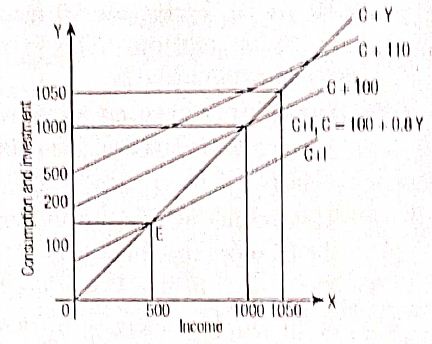
| MPC | MPS | k |
| 0.00 | 1.00 | 1 |
| 0.10 | 0.90 | 1.11 |
| 0.50 | 0.50 | 2.00 |
| 0.75 | 0.25 | 4.00 |
Working
(i) Suppose government undertakes investment expenditure equal to र100 cr on public works.
(ii) Income of labourers and suppliers of materials increases by र100 cr
(iii) If MPC is 0.8 that is 80 %. र80 cr is spent on consumption र20 cr salved
(iv) Suppliers of goods get an income of र80 cr. They spend र64 cr (ie 80% of र80 cr).
(v) In this manner consumption expenditure and increase in income act in a chain like manner.
42.
Cyclical unemployment:
(i) During the downturn phase (recession and depression) of trade cycle, income and output fall leading to cyclical unemployment.
(ii) It is caused by deficiency of effective demand
Structural unemployment:
(i) Unemployment due to massive and deep rooted changes in economic structure leads to structural unemployment.
(ii) Lack of demand for the product or shift in demand to other products cause this type of unemployment.
(iii) (e.g.) rise in demand for mobile phones has adversely affected the demand for cameras, tape recorders
Disguised unemployment:
(i) It occurs in agriculture when more people are there than required. Even if some workers are withdrawn, production does not suffer.
Actual marginal productivity is zero, less or negative.
(i) Seasonal unemployment
1. In agriculture and agro based industries like sugar, production activities are carried out only in some seasons.
2. These industries offer employment only during that season in a year.
3. People remain unemployed during the off season.
4. Seasonal unemployment takes place from demand side also (eg) ice cream industry, holiday resorts
(ii) Frictional unemployment (Temporary unemployment)
1. It arises due to imbalance between supply of labour and demand for labour.
2. It is because of immobility of labour, lack of necessary skills, break down of machinery, shortage of raw materials.
3. The persons who lose jobs and in search of jobs also come under frictional unemployment
(iii) Educated unemployment
1. Educated people are underemployed or unemployed when qualification does not match the job.
2. Faulty education system, lack of employable skills, mass student turnout and preference for white collar jobs are highly responsible for educated unemployment.
43.
Introduction:
National income can be measured by the social accounting method. Under this method, the transactions among various sectors such as firms, households, government are recorded and their interrelationships traced.
Firms:
undertake productive activities. They employ factors of production to produce goods and services.
Households:
Households are consuming entities. They represent the factors of production, who receive payment for services rendered by them to firms. (i) Households consume the goods produced by the firms. There is a circular flow of money between these two groups.
Government:
The Government sector refers to the economic transactions of public bodies at all levels-centre, state and local. Their purchases may be financed through taxation, public borrowings. The government provides public health, education. They satisfy the collective wants of society. But Post Offices and railways are separated from the Government sector and included as "Firms".
Rest of the world:
It relates to international economic transactions - income, export, import external loan transaction, and allied overseas investment income and payments.
Capital sector:
(i) Capital sector refers to saving and investment activities. It includes the transactions of banks, insurance corporations, financial houses. These are not included under "Firms".
(ii) The economy is also divided into primary, secondary tertiary and quaternary sectors.
Conclusion:
The social accounting framework is useful for economists as well as policy makers, because it represents the major economic flows and statistical relationships among various sectors of the economic system. It is possible to forecast the trends of economy more accurately.
44.
| S.No | Features | Capitalism | Socialism | Mixedism |
|---|---|---|---|---|
| 1. | Ownership of Means of Production | Private Ownership | Public Ownership | Private Ownership and Public Ownership |
| 2. | Economic Motive | Profit | Social Welfare | Social Welfare and Profit Motive |
| 3. | Solution of Central Problems | Free Market System | Central Planning System | Central Planning System and Free Market System |
| 4. | Government Role | Internal Regulation only | Complete Involvement | Limited Role |
| 5. | Income Distribution | Unequal | Equal | Less unequal |
| 6. | Nature of Enterprise | Private Enterprise | Government Enterprise | Both Private and State Enterprises |
| 7. | Economic Freedom | Complete Freedom | Lack of Freedom | Limited Freedom |
| 8 | Major Problem | Inequally | Inefficiency | Inequality and Inefficiency |
45.
(i) It refers to deposits that can be withdrawn by individuals without any prior notice to the bank.
(ii) In other words, the owners of these deposits are allowed to withdraw money anytime by writing a withdrawal slip or a cheque at the bank counter or from ATM centres using debit card.
46.
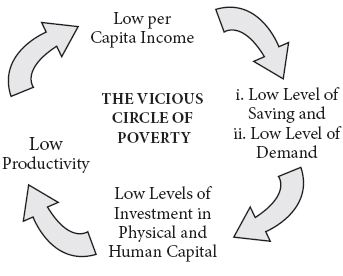
47.
“The accelerator coefficient is the ratio between induced investment and an initial change in consumption."
48.
1. Macroeconomics in its modern form, began with John Maynard Keynes and his book “The General Theory of Employment, Interest and Money” published in 1936.
2. Keynes offered an explanation for fallout from the Great Depression, when goods remained unsold and workers unemployed.
3. Hence, Keynes is regarded as the ‘Father of Modern Macro Economics’.
49.
(i) Ceteris paribus (constant extraneous variables).
(ii) Existence of Normal Conditions.
(iii) Existence of a Laissez-faire Capitalist Economy.
50.
Environmental goods are typically non-market goods, including clear air, clean water, landscape, green transport infrastructure, public parks, rivers, mountains, forest and beaches.
51.
1. Loans out of its own fund.
2. Loans out of borrowed capital and
3. Loans through Bank's guarantee.
52.
(i) Plastic money refers to the hard plastic cards used everyday in place of actual bank notes.
(ii) They aim at removing the need for carrying cash to make transactions.
(iii) (E.g.) Cash cards, Credit cards, Debit cards, Pre-paid Cash cards, Store cards, Forex cards and Smart cards.
53.
(i) It arises due to imbalance between supply of labour and demand for labour.
(ii) It is because of immobility of labour, lack of necessary skills, breakdown of machinery, shortage of raw materials.
(iii) The persons who lose jobs and in search of jobs are also included.
54.
(i) NDP = GDP - Depreciation.
(ii) NNP = GNP - Depreciation.
(iii) The difference between NDP and NNP is the net factor income from abroad.
(iv) In NDP it is excluded but in NNP it is included.

12th Standard Syllabus & Materials
12th Standard
TN 12th Computer Applications களப்பெயர் முறைமை (DNS) Sample Question Papers Study Material - QB365 Set A
NEW12th Standard
TN 12th Computer Applications வலையமைப்பு எடுத்துக்காட்டுகள் மற்றும் நெறிமுறைகள் Sample Question Papers Study Material - QB365 Set A
NEW12th Standard
TN 12th Computer Applications கணினி வலையமைப்பு ஓர் அறிமுகம் Sample Question Papers Study Material - QB365 Set A
NEW12th Standard
TN 12th Computer Applications PHP-உடன் MySQL-ஐ இணைத்தல் Sample Question Papers Study Material - QB365 Set A



Tamilnadu Stateboard 12th Standard Subjects

Maths

Chemistry

Physics

Biology

Computer Science

Business Maths and Statistics
Economics

Commerce

Accountancy

History

Computer Applications
Biology
Computer Technology
Computer Applications
Computer Science
Business Maths and Statistics
Commerce
Economics
Maths
Chemistry
Physics
Computer Technology
History
Accountancy

Tamil

English

French
Tamilnadu Stateboard Standards
