
 100% FREE ACCESS
12th Standard Syllabus & Materials
12th Standard
TN 12th Maths Applications of Matrices and Determinants Sample Question Papers Study Material - QB365 Set A
NEW12th Standard
TN 12th Computer Applications மின்னணு தரவு பரிமாற்றம் Sample Question Papers Study Material - QB365 Set A
NEW12th Standard
TN 12th Computer Applications மின் - வணிக பாதுகாப்பு அமைப்புகள் Sample Question Papers Study Material - QB365 Set A
NEW12th Standard
TN 12th Computer Applications மின்னணு செலுத்தல் முறைகள் Sample Question Papers Study Material - QB365 Set A
NEW12th Standard
TN 12th Computer Applications மின் - வணிகம் Sample Question Papers Study Material - QB365 Set A
NEW12th Standard
TN 12th Computer Applications திறந்த மூல கருத்துருக்கள் Sample Question Papers Study Material - QB365 Set A

Published on: 27/02/2021
12th Standard English Medium Accountancy Reduced Syllabus Annual Exam Model Question Paper with Answer key - 2021
Download Tamil Nadu 12th Standard Accountancy question papers, model tests, one-mark questions, important questions, and public exam papers in PDF format. Free study materials and answer keys for TN State Board students.
Questions + Answers key
Take MCQ Accountancy Test
1.
A firm has liabilities is Rs. 50,000 and Capital is Rs. 25,000. Then its assets is ______________
Rs. 1,00,000
Rs. 25,000
Rs. 50,000
Rs. 75,000
2.
Equity share capital is Rs.2,00,000, Reserve & surplus is Rs.30,000. Debenture Rs.40,000 and the shareholder's funds will be ____________
Rs.2,00,000
Rs.2,30,000
Rs.1,90,000
Rs.1,70,00
3.
____________ are used for recording both cash and credit sales of goods.
Purchase voucher
Sales vouchers
Contra voucher
Receipt voucher
4.
Application money must be at least _____ per cent of the nominal value of the shares.
2
3
5
6
5.
When figure relating to several years are considered for the purpose of analysis, the analysis is called ______________
Horizontal analysis
Vertical analysis
Trend analysis
Cash flow analysis
6.
_________maybe dissolved at any time by a partner serving notice on the other partners
Partnership at deed
Dissolution of partnership
Partnership at will
All of the above
7.
At the time of admission of a new partner, ________ profit ratio should be find out.
old
new
both (a) and (b)
none of these
8.
The name under which the business of a firm is carried on is called the ____________
Company name
Firm name
Partnership firm
Partner's name
9.
Goodwill helps in earning more profit and attracts more _________
customers
producers
competitors
suppliers
10.
Rs. 10,000 received as to annual membership subscription. Out of this Rs. 2,000 is pertaining to the previous accounting period whereas Rs. 1000 is receivable at the end of the current accounting period. Calculate the amount of subscription that will be shown in the income and expenditure account for this accounting.
Rs. 10,000
Rs. 9,000
Rs. 12,000
Rs. 8,000
11.
James and Kamal are sharing profits and losses in the ratio of 5:3. They admit Sunil as a partner giving him 1/5 share of profits. Find out the sacrificing ratio.
1:3
3:1
5:3
3:5
12.
13.
Which of the following statements is not true?
Notes and schedules also form part of financial statements
The tools of financial statement analysis include common-size statement
Trend analysis refers to the study of movement of figures for one year
The common–size statements show the relationship of various items with somecommon base, expressed as percentage of the common base
14.
Match the pair and identify the correct option
| (1) Under subscription | (i) Amount prepaid for calls |
| (2) Over subscription | (ii) Subscription above the offered shares |
| (3) Calls in arrear | (iii) Subscription below the offered shares |
| (4) Calls in advance | (iv) Amount unpaid on calls |
| (1) | (2) | (3) | (4) |
| (i) | (ii) | (iv) | (iv) |
| (1) | (2) | (3) | (4) |
| (iv) | (iii) | (ii) | (i) |
| (1) | (2) | (3) | (4) |
| (iii) | (ii) | (iv) | (i) |
| (1) | (2) | (3) | (4) |
| (iii) | (iv) | (i) | (ii) |
15.
Current ratio indicates
Ability to meet short term obligations
Efficiency of management
Profitability
Long term solvency
16.
17.
Which of the following statements is true?
Goodwill is an intangible asset
Goodwill is a current asset
Goodwill is a fictitious asset
Goodwill cannot be acquired
18.
Profit after interest on drawings, interest on capital and remuneration is Rs. 10,500. Geetha, a partner, is entitled to receive commission @ 5% on profits after charging such commission. Find out commission.
Rs. 50
Rs. 150
Rs. 550
Rs. 500
19.
Receipts and payments account records receipts and payments of
Revenue nature only
Capital nature only
Both revenue and capital nature
None of the above
20.
When capital in the beginning is Rs. 10,000, drawings during the year is Rs. 6,000, profit made during the year is Rs. 2,000 and the additional capital introduced is 3,000, find out the amount of capital at the end
Rs. 9,000
Rs. 11,000
Rs. 21,000
Rs. 3,000
21.
Calculate the current ratio from the following information.
| Particulars | Rs. | Particulars | Rs. |
|---|---|---|---|
| Current investments | 15,000 | Trade creditors | 36,000 |
| Inventories | 29,000 | Bills payable | 10,000 |
| Cash and cash equivalents | 5,000 | Expenses payable | 8,000 |
| Trade receivables | 5,000 |
22.
Mukil, Mohit and Sonu are partners sharing profit in the ratio 3:2: 1. Mukil retires from the partnership.
In order to settle his claim, the following revaluation of assets and liabilities was agreed upon:
(i) The value of Machinery is increased by Rs. 25,000.
(ii) The value of Investment-is-increased by Rs 2,000.
(ill) A Provision for outstanding bill standing in the books at Rs.1,000 is now not required.
(iv) The value of Land and Building is decreased by Rs.12,000.
Give journal entries and prepare Revaluation account
23.
Sheela and Neela were sharing profits in the ratio of 4:3. Kamala was admitted with 1/5th share in profits of business. Calculated the New profit Ratio and the sacrificing ratio.
24.
Calculate the missing information:
| Particulars | Rs. |
|---|---|
| Closing capital | 32,000 |
| Drawings | 4,800 |
| Additional capital | 8,000 |
| Profit made during the year | 9,600 |
25.
From the following balances prepare a balance sheet as on 31st1March 2016.
| Cash in hand | 12,000 |
|---|---|
| Cash at bank | 8,000 |
| Books | 16,000 |
| Billiard Table | 24,000 |
| Furniture | 30,000 |
| Investment | 30,000 |
| Prepaid expenses | 20,000 |
| Building | 1,00,000 |
| Outstanding expenses | 40,000 |
| Subscription received in advance | 24,000 |
| Subscription accrued | 20,000 |
| Surplus (Income over | |
| expenditure) | 20,000 |
26.
From the Receipt and Payment Account given below, prepare the Income and Expenditure Account of clean Delhi club for the year ended March 31, 2017
| Receipts | Rs | Payments | Rs |
|---|---|---|---|
| To Balance b/d | By Salary | 1,500 | |
| Cash in hand | 3200 | By Rent | 800 |
| To Subscriptions | 22,500 | By Electricity | 3,500 |
| To Entrance fees | 1,250 | By Taxes | 1,700 |
| To Donations | 2,500 | By Printing stationery | 380 |
| To Rent of hall | 750 | By Sundry expenses | 920 |
| To Sale of investment | 3,000 | By Books purchased | 7,500 |
| By Fixed deposit with bank | 5,000 | ||
| (on31-3-2014) | |||
| By Balance c/d | |||
| Cash in hand 400 | |||
| Cash at bank 1,500 | 1,900 | ||
| 33,200 | 33,200 |
27.
Calculate
(i) Inventory turnover ratio
(ii) Trade receivable turnover ratio
(iii) Trade payable turnover ratio and
(iv) Fixed assets turnover ratio from the following information obtained from Delphi Ltd.
| Particulars | As on 31st March, 2018 Rs. |
As on 31st March, 2019 Rs. |
|---|---|---|
| Inventory | 1,40,000 | 1,00,000 |
| Trade receivables | 80,000 | 60,000 |
| Trade payables | 40,000 | 50,000 |
| Fixed assets | 5,50,000 | 5,00,000 |
Additional information:
(i) Revenue from operations for the year Rs.10,50,000
(ii) Purchases for the year Rs.4,50,000
(iii) Cost of revenue from operations Rs.6,00,000.
Assume that sales and purchases are for credit.
28.
29.
Viswanath Furniture Ltd. invited applications for 20,000 shares of Rs.10 each at a premium of Rs.2 per share payable.
Rs.2 on application
Rs.5 (including premium) on allotment
Rs.5 on first and final call
There was over subscription and applications were received for 30,000 shares and the excess applications were rejected by the directors. All the money due were received. Pass the journal entries.
30.
Mani, Rama and Devan are partners in a firm sharing profits and losses in the ratio of 4 : 3 : 3. Their balance sheet as on 31st March, 2019 is as follows:
| Liabilities | Rs. | Rs. | Asset | Rs. |
|---|---|---|---|---|
| Capital accounts: | Buildings | 80,000 | ||
| Mani | 50,000 | Stock | 20,000 | |
| Rama | 50,000 | Furniture | 70,000 | |
| Devan | 50,000 | 1,50,000 | Debtors | 20,000 |
| Sundry creditors | 20,000 | Cash in hand | 10,000 | |
| Profit and loss A/c | 30,000 | |||
| 2,00,000 | 2,00,000 |
Mani retired from the partnership firm on 31.03.2019 subject to the following adjustments:
(i) Stock to be depreciated by Rs. 5,000
(ii) Provision for doubtful debts to be created for Rs. 1,000.
(iii) Buildings to be appreciated by Rs. 16,000
(iv) The final amount due to Mani is not paid immediately
Prepare revaluation account and capital account of partners after retirement.
31.
Khan Ltd. issued 50,000 shares of Rs.10 each to the public payable Rs.4 on application, Rs.4 on allotment and Rs.2 on first and final call. Applications were received for 65,000 shares. The directors decided to allot 50,000 shares on pro rata basis and surplus application money was utilised for allotment. Pass journal entries assuming that the amounts due were received.
32.
Record the following transactions in Tally.
1. Robert commenced a transport business with a capital of Rs.1,00,000
2. An account was opened with State Bank of India and deposited Rs. 30,000
3. Purchased furniture by paying cash Rs. 10,000
4. Goods purchased on credit from Mohaideen for Rs. 20,000
5. Cash sales made for Rs. 8,000
6. Goods purchased from Rathinam for Rs. 5,000 and money deposited in CDM
7. Goods sold to Rony on credit for Rs. 60,000
8. Money withdrawn from bank for office use Rs. 9,000
9. Part payment of Rs.10,000 made to Mohaideen by cheque
10. Rony made part payment of Rs. 5,000 by cash
11. Salaries paid to staff through ECS Rs. 6,000
12. Wages of Rs. 3,000 paid by cash
13. Purchased stationery from Pandian Ltd. on credit Rs. 4,000
33.
From the following details, calculate the value of goodwill at 2 years purchase of super profit:
(a) Total assets of a firm are Rs. 5,00,000
(b) The liabilities of the firm are Rs. 2,00,000
(c) Normal rate of return in this class of business is 12.5 %.
(d) Average profit of the firm is Rs. 60,000
34.
Antony and Ranjith started a business on 1st April 2018 with capitals of Rs. 4,00,000 and Rs. 3,00,000 respectively. According to the Partnership Deed, Antony is to get salary of Rs. 90,000 per annum, Ranjith is to get 25% commission on profit after allowing salary to Antony and interest on capital @ 5% p.a. but after charging such commission. Profit-sharing ratio between the two partners is 1:1. During the year, the firm earned a profit of Rs. 3,65,000.
Prepare profit and loss appropriation account. The firm closes its accounts on 31st March every year.
35.
From the following information, prepare capital accounts of partners Mannan and Sevagan, when their capitals are fluctuating.
| Particulars | Mannan Rs. | Sevagan Rs. |
|---|---|---|
| Capital on 1st January 2018 (Cr. balance) | 2,00,000 | 1,75,000 |
| Drawings during 2018 | 40,000 | 35,000 |
| Interest on drawings | 1,000 | 500 |
| Share of profit for 2018 | 21,000 | 16,500 |
| Interest on capital | 12,000 | 10,500 |
| Salary | 18,000 | Nil |
| Commission | Nil | 2,500 |
36.
From the following receipts and payment account, prepare income and expenditure account of Kumbakonam Basket Ball Association for the year ended 31st March, 2018
| Receipts | Rs. | Rs. | Payments | Rs. | Rs. |
|---|---|---|---|---|---|
| To Balance b/d | By Rent of ground paid | 12,000 | |||
| Cash in hand | 23,000 | By Printing charges | 5,000 | ||
| Cash at bank | 12,000 | 35,000 | By Bank charges | 1,000 | |
| To Rent of hall received | 6,000 | By Insurance for building | 2,000 | ||
| To Subscription received | 9,000 | By Tournament expenses | 16,000 | ||
| To Life membership fees | 7,000 | By Audit fees | 3,000 | ||
| To Locker rent received | 2,000 | By Sports materials purchased | 4,000 | ||
| By Balance c/d | |||||
| Cash in hand | 2,000 | ||||
| Cash at bank | 14,000 | 16,000 | |||
| 59,000 | 59,000 |
37.
Compute capital fund of Karur Social Club as on 31.03.2018
| Particulars as on 31.03.2018 | Rs. |
|---|---|
| Furniture | 50,000 |
| Buildings | 40,000 |
| Subscription outstanding for 2017-18 | 10,000 |
| Subscription received in advance for 2018-19 | 5,000 |
| Loan borrowed | 10,000 |
| Investments | 20,000 |
| Cash in hand | 4,000 |
| Cash at bank | 6,000 |
38.
Common size statement is also known as 100 % statement. Do you agree?
39.
A and B are partners in a firm without a partnership deed. A is an active partner and claims a salary of Rs. 18,000 per month. State with reasons whether the claim is valid or not
40.
On the admission of C, A and B decide to record an unrecorded asset worth Rs.10,000 State whether the revaluation account will be debited or credited.
41.
Can a limited company maintain its accounts under single entry system?
42.
Arya, Benin and Charles are partners sharing profits and losses in the ratio of 3:3:2. Charles retires and his share is taken up by Arya. Calculate the new profit sharing ratio and gaining ratio of Arya and Benin.
43.
44.
Compute average profit from the following information.
2016: Rs. 8,000; 2017: Rs. 10,000; 2018: Rs. 9,000
45.
From the following information, find out the value of goodwill by capitalisation method:
(a) Average profit = Rs. 60,000
(b) Normal rate of return = 10%
(c) Capital employed = Rs. 4,50,000
46.
From the following particulars, show how the item ‘subscription’ will appear in the Income and Expenditure Account for the year ended 31-12-2018? Subscription received in 2018 is Rs.50,000 which includes Rs.5,000 for 2017 and Rs.7,000 for 2019. Subscription outstanding for the year 2018 is Rs 6,000. Subscription of Rs.4,000 was received in advance for 2018 in the year 2017.
47.
Write a note an Long-term solvency ratios.
48.
Explains the divisions of share capital.
49.
Explain the procedure for preparation of final accounts of a partnership firm.
50.
Varun and Barath are partners sharing profits and losses 5:4. They admit Dhamu into partnership. The new profit sharing ratio is agreed at 1:1:1. Dhamu’s share of goodwill is valued at Rs. 15,000 of which he pays Rs .10,000 in cash. Pass necessary journal entries for adjustment of goodwill on the assumption that the fluctuating capital method is followed.
51.
From the following Balance Sheet of Pioneer Ltd. calculate proprietary ratio:
| Particulars | Rs. |
|---|---|
| I EQUITY AND LIABILITIES | |
| 1. Shareholders' funds | |
| (a) Share capital | |
| (i) Equity share capital | 1,00,000 |
| (ii) Preference share capital | 75,000 |
| (b) Reserves and surplus | 25,000 |
| 2. Non-current liabilities | |
| Long-term borrowings | - |
| 3. Current liabilities | |
| Trade payables | 2,00,000 |
| Total | 4,00,000 |
| II ASSETS | |
| 1. Non-current assets | |
| (a) Fixed assets | 2,75,000 |
| (b) Non-current investments | 50,000 |
| 2. Current assets | |
| Cash and Cash equivalents | 75,000 |
| Total | 4,00,000 |
52.
Briefly explain any three limitations of financial statements
53.
Calculate trend percentages for the following particulars of Kurinji Ltd.
| Particulars | Rs.in thousands | ||
|---|---|---|---|
| 2015-16 | 2016-17 | 2017-18 | |
| Revenue from operations | 120 | 132 | 156 |
| Other income | 50 | 38 | 65 |
| Expenses | 100 | 135 | 123 |
54.
1.
(d)
Rs. 75,000
2.
(c)
Rs.1,90,000
3.
(b)
Sales vouchers
4.
(c)
5
5.
(a)
Horizontal analysis
6.
(c)
Partnership at will
7.
(b)
new
8.
(b)
Firm name
9.
(a)
customers
10.
(b)
Rs. 9,000
11.
(c)
5:3
12.
(c)
13.
(c)
Trend analysis refers to the study of movement of figures for one year
14.
(c)
| (1) | (2) | (3) | (4) |
| (iii) | (ii) | (iv) | (i) |
15.
(a)
Ability to meet short term obligations
16.
(b)
17.
(a)
Goodwill is an intangible asset
18.
(d)
Rs. 500
19.
(c)
Both revenue and capital nature
20.
(a)
Rs. 9,000
21.
Current ratio = \(\frac { Current\ assets }{ Current\ liabilities } \)
Current assets Current investments + Inventories + Trade receivables + Cash and cash equivalents + Prepaid expenses
= 15,000 + 29,000 + 5,000 + 5,000 + 0
= Rs.54,000
Current liabilities = Trade creditors + Bills payable + Expenses payable
= 36,000 + 10,000 + 8,000 = Rs.54,000
∴ Current assets = \(\frac { 54,000 }{ 54,000 } \) = 1 : 1
22.
| Date | Particulars | L.F | Depit Rs |
Credit Rs |
|
|---|---|---|---|---|---|
| Machinery A/c | Dr | 25,000 | |||
| Investments A/c | Dr | 2,000 | |||
| Provision for outstanding bill A/c | Dr | 1,000 | |||
| To Revaluation A/c | 28,000 | ||||
| (Increase in value of Assets i.e., Machinery and investment and reduction in provision) | |||||
| Revaluation A/c | Dr | 12,000 | |||
| To Land and Building A/c | 12,000 | ||||
| (Decrease in value of assets) | |||||
| Revaluation A/c | Dr | 16,000 | |||
| To Mukil's capital A/c | 8,000 | ||||
| To Mohit's capital A/c | 5,333 | ||||
| To Sonus capital A/c | 2,667 | ||||
| (Profit on revaluation credited to all partners capital Ale in old profit sharing ratio) |
| Particulars | Rs | Particulars | Rs |
|---|---|---|---|
| Land and Building | 12,000 | Machinery | 25,000 |
| Profit transferred to | Investments | 2,000 | |
| Mukil's capital 8,000 | |||
| Mohit's capital 5,333 | |||
| Sonu's capital 2,667 | 16,000 | ||
| 28,000 | 28,000 |
23.
(i) New partner sharing ratio:
Let the total profit be 1
New partner Kamala's share \(=\frac{1}{5}\)
Remaining share of Sheela and Neela \(=1-\frac{1}{5}=\frac{5-1}{5}=\frac{4}{5}\)
New share of Sheela = Remaining share x Sheela's old share
Sheela \(=\frac{4}{5}\times\frac{4}{7}=\frac{16}{35}\)
Neela \(=\frac{4}{5}\times\frac{3}{7}=\frac{12}{35}\)
Share of new partner:
Kamala \(=\frac{1}{5}\)
In order to equalize the denominator, multiply and divide Kamala's share by 7.
Kamala's share \(=\frac{1}{5}\times\frac{1}{7}=\frac{7}{35}\)
New profit sharing ratio of Sheela, Neela and Kamala \(=\frac{16}{35}:\frac{12}{32}=\frac{7}{35}\) that 16:12:7
ii. Sacrificing ratio:
Sacrifice = Old share - New share
Sheela's sacrifice \(=\frac { 4 }{ 7 } -\frac { 16 }{ 35 } =\frac { 15-12 }{ 35 } =\frac { 4 }{ 35 } \)
Neela's sacrifice \(=\frac { 3 }{ 7 } -\frac { 12 }{ 35 } =\frac { 15-12 }{ 35 } =\frac { 3 }{ 35 } \)
Sacrificing ratio \(=\frac { 4 }{ 35 } :\frac { 3 }{ 35 } =4:3\)
24.
| Particulars | Rs. |
|---|---|
| Closing capital | 32,000 |
| Add: Drawings | 4,800 |
| 36,800 | |
| Less: Additional capital | 8,000 |
| Adjusted closing capital | 28,800 |
| Less: Opening capital [B/F] | 19,200 |
| Profit made during the year | 9,600 |
25.
| Liabilities | Rs. | Rs | Assets | Rs. |
|---|---|---|---|---|
| subscription in advance | 24,000 | Cash in hand | 12,000 | |
| Out standing expenses | 40,000 | Cash at bank | 8,000 | |
| Capital fund | 1,76,000 | Books | 16,000 | |
| (balanceing figure) | Billiard Table | 24,000 | ||
| Add:Surplus | 20,000 | 1,96,000 | Furniture | 30,000 |
| Investment | 30,000 | |||
| Prepaid expenses | 20,000 | |||
| Building | 1,00,000 | |||
| Subscription accrued | 20,000 | |||
| 2,60,000 | 2,60,000 |
26.
| Expenditure | Rs. | Income | Rs. |
|---|---|---|---|
| To Salary | 1,500 | By Subscriptions | 22,500 |
| To Rent | 800 | By Entrance fees | 1,250 |
| To Electricity | 3,500 | By Donation | 2,500 |
| To Printing & Stationery | 380 | ||
| To Surplus | |||
| (Excess of income over | |||
| expenditure) | |||
| 27,000 | 27,000 |
27.
(i) Inventory turnover ratio = \(\frac{Cost\ of\ revenue\ from\ operations}{Average\ inventory}\) = \(\frac{6,00,000}{1,20,000}\) = 5 times
Average inventory = \(\frac{Opening\ inventory + Closing\ inventory}{2}\)
= \(\frac{1,40,000 + 1,00,000}{2}\)= \(\frac{2,40,000}{2}\)= Rs. 1,20,000
(ii) Trade receivables turnover ratio = \(\frac{Credit\ revenue\ from\ operations}{Average\ trade\ receivables}\)
= \(\frac{10,50,000}{70,000}\) = 15 times
Average trade receivables = \(\frac{Opening\ trade\ receivables + Closing\ trade\ receivables}{2}\)
= \(\frac{80,000 + 60,000}{2}\) =\(\frac{1,40,000}{2}\)= Rs.70,000
(iii) Creditors payables turnover ratio = \(\frac{Net\ credit purchases}{Average\ trade\ payables}\) = \(\frac{4,50,000}{45,000}\)= 10 times
Average trade payables = \(\frac{Opening\ trade\ payables + Closing\ trade\ payables}{2}\)
= \(\frac{40,000 + 50,000}{2}\) = \(\frac{90,000}{2}\) = Rs. 45,000
(iv) Fixed assets turnover ratio = \(\frac{Revenue\ from\ operations}{Average\ xed\ assets}\)= \(\frac{10,50,000}{5,25,000}\) = 2 times
Average fixed assets = \(\frac{Opening\ fixed\ assets + Closing\ fixed\ assets}{2}\)
= \(\frac{5,50,000 + 5,00,000}{2}\) = \(\frac{10,50,000}{2}\)= Rs. 5,25,000
28.
29.
| Date | Particulars | L.F | Debit Rs. | Credit Rs. | |
|---|---|---|---|---|---|
| (i) | Share capital A/c | Dr | 2,500 | ||
| To Share forfeited A/c | 2,500 | ||||
| To share final call | 500 | ||||
| (250 shares forfeited failed to pay final call) | |||||
| (ii) | Share capital A/c | Dr | 2,500 | ||
| Share premium A/c | Dr | 250 | |||
| To share allotment | 1,000 | ||||
| To share 1st call A/c | 500 | ||||
| To share final call A/c | 500 | ||||
| To share forfeiture A/c | 750 | ||||
| (250 Shares were forfeited failed to pay allotment, 1st calls final call) | |||||
| Share capital | Dr | 2,000 | |||
| (iii) | Securities premium A/c | Dr | 250 | ||
| To Share allotment A/c | 1,000 | ||||
| To share 1st call A/c | 500 | ||||
| To share forfeiture A/c | Dr | 750 | |||
| (250 Shares were forfeited failed to pay allotment, 1st calls) |
Forfeited share account : (i) Rs. 2000; (ii) 750; (iii) 750
30.
| Particulars | Rs. | Rs. | Particulars | Rs. |
|---|---|---|---|---|
| To Stock A/c | 5,000 | By Buildings A/c | 16,000 | |
| To Provision for doubtful debts A/c | 1,000 | |||
| To Profit on revaluation transferred to | ||||
| Mani’s capital A/c (4/10) | 4,000 | |||
| Rama’s capital A/c (3/10) | 3,000 | |||
| Devan’s capital A/c (3/10) | 3,000 | 10,000 | ||
| 16,000 | 16,000 |
| Particulars | Mani Rs. |
Rama Rs. |
Devan Rs. |
Particulars | Mani Rs. |
Rama Rs. |
Devan |
|---|---|---|---|---|---|---|---|
| To Mani’s loan A/c | 66,000 | By Balance b/d | 50,000 | 50,000 | 50,000 | ||
| To Balance c/d | 62,000 | 62,000 | By Revaluation A/c | 4,000 | 3,000 | 3,000 | |
| By Profit and loss A/c | 12,000 | 9,000 | 9,000 | ||||
| 66,000 | 62,000 | 62,000 | 66,000 | 62,000 | 62,000 | ||
| By Balance b/d | 62,000 | 62,000 |
31.
| Date | Particulars | L.F. | Debit Rs. |
Credit Rs. |
|
|---|---|---|---|---|---|
| Bank A/c (65,000 × 4) | Dr. | 2,60,000 | |||
| To Equity share application A/c | 2,60,000 | ||||
| (Application money received) | |||||
| Equity share application A/c (50,000 × 4) | Dr. | 2,00,000 | |||
| To Equity share capital A/c | 2,00,000 | ||||
| (Transfer of share application money to share capital) | |||||
| Equity share application A/c (15,000 × 4) | Dr. | 60,000 | |||
| To Equity share allotment A/c | 60,000 | ||||
| (Excess share application money utilised for allotment) | |||||
| Equity share allotment A/c | Dr. | 2,00,000 | |||
| To Equity share capital A/c | 2,00,000 | ||||
| (Share allotment money due) | |||||
| Bank A/c (2,00,000 – 60,000) | Dr. | 1,40,000 | |||
| To Equity share allotment A/c | 1,40,000 | ||||
| (Allotment money received) | |||||
| Equity share first and final call A/c (50,000 × 2) | Dr. | 1,00,000 | |||
| To Equity share capital A/c | 1,00,000 | ||||
| (Share first and final call money due) | |||||
| Bank A/c | Dr. | 1,00,000 | |||
| To Equity share first and final call A/c | 1,00,000 | ||||
| (Share first and final call money received) |
32.
| S.NO. | Particulars | Debit Rs. | Credit Rs. | Voucher type | Group | |
|---|---|---|---|---|---|---|
| (1) | Cash A/c | Dr. | 1,00,000 | Receipt | Cash -in -Hand | |
| To Robert’s Capital A/c | 1,00,000 | Voucher | Capital Account | |||
| (2) | State Bank of India A/c | Dr. | 30,000 | Contra | Bank Accounts | |
| To Cash A/c | 30,000 | Voucher | Cash-in-Hand | |||
| (3) | Furniture A/c | Dr. | 10,000 | Payment | Fixed Assets | |
| To Cash A/c | 10,000 | Voucher | Cash-in-Hand | |||
| (4) | Purchases A/c | Dr. | 20,000 | Purchase | Purchase Accounts | |
| To Mohaideen A/c | 20,000 | Voucher | Sundry Creditors | |||
| (5) | Cash A/c | Dr. | 8,000 | Sales | Cash-in-Hand | |
| To Sales A/c | 8,000 | Voucher | Sales Accounts | |||
| (6) | Purchases A/c | Dr. | 5,000 | Purchase | Purchase Accounts | |
| To Cash A/c | 5,000 | Voucher | Cash-in-Hand | |||
| (7) | Rony A/c | Dr. | 60,000 | Sales | Sundry Debtors | |
| To Sales A/c | 60,000 | Voucher | Sales Accounts | |||
| (8) | Cash A/c | Dr. | 9,000 | Contra | Cash-in-Hand | |
| To Bank A/c | 9,000 | Voucher | Bank Accounts | |||
| (9) | Mohaideen A/c | Dr. | 10,000 | Payment | Sundry Creditors | |
| To Bank A/c | 10,000 | Voucher | Bank Accounts | |||
| (10) | Cash A/c | Dr. | 5,000 | Receipt | Cash -in -Hand | |
| To Arun A/c | 5,000 | Voucher | Sundry Debtors | |||
| (11) | Salaries A/c | Dr. | 6,000 | Payment | Indirect Expenses | |
| To Bank A/c | 6,000 | Voucher | Bank Accounts | |||
| (12) | Wages A/c | Dr. | 3,000 | Payment | Direct Expenses | |
| To Cash A/c | 3,000 | Voucher | Cash-in-Hand | |||
| (13) | Stationery A/c | Dr. | 4,000 | Journal | Indirect Expenses | |
| To Pandian Ltd. A/c | 4,000 | Voucher | Sundry Creditors |
Following steps are to be followed to enter the transaction in Tally ERP 9
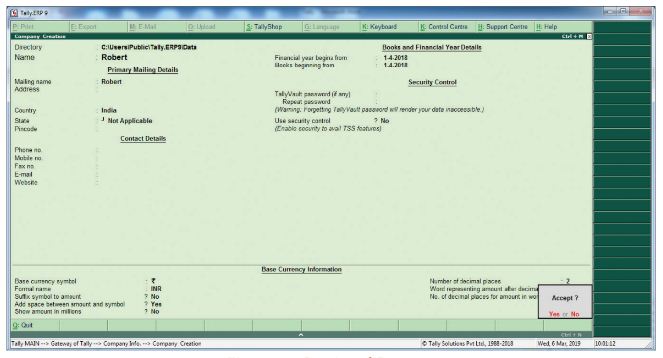
1. To create company
Company Info > Create Company
Type the Name as Robert and keep all other fields as they are and choose ‘Yes’ to accept.
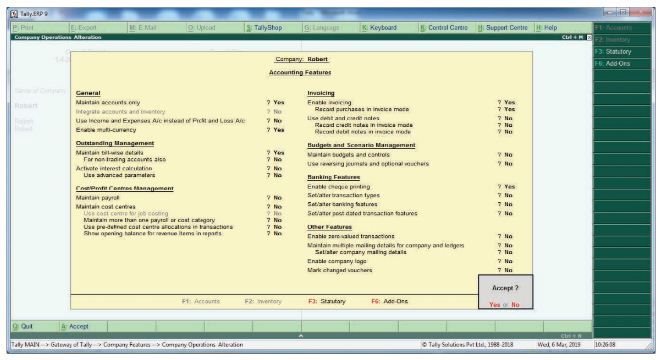
2. To maintain accounts only
Gateway of Tally > F11 Accounting Features > General > Maintain accounts only: Yes > Accept> Yes
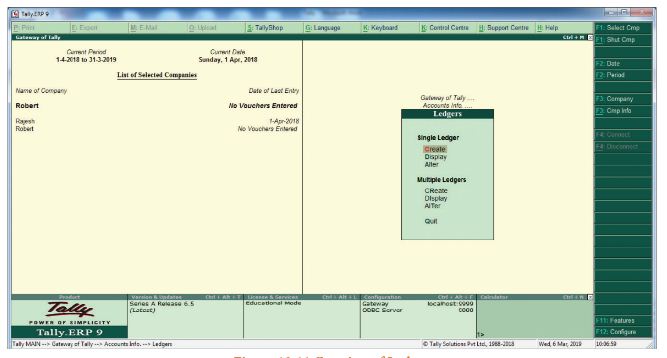
3. To Create ledger accounts
Gateway of Tally > Masters > Accounts Info > Ledgers > Single Ledger > Create
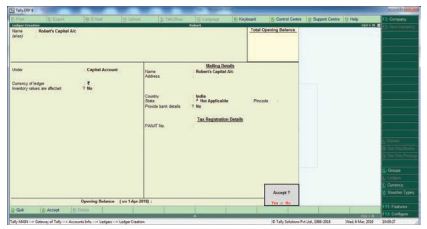
(i) To Create Devi's Capital A/c
Name: Devi's Capital A/c
Under Capital Account
Accept: Yes
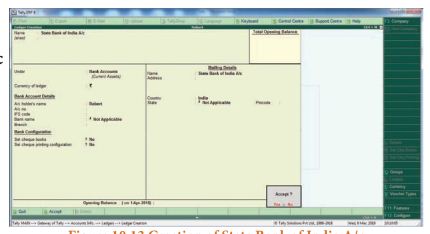
(ii) To Create Indian Bank A/c
Name: Indian Bank A/c
Under: Bank Accounts
Accept: Yes
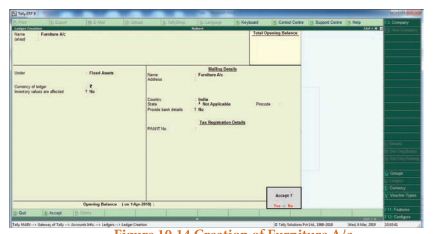
(iii) To Create Furniture A/c
Name: Furniture A/c
Under: Fixed Assets
Accept: Yes
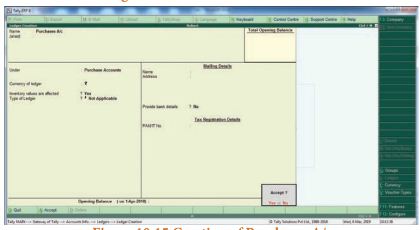
(iv) To Create Purchases A/c
Name: Purchases A/c
Under: Purchase
Accept: Yes
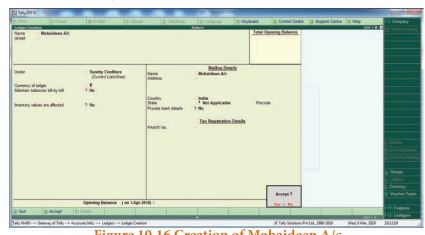
(v) To Create Mohaideen A/c
Name: Mohaideen A/c
Under: Sundry Creditors
Accept: Yes
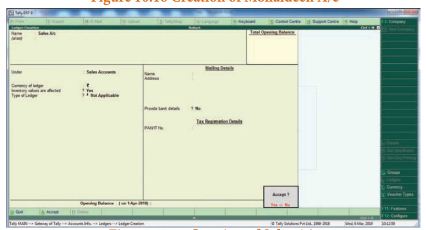
(vi) To Create Sales A/c
Name: Sales A/c
Under: Sales Account
Accept: Yes
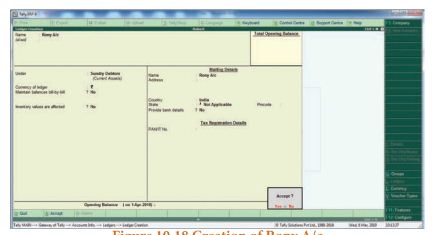
(vii) To create Rony A/c
Name: Rony A/c
Under: Sundry Debtors
Accept: Yes
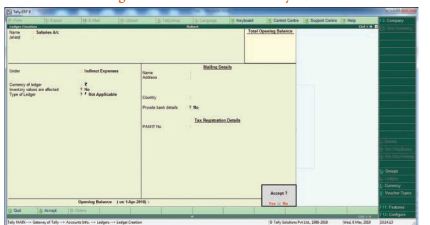
(viii) To create Salaries A/c
Name: Salaries A/c
Under: Indirect Expenses
Accept: Yes
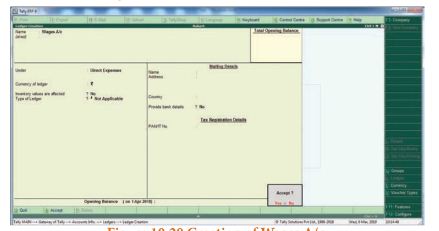
(ix) To create Wages A/c
Name: Wages A/c
Under: Direct Expenses
Accept: Yes
(x) To create Stationery A/c
Name: Stationery A/c
Under: Indirect Expenses
Accept: Yes
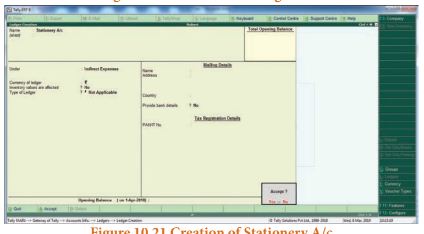
(xi) To create Pandian Ltd. A/c
Name: Pandian Ltd. A/c
Under:Sundry Creditors
Accept: Yes
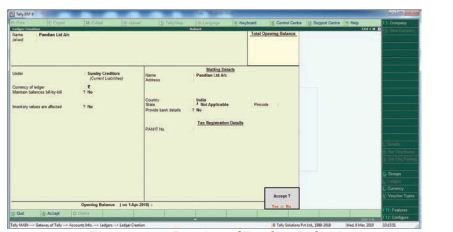
4. To enter transactions through vouchers
Gateway of Tally > Transactions > Accounting Vouchers
(i) Robert commenced a transport business with a capital of Rs. 1,00,000
F6: Receipt Voucher: Accounts: Cash
Particulars: Robert Capital A/c (Choose from List of Ledgers Accounts)
Enter the amount of Capital Rs. 1,00,000
Narration: Capital Introduced
Accept: Yes
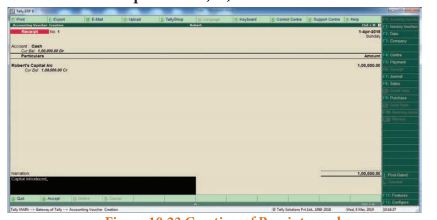
(ii) An account was opened with State Bank of India and deposited Rs. 30,000
F4: Contra Voucher
Accounts: State Bank of India
Particulars: Cash
Amount: Rs. 30,000
Narration: Opened bank account in SBI
Accept: Yes
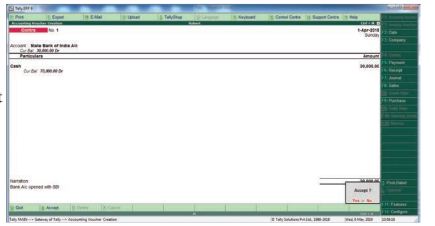
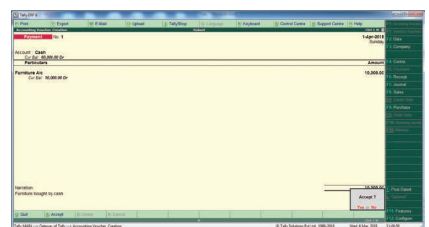
(iii) Purchased Furniture by paying cash Rs. 10,000
F5: Payment Vouchers
Account: Cash
Particulars: Furniture A/c
Amount: Rs. 15,000
Narration: Furniture bought by Cash
Accept: Yes
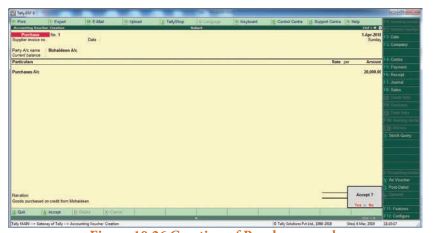
4 Goods purchased on credit from Mohaideen for Rs. 20,000
F9: Purchase voucher
Party A/c name: Mohaideen A/c
Particulars: Purchases A/c
Amount: Rs. 20,000
Narration: Goods purchased on
credit from Mohaideen
Accept Yes
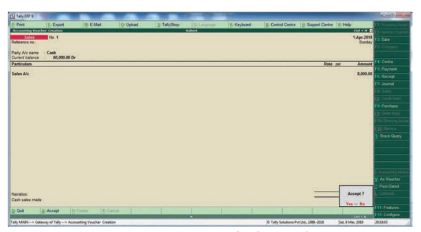
(5) Cash sales made for Rs. 8,000
F8: Sales Voucher,
Account: Cash
Particulars: Sales A/c
Amount: Rs. 8,000
Narration: Cash Sales Mode
Accept: Yes
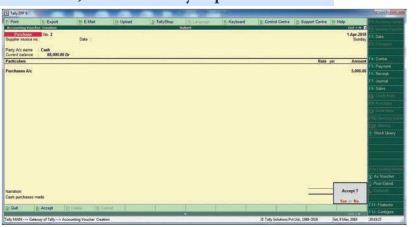
(6) Goods purchased from Rathinam for Rs. 5,000 and money deposited in CDM
F9: Purchase Voucher
Account: Bank
Particulars: Purchase A/c
Amount: Rs. 5,000
Narration: Goods Purchased
(vii) Goods sold to Rony on credit for Rs. 60,000
F8: Sales Voucher
Party: A/c Name: Rony A/c
Particulars: Sales A/c
Amount: Rs. 70,000
Narration: Goods sold on credit to Rony
Accept: Yes
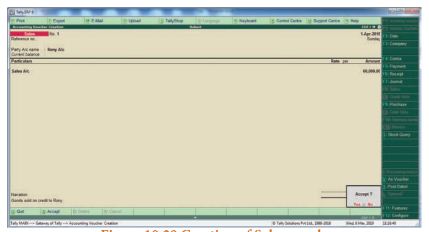
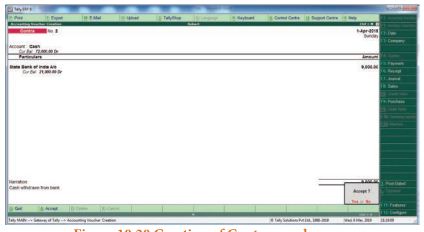
(viii) Money withdrawn from bank for office use Rs. 9,000
F4: Contra Voucher
Account: Cash
Particulars: State Bank of India A/c
Amount: Rs. 9,000
Narration: Cash withdrawn from bank
Accept: Yes
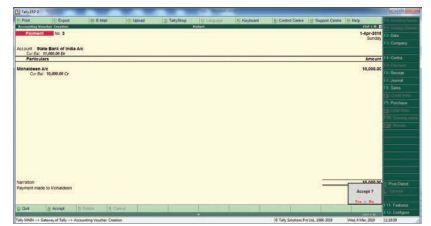
(ix) Part payment of Rs 10,000 to Mohaideen by cheque
F5: Payment Vouchers
Account: State Bank of India
Particulars: Mohaideen A/c
Amount: Rs.10,000
Narration: Payment made to
Mohaideen by cheque
Accept Yes
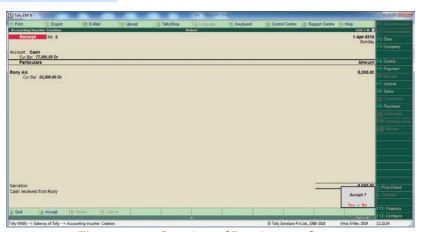
(x) Rony made part payment of Rs. 5,000 by cash
F6: Receipt voucher
Account: Cash
Particulars: Rony A/c
Amount: Rs. 5,000
Narration: Cash received from Rony
Accept Yes.
(xi) Salaries Paid to Staff through ECS Rs. 6,000
F5: Payment Vouchers
Account: Indian Bank
Particulars: Salaries A/c
Amount: Rs 6,000
Narration: Salaries paid through ECS,
Accept: Yes
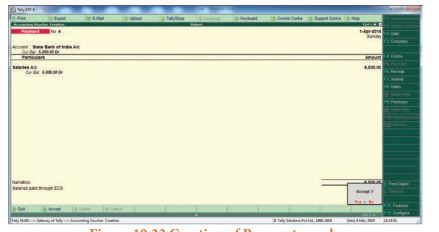
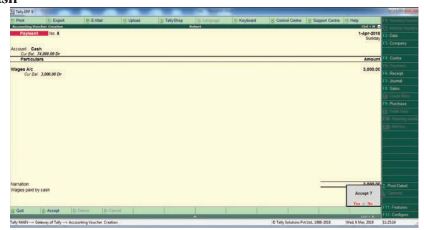
(xii) Wages of Rs. 3,000 paid by cash
F5: Payment voucher
Account: Cash
Particulars: Wages A/c
Amount: Rs. 3,000
Narration: Wages paid by cash
Accept Yes
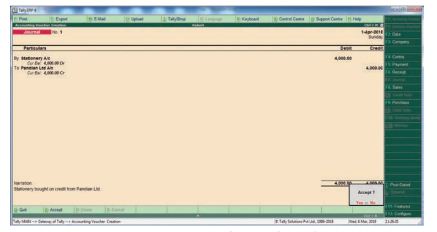
(xiii) Purchased stationery from Pandian Ltd. on credit Rs.4,000
F7: Journal Voucher
Particulars: Computer A/c
Account: Muthu Ltd.
Amount: Rs. 4,000
Narration: Stationery bought on credit from Pandian Ltd.
Accept: Yes
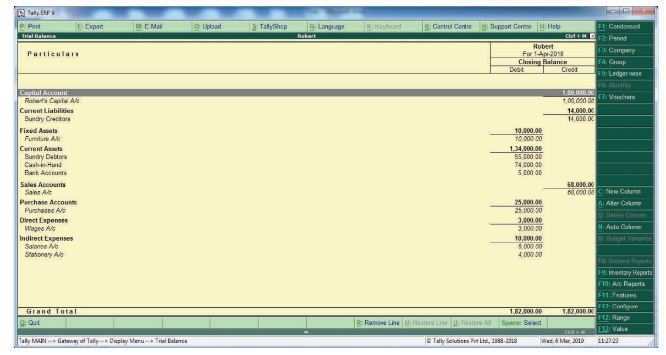
To view reports
(i) To view Trial Balance
Gateway of Tally > Reports > Display > Trial Balance > Alt + F1 (detailed)
(ii) To view profit and loss Account
F10: A/c Reports > Profit & Loss A/c > Alt + F1 (detailed) or
Gateway of Tally > Reports > Profit & Loss A/c Alt + F1 (detailed)
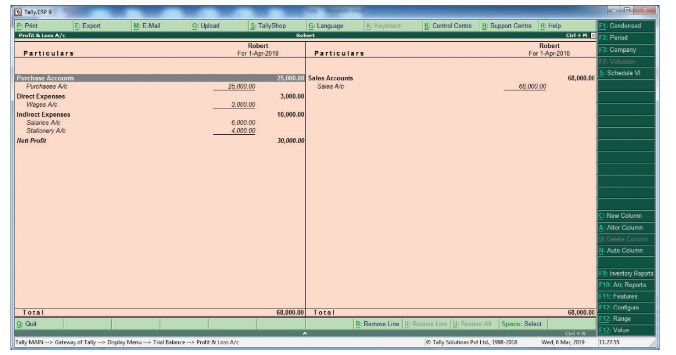
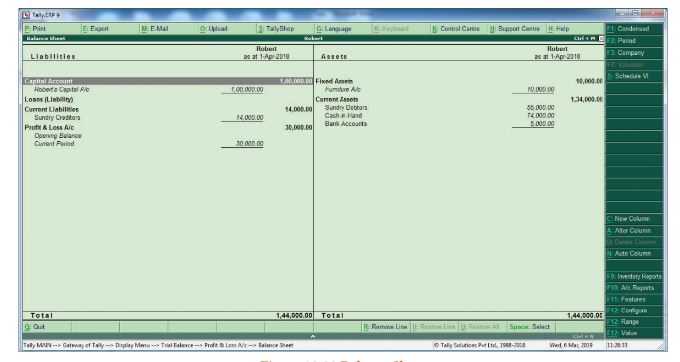
(iii) To view Balance sheet
F10: A/c Reports > Balance sheet > Alt + F1 (detailed)
Gate of Tally > Reports > Balance Sheet > Alt + F1 (detailed)
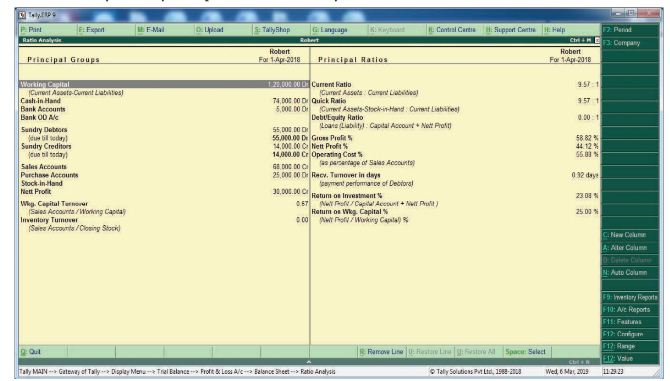
(iv) To view Ratio Analysis
F10: A/c Reports > Ratio Analysis (or)
Gateway of Tally > Reports > Ratio Analysis
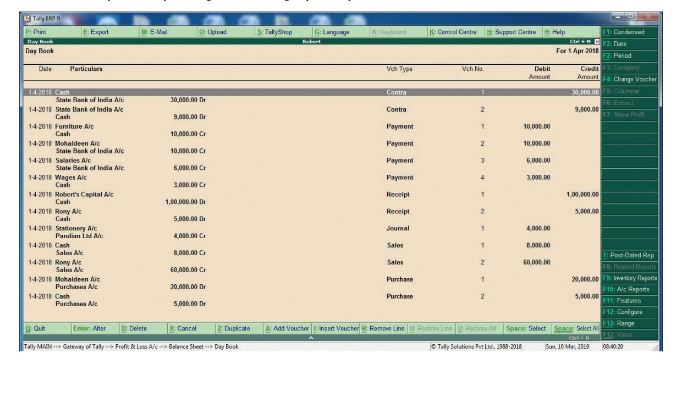
(v) To view Day book
F10: A/c Reports > Day Book > Alt + F1 (detailed (or)
Gateway of Tally > Reports > Display > Day Books > Alt + F1 (detailed)
33.
Goodwill = Super profit \(\times\) Number of years of purchase
Super profit = Average profit - Normal profit
Normal profit = Capital employed \(\times\) Normal rate of return
Capital employed = Fixed asset + Current assets - Current liabilities
5,00,000 - 2,00,000 = Rs. 3,00,000
Normal profit = 3,00,000 x 12.5%
= Rs. 37,500
Super profit = 60,000 - 37,500 = Rs. 22,500
Goodwill = 22,500 \(\times\) 2
= Rs. 45,000
34.
| Particulars | Rs. | Rs. | Particulars | Rs. |
|---|---|---|---|---|
| To Interest on capital A/c | By Profit and loss A/c | 3,65,000 | ||
| Antony (4,00,000 \(\times\) 5%) | 20,000 | |||
| Ranjith (3,00,000 \(\times\) 5%) | 15,000 | 35,000 | ||
| To Salary to Antony | 90,000 | |||
| To Commission to Ranjith | 48,000 | |||
| To Partner's capital A/c (profit) | ||||
| Antony \(\left( 1,92,000\times \frac { 1 }{ 2 } \right) \) | 96,000 | |||
| Ranjith \(\left( 1,92,000\times \frac { 1 }{ 2 } \right) \) | 96,000 | 1,92,000 | ||
| 3,65,000 | 3,65,000 |
Profit before commission = 3,65,000 - (35,000 + 90,000) = Rs. 2,40,000
Commission = Net profit before commission \(\times\) \(\frac{Rate \ of \ commission}{(100+Rate \ of \ commission)}\)
Commission = 2,40,000 \(\times\) \(\frac{25}{125}\) = Rs. 48,000
35.
| Particulars | Mannan Rs. |
Sevagan Rs. |
Particulars | Mannan Rs. |
Sevagan Rs. |
|---|---|---|---|---|---|
| To Drawings A/c | 40,000 | 35,000 | By Balance b/d | 2,00,000 | 1,75,000 |
| To Interest on | By Profit and loss | ||||
| drawings A/c | 1,000 | 500 | appropriation A/c | 21,000 | 16,500 |
| To Balance c/d | 2,10,00 | 1,69,000 | By Interest on capital A/c | 12,000 | 10,500 |
| By Salary A/c | 18,000 | - | |||
| By Commission A/c | - | 2,500 | |||
| 2,51,000 | 2,04,500 | 2,51,000 | 2,04,500 | ||
| 2,10,000 | 1,69,000 |
36.
| Expenditure | Rs | Income | Rs |
|---|---|---|---|
| To Rent of ground | 12,000 | By Rent of hall received | 6,000 |
| To Printing Charges | 5,000 | By Subscription received | 9,000 |
| To Bank charges | 1,000 | By Locker rent received | 2,000 |
| To Tournament expenses | 16,000 | By Deficit | 26,000 |
| To Audit fees | 3,000 | (Excess of expenditure over income) | |
| To Sports materials purchased | 4,000 | ||
| To Insurance for building | 2,000 | ||
| 43,000 | 43,000 |
37.
| Liabilities | Rs. | Assets | Rs. |
|---|---|---|---|
| Capital fund | 1,15,000 | Buildings | 40,000 |
| (Balancing figure) | Furniture | 50,000 | |
| Loan borrowed | 10,000 | Investments | 20,000 |
| Subscription received in advance | 5,000 | Subscription outstanding | 10,000 |
| Cash at bank | 6,000 | ||
| Cash in hand | 4,000 | ||
| 1,30,000 | 1,30,000 |
38.
Yes, common size statement is also known as 100 % statement. Since in this statement, all items are expressed as percentage of the base item i.e. revenue from operations in case of common size statement of profit and loss or total assets in case of common size balance sheet.
39.
According to Indian partnership Act, 1932, no salary is allowed to partners in the absence of partnership deed so the claim of A for salary of Rs.18,000 per month is not valid.
40.
Revaluation account will be credited
41.
No, due to legal restrictions, a company cannot maintain its accounts under single entry system.
42.
Share gained by Arya = \(\frac{2}{8}\)
Gaining ratio = \(\frac{2}{8}\): 0 that is, \(\frac{1}{4}:\)0 or 1 : 0
New share of continuing partner = Old share + Share gained
Arya \(=\frac{3}{8}+\frac{2}{8}=\frac{5}{8}\)
Benin \(=\frac{3}{8}+0=\frac{3}{8}\)
Therefore, new profit sharing ratio of Arya and Benin is \(\frac{5}{8}:\frac{3}{8}\) that is 5:3
43.
44.
Average profit = \(\frac{Total \ profit}{Number\ of\ years}\)
Average profit = \(\frac{8,000+10,000+9,000}{3}\)
Average profit: Rs. 9,000
45.
Total capitalised value of the average profit = \(\frac { Average\ profit }{ Normal\ rate\ of\ return } \)\(\times\) 100
=\(\frac { 60,000 }{ 10 } \) \(\times\) 100
= Rs. 6,00,000
Goodwill = Total capitalised value of the average profit – Capital employed
= 6,00,000 – 4,50,000
= Rs. 1,50,000
46.
| Expenditure | Rs | Income | Rs | Rs |
|---|---|---|---|---|
| By Subscription received | ||||
| during the year | 50,000 | |||
| Less: Subscription received for | ||||
| 2017 | 5000 | |||
| 45,000 | ||||
| Less: Subscription received for 2019 | 7,000 | |||
| 38,000 | ||||
| Add: Subscription due for 2018 | 6,000 | |||
| 44,000 | ||||
| Add: Received in advance in | ||||
| 2017 for 2018 | 4,000 | 48,000 |
47.
(i) Long-term solvency means the firm's ability to meet its liabilities in the long run.
(ii) Long term solvency ratios help to determine the ability of the business to repay its debts in the long run.
(iii) The following ratios are normally computed for evaluating long term solvency of the business:
(i) Debt equity ratio
(ii) Proprietary ratio
(iii) Capital gearing ratio
48.
The share capital of a company is divided into the following categories:
(i) Authorised capital
It means such capital as is authorised by the memorandum of association. It is the maximum amount which can be raised as capital. It is also known as registered capital or nominal capital.
(ii) Issued capital
This represents that part of authorised capital which is offered for subscription.
(iii) Subscribed capital It refers to that part of issued capital which has been applied for and also allotted by the company.
(iv) Called up capital It refers to that part of subscribed capital which has been called up by the company for payment.
(v) Paid up capital
It is that part of called up capital which has been actually paid by the shareholders.
(vi) Reserve capital
The company can reserve a part of its subscribed capital to be called up only at the time of winding up. It is called reserve capital.
49.
(i) In sole proprietorship, the profit or loss in the profit and loss account is transferred directly to the sole proprietor's capital account. In partnership, profit and loss appropriation account is prepared to which net profit or loss from profit and to which net profit or loss from profit and loss account is transferred.
(ii) In the profit and loss appropriation account, adjustments for interest on capital, interest on drawings, salary and other remuneration due to the partners are shown. Finally, the balance in the appropriation account is transferred to the partner's capital account in the profit sharing ratio.
(iii) Capital account balance of the sole proprietor alone is shown in the balance sheet of sole proprietorship. The balance sheet of a partnership concern shows the balances in the individual capital accounts (an current accounts) of the partners.
50.
Calculation of sacrificing ratio
Sacrificing ratio = Old share - New share
Varun \(=\frac { 5 }{ 9 } =\frac { 1 }{ 3 } =\frac { 5-3 }{ 9 } =\frac { 2 }{ 9 } \)
Bharath \(=\frac { 4 }{ 9 } =\frac { 1 }{ 3 } =\frac { 4-3 }{ 9 } =\frac { 1 }{ 9 } \)
Therefore, sacrificing ratio is 2 : 1
| Date | Particulars | L.F | Debit Rs. |
Credit Rs. |
|---|---|---|---|---|
| Cash A/c Dr | 10,000 | |||
| Damn's capital A/c Dr | 5,000 | |||
| To Varun's capital A/c (2/3) | 10,000 | |||
| To Bharath's Capital A/c (1/3) | 5,000 | |||
| (Share of goodwill of Damu credited to old partner's capital account) |
51.
Proprietary ratio = \(\frac{Shareholders ' funds}{Total assets}\) = \(\frac{2,00,000}{4,00,000}\) = 0.5:1
Shareholders’ funds = Equity share capital + Preference share capital + Reserves and surplus
= 1,00,000 + 75,000 + 25,000
= Rs. 2,00,000
(iii) Capital gearing ratio
Proprietary ratio gives the proportion of shareholders’ funds to total assets. Proprietary ratio shows the extent to which the total assets have been financed by the shareholders’ funds. It is calculated as follows:
Capital gearing ratio = \(\frac{Funds\ bearing\ fixed\ interest\ or\ fixed\ dividend}{Equity\ shareholders'\ funds}\)
| Funds bearing fixed interest or fixed dividend | Equity shareholders’ funds |
|---|---|
| Preference share capital | Equity shareholders’ funds |
| Debentures | = Equity share capital + Reserves and surplus |
| Bonds | |
| Long term borrowings carrying fixed interest |
Capital gearing ratio is a measure of long term solvency as well as capital structure. When thecapital gearing ratio is greater than one, the firm is said to be high geared.
52.
(i) Give only interim reports:
Financial statements are prepared at the end of every accounting period. But the actual position of the business can be known only when the business is closed.
(ii) LImited access to external users:
The external users do not have detailed and frequent information of financial results as they have limited access
(iii) Influenced by personal judgement:
Preparation of financial statements may be influenced by personal judgements and therefore these are not free from bias.
53.
| Particulars | Rs.in thousands | Trend percentages | ||||
|---|---|---|---|---|---|---|
| 2015-16 | 2016-17 | 2017-18 | 2015-16 | 2016-17 | 2017-18 | |
| Revenue from operations | 120 | 132 | 156 | 100 | 110 | 130 |
| Add: Other income | 50 | 38 | 65 | 100 | 76 | 130 |
| Total revenue | 170 | 170 | 221 | 100 | 100 | 130 |
| Less: Expenses | 100 | 135 | 123 | 100 | 135 | 123 |
| Profit | 70 | 35 | 98 | 100 | 50 | 140 |
Computation of trend percentage for revenue from operations:
For 2016-17: \(\cfrac { 132 }{ 120 } \times 100=110\)%
For 2017-18: \(\cfrac { 156 }{ 120 } \times 100=130\)%
54.

12th Standard Syllabus & Materials
12th Standard
TN 12th Computer Applications வலையமைப்பு வடமிடல் Sample Question Papers Study Material - QB365 Set A
NEW12th Standard
TN 12th Computer Applications களப்பெயர் முறைமை (DNS) Sample Question Papers Study Material - QB365 Set A
NEW12th Standard
TN 12th Computer Applications வலையமைப்பு எடுத்துக்காட்டுகள் மற்றும் நெறிமுறைகள் Sample Question Papers Study Material - QB365 Set A
NEW12th Standard
TN 12th Computer Applications கணினி வலையமைப்பு ஓர் அறிமுகம் Sample Question Papers Study Material - QB365 Set A



Tamilnadu Stateboard 12th Standard Subjects

Maths

Chemistry

Physics

Biology

Computer Science

Business Maths and Statistics

Economics

Commerce
Accountancy

History

Computer Applications
Biology
Computer Technology
Computer Applications
Computer Science
Business Maths and Statistics
Commerce
Economics
Maths
Chemistry
Physics
Computer Technology
History
Accountancy

Tamil

English

French
Tamilnadu Stateboard Standards
