
 100% FREE ACCESS
12th Standard Syllabus & Materials
12th Standard
TN 12th Maths Applications of Matrices and Determinants Sample Question Papers Study Material - QB365 Set A
NEW12th Standard
TN 12th Computer Applications மின்னணு தரவு பரிமாற்றம் Sample Question Papers Study Material - QB365 Set A
NEW12th Standard
TN 12th Computer Applications மின் - வணிக பாதுகாப்பு அமைப்புகள் Sample Question Papers Study Material - QB365 Set A
NEW12th Standard
TN 12th Computer Applications மின்னணு செலுத்தல் முறைகள் Sample Question Papers Study Material - QB365 Set A
NEW12th Standard
TN 12th Computer Applications மின் - வணிகம் Sample Question Papers Study Material - QB365 Set A
NEW12th Standard
TN 12th Computer Applications திறந்த மூல கருத்துருக்கள் Sample Question Papers Study Material - QB365 Set A

Published on: 27/02/2021
12th Standard English Medium Accountancy Reduced Syllabus Public Exam Model Question Paper - 2021
Download Tamil Nadu 12th Standard Accountancy question papers, model tests, one-mark questions, important questions, and public exam papers in PDF format. Free study materials and answer keys for TN State Board students.
Questions + Answers key
Take MCQ Accountancy Test
1.
Capital account of a retiring partner always shows balance ___________
Credit
Debit
Asset
Liability
2.
A method wherein omitted information is determined in the first place and by using this information net income or net loss is ascertained is known as __________
Nominal method
Cash method
Conversion method
Net profit method
3.
In partnership accounting, capital accounts are prepared under following method __________
Fluctuating
Fixed
Both (a) & (b)
None of these
4.
Share application and allotment account is a _____________
Personal A/c
Real A/c
Nominal A/c
None of these
5.
_____ means the firm's ability to meet its liabilities in the long run.
Long term solvency
Short term solvency
Profitability
None of these
6.
All transactions related to receipt either in cash or through bank are recorded using ____________
payment voucher
contra voucher
receipt voucher
sales voucher
7.
_____________ comparison is comparison of one firm with other firm or firms in the industry.
Intra firm
Inter firm
Both 'a' and 'b'
None of these
8.
Match List I with List II and Select the Correct Answer using the Codes given below
| List I | List II | ||
|---|---|---|---|
| (i) | Partnership Act | 1. | 2013 |
| (ii) | Agreement | 2. | 50 |
| (iii) | Indian companies Act | 3. | Oral or written |
| (iv) | Maximum Number | 4. | 1932 |
| (i) | (ii) | (iii) | (iv) |
| 2 | 3 | 1 | 4 |
| (i) | (ii) | (iii) | (iv) |
| 1 | 2 | 3 | 4 |
| (i) | (ii) | (iii) | (iv) |
| 4 | 3 | 1 | 2 |
| (i) | (ii) | (iii) | (iv) |
| 3 | 4 | 2 | 1 |
9.
Net asset value method is based on the assumption that the company is__________.
a going concern
going to be liquidated
both 'a' and 'b'
none of the above
10.
_______Items will be recorded in the balance sheet
Revenue
Capital
Expense
None of these
11.
On revaluation, the increase in the value of assets leads to
Gain
Loss
Expense
None of these
12.
On revaluation, the increase in liabilities leads to
Gain
Loss
Profit
None of these
13.
Balance sheet provides information about the financial position of a business concern
Over a period of time
As on a particular date
For a period of time
For the accounting period
14.
If a share of Rs.10 on which Rs.8 has been paid up is forfeited. Minimum reissue price is
Rs.10 per share
Rs.8 per share
Rs.5 per share
Rs.2 per share
15.
Current liabilities Rs. 40,000; Current assets Rs. 1,00,000 ; Inventory Rs. 20,000. Quick ratio is
1:1
2.5:1
2:1
1:2
16.
Function key F11 is used for
Company Features
Accounting vouchers
Company Configuration
None of these
17.
The total capitalised value of a business is Rs. 1,00,000; assets are Rs. 1,50,000 and liabilities are Rs. 80,000. The value of goodwill as per the capitalisation method will be
Rs. 40,000
Rs. 70,000
Rs. 1,00,000
Rs. 30,000
18.
Profit after interest on drawings, interest on capital and remuneration is Rs. 10,500. Geetha, a partner, is entitled to receive commission @ 5% on profits after charging such commission. Find out commission.
Rs. 50
Rs. 150
Rs. 550
Rs. 500
19.
Which of the following should not be recorded in the income and expenditure account?
Sale of old news papers
Loss on sale of asset
Honorarium paid to the secretary
Sale proceeds of furniture
20.
Which of the following items relating to bills payable is transferred to total creditors account?
Opening balance of bills payable
Closing balance of bills payable
Bills payable accepted during the year
Cash paid for bills payable
21.
Explain the traditional classifications of ratio analysis.
22.
What are the characteristics of a company?
23.
The firm of A and B earned a profit of Rs.2,75,000 during the year ending on 31st March, 2015. They have decided to donate 10% of this profit to an NGO working for senior citizens. Pass necessary journal entry for the distribution of profits. Identify the values shown by the firm in donating a part of profit of NGO.
24.
Following is the balance sheet of Magesh Ltd. as on 31st March, 2019:
| Particulars | Rs. |
|---|---|
| I EQUITY AND LIABILITIES | |
| 1. Shareholders’ funds | |
| Equity share capital | 2,00,000 |
| 2. Non-current liabilities | |
| Long term borrowings | 50,000 |
| 3. Current liabilities | |
| (a) Short-term borrowings | 17,000 |
| (b) Trade payables | 25,000 |
| (c) Other current liabilities | |
| Expenses payable | 3,000 |
| (d) Short-term provisions | 5,000 |
| Total | 3,00,000 |
| II ASSETS | Rs. |
| 1. Non-current assets | |
| Fixed assets | |
| (a) Tangible assets | 1,50,000 |
| (b) Trade receivables | 70,000 |
| (c) Cash and cash equivalents | 30,000 |
| (d) Other current assets | |
| Prepaid expenses | 5,000 |
| Total | 3,00,000 |
Calculate:
(i) Current ratio
(ii) Quick ratio
25.
State any three advantages of ratio analysis.
26.
Rajesh and Ramesh are partners sharing profits in the ratio 3:2. Raman is admitted as a new partner and the new profit sharing ratio is decided as 5:3:2. The following revaluations are made. Pass journal entries and prepare revaluation account.
(a) The value of building is increased by Rs. 15,000.
(b) The value of the machinery is decreased by Rs. 4,000.
(c) Provision for doubtful debt is made for Rs. 1,000.
27.
From the following information relating to Arul enterprises, calculate the value of goodwill on the basis of 2 years purchase of the average profits of 3 years.
(a) Profits for the years ending 31st December 2016, 2017 and 2018 were Rs. 46,000, Rs. 44,000 and Rs. 50,000 respectively.
(b) A non-recurring income of Rs. 5,000 is included in the profits of the year 2016.
(c) The closing stock of the year 2017 was overvalued by Rs. 10,000.
28.
From the following particulars of Tamil Educational Society, prepare Receipts and Payments account for the year ended 31st March, 2019.
| Particulars | Rs. | Particulars | Rs. |
|---|---|---|---|
| Opening cash balance as on 1.4.2018 | 18,000 | Building purchased | 2,10,000 |
| Rent paid | 6,000 | Staff salary | 55,000 |
| Scholarship given | 15,200 | Subscription received | 2,65,000 |
| Entrance fees received | 18,500 |
29.
Write a short note on
i) Intra-firm comparison
ii) Inter-firm comparison
30.
The value of Plant and machinery increased by 10%. State whether revaluation account will be debited or credited.
31.
What are the possible reasons for keeping incomplete records?
32.
If the partner's capital accounts are fixed, where will you record the following items?
(a) Salary payable to a partner
(b) Drawings made by a partner
33.
From the following particulars, prepare comparative income statement of Arul Ltd.
| Particulars | 2015-16 Rs. |
2016-17 Rs. |
|---|---|---|
| Revenue from operations | 50,000 | 60,000 |
| Other income | 10,000 | 30,000 |
| Expenses | 40,000 | 50,000 |
34.
Raja, Roja and Pooja are partners sharing profits in the ratio of 4:5:3. Roja retires from the firm. Calculate the new profit sharing ratio and gaining ratio.
35.
What is Accounting Information System (AIS)?
36.
What is normal rate of return?
37.
How will the following items appear in the final accounts of a sports club?
| Particulars | Rs. |
|---|---|
| Stock of sports materials (01.04.2018) | 3,000 |
| Sports materials purchased during current year | 9,000 |
| Sale of old sport materials during current year | 500 |
| Stock of sports materials (31.03.2019) | 4,000 |
38.
Following is the extract of the balance sheet of Hindustan Products Ltd., as on 31st March 2019.
| Particulars | Rs. |
|---|---|
| I. EQUITY AND LIABILITIES | |
| 1. Shareholders' funds | |
| (a) Share capital | 2,90,000 |
| (b) Reserves and surplus | 60,000 |
| 2. Non-current liabilities | |
| Long term borrowings | 40,000 |
| 3. Current liabilities | |
| (a) Trade payables | 1,15,000 |
| (b) Other current liabilities | 15,000 |
| Total | 5,20,000 |
39.
Lakshmi and Saraswathi are partners of a firm sharing profits and losses in proportion to capital. Trial Balance sheet as on 31st March 2019 is as under
| Liabilities | Rs. | Rs. | Assets | Rs. | Rs. |
|---|---|---|---|---|---|
| Sundry creditors | 60,000 | Bank | 12,000 | ||
| Bills payable | 40,000 | Sundry debtors A/c | 40,000 | ||
| Capital Accounts: | Stock | 40,000 | |||
| Lakshmi | 60,000 | Plant | 90,000 | ||
| Saraswathi | 40,000 | 1,000,000 | Furniture | 18,000 | |
| 2,00,000 | 2,00,000 |
They decided to admit Sulochana into the partnership with effect from 1st April, 2005 on the following terms.
(a) Sulochana shall bring in a capital Rs. 50,000 for \(\frac{1}{5}\)th share of profits.
(b) Goodwill is to be valued at Rs. 40,000.
(c) Plant and furniture was to be depreciated by 5%
(d) Provision for doubtful debts be created at 1\(\frac{1}{2}\%\) on sundry debtors.
Show revaluation account, capital accounts, bank account and Balance sheet of the reconstituted partnership.
40.
Priya, Latha, and Kalai are partners sharing profits and losses in the ratio of 3:2:1 respectively. Priya died on 31st December, 2018 Final amount due to her showed a credit balance of Rs.1,20,000. Pass journal entries if
(a) The amount due is paid off immediately,·
(b) The amount due is not paid immediately,
(c) Rs.80,000 is paid and the balance in future.
41.
What shall be the profits of the concern if:
| Particulars | Rs. |
|---|---|
| Opening capital | 1,60,000 |
| Closing capital | 1,80,000 |
| Drawings | 36,000 |
| Additional capital | 10,000 |
42.
How will the following items appear in the final accounts of sports club.
| Particulars | Rs |
|---|---|
| Stock of sports materials (1.4.2019) | 3,000 |
| Sports materials purchased during | |
| current year | 9,000 |
| Sale of old sports materials during | |
| current year | 500 |
| Stock of sports materials (31.3 .20 19) | 4,000 |
43.
From the Receipt and Payment Account given below, prepare the Income and Expenditure Account of clean Delhi club for the year ended March 31, 2017
| Receipts | Rs | Payments | Rs |
|---|---|---|---|
| To Balance b/d | By Salary | 1,500 | |
| Cash in hand | 3200 | By Rent | 800 |
| To Subscriptions | 22,500 | By Electricity | 3,500 |
| To Entrance fees | 1,250 | By Taxes | 1,700 |
| To Donations | 2,500 | By Printing stationery | 380 |
| To Rent of hall | 750 | By Sundry expenses | 920 |
| To Sale of investment | 3,000 | By Books purchased | 7,500 |
| By Fixed deposit with bank | 5,000 | ||
| (on31-3-2014) | |||
| By Balance c/d | |||
| Cash in hand 400 | |||
| Cash at bank 1,500 | 1,900 | ||
| 33,200 | 33,200 |
44.
Vinoth, Karthi and Pranav are partners sharing profits and losses in the ratio of 2:2:1. Pranav retires from partnership on 1st April 2018. The following adjustments are to be made.
(i) Increase the value of land and building by Rs. 18,000
(ii) Reduce the value of machinery by Rs. 15,000
(iii) A provision would also be made for outstanding expenses for Rs. 8,000.
Give journal entries and prepare revaluation account.
45.
Gaja Ltd issued 40,000 shares of Rs.10 each to the public payable Rs.2 on application, Rs.5 on allotment and Rs.3 on first and final call. Applications were received for 50,000 shares. The Directors decided to allot 40,000 shares on pro rata basis and surplus of application money was utilised for allotment. Pass journal entries assuming that the amounts due were received.
46.
Charles, Muthu and Sekar are partners, sharing profits in the ratio of 3 : 4 : 2. Their balance sheet as on 31st December, 2018 is as under:
| Liabilities | Rs. | Rs. | Asset | Rs. |
|---|---|---|---|---|
| Capital accounts: | Furniture | 20,000 | ||
| Charles | 30,000 | Stock | 40,000 | |
| Muthu | 40,000 | Debtors | 30,000 | |
| Sekar | 20,000 | 90,000 | Cash at bank | 42,000 |
| Workmen compensation fund | 27,000 | Profit and loss A/c (loss) | 18,000 | |
| Sundry creditors | 33,000 | |||
| 1,50,000 | 1,50,000 |
On 1.1.2019, Charles retired from the partnership firm on the following arrangements.
(i) Stock to be appreciated by 10%
(ii) Furniture to be depreciated by 5%
(iii) To provide Rs. 1,000 for bad debts
(iv) There is an outstanding repairs of Rs. 11,000 not yet recorded
(v) The final amount due to Charles was paid by cheque
Prepare revaluation account, partners’ capital account and the balance sheet of the firm after retirement.
47.
Prepare common-size balance sheet of Maria Ltd. as on 31st March, 2018.
| Particulars | 31st March 2018 |
|---|---|
| Rs. | |
| I EQUITY AND LIABILITIES | |
| Shareholders’ funds | 4,00,000 |
| Non-current liabilities | 3,20,000 |
| Current liabilities | 80,000 |
| Total | 8,00,000 |
| II ASSETS | |
| Non-current assets | 6,00,000 |
| Current assets | 2,00,000 |
| Total | 8,00,000 |
48.
Record the following transactions in Tally.
1. Robert commenced a transport business with a capital of Rs.1,00,000
2. An account was opened with State Bank of India and deposited Rs. 30,000
3. Purchased furniture by paying cash Rs. 10,000
4. Goods purchased on credit from Mohaideen for Rs. 20,000
5. Cash sales made for Rs. 8,000
6. Goods purchased from Rathinam for Rs. 5,000 and money deposited in CDM
7. Goods sold to Rony on credit for Rs. 60,000
8. Money withdrawn from bank for office use Rs. 9,000
9. Part payment of Rs.10,000 made to Mohaideen by cheque
10. Rony made part payment of Rs. 5,000 by cash
11. Salaries paid to staff through ECS Rs. 6,000
12. Wages of Rs. 3,000 paid by cash
13. Purchased stationery from Pandian Ltd. on credit Rs. 4,000
49.
Thai Ltd. issued 1,00,000 equity shares of Rs. 10 each, payable Rs. 5 on application, Rs. 2 on allotment Rs. 2 on first call and Rs. 1 on final call. All the shares are subscribed and amount was duly received. Pass journal entries.
50.
Write a brief note on accounting vouchers.
51.
From the following information, compute the value of goodwill by capitalising super profit:
(a) Capital employed is Rs. 4,00,000
(b) Normal rate of return is 10%
(c) Profit for 2016: Rs. 62,000; 2017: Rs. 61,000 and 2018: Rs. 63,000
52.
From the following information, prepare capital accounts of partners Mannan and Sevagan, when their capitals are fluctuating.
| Particulars | Mannan Rs. | Sevagan Rs. |
|---|---|---|
| Capital on 1st January 2018 (Cr. balance) | 2,00,000 | 1,75,000 |
| Drawings during 2018 | 40,000 | 35,000 |
| Interest on drawings | 1,000 | 500 |
| Share of profit for 2018 | 21,000 | 16,500 |
| Interest on capital | 12,000 | 10,500 |
| Salary | 18,000 | Nil |
| Commission | Nil | 2,500 |
53.
From the following information, prepare capital accounts of partners Shanthi and Sumathi, when their capitals are fixed.
| Particulars | Shanthi Rs. |
Sumathi Rs. |
|---|---|---|
| Capital on 1st January 2 | 1,00,000 | 80,000 |
| Current account on 1st January 2018 (Cr.) | 5,000 | 3,000 |
| Additional capital introduced on 1st June 2018 | 10,000 | 20,000 |
| Drawings during 2018 | 20,000 | 13,000 |
| Interest on drawings | 500 | 300 |
| Share of profit for 20 | 10,000 | 8,000 |
| Interest on capital | 6,300 | 5,400 |
| Salary | 9,000 | Nil |
| Commission | Nil | 1,200 |
54.
From the information given below, prepare Receipts and Payments account of Madurai Mother Theresa Mahalir Mandram for the year ended 31st December, 2018
| Particulars | Rs. | Particulars | Rs. |
|---|---|---|---|
| Cash balance as on 1.1.2018 | 2,000 | Fire Insurance premium paid | 1,500 |
| Bank balance as on 1.1.2018 | 3,000 | Subscription received | 8,500 |
| Sale of old newspapers | 500 | Furniture purchased | 6,000 |
| Stationery purchased | 6,000 | Purchase of newspapers | 700 |
| Audit fees paid | 2,000 | Depreciation on furniture | 900 |
| Entrance fees received | 3,000 | Cash balance as on 31.12.2018 | 2,500 |
| Sundry charges | 6,000 | Conveyance paid | 1,000 |
| Scholarships given | 2,000 | Sale of furniture | 4,000 |
| Interest on investments | 2,000 |
1.
(a)
Credit
2.
(c)
Conversion method
3.
(c)
Both (a) & (b)
4.
(a)
Personal A/c
5.
(a)
Long term solvency
6.
(c)
receipt voucher
7.
(b)
Inter firm
8.
(c)
| (i) | (ii) | (iii) | (iv) |
| 4 | 3 | 1 | 2 |
9.
(b)
going to be liquidated
10.
(b)
Capital
11.
(a)
Gain
12.
(b)
Loss
13.
(b)
As on a particular date
14.
(d)
Rs.2 per share
15.
(c)
2:1
16.
(a)
Company Features
17.
(d)
Rs. 30,000
18.
(d)
Rs. 500
19.
(d)
Sale proceeds of furniture
20.
(c)
Bills payable accepted during the year
21.
Traditional classification of ratio is done on the basis of the financial statements from which the ratios are calculated. Under the traditional classification, the ratios are classified as:
(i) Balance sheet ratios,
(ii) Income statement ratios and
(iii) Inter-statement ratio.
(i) Balance sheet ratio: If both items in a ratio are from balance sheet, it is classified as balance sheet ratio.
(ii) Income statement ratio: If the two items in a ratio are from income statement, it is classified as income statement ratio.
(iii) Inter-statement ratio: If a ratio is computed with one item from income statement and another item from balance sheet, it is called inter-statement ratio.
22.
Following are the characteristics of a company:
(a) Voluntary association: A company is a voluntary association of persons. No law can compel persons to form a company
(b) Separate legal entity: Company is an artificial person. It has a separate legal entity which is separate and distinct from its members.
(c) Common seal: A company may have a common seal which can be affixed on the documents.
(d) Perpetual succession: A company continues for ever. Its continuity is not affected by the changes in its members. It can be wound up only by law.
(e) Limited liability: The liability of the shareholders of the company is limited to the extent of face value of the shares held by the shareholders.
(f) Transferability of shares: The shares of a company are freely transferable except incase of a private company.
23.
| Date | Particulars | L.f | Debit Rs. |
Credit Rs. |
|---|---|---|---|---|
| Profit and loss appropriation A/c Dr | 2,47,500 | |||
| To A's capital A/c | 1,23,750 | |||
| To A's capital A/c (Being profit transferred to capital account) | 1,23,750 |
Values shown by the firm are
i. Responsibility :
Firm has shown responsibility towards senior citizens by giving them their dues.
ii. Compassion:
Partners have shown compassion towards senior citizens by fulfilling their duties towards senior citizens .
24.
(i) Current ratio = \(\frac{Current assets}{Current liabilities}\) = \(\frac{1,50,000}{50,000}\) = 3:1
Current assets = Inventories + Trade receivables + Cash and cash equivalents + Prepaid expenses
= 45,000 + 70,000 + 30,000 + 5,000 = Rs.1,50,000
Current liabilities = Short term borrowings + Trade payables + Expenses payable + Short term provisions
= 17,000 + 25,000 + 3,000 + 5,000 = Rs.50,000
(ii) Quick ratio = \(\frac{Quick assets}{Current liabilities}\) = \(\frac{1,00,000}{50,000}\) = 2:1
Quick assets = Total current assets – Inventories – Prepaid expenses
= 1,50,000 – 45,000 – 5,000 = Rs.1,00,000
25.
Following are the advantages of ratio analysis:
(i) Measuring operational efficiency : Ratio analysis helps to know operational efficiency of a business by finding the relationship between operating cost and revenues and also by comparison of present ratios with those of the past ratios.
(ii) Intra Firm Comparison: Comparison efficiency of different division of an organisation is possible by comparing the relevant ratio.
(iii) Inter Firm Comparison: Ratio analysis helps the firm to compare its performance with other firms.
26.
| Date | Particulars | L.F. | Debit Rs. |
Credit Rs. |
|
|---|---|---|---|---|---|
| Buildings A/c | Dr. | 15,000 | |||
| To Revaluation A/c (Appreciation in value of buildings recorded) |
15,000 | ||||
| Revaluation A/c | Dr. | 5,000 | |||
| To Machinery A/c | 4,000 | ||||
| To Provision for doubtful debts A/c (Decrease in assets recorded and provision made) |
1,000 | ||||
| Revaluation A/c | Dr. | 10,000 | |||
| To Rajesh’s capital A/c | 6,000 | ||||
| To Ramesh’s capital A/c (Profit on revaluation transferred) |
4,000 |
| Particulars | Rs. | Rs. | Particulars | Rs. |
|---|---|---|---|---|
| To Machinery A/c | 4,000 | By Buildings A/c | 15,000 | |
| To Provision for doubtful debts A/c | 1,000 | |||
| To Profit on revaluation transferred to | ||||
| Rajesh’s capital A/c (3/5) | 6,000 | |||
| Ramesh’s capital A/c (2/5) | 4,000 | 10,000 | ||
| 15,000 | 15,000 |
27.
| Particulars | 2016 Rs. |
2017 Rs. |
2018 Rs. |
|---|---|---|---|
| Profit | 46,000 | 44,000 | 50,000 |
| Less: Non- recurring income | 5,000 | - | - |
| 41,000 | 44,000 | 50,000 | |
| Less: Over valuation of closing stock | - | 10,000 | - |
| 41,000 | 34,000 | 50,000 | |
| Add: Over valuation of opening stock | - | - | 10,000 |
| Profit after adjustments | 41,000 | 34,000 | 60,000 |
Tutorial note: Over valuation of closing stock in 2017 will result in over valuation of opening stock in 2018.
Average profit = \(\frac { Total\ profit }{ Number\ of\ year } \)
= \(\frac { 41,000+34,000+60,000 }{ 3 } \)
= \(\frac { 1,35,000 }{ 3 } \) = Rs. 42,000
Goodwill = Average profit \(\times\) Number of years of purchase
= 45,000 × 2
= Rs. 90,000
28.
| Receipts | Rs. | Payments | Rs. |
|---|---|---|---|
| To Balance b/d | By Rent paid | 6,000 | |
| Cash in hand | 18,000 | By Scholarship given | 15,200 |
| To Entrance fees | 18,500 | By Building purchased | 2,10,000 |
| To Subscription received | 2,65,000 | By Staff salary | 55,000 |
| By Balance c/d | |||
| Cash in hand | 15,300 | ||
| 3,01,500 | 3,01,500 |
29.
(i) Intra-firm comparison is comparison within the organisation among different departments, division etc
(ii) Inter-firm comparison is comparison of one firm with other firm or firms in the industry.
30.
Revaluation account will be credited
31.
(i) Simple method: Proprietors, who do not have the proper knowledge of accounting principles. Find it much convenient and easier to maintain their business records under this system.
(ii) Less expensive: It is an economical mode of maintaining records as there is no need to appoint specialised accountant.
(iii) Flexible: Owner may record transactions as particular own needs. It can be easily adjusted or changed whenever needed.
(iv) Less time consuming: Maintaining books according to the single entry system is less time consuming, as only few books are to be maintained. Further the books are not as comprehensive as they are under double entry system.
32.
(a) Under fixed capital method, salary payable to a partner is recorded in the current account
(b) Under fixed capital method, drawings made by a partner is recorded in the current account.
33.
| Particulars | 2015-16 | 2016-17 | Absolute amount of increase (+) or decrease (-) |
Percentage increase (+) or decrease (-) |
|---|---|---|---|---|
| Revenue from Operations | 50,000 | 60,000 | +10,000 | +20 |
| Add: Other income | 10,000 | 30,000 | +20,000 | +200 |
| Total revenue | 60,000 | 90,000 | +30,000 | +50 |
| Less: Expenses | 40,000 | 50,000 | +10,000 | +25 |
| Profit before tax | 20,000 | 40,000 | +20,000 | 100 |
Note:
Computation of percentage increase for revenue form operations = \(\frac{10,000}{50,000}\times100\) = 20%
Percentage increase for other incomes = \(\frac{20,000}{10,000}\times100\) = 200%
Percentage increase for expenses = \(\frac{10,000}{40,000}\times100\) = 25%
34.
Since, new profit sharing ratio, share gained and the proportion of share gained is not given, the new share is calculated by assuming that the share gained is in the proportion of old ratio. Therefore, the new profit sharing ratio and the gaining ratio between the continuing partners, Raja and Pooja is their old profit sharing ratio, that is 4:3.
35.
Accounting Information System (AIS) collects financial data, processes them and provides information to the various users. To provide information AIS requires data from other information system that is manufacturing, marketing and human resources.
36.
Normal rate of return refers to the rate at which profit is earned by similar business entities in the industry under normal circumstances.
37.
| Expenditure | Rs. | Rs. | Income | Rs. |
|---|---|---|---|---|
| To Sports materials consumed: | By Sale of old sports materials | 500 | ||
| Opening stock | 3,000 | |||
| Add: Purchased in the current year | 9,000 | |||
| 12,000 | ||||
| Less: Closing stock | 4,000 | 8,000 |
| Liabilities | Rs. | Rs. | Assets | Rs. | Rs. |
|---|---|---|---|---|---|
| Stock of sports materials | 4,000 |
38.
Return on Investment (ROI) = \(\frac { Net\quad profit\quad before\quad interest\quad and\quad tax }{ Capital\quad employed } \)
Capital employed = Share capital + Reserves and surplus + Long term borrowings
= 2,90,000 + 60,000 + 50,000 = Rs.3,90,000
∴ Return on Investment = \(\frac { 50,000 }{ 4,00,000 } \) x 100 = 12.5%
39.
| Particulars | Rs. | Particulars | Rs. | Rs. |
|---|---|---|---|---|
| To Plant A/c | 4,500 | By Loss on revaluation: | ||
| To Furniture A/c | 900 | Lakshmi's capital A/c | 3,600 | |
| To Provision for doubtful debts | 600 | Saraswathi's capital A/c | 2,400 | 6,000 |
| 6,000 | 6,000 |
| Particulars | Lakshmi Rs. |
Saraswathi Rs. |
Sulochana Rs. |
Particulars | Lakshmi Rs. |
Saraswathi Rs. |
Sulochana Rs |
|---|---|---|---|---|---|---|---|
| To Revaluation A/c | 3,600 | 2,400 | By Balance b/d | 60,000 | 40,000 | ||
| To Balance c/d | 34,000 | 26,000 | By Bank A/c | - | - | 50,000 | |
| 84,000 | 56,000 | 50,000 | 84,000 | 56,000 | 50,000 | ||
| By Balance b/d | 80,400 | 53,000 | 50,000 |
| Particulars | Rs. | Particulars | Rs. |
|---|---|---|---|
| To Balance b/s | 12,000 | By Balance c/d | 62,000 |
| To Sulochana's capital A/c | 50,000 | ||
| 62,000 | 62,000 |
| Liabilities | Rs. | Rs. | Assets | Rs. | Rs. |
|---|---|---|---|---|---|
| Sundry creditors | 60,000 | Bank | 62,000 | ||
| Bills payable | 40,000 | Sundry Debtors | 40,000 | ||
| Less: Provision for doubtful debts | 600 | 39,400 | |||
| Capital Accounts: | Stock | 40,000 | |||
| Lakshmi | 80,400 | Plant | 90,000 | ||
| Saraswathi | 53,600 | Less: Depreciation | 4,500 | 85,500 | |
| Sulochana | 50,000 | 1,84,000 | Furniture | 18,000 | |
| Less: Depreciation | 900 | 17,100 | |||
| Goodwill | 40,000 | ||||
| 2,84,000 | 2,84,000 |
40.
| Date | Particulars | L.F | Debit Rs |
Credit Rs |
|
|---|---|---|---|---|---|
| a)Priya's Executors A/c | Dr |
1,20,000 | |||
| To BankA/c | 1,20,000 | ||||
| (b)Priya's Executors A/c | Dr | 1,20,000 | |||
| To Priya Executor's loan A/c | 1,20,000 | ||||
| (Amount due transferred to loan account | |||||
| (c) Priyas Executors A/c | Dr | 1,20,000 | |||
| To BankA/c | 80,000 | ||||
| To Priya's Executors loan A/c | 40,000 | ||||
| Rs.80,000 paid and the balance transferred to loan account |
41.
| Particulars | Rs. |
|---|---|
| Closing capital | 1,80,000 |
| Add: Drawings | 36,000 |
| 2,16,000 | |
| Less: Additional capital | 10,000 |
| Adjusted closing capital | 2,06,000 |
| Less: Opening capital | 1,06,000 |
| Profit for the year | 46,000 |
42.
| Expenditure | Rs | Rs | Income | Rs |
|---|---|---|---|---|
| To Sports materials | By Sale of old sports | |||
| Consumed: | materials | 500 | ||
| Opening stock | 3,000 | |||
| Add: Purchased in the | ||||
| current year | 9,000 | |||
| 12,000 | ||||
| Less; Closing stock | 4,000 | 8,000 | ||
| Liabilities | Rs. | Assets | Rs. |
|---|---|---|---|
| Stock of sports materials | 4,000 |
43.
| Expenditure | Rs. | Income | Rs. |
|---|---|---|---|
| To Salary | 1,500 | By Subscriptions | 22,500 |
| To Rent | 800 | By Entrance fees | 1,250 |
| To Electricity | 3,500 | By Donation | 2,500 |
| To Printing & Stationery | 380 | ||
| To Surplus | |||
| (Excess of income over | |||
| expenditure) | |||
| 27,000 | 27,000 |
44.
| Date | Particulars | L.F | Debit Rs |
Credit Rs |
|
|---|---|---|---|---|---|
| 2018 April 1 | Land and building A/c | Dr | 18,000 | ||
| To Revaluation A/c | 18,000 | ||||
| (Increase in the value of building accounted) | |||||
| 2018 April 1 | Revaluation A/c | Dr. | 23,000 | ||
| To Machinery A/c | 15,000 | ||||
| To Outstanding expenses A/c | 8,000 | ||||
| (Reduction in the value of machinery | |||||
| and outstanding expenses accounted) | |||||
| 2018 April 1 | Vinoth's capital A/c | Dr | 2,000 | ||
| Karthi's capital A/c | Dr. | 2,000 | |||
| Pranar's capital A/c | Dr | 1,000 | |||
| To Revaluation A/c | 5,000 | ||||
| (Loss on revaluation transferred to | |||||
| capital accounts) |
| Particulars | Rs | Particulars | Rs | Rs |
|---|---|---|---|---|
| To Machinery A/c | 15,000 | By Land and building A/c | 18,000 | |
| To Outstanding expenses A/c | 8,000 | By Loss on revaluation transferred to | ||
| Vinoth's capital A/c (5,000 x 2/5) | 2,000 | |||
| Karthi's capital A/c (5,000 x 2/5) | 2,000 | |||
| Prana's capital A/c (5,000 x 1/5) | 1,000 | |||
| 5,000 | ||||
| 23,000 | 23,000 |
45.
| Date | Particulars | L.F | Debit Rs. | Credit Rs. | |
|---|---|---|---|---|---|
| Bank A/c (50,000 \(\times\) 2) | Dr | 1,00,000 | |||
| To Share application A/c | 1,00,000 | ||||
| (Application money received) | |||||
| Share application A/c (40,000 \(\times\) 2) | Dr | 80,000 | |||
| To Share capital A/c | 80,000 | ||||
| (Transfer of share application money of share capital) | |||||
| Share application A/c (10,000 \(\times\) 3) | Dr | 20,000 | |||
| To Share allotment A/c | 20,000 | ||||
| (Excess share application money utilised for allotment) | |||||
| Share allotment A/c | Dr | 2,00,000 | |||
| To Share capital A/c | 2,00,000 | ||||
| (share allotment money due) | |||||
| Bank Alc (2,00,000 -20,000) | Dr | 2,00,000 | |||
| To Share allotment A/c | 2,00,000 | ||||
| (Allotment money received) | |||||
| Share first and final call Alc (40,000 \(\times\) 3) | Dr | 1,20,000 | |||
| To Share capital A/c | 1,20,000 | ||||
| (share first and final call money due) | |||||
| Bank A/c | Dr | 1,20,000 | |||
| 1,20,000 | |||||
| To Share first and final call A/c | |||||
| (share first and final money received) |
46.
| Particulars | Rs. | Rs. | Particulars | Rs. | |
|---|---|---|---|---|---|
| To Furniture A/c | 1,000 | By Stock A/c | 4,000 | ||
| To Provision for bad debts A/c | 1,000 | By Loss on revaluation transferred to | |||
| To Outstanding repairs | 11,000 | Charles capital A/c (3/9) | 3,000 | ||
| Muthu’s capital A/c (4/9) | 4,000 | ||||
| Sekar’s capital A/c (2/9) | 2,000 | 9,000 | |||
| 13,000 | 13,000 |
| Particulars | Charles Rs. |
Muthu Rs. |
Sekar Rs. |
Particulars | Charles Rs. |
Muthu Rs. |
Sekar |
|---|---|---|---|---|---|---|---|
| To Profit and loss A/c | 6,000 | 8,000 | 4,000 | By Balance b/d | 30,000 | 40,000 | 20,000 |
| To Revaluation A/c (loss |
3,000 | 4,000 | 2,000 | By Workmen’s compensation fund |
9,000 | 12,000 | 6,000 |
| To Bank | 30,000 | - | - | ||||
| 40,000 | 20,000 | ||||||
| 39,000 | 52,000 | 26,000 | 39,000 | 52,000 | 26,000 | ||
| By Balance b/d | - | 40,000 | 20,000 |
| Liabilities | Rs. | Rs. | Asset | Rs. | Rs. |
|---|---|---|---|---|---|
| Capital accounts: | Furniture | 20,000 | |||
| Muthu | 40,000 | Less: Depreciation | 1,000 | 19,000 | |
| Sekar | 20,000 | 60,000 | Stock | 40,000 | |
| Sundry creditors | 33,000 | Add: Appreciation | 4,000 | 44,000 | |
| Outstanding repairs | 11,000 | Debtors | 30,000 | ||
| Less: Provision for bad debts | 1,000 | 29,000 | |||
| Cash at bank | 42,000 | ||||
| Less: Amount paid to Charles | 30,000 | ||||
| 1,04,000 | 1,04,000 |
47.
| Particulars | Absolute amount | Percentage of total assets |
| Rs. | ||
| I EQUITY AND LIABILITIES | ||
| Shareholders’ funds | 4,00,000 | 50 |
| Non-current liabilities | 3,20,000 | 40 |
| Current liabilities | 80,000 | 10 |
| Total | 8,00,000 | 100 |
| II ASSETS | ||
| Non-current assets | 6,00,000 | 75 |
| Current assets | 2,00,000 | 25 |
| Total | 8,00,000 | 100 |
48.
| S.NO. | Particulars | Debit Rs. | Credit Rs. | Voucher type | Group | |
|---|---|---|---|---|---|---|
| (1) | Cash A/c | Dr. | 1,00,000 | Receipt | Cash -in -Hand | |
| To Robert’s Capital A/c | 1,00,000 | Voucher | Capital Account | |||
| (2) | State Bank of India A/c | Dr. | 30,000 | Contra | Bank Accounts | |
| To Cash A/c | 30,000 | Voucher | Cash-in-Hand | |||
| (3) | Furniture A/c | Dr. | 10,000 | Payment | Fixed Assets | |
| To Cash A/c | 10,000 | Voucher | Cash-in-Hand | |||
| (4) | Purchases A/c | Dr. | 20,000 | Purchase | Purchase Accounts | |
| To Mohaideen A/c | 20,000 | Voucher | Sundry Creditors | |||
| (5) | Cash A/c | Dr. | 8,000 | Sales | Cash-in-Hand | |
| To Sales A/c | 8,000 | Voucher | Sales Accounts | |||
| (6) | Purchases A/c | Dr. | 5,000 | Purchase | Purchase Accounts | |
| To Cash A/c | 5,000 | Voucher | Cash-in-Hand | |||
| (7) | Rony A/c | Dr. | 60,000 | Sales | Sundry Debtors | |
| To Sales A/c | 60,000 | Voucher | Sales Accounts | |||
| (8) | Cash A/c | Dr. | 9,000 | Contra | Cash-in-Hand | |
| To Bank A/c | 9,000 | Voucher | Bank Accounts | |||
| (9) | Mohaideen A/c | Dr. | 10,000 | Payment | Sundry Creditors | |
| To Bank A/c | 10,000 | Voucher | Bank Accounts | |||
| (10) | Cash A/c | Dr. | 5,000 | Receipt | Cash -in -Hand | |
| To Arun A/c | 5,000 | Voucher | Sundry Debtors | |||
| (11) | Salaries A/c | Dr. | 6,000 | Payment | Indirect Expenses | |
| To Bank A/c | 6,000 | Voucher | Bank Accounts | |||
| (12) | Wages A/c | Dr. | 3,000 | Payment | Direct Expenses | |
| To Cash A/c | 3,000 | Voucher | Cash-in-Hand | |||
| (13) | Stationery A/c | Dr. | 4,000 | Journal | Indirect Expenses | |
| To Pandian Ltd. A/c | 4,000 | Voucher | Sundry Creditors |
Following steps are to be followed to enter the transaction in Tally ERP 9
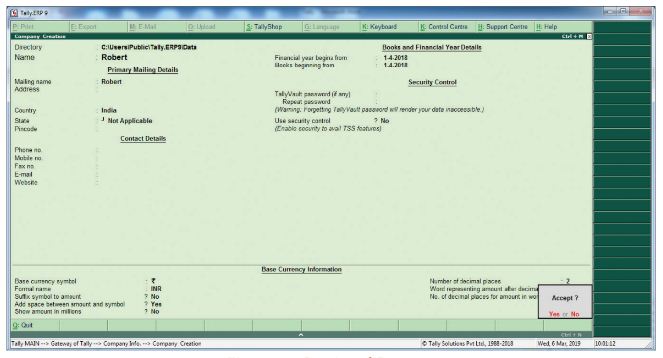
1. To create company
Company Info > Create Company
Type the Name as Robert and keep all other fields as they are and choose ‘Yes’ to accept.
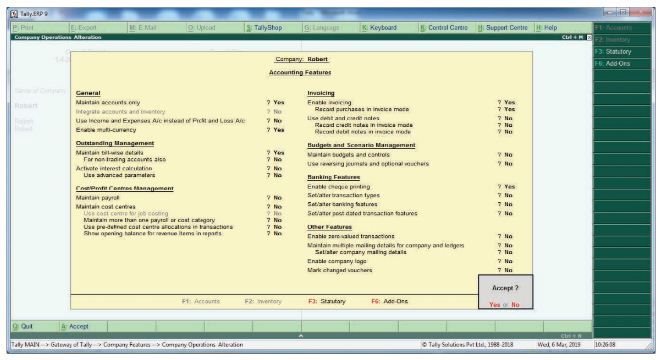
2. To maintain accounts only
Gateway of Tally > F11 Accounting Features > General > Maintain accounts only: Yes > Accept> Yes
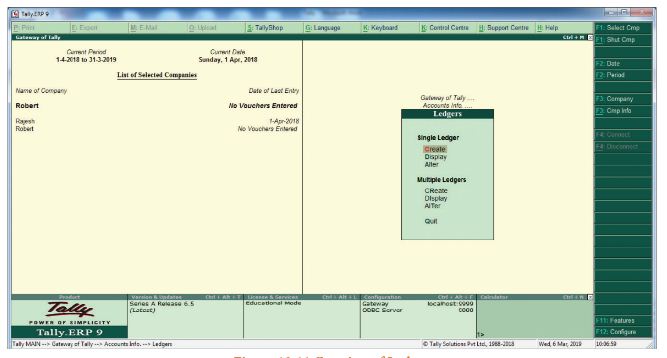
3. To Create ledger accounts
Gateway of Tally > Masters > Accounts Info > Ledgers > Single Ledger > Create
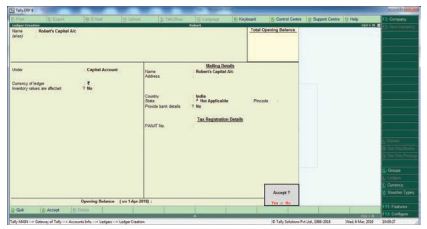
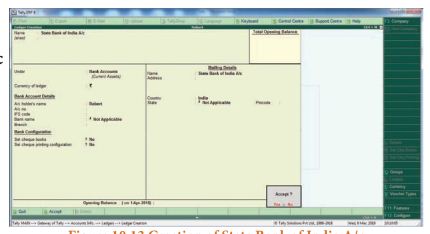
(i) To Create Devi's Capital A/c
Name: Devi's Capital A/c
Under Capital Account
Accept: Yes
(ii) To Create Indian Bank A/c
Name: Indian Bank A/c
Under: Bank Accounts
Accept: Yes
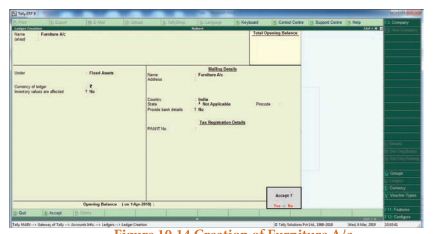
(iii) To Create Furniture A/c
Name: Furniture A/c
Under: Fixed Assets
Accept: Yes
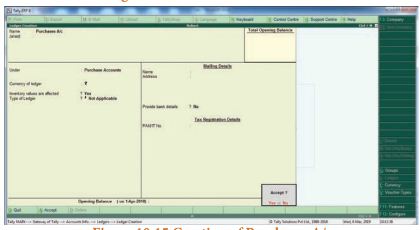
(iv) To Create Purchases A/c
Name: Purchases A/c
Under: Purchase
Accept: Yes
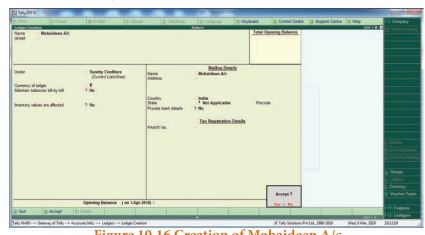
(v) To Create Mohaideen A/c
Name: Mohaideen A/c
Under: Sundry Creditors
Accept: Yes
(vi) To Create Sales A/c
Name: Sales A/c
Under: Sales Account
Accept: Yes
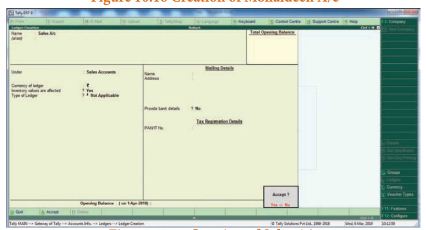
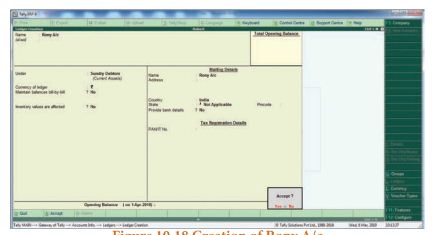
(vii) To create Rony A/c
Name: Rony A/c
Under: Sundry Debtors
Accept: Yes
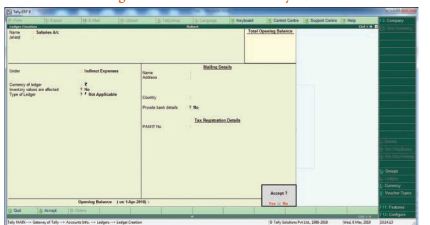
(viii) To create Salaries A/c
Name: Salaries A/c
Under: Indirect Expenses
Accept: Yes
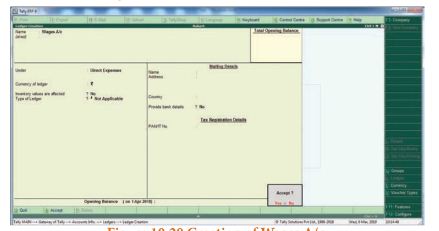
(ix) To create Wages A/c
Name: Wages A/c
Under: Direct Expenses
Accept: Yes
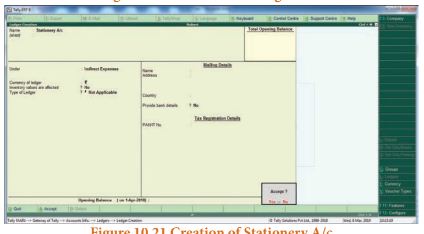
(x) To create Stationery A/c
Name: Stationery A/c
Under: Indirect Expenses
Accept: Yes
(xi) To create Pandian Ltd. A/c
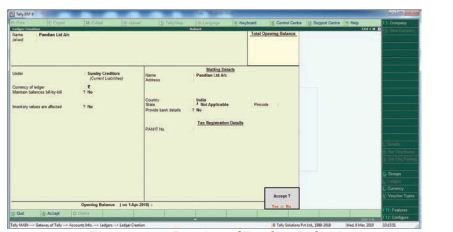
Name: Pandian Ltd. A/c
Under:Sundry Creditors
Accept: Yes
4. To enter transactions through vouchers
Gateway of Tally > Transactions > Accounting Vouchers
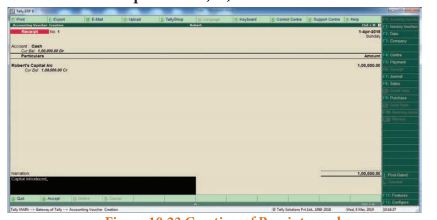
(i) Robert commenced a transport business with a capital of Rs. 1,00,000
F6: Receipt Voucher: Accounts: Cash
Particulars: Robert Capital A/c (Choose from List of Ledgers Accounts)
Enter the amount of Capital Rs. 1,00,000
Narration: Capital Introduced
Accept: Yes
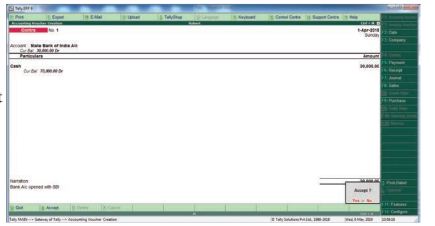
(ii) An account was opened with State Bank of India and deposited Rs. 30,000
F4: Contra Voucher
Accounts: State Bank of India
Particulars: Cash
Amount: Rs. 30,000
Narration: Opened bank account in SBI
Accept: Yes
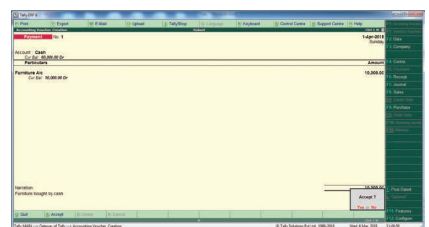
(iii) Purchased Furniture by paying cash Rs. 10,000
F5: Payment Vouchers
Account: Cash
Particulars: Furniture A/c
Amount: Rs. 15,000
Narration: Furniture bought by Cash
Accept: Yes
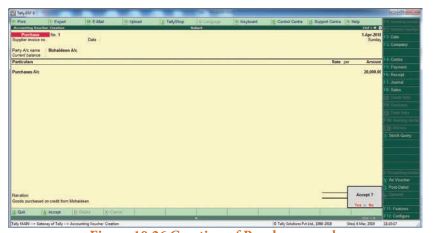
4 Goods purchased on credit from Mohaideen for Rs. 20,000
F9: Purchase voucher
Party A/c name: Mohaideen A/c
Particulars: Purchases A/c
Amount: Rs. 20,000
Narration: Goods purchased on
credit from Mohaideen
Accept Yes
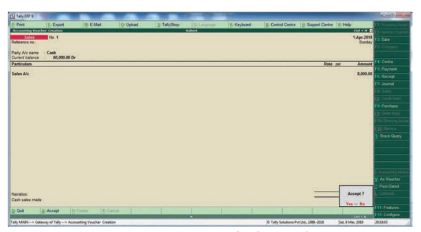
(5) Cash sales made for Rs. 8,000
F8: Sales Voucher,
Account: Cash
Particulars: Sales A/c
Amount: Rs. 8,000
Narration: Cash Sales Mode
Accept: Yes
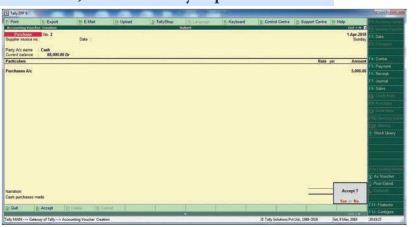
(6) Goods purchased from Rathinam for Rs. 5,000 and money deposited in CDM
F9: Purchase Voucher
Account: Bank
Particulars: Purchase A/c
Amount: Rs. 5,000
Narration: Goods Purchased
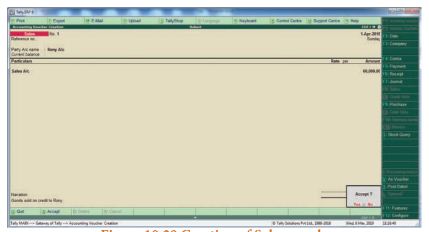
(vii) Goods sold to Rony on credit for Rs. 60,000
F8: Sales Voucher
Party: A/c Name: Rony A/c
Particulars: Sales A/c
Amount: Rs. 70,000
Narration: Goods sold on credit to Rony
Accept: Yes
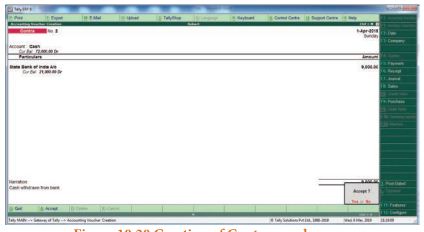
(viii) Money withdrawn from bank for office use Rs. 9,000
F4: Contra Voucher
Account: Cash
Particulars: State Bank of India A/c
Amount: Rs. 9,000
Narration: Cash withdrawn from bank
Accept: Yes
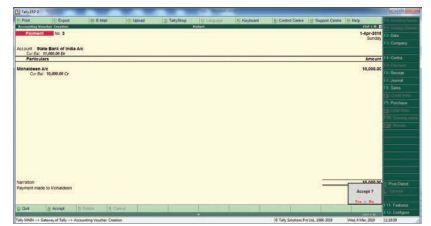
(ix) Part payment of Rs 10,000 to Mohaideen by cheque
F5: Payment Vouchers
Account: State Bank of India
Particulars: Mohaideen A/c
Amount: Rs.10,000
Narration: Payment made to
Mohaideen by cheque
Accept Yes
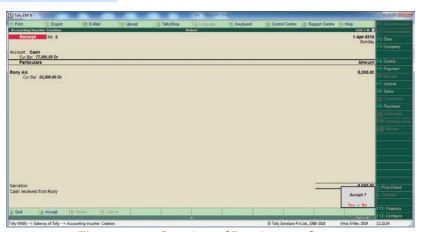
(x) Rony made part payment of Rs. 5,000 by cash
F6: Receipt voucher
Account: Cash
Particulars: Rony A/c
Amount: Rs. 5,000
Narration: Cash received from Rony
Accept Yes.
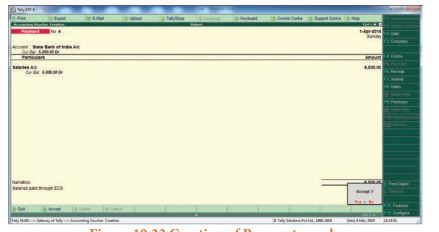
(xi) Salaries Paid to Staff through ECS Rs. 6,000
F5: Payment Vouchers
Account: Indian Bank
Particulars: Salaries A/c
Amount: Rs 6,000
Narration: Salaries paid through ECS,
Accept: Yes
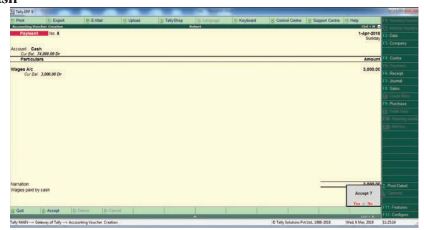
(xii) Wages of Rs. 3,000 paid by cash
F5: Payment voucher
Account: Cash
Particulars: Wages A/c
Amount: Rs. 3,000
Narration: Wages paid by cash
Accept Yes
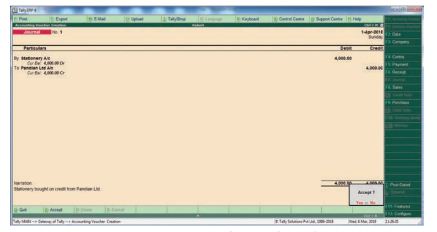
(xiii) Purchased stationery from Pandian Ltd. on credit Rs.4,000
F7: Journal Voucher
Particulars: Computer A/c
Account: Muthu Ltd.
Amount: Rs. 4,000
Narration: Stationery bought on credit from Pandian Ltd.
Accept: Yes
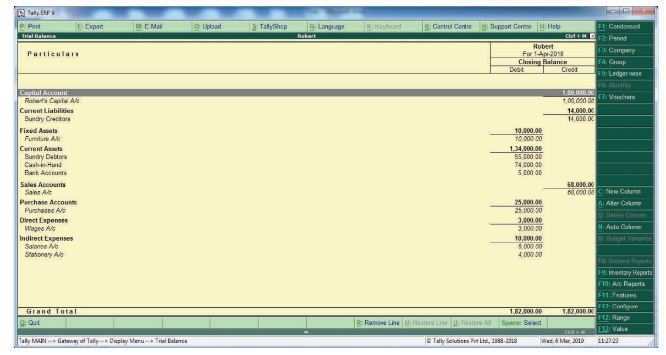
To view reports
(i) To view Trial Balance
Gateway of Tally > Reports > Display > Trial Balance > Alt + F1 (detailed)
(ii) To view profit and loss Account
F10: A/c Reports > Profit & Loss A/c > Alt + F1 (detailed) or
Gateway of Tally > Reports > Profit & Loss A/c Alt + F1 (detailed)
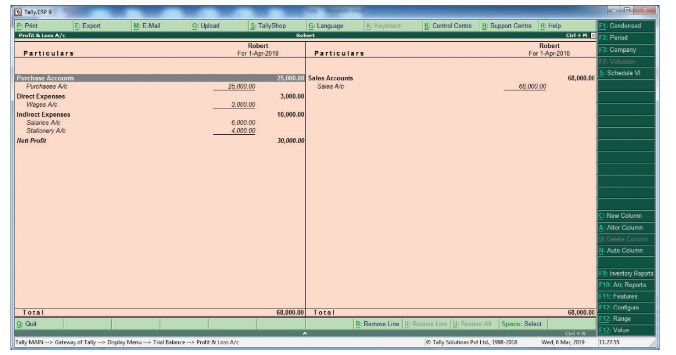
(iii) To view Balance sheet
F10: A/c Reports > Balance sheet > Alt + F1 (detailed)
Gate of Tally > Reports > Balance Sheet > Alt + F1 (detailed)
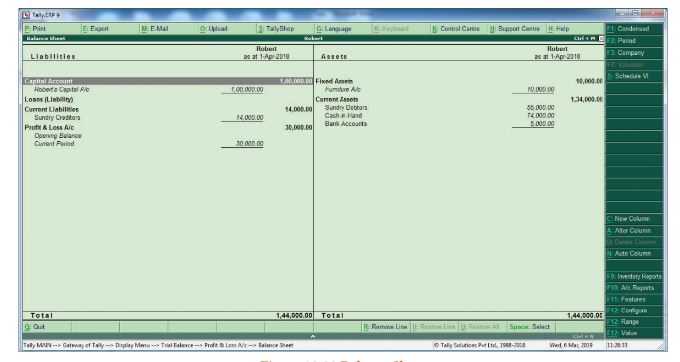
(iv) To view Ratio Analysis
F10: A/c Reports > Ratio Analysis (or)
Gateway of Tally > Reports > Ratio Analysis
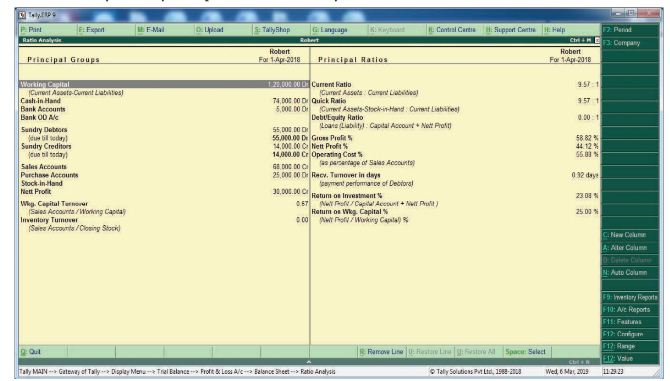
(v) To view Day book
F10: A/c Reports > Day Book > Alt + F1 (detailed (or)
Gateway of Tally > Reports > Display > Day Books > Alt + F1 (detailed)
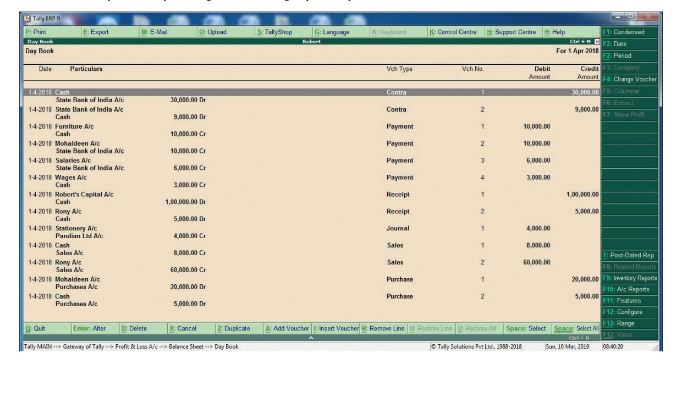
49.
| Date | Particulars | L.F. | Debit Rs. |
Credit Rs. |
|
|---|---|---|---|---|---|
| Bank A/c | Dr. | 5,00,000 | |||
| To Equity share application A/c | 5,00,000 | ||||
| (Application money received) | |||||
| Equity share application A/c | Dr. | 5,00,000 | |||
| To Equity share capital A/c | 5,00,000 | ||||
| (Transfer of share application money to share capital) | |||||
| Equity share allotment A/c | Dr. | 2,00,000 | |||
| To Equity share capital A/c | 2,00,000 | ||||
| (Share allotment money due) | |||||
| Bank A/c | Dr. | 2,00,000 | |||
| To Equity share allotment A/c | 2,00,000 | ||||
| (Allotment money received) | |||||
| Equity share first call A/c | Dr. | 2,00,000 | |||
| To Equity share capital A/c | 2,00,000 | ||||
| (Share first call money due) | |||||
| Bank A/c | Dr. | 2,00,000 | |||
| To Equity share first call A/c | 2,00,000 | ||||
| (Share first call money received) | |||||
| Equity share second and final call A/c | Dr. | 1,00,000 | |||
| To Equity share capital A/c | 1,00,000 | ||||
| (Share second and final call money due) | |||||
| Bank A/c | Dr. | 1,00,000 | |||
| To Equity share second and final call A/c | 1,00,000 | ||||
| (Share second and final call money received) |
50.
This type of a voucher basically analyses a business transaction from the accounting stand point and is used for recording purposes
These are commonly prepared by accountants on the basis of supporting vouchers and approved by a different individual. They are further subdivided into two, Cash and Non-cash vouchers.
Examples of cash type :
1. Credit Vouchers
2. payment Vouchers
3. Contra Vouchers
4. Purchase Vouchers
5. Sales Vouchers
6. journal vouchers
Examples of the Non-cash type :
1. Debit note
2. Credit note
3. Invoice
51.
Average profit = \(\frac { Total\ profit }{ Number\ of\ year } \)
=\(\frac { 62,000+61,000+63,000 }{ 3 } \)
= \(\frac { 1,86,000 }{ 3 } \)
= Rs. 62,000
Normal profit = Capital employed \(\times\) Normal rate of return
= 4,00,000 \(\times\) 10%
= Rs. 40,000
Super profit = Average profit - Normal profit
= 62,000 – 40,000
= Rs. 22,000
Goodwill = \(\frac { Super\ profit }{ Normal\ rate\ of\ return } \) \(\times\)100
= \(\frac { 22,000 }{ 10 } \) \(\times\) 100
= Rs. 2,20,000
52.
| Particulars | Mannan Rs. |
Sevagan Rs. |
Particulars | Mannan Rs. |
Sevagan Rs. |
|---|---|---|---|---|---|
| To Drawings A/c | 40,000 | 35,000 | By Balance b/d | 2,00,000 | 1,75,000 |
| To Interest on | By Profit and loss | ||||
| drawings A/c | 1,000 | 500 | appropriation A/c | 21,000 | 16,500 |
| To Balance c/d | 2,10,00 | 1,69,000 | By Interest on capital A/c | 12,000 | 10,500 |
| By Salary A/c | 18,000 | - | |||
| By Commission A/c | - | 2,500 | |||
| 2,51,000 | 2,04,500 | 2,51,000 | 2,04,500 | ||
| 2,10,000 | 1,69,000 |
53.
| Date | Particulars | Shanthi Rs. |
Sumathi Rs. |
Date | Particulars | Shanthi Rs. |
Sumathi Rs. |
|---|---|---|---|---|---|---|---|
| 2018 | 2018 | ||||||
| Jan 1 | By Balance b/d | 1,00,000 | 80,000 | ||||
| Dec 31 | To Balance c/d | 1,10,000 | 1,00,000 | June 1 | By Bank (Additional capital) |
10,000 | 20,000 |
| 1,10,000 | 1,00,000 | 1,10,000 | 1,00,000 | ||||
| 2019 | |||||||
| Jan 1 | By Balance b/d | 1,10,000 | 1,00,000 |
| Date | Particulars | Shanthi Rs. |
Sumathi Rs. |
Date | Particulars | Shanthi Rs. |
Sumathi Rs. |
|---|---|---|---|---|---|---|---|
| To Drawings | 20,000 | 13,000 | By Balance b/d | 5,000 | 3,000 | ||
| To Interest on | By Profit and loss | ||||||
| 500 | 300 | ||||||
| drawings | appropriation A/c | 10,000 | 8,000 | ||||
| To Balance c/d | 9,800 | 4,300 | (share of profit) | ||||
| By Interest on capital | 6,300 | 5,400 | |||||
| By Salary | 9,000 | - | |||||
| By Commission | - | 1,200 | |||||
| 30,300 | 17,600 | 30,300 | 17,600 | ||||
| By Balance b/d | 9,800 | 4,300 |
54.
| Receipts | Rs. | Rs. | Payments | Rs. |
|---|---|---|---|---|
| To Balance bid | By stationery purchased | 6,000 | ||
| Cash in hand | 2,000 | By Audit fees paid | 2,000 | |
| Cash at bank | 3,000 | 5,000 | By Scholarship given | 2,000 |
| To Sale of old news papers | 5,00 | By Sundry charges | 6,000 | |
| To Entrance fees received | 3,000 | By Fire insurance premium paid | 1,500 | |
| To Subscription received | 8,500 | By Furniture purchased | 6,000 | |
| To Sales of furniture | 4,000 | By Purchase of news papers | 700 | |
| To Interest on investment | 2,000 | By Conveyance paid | 1,000 | |
| To Balance c!d | 4,700 | By Balance cld | ||
| (Bank overdraft) | Cash in hand | 2,500 | ||
| 27,700 | 27,700 |
[Hint: As depreciation on furniture is a non cash item, it is excluded in receipts and payments account]

12th Standard Syllabus & Materials
12th Standard
TN 12th Computer Applications வலையமைப்பு வடமிடல் Sample Question Papers Study Material - QB365 Set A
NEW12th Standard
TN 12th Computer Applications களப்பெயர் முறைமை (DNS) Sample Question Papers Study Material - QB365 Set A
NEW12th Standard
TN 12th Computer Applications வலையமைப்பு எடுத்துக்காட்டுகள் மற்றும் நெறிமுறைகள் Sample Question Papers Study Material - QB365 Set A
NEW12th Standard
TN 12th Computer Applications கணினி வலையமைப்பு ஓர் அறிமுகம் Sample Question Papers Study Material - QB365 Set A



Tamilnadu Stateboard 12th Standard Subjects

Maths

Chemistry

Physics

Biology

Computer Science

Business Maths and Statistics

Economics

Commerce
Accountancy

History

Computer Applications
Biology
Computer Technology
Computer Applications
Computer Science
Business Maths and Statistics
Commerce
Economics
Maths
Chemistry
Physics
Computer Technology
History
Accountancy

Tamil

English

French
Tamilnadu Stateboard Standards
