
 100% FREE ACCESS
12th Standard Syllabus & Materials
12th Standard
TN 12th Maths Applications of Matrices and Determinants Sample Question Papers Study Material - QB365 Set A
NEW12th Standard
TN 12th Computer Applications மின்னணு தரவு பரிமாற்றம் Sample Question Papers Study Material - QB365 Set A
NEW12th Standard
TN 12th Computer Applications மின் - வணிக பாதுகாப்பு அமைப்புகள் Sample Question Papers Study Material - QB365 Set A
NEW12th Standard
TN 12th Computer Applications மின்னணு செலுத்தல் முறைகள் Sample Question Papers Study Material - QB365 Set A
NEW12th Standard
TN 12th Computer Applications மின் - வணிகம் Sample Question Papers Study Material - QB365 Set A
NEW12th Standard
TN 12th Computer Applications திறந்த மூல கருத்துருக்கள் Sample Question Papers Study Material - QB365 Set A

Published on: 13/05/2022
QB365 provides detailed and simple solution for every Creative Questions in class 12 Biology Subject. It will helps to get more idea about question pattern in every Creative questions with solution.
latest Creative QuestionsDownload Tamil Nadu 12th Standard Biology question papers, model tests, one-mark questions, important questions, and public exam papers in PDF format. Free study materials and answer keys for TN State Board students.
Questions + Answers key
Take MCQ Biology Test1.
Describe the structure of dicot seed.
2.
Describe the development of monosporic embryo sac.
3.
Write about the different types of ovules.
4.
Describe the development process of male gametophyte.(or) Explain the different mode of entry of pollen tube into the ovule.
5.
Give a comparative account on Anther wall layers
1.
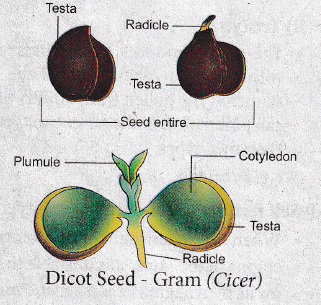
(i) Structure of a Cicer seed as an example for Dicot seed The mature seeds are attached to the fruit wall by a stalk called funiculus.
(ii) The funiculus disappears leaving a scar called hilum. Below the hilum a small pore called micropyle is present.
(iii) It facilitates entry of oxygen and water into the seeds during germination.
(iv) Each seed has a thick outer covering called seed coat.
(v) The seed coat is developed from integuments of the ovule.
(vi) The outer coat is called testa and is hard whereas the inner coat is thin, membranous and is called tegmen.
(vii) In Pea plant the tegmen and testa are fused. Two cotyledons laterally attached to the embryonic axis are present.
(viii) It stores the food materials in pea whereas in other seeds like castor the endosperm contains reserve food and the cotyledons are thin.
(xi) The portion of embryonal axis projecting beyond the cotyledons is called radicle or embryonic root.
(x) The other end of the axis called embryonic shoot is the plumule.
(xi) Embryonal axis above the level of cotyledon is called epicotyl whereas the cylindrical region between the level of cotyledon is called hypocotyl.
(xii) The epicotyl terminates in plumule whereas the hypocotyl ends in radicle.
2.
The functional megaspore is the first cell of the embryo sac or female gametophyte. The megaspore elongates along the micropylar-chalazal axis. The nucleus undergoes a mitotic division. Wall formation does not follow the nuclear division. A large central vacuole now appears between the two daughter nuclei. The vacuole expands and pushes the nuclei towards the opposite poles of the embryo sac. Both the nuclei divide twice mitotically, forming four nuclei at each pole. At this stage, all the eight nuclei are present in a common cytoplasm (free nuclear division). After the last nuclear division, the cell undergoes appreciable elongation, assuming a sac-like appearance. This is followed by the cellular organization of the embryo sac. Of the four nuclei at the micropylar end of the embryo sac, three organize into an egg apparatus, the fourth one is left free in the cytoplasm of the central cell as the upper polar nucleus. Three nuclei of the chalazal end form three antipodal cells whereas the fourth one functions as the lower polar nucleus. Depending on the plant the 2 polar nuclei may remain free or may fuse to form a secondary nucleus (central cell). The egg apparatus is made up of a central egg cell and two synergids, one on each side of the egg cell. Synergids secrete chemotropic substances that help to attract the pollen tube. The special cellular thickening called filiform apparatus of synergids to help in the absorption, conduction of nutrients from the nucellus to embryo sac. It also guides the pollen tube into the egg. Thus, a 7 celled with 8 nucleated embryo sac is formed.
3.
There are 5 types of ovules.
1. Orthotropous:
Micropyle is at the distal end and the micropyle, the funicle and the chalaza lie in one straight vertical line.
2. Anatropous:
The body of the ovule becomes completely inverted so that the micropyle and funiculus come to lie very close to each other.
E.g: Dicots, Monocots (Common)
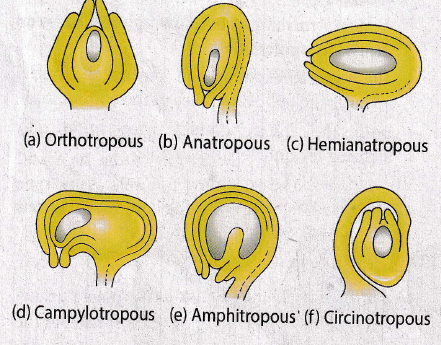
3. Hemianatropous:
The body of the ovule is placed transversely and at right angles to the funicle.
E.g: Primulaceae.
4. Campylotropous:
(i) The body of the ovule at the micropylar end is curved and more or less bean shaped. The embryo sac is slightly curved.
(ii) All the three, hilum, micropyle and chalaza are adjacent to one another, with the micropyle oriented towards the placenta.
E.g: Leguminosae.
5. a) Amphitropous:
The distance between hilum and chalaza is less. The curvature of the ovule leads to horse shoe shaped nucellus.
E.g: Alismataceae.
b) Circinotropous:
Funiculus is very long and surrounds the ovule.
E.g: Cactaceae
4.
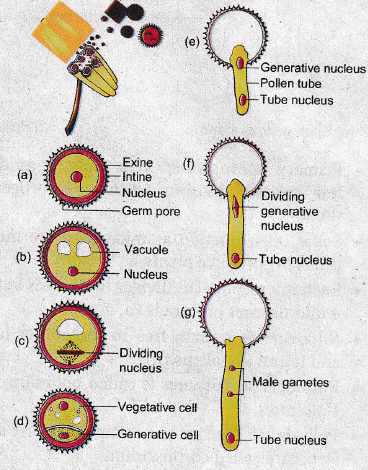
(i) The microspore is the first cell of the male gametophyte and is haploid.
(ii) The development of male gametophyte takes place while they are still in the microsporangium.
(iii) The nucleus of the microspore divides to form a vegetative and a generative nuclei.
(iv) A wall is laid around the generative nucleus resulting in the formation of two unequal cells, a large irregular nucleus bearing with abundant food reserve called vegetative cell and a small generative cell.
(v) At this two celled stage, the pollens are liberated from the anther.
(vi) In some plants, the generative cell again undergoes a division to form two male gametes.
(vii) In these plants, the pollen is liberated at 3 celled stages.
(viii) In 60% of the angiosperms, pollen is liberated in 2 celled stages.
(ix) The growth of the male gametophyte occurs only if the pollen reaches the right stigma.
(x) The pollen on reaching the stigma of absorbs moisture and swells.
(xi) The intine grows as pollen tube through the germ pore.
(xii) In case the pollen is liberated at 2 celled stages the generative cell divides in the pollen into 2 male cells (sperms) after reaching the stigma.
(xiii) The stages in the development of male gametophyte occurs in gynoecium of the plant.
5.
Anther wall: The mature anther wall consists of the following layers a. Epidermis
b. Endothecium
c. Middle layers
d. Tapetum.
a. Epidermis: It is single layered and protective in function. The cells undergo repeated anticlinal divisions to cope up with the rapidly enlarging internal tissues.
b. Endothecium: It is generally a single layer of radially elongated cells found below the epidermis. The inner tangential wall develops bands (sometimes radial walls also) of cellulose (sometimes also slightly lignified). The cells are hygroscopic. In the anthers of aquatic plants, saprophytes, cleistogamous flowers, and extreme parasites endothelial differentiation is absent. The cells along the junction of the two sporangia of an anther lobe lack these thickenings. This region is called stomium. This region along with the hygroscopic nature of endothecium helps in the dehiscence of anther at maturity.
c. Middle layers: Two to three layers of cells next to endothecium constitute middle layers. They are generally ephemeral. They disintegrate or get crushed during maturity.
d. Tapetum: It is the innermost layer of the anther wall and attains its maximum development at the tetrad stage of microsporogenesis. It is derived partly from the peripheral wall layer and partly from the connective tissue of the anther lining the anther locule. Thus, the tapetum is dual in origin. It nourishes the developing sporogenous tissue, microspore mother cells, and microspores. The cells of the tapetum may remain uninucleate or may contain more than one nucleus or the nucleus may become polyploid. It also contributes to the wall materials, sporopollenin, pollenkitt, tryphine, and a number of proteins that control incompatibility reaction. Tapetum also controls the fertility or sterility of the microspores or pollen grains.

12th Standard Syllabus & Materials
12th Standard
TN 12th Computer Applications வலையமைப்பு வடமிடல் Sample Question Papers Study Material - QB365 Set A
NEW12th Standard
TN 12th Computer Applications களப்பெயர் முறைமை (DNS) Sample Question Papers Study Material - QB365 Set A
NEW12th Standard
TN 12th Computer Applications வலையமைப்பு எடுத்துக்காட்டுகள் மற்றும் நெறிமுறைகள் Sample Question Papers Study Material - QB365 Set A
NEW12th Standard
TN 12th Computer Applications கணினி வலையமைப்பு ஓர் அறிமுகம் Sample Question Papers Study Material - QB365 Set A



Tamilnadu Stateboard 12th Standard Subjects

Maths

Chemistry

Physics
Biology

Computer Science

Business Maths and Statistics

Economics

Commerce

Accountancy

History

Computer Applications
Biology
Computer Technology
Computer Applications
Computer Science
Business Maths and Statistics
Commerce
Economics
Maths
Chemistry
Physics
Computer Technology
History
Accountancy

Tamil

English

French
Tamilnadu Stateboard Standards



