
 100% FREE ACCESS
12th Standard Syllabus & Materials
12th Standard
TN 12th Maths Applications of Matrices and Determinants Sample Question Papers Study Material - QB365 Set A
NEW12th Standard
TN 12th Computer Applications மின்னணு தரவு பரிமாற்றம் Sample Question Papers Study Material - QB365 Set A
NEW12th Standard
TN 12th Computer Applications மின் - வணிக பாதுகாப்பு அமைப்புகள் Sample Question Papers Study Material - QB365 Set A
NEW12th Standard
TN 12th Computer Applications மின்னணு செலுத்தல் முறைகள் Sample Question Papers Study Material - QB365 Set A
NEW12th Standard
TN 12th Computer Applications மின் - வணிகம் Sample Question Papers Study Material - QB365 Set A
NEW12th Standard
TN 12th Computer Applications திறந்த மூல கருத்துருக்கள் Sample Question Papers Study Material - QB365 Set A

Published on: 13/05/2022
QB365 provides detailed and simple solution for every book back questions in class 12 Biology subject.It will helps to get more idea about question pattern in every book back questions with solution.
latest Book back QuestionsDownload Tamil Nadu 12th Standard Biology question papers, model tests, one-mark questions, important questions, and public exam papers in PDF format. Free study materials and answer keys for TN State Board students.
Questions + Answers key
Take MCQ Biology Test1.
Give definitions for organic farming?
2.
Write the cosmetic uses of Aloe.
3.
How are microbial inoculants used to increase the soil fertility?
4.
5.
Pyramid of energy is always upright. Give reasons
6.
‘Green algae are not likely to be found in the deepest strata of the ocean’. Give at least one reason.
7.
What are ecological equivalents? Give one example
8.
What are the enzymes you can used to cut terminal end and internal phospho di ester bond of nucleotide sequence?
9.
What are the materials used to grow microorganism like Spirulina?
10.
11.
12.
Give the names of the scientists who rediscovered Mendelism
13.
What are clones?
14.
List out two sub-aerial stem modifications with example.
15.
What is reproduction?
16.
Which is called as the “King of Bitters”? Mention their medicinal importance.
17.
Discuss the gross primary productivity is more efficient than net primary productivity.
18.
19.
Distinguish habitat and niche
20.
21.
You are working in a biotechnology lab with a bacterium namely E.coli. How will you cut the nucleotide sequence? explain it.
22.
23.
| s.no | gamete types | Number of progenies |
| 1 | ABC | 349 |
| 2 | Abc | 114 |
| 3 | abC | 124 |
| 4 | AbC | 5 |
| 5 | aBc | 4 |
| 6 | aBC | 116 |
| 7 | ABc | 128 |
| 8 | abc | 360 |
i) What is the name of this test cross?
ii) How will you construct gene mapping from the above given data?
iii) Find out the correct order of genes.
24.
If you cross dominant genotype PV/PV male Drosophila with double recessive female and obtain F1 hybrid. Now you cross F1 male with double recessive female.
i) What type of linkage is seen?
ii) Draw the cross with correct genotype.
iii) What is the possible genotype in F2 generation?
25.
When two different genes came from same parent they tend to remain together.
i) What is the name of this phenomenon?
ii) Draw the cross with suitable example.
iii) Write the observed phenotypic ratio.
1.
Organic farming is an alternative agricultural system in which plants/crops are cultivated in natural ways by using biological inputs to maintain soil fertility and ecological balance thereby minimizing pollution and wastage.
2.
1. Aloin - a mixture of glucosides.
2. Its gel used as skin tonic.
3. Cooling effect and moisturizing effect helps in creams, lotions, shampoos, shaving creams, after shave lotions preparation.
4. Used has emollient, antibacterial, antioxidant, antifungal and antiseptic.
3.
Micro organisms are efficient in fixing nitrogen, solubilizing phosphate and decomposing cellulose. They improve soil fertility, plant growth. They are ecofriendly and cost-effective than chemical fertilizers. Example. Azospirillum.
4.
5.
There is a gradual decrease in energy transfer at successive tropic levels from producers to higher levels, hence the pyramid of energy is always upright.
6.
The blue green light have short wavelength & penetrates into the water. Green algae is unable to use that component of light. Blue light can penetrate up to 500 ft depth therefore algae are unlikely to survive below that depth.
7.
Taxonomically different species occupying similar habitats (Niches) in different geographical regions are called Ecological equivalents.
E.g: Certain species of epiphytic orchids of Western Ghats of India differ from the epiphytic orchids of South America. But they are epiphytes.
8.
Restriction endonuclease. e.g: Hind II, EcoR I, Pvul, Bam H I, Taq I.
9.
Spirulina can be grown easily on materials like waste water from potato processing plants (containing starch), straw, molasses, animal manure and even sewage, to produce large quantities.
10.
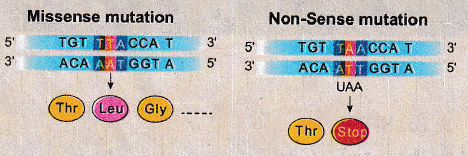
11.
12.
(i) Hugo de Vries of Holland
(ii) Carl Correns of Germany
(iii) Erich von Tschermak of Austria
13.
Individuals formed by asexual reproductive methods are morphologically and genetically identical and are called clones.
14.
Sucker - chrysanthemum
Stolon - jasmine
15.
Reproduction is a biological process in which an organism give rise to offsprings. This helps to maintain continuity of its species.
16.
1. It is Andrographis paniculata belongs to Acanthaceae family.
2. It is a potent hepatoprotective to treat liver disorders.
3. Used to make Nilavembu Kudineer to treat malaria and dengue.
17.
Gross Primary Productivity (GPP) is the total amount of food energy or biomass produced in an ecosystem by autotrophs through the process of photosynthesis whereas Net Primary Productivity (NPP) is the proportion of energy which remains after respiration loss in the plant. When we compare GPP with NPP more energy is present in former than in latter.
18.
19.
The differences between habitat and niche are as follows.
| S. No | Habitat | Niche |
| 1 | A specific physical space occupied by an organism (species). | A functional space occupied by an organism in the same eco-system |
| 2 | Same habitat may be shared by many organisms (species). | A single niche is occupied by a single species. |
| 3 | Habitat specificity is exhibited by organism. | Organisms may change their niche with time and season |
20.
21.
(i) ECORI is from Escherichia ( E ) coli (co), strain RY 13 (R) & first endonuclease (I) to be discovered.
(ii) It contains 2 different antibiotics resistance genes & recognition site for several restriction enzymes.
(iii) This sequence is referred to as a restriction site & is generally -palindromic which means that the sequence in both DNA strands at this site read same in 5' - 3' direction & in-the 3'-5' direction.
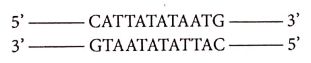
(iv) The exact kind of cleavage produced by a restriction enzyme is important in the design of a gene cloning experiment.
(v) Some cleave both strands of DNA through the centre resulting in blunt or flush end.
(vi) These are known as symmetric cuts.
(vii) Some enzymes cut in a way producing protruding & recessed ends known as sticky or cohesive end.
(viii) These are known as staggered or asymmetric cuts.
22.
23.
(i) Three point test cross.
(ii)
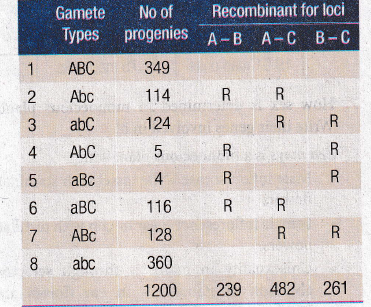
If we analyse the loci of two alleles at a time, starting with AB, since AB and ab are parental genotypes, the recombination will be Ab/aB.
The recombinant frequency for these two alleles can be calculated as follows.
\(RF = \frac{Total\ no.\ of \ recombination}{Total\ no.\ of\ progenies}\times100\)
\(\mathrm{RF}=\frac{114+5+4+116}{1200} \times 100 \)
\(\mathrm{RF}=\frac{239}{1200}=19.91 \)
For A and C loci, the recombinants are Ac / aC - RF will be as follows.
\(\mathrm{RF}=\frac{114+134+116+128}{1200} \times 100 \)
\(\mathrm{RF}=\frac{482}{1200}=40.1 \)
For B and C loci, the recombinants are Bc / bC- RF will be as follows.
\(R F=\frac{124+5+4+128}{1200} \times 100 \)
\(R F=\frac{261}{1200}=21.75 \)
All the loci are linked, because all the RF value is less than 50%. In this A - and C loci show highest RF value, they must be farthest apart. Therefore B locis must lie in between them.
The order of genes should be abc. A genetic map can be drawn as follows.
(iii)

24.
(i) Incomplete linkage
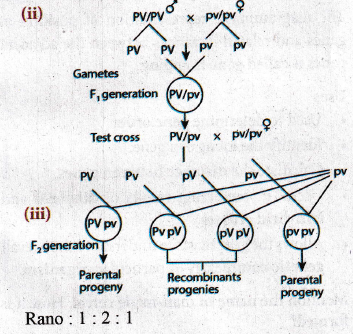
Rano : 1:2:1
25.
(i) Complete Linkage
(ii)
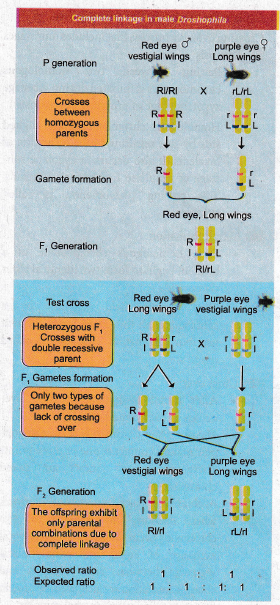
(iii) Observed ratio 1:1

12th Standard Syllabus & Materials
12th Standard
TN 12th Computer Applications வலையமைப்பு வடமிடல் Sample Question Papers Study Material - QB365 Set A
NEW12th Standard
TN 12th Computer Applications களப்பெயர் முறைமை (DNS) Sample Question Papers Study Material - QB365 Set A
NEW12th Standard
TN 12th Computer Applications வலையமைப்பு எடுத்துக்காட்டுகள் மற்றும் நெறிமுறைகள் Sample Question Papers Study Material - QB365 Set A
NEW12th Standard
TN 12th Computer Applications கணினி வலையமைப்பு ஓர் அறிமுகம் Sample Question Papers Study Material - QB365 Set A



Tamilnadu Stateboard 12th Standard Subjects

Maths

Chemistry

Physics
Biology

Computer Science

Business Maths and Statistics

Economics

Commerce

Accountancy

History

Computer Applications
Biology
Computer Technology
Computer Applications
Computer Science
Business Maths and Statistics
Commerce
Economics
Maths
Chemistry
Physics
Computer Technology
History
Accountancy

Tamil

English

French
Tamilnadu Stateboard Standards



