
 100% FREE ACCESS
12th Standard Syllabus & Materials
12th Standard
TN 12th Computer Applications மின்னணு தரவு பரிமாற்றம் Sample Question Papers Study Material - QB365 Set A
NEW12th Standard
TN 12th Computer Applications மின் - வணிக பாதுகாப்பு அமைப்புகள் Sample Question Papers Study Material - QB365 Set A
NEW12th Standard
TN 12th Computer Applications மின்னணு செலுத்தல் முறைகள் Sample Question Papers Study Material - QB365 Set A
NEW12th Standard
TN 12th Computer Applications மின் - வணிகம் Sample Question Papers Study Material - QB365 Set A
NEW12th Standard
TN 12th Computer Applications திறந்த மூல கருத்துருக்கள் Sample Question Papers Study Material - QB365 Set A
NEW12th Standard
TN 12th Computer Applications வலையமைப்பு வடமிடல் Sample Question Papers Study Material - QB365 Set A

Published on: 02/06/2021
QB365 provides detailed and simple solution for every book back questions in class 12 Biology subject.It will helps to get more idea about question pattern in every book back questions with solution.
Download Tamil Nadu 12th Standard Biology question papers, model tests, one-mark questions, important questions, and public exam papers in PDF format. Free study materials and answer keys for TN State Board students.
Questions + Answers key
Take MCQ Biology Test1.
Give definitions for organic farming?
2.
Write the cosmetic uses of Aloe.
3.
Expand CCS. (or) What is CCS?
4.
Pyramid of energy is always upright. Give reasons
5.
Soil formation can be initiated by biological organisms. Explain how?
6.
‘Green algae are not likely to be found in the deepest strata of the ocean’. Give at least one reason.
7.
Why are some organisms called as eurythermals and some others as stenohaline ?
8.
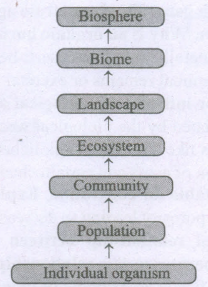
What is ecological hierarchy? Name the levels of ecological hierarchy.
9.
Define ecology.
10.
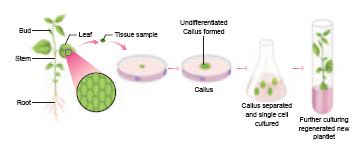
What is the name of the process given below? Write its 4 types.
11.
What are the enzymes you can used to cut terminal end and internal phospho di ester bond of nucleotide sequence?
12.
13.
Define Genetics.
14.
Name the seven contrasting traits of Mendel.
15.
“Tissue culture is the best method for propagating rare and endangered plant species”- Discuss.
16.
Mention the contribution of Hofmeister towards Embryology.
17.
What is reproduction?
18.
Which is called as the “King of Bitters”? Mention their medicinal importance.
19.
20.
21.
You are working in a biotechnology lab with a bacterium namely E.coli. How will you cut the nucleotide sequence? explain it.
22.
Distinguish mound layering and air layering.
23.
How do you use the biotechnology in modern practice?
24.
Highlight the milestones from the history of plant embryology.
25.
Explain the conventional methods adopted in vegetative propagation of higher plants.
1.
Organic farming is an alternative agricultural system in which plants/crops are cultivated in natural ways by using biological inputs to maintain soil fertility and ecological balance thereby minimizing pollution and wastage.
2.
1. Aloin - a mixture of glucosides.
2. Its gel used as skin tonic.
3. Cooling effect and moisturizing effect helps in creams, lotions, shampoos, shaving creams, after shave lotions preparation.
4. Used has emollient, antibacterial, antioxidant, antifungal and antiseptic.
3.
CSS - Carbon Capture and Storage.
4.
There is a gradual decrease in energy transfer at successive tropic levels from producers to higher levels, hence the pyramid of energy is always upright.
5.
Soil formation is initiated by the weathering process. Biological weathering takes place when organisms like bacteria, fungi, lichens & plants help in the breakdown of rocks through the production of acids & certain chemical substances.
6.
The blue green light have short wavelength & penetrates into the water. Green algae is unable to use that component of light. Blue light can penetrate up to 500 ft depth therefore algae are unlikely to survive below that depth.
7.
1. Eurythermal: Organisms which can tolerate a wide range of temperature fluctuations.
2. Stenohaline: Organisms which can withstand only small range of salinity.
3. These variations the organisms also grow in different environment.
8.
The interaction of organisms with their environment results in the establishment of grouping of organisms
Levels of ecological hierarchy
9.
1. It deals with the study of environment in relation to organisms.
2. It can be studied by considering individual organisms, population, community, biome or biosphere and their environment.
10.
Name of the process-Plant tissue culture Types:
(a) Organ culture
(b) Meristem culture
(c) Protoplast culture
(d) Cell culture
11.
Restriction endonuclease. e.g: Hind II, EcoR I, Pvul, Bam H I, Taq I.
12.
13.
"Genetics" is the branch of biological science which deals with the mechanism of transmission of characters from parents to off springs.
14.
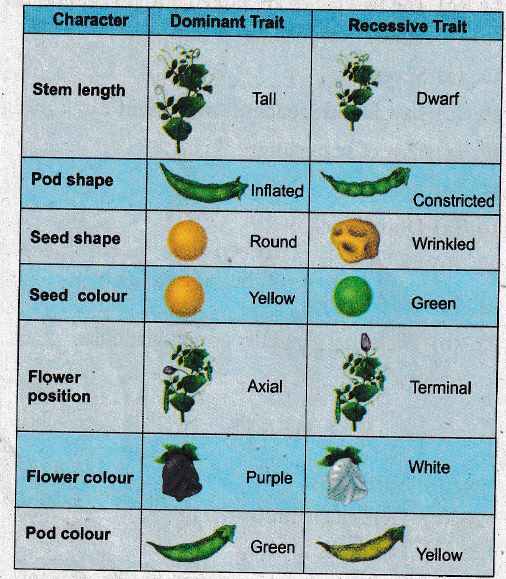
Seven characters of pisum satiyum studied by Mendel.
15.
A single cell from a rare and endangered plant can be grown into a an entire plant. So it is considered as the best method.
16.
Hofmeister described the structure of pollen tetrad
17.
Reproduction is a biological process in which an organism give rise to offsprings. This helps to maintain continuity of its species.
18.
1. It is Andrographis paniculata belongs to Acanthaceae family.
2. It is a potent hepatoprotective to treat liver disorders.
3. Used to make Nilavembu Kudineer to treat malaria and dengue.
19.
20.
21.
(i) ECORI is from Escherichia ( E ) coli (co), strain RY 13 (R) & first endonuclease (I) to be discovered.
(ii) It contains 2 different antibiotics resistance genes & recognition site for several restriction enzymes.
(iii) This sequence is referred to as a restriction site & is generally -palindromic which means that the sequence in both DNA strands at this site read same in 5' - 3' direction & in-the 3'-5' direction.
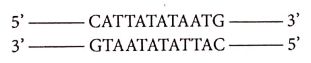
(iv) The exact kind of cleavage produced by a restriction enzyme is important in the design of a gene cloning experiment.
(v) Some cleave both strands of DNA through the centre resulting in blunt or flush end.
(vi) These are known as symmetric cuts.
(vii) Some enzymes cut in a way producing protruding & recessed ends known as sticky or cohesive end.
(viii) These are known as staggered or asymmetric cuts.
22.
| Mound Layering | Air Layering |
|---|---|
| A lower flexible branch of the plant is selected. | A healthy, stiff branch of the plant is selected. |
| The branch is bent to the ground. | The stem is girdled at the nodal region hormones applied. |
| A part of the branch is buried in the soil leaving the tips exposed and allowed for rooting | The girdled portion is covered with Damp or moist soil and allowed for rooting. |
23.
Modern biotechnology
(i) There are two main features of this technology, that differentiated it from the conventional technology are its
i) ability to change the genetic material for getting new products with specific requirements through recombinant DNA technology
ii) ownership of the newly developed technology and its social impact.
(ii) Modern biotechnology embraces all methods of genetic modification by recombinant DNA and cell fusion technology.
The major focus of biotechnology are
(i) Fermentation for production of acids, enzymes, alcohols, antibiotics, fine chemicals, vitamins and toxins
(ii) Biomass for bulk production of single cell protein , alcohol, and biofuel
(iii) Enzymes as biosensors, in processing industry
(iv) Biofuels for production of hydrogen, alcohol, methane
(v) Microbial inoculants as biofertilizer, and nitrogen fixers
(vi) Plant and animal cell culture for production of secondary metabolites, monoclonal antibodies
(vii) Recombinant DNA technology for production of fine chemicals, enzymes, vaccines, growth hormones, antibiotics, and interferon.
(viii) Process engineering - tools of biotechnology is used for effluent treatment , water recycling.
24.
1824 - G.B. Amici discovered the pollentube.
1848 - Hofmeister described the structure of pollen tetrad.
1870 - Hanstein described the development of embryo in Capsella and Alisma.
1878 - E. Strasburger reported poly embryony.
1884 - E. Strasburger discovered the process of syngamy.
1898 & 1899 - S.G. Nawaschin and L. Guignard independently, discovered double fertilizations.
25.
Artificial propagation of higher plants used by man for a very long time are called conventional methods
1) Cutting
The cut parts from (root, stem, leaf) parent plant are grown in suitable medium. They grow into new plants
Example:
(i) Root Cutting - Malus.
(ii) Stem Cutting - Hibiscus.
(iii) Leaf cutting - Begonia.
2) Grafting
Parts of two different plants are joined so that they continue to grow as one plant of the two plants the plant which is in contact with the soil is called stock the plant used for grafting is called scion.
Example:
(i) Citrus, Mango.
(ii) There are different types of grafting based on the method of uniting the scion and stock.
Layering
The stem of the parent plant is allowed to develop roots while still intact. After the roots formation rooted part is cut and planted to grow as a new plant.
Example:
Ixora, Jasminum
It is of two types - Mound / Air layering.

12th Standard Syllabus & Materials
12th Standard
TN 12th Computer Applications களப்பெயர் முறைமை (DNS) Sample Question Papers Study Material - QB365 Set A
NEW12th Standard
TN 12th Computer Applications வலையமைப்பு எடுத்துக்காட்டுகள் மற்றும் நெறிமுறைகள் Sample Question Papers Study Material - QB365 Set A
NEW12th Standard
TN 12th Computer Applications கணினி வலையமைப்பு ஓர் அறிமுகம் Sample Question Papers Study Material - QB365 Set A
NEW12th Standard
TN 12th Computer Applications PHP-உடன் MySQL-ஐ இணைத்தல் Sample Question Papers Study Material - QB365 Set A



Tamilnadu Stateboard 12th Standard Subjects

Maths

Chemistry

Physics
Biology

Computer Science

Business Maths and Statistics

Economics

Commerce

Accountancy

History

Computer Applications
Biology
Computer Technology
Computer Applications
Computer Science
Business Maths and Statistics
Commerce
Economics
Maths
Chemistry
Physics
Computer Technology
History
Accountancy

Tamil

English

French
Tamilnadu Stateboard Standards



