
 100% FREE ACCESS
12th Standard Syllabus & Materials
12th Standard
TN 12th Computer Applications மின்னணு தரவு பரிமாற்றம் Sample Question Papers Study Material - QB365 Set A
NEW12th Standard
TN 12th Computer Applications மின் - வணிக பாதுகாப்பு அமைப்புகள் Sample Question Papers Study Material - QB365 Set A
NEW12th Standard
TN 12th Computer Applications மின்னணு செலுத்தல் முறைகள் Sample Question Papers Study Material - QB365 Set A
NEW12th Standard
TN 12th Computer Applications மின் - வணிகம் Sample Question Papers Study Material - QB365 Set A
NEW12th Standard
TN 12th Computer Applications திறந்த மூல கருத்துருக்கள் Sample Question Papers Study Material - QB365 Set A
NEW12th Standard
TN 12th Computer Applications வலையமைப்பு வடமிடல் Sample Question Papers Study Material - QB365 Set A

Published on: 13/05/2022
QB365 provides detailed and simple solution for every book back questions in class 12 Biology subject.It will helps to get more idea about question pattern in every book back questions with solution.
latest Book back QuestionsDownload Tamil Nadu 12th Standard Biology question papers, model tests, one-mark questions, important questions, and public exam papers in PDF format. Free study materials and answer keys for TN State Board students.
Questions + Answers key
Take MCQ Biology Test1.
2.
What is seed ball?
3.
How is rhytidome act as the structural defence by plants against fire?
4.
5.
Give the examples for micro propagation performed plants .
6.
What are multiple alleles?
7.
Define the term Diplospory
8.
What is Cantharophily.
9.
What are millets? What are its types? Give example for each type.
10.
How do sacred groves help in the conservation of biodiversity?
11.
Generally human activities are against to the ecosystem, where as a student how will you help to protect ecosystem?
12.
Name of the food chain which is generally present in all type of ecosystem. Explain and write their significance.
13.
Water is very essential for life. Write any three features for plants which enable them to survive in water scarce environment.
14.
Mention any two significant roles of predation plays in nature.
15.
What is mutualism? Mention any two example where the organisms involved are commercially exploited in modern agriculture.
16.
17.
What is meant by cytoplasmic inheritance
18.
“Endothecium is associated with dehiscence of anther” Justify the statement
19.
Why does the zygote divides only after the division of Primary endosperm cell.
20.
21.
Based on the material used, how will you classify the culture technology? Explain it.
22.
Is there any possibilities to transfer a suitable desirable gene to host plant without vector? Justify your answer.
23.
Mention the application of Biotechnology.
24.
Write the steps involved in molecular mechanism of DNA recombination with diagram.
25.
Explain the law of dominance in monohybrid cross.
1.
2.
It is a technique of encasing seeds in a mixture of clay & soil humus & scattering them on to suitable ground, not planting of trees manually.
3.
1. The outer bark of trees which extends to the last formed periderm is called rhytidome.
2. It is composed of multiple layers of suberized periderm, cortical & phloem tissues.
3. It protects the stem against fire, water loss, invasion of insects & prevents infection by microorganisms.
4.
5.
Pineapple, banana, strawberry and potato.
6.
A group of genes that together determine a characteristic of an organism.
7.
A diploid embryosac is formed from megaspore mother cell without a regular meiotic division
Example:
Eupatorium, Aerva
8.
Pollination carried out by beetle is called cantharophily.
9.
| S.No | Common name | Botanical name |
| 1 | Foxtail Millet | Staria italica |
| 2 | Kodo Millet | Paspalum scrobiculatum |
10.
(i) They help for detailed floristic and faunistic studies
(ii) These groves provide a number of ecosystem services to the neighborhood like protecting watershed, fodder, medicinal plants and microclimate control
11.
(I) Buying and use only ecofriendly products and recycle them.
(II) Growing more trees.
(III) Choosing sustained farm products (vegetables, fruits and greens, etc.)
(IV) Reduce the use of natural resources.
(V) Recycle the waste and reduce the amount of waste you produce.
(VI) Reduce consumption of water and electricity.
(VII) Reduce or eliminate the use of house-hold chemicals and pesticides.
(VIII) Maintain your cars and vehicles properly. (In order to reduce carbon emission).
(IX) Create awareness and educate about ecosystem protection among your friends and family members and ask them to find out solution to minimise this problem.
12.
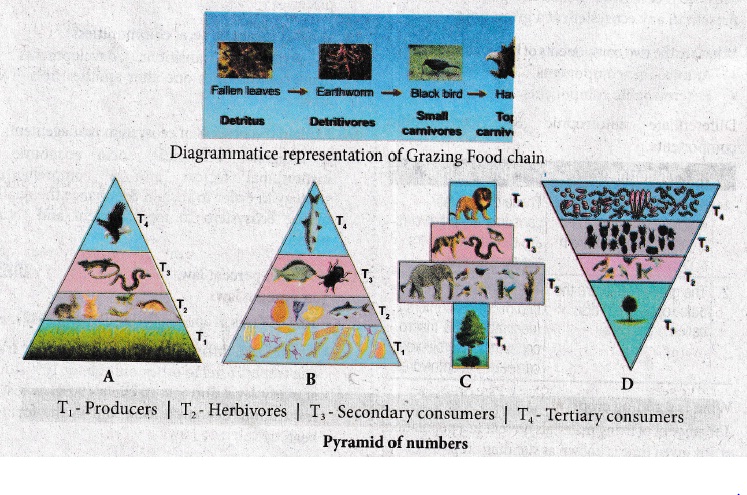
Detritus food chain
(i) This type of food chain begins with dead organic matter which is an important source of energy.
(ii) A large amount of organic matter is derived from the dead plants, animals and their excreta.
(iii) This type of food chain is present in all ecosystems
(iv) The transfer of energy from the dead organic matter is transferred through a series of organisms called detritus consumers. (detrivores)-Small carnivores -large (top) carnivores with repeated eating and being eaten respectively.
13.
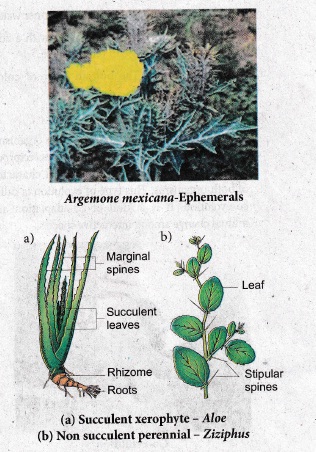
(a) Life cycle is completed within a short period (Ephemerals)
(b) In succulents the stem possess a water storage region
(c) Root hairs & root caps are also well developed
14.
1. Many herbivores are predators. Cattles, camels, goats etc., frequently browse on the tender shoots of herbs, shrubs and trees. Generally annuals suffer more than the perennials. Grazing and browsing may cause remarkable changes in vegetation. Nearly 25 percent of all insects are known as phytophagous (feeds on plant sap and other Parts of Plant).
2. Many defense mechanisms are evolved to avoid their predations by plants. Examples: Calotropis produces highly poisonous cardiac glycosides, tobacco produces nicotine, coffee plants produce caffeine, Cinchona plant produces quinine. Thorns of Bougainvillea, spines of Opuntia, and latex of cacti also protect them from Predators.
15.
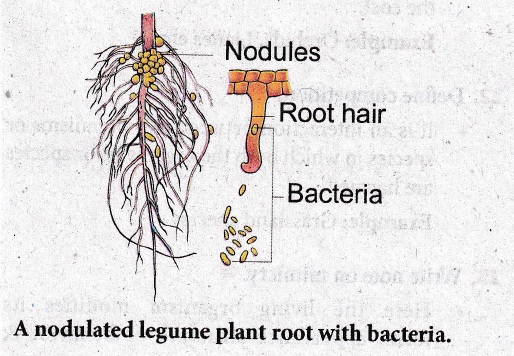
(a) Mutualism: It is an interaction between two species of organisms in which both are benefitted from the obligate association. The following are common examples of mutualism.
(b) Nitrogen fixation : Rhizobium (Bacterium) forms nodules in the roots of leguminous plants and lives symbiotically. The Rhizobium obtains food from leguminous plant and in turn fixes atmospheric nitrogen into nitrate, making it available to host plants.
Other examples:
Water fern (Azolla) and Nitrogen fixing Cyanobacterium (Anabaena) .
16.
17.
It is based on independent, self-replicating extra chromosomal unit called plasmogene located in the cytoplasmic organelles, chloroplast & Mitochondrion.
18.
Endothecium is a single layer of radially elongated cells, The inner tangential wall of this cell develops bands of a cellulose, The cells are hygroscopic. The stomium of anther lobe lack these thickenings. Stomium along with the hygroscopic nature of endothecium helps in the dehiscence of anther
19.
The primary endosperm nucleus divides immediately after fertilization. It develops into an endosperm which is a nutritive tissue and a regulatory structure. The zygote divides only after that to form an embryo so that it can get nourishment from the endosperm that has formed earlier.
20.
21.
Types of Plant tissue cultures
Based on the explants some other plant tissue culture types are
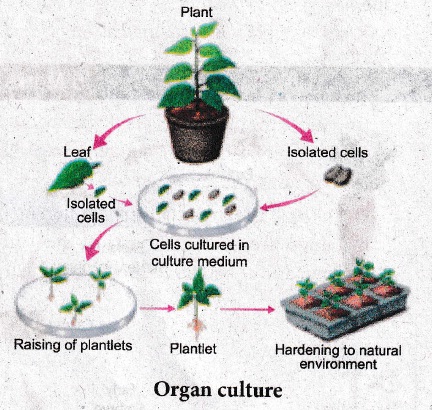
(a) Organ culture
(b) Meristem culture
(c) Protoplast culture
(d) Cell culture
(a) Organ culture
The culture of embryos, anthers, ovaries roots, shoots or other organs of plants on culture media.
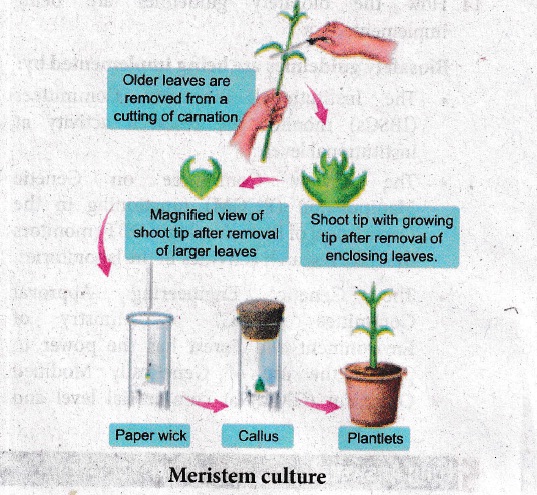
(b) Meristem Culture:
The culture of any plant meristematic tissue on culture media.
(c) Protoplast Culture:
1. Protoplasts are cells without a cell wall, but bounded by a cell membrane or plasma membrane.
2. Using protoplasts, it is possible to regenerate whole plants from single cells and also develop somatic hybrids.
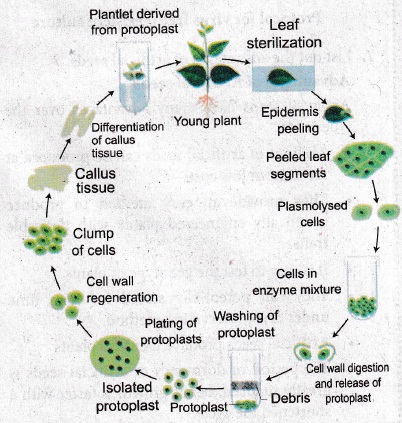
The steps involved in protoplast culture
(i) Isolation of protoplast:
1. Small bits of plant tissue like leaf tissue are used for isolation of protoplast.
2. The leaf tissue is immersed in 0.5% Macrozyme and 2% Onozuka cellulase enzymes dissolved in 13% sorbitol or mannitol at pH 5.4.
3. It is then incubated over-night at 25oC.
4. After a gentle teasing of cells, protoplasts are obtained, and these are then transferred to 20% sucrose solution to retain their viability.
They are then centrifuged to get pure protoplasts as different from debris of cell walls.
(ii) Fusion of Protoplast
1. It is done through the use of a suitable fusogen. This is normally PEG (Polyethylene Glycol).
2. The isolated protoplast are incubated in 25 to 30% concentration of PEG with Ca++ ions and the Protoplast shows agglutination (the formation of clumps of cells) and fusion.
(iii) Culture of Protoplast:
MS liquid medium is used with some modification in droplet, plating or micro drop array techniques. Protoplast viability is tested with fluorescein diacetate before the culture. The cultures are incubated in continuous light 1000-2000 lux at 25oC. The cell wall formation occurs within 24-48 hours and the first division of new cells occurs between 2-7 days of culture.
(iv) Selection of somatic hybrid cells:
The fusion product of protoplasts without nucleus of different cells is called a cybrid. Following this nuclear fusion happen. This process is called somatic hybridization.
(d) Cell Suspension Culture
The growing of cells including the culture of single cells or small aggregates of cells in vitro in liquid medium is known as cell suspension culture. The cell suspension is prepared by transferring a portion of callus to the liquid medium and agitated using rotary shaker instrument. The cells are separated from the callus tissue and used for cell suspension culture.
22.
Direct or Vector less Gene Transfer
In the direct gene transfer methods, the foreign gene of interest is delivered into the host plant without the help of a vector, The following are some of the common methods of direct gene transfer in plants.
(i) Chemical mediated gene transfer: Certain chemicals like polyethylene glycol (PEG) and dextran sulphate induce DNA uptake into plant protoplasts.
(ii) Microinjection: The DNA is directly injected into the nucleus using fine tipped glass needle or micro pipette to transform plant cells. The protoplasts are immobilized on a solid support (agarose on a microscopic slide) or held with a holding pipette under section.
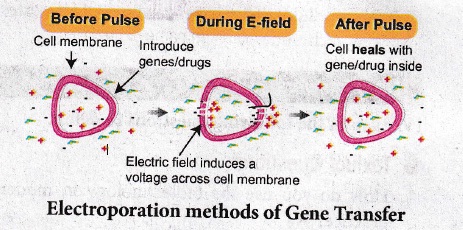
(iii) Electroporation Methods of Gene Transfer: A pulse of high voltage is applied to protoplasts, cells or tissues which makes transient pores in the plasma membrane through which uptake of foreign DNA occurs.
(iv) Liposome mediated method of Gene transfer: Liposomes the artificial phospholipid vesicles are useful in gene transfer. The gene or DNA is transferred from liposome into vacuole of plant cells. It is carried out by encapsulating DNA into the vacuole. This technique is advantageous because the liposome protects the introduced DNA from being damaged by the acidic pH and protease enzymes present in the vacuole. Liposome and tonoplast of vacuole fusion resulted in gene transfer. This process is called lipofection.
.jpg)
(v) Biolistics: The foreign DNA is coated onto the surface of minute gold or tungsten particles (1-3 \(\mu\)m) and bombarded onto the target tissue or cells using a particle gun (also called as gene gun/ micro projectile gun/shotgun) Then the bombarded cells or tissues are cultured on selected medium to regenerate plants from the transformed cells.
23.
Applications of Biotechnology
1. Biotechnology is one of the most important applied interdisciplinary sciences of the 21st century. It is the trusted area that enables us to find the beneficial way of life.
2. Biotechnology has wide applications in various sectors like agriculture, medicine, environment and commercial industries.
3. This science has an invaluable outcome like transgenic varieties of plants e.g. transgenic cotton (Bt-cotton), rice, tomato, tobacco, cauliflower, potato and banana.
4. The development of transgenics as pesticide resistant, stress resistant and disease resistant varieties of agricultural crops is the immense outcome of biotechnology.
5. The synthesis of human insulin and blood protein in E.coli and utilized for insulin deficiency disorder in human is a breakthrough in biotech industries in medicine.
6. The synthesis of vaccines, enzymes, antibiotics, dairy products and beverages are the products of biotech industries.
7. Biochip based biological computer is one of the successes of biotechnology.
8. Genetic engineering involves genetic manipulation, tissue culture involves aseptic cultivation of totipotent plant cell into plant clones under controlled atmospheric conditions.
9. Single cell protein from Spirulina is utilized in food industries.
10. Production of secondary metabolites, biofertilizers, biopesticides and enzymes.
11. Biomass energy, biofuel, bioremediation and phytoremediation for environmental biotechnology.
24.
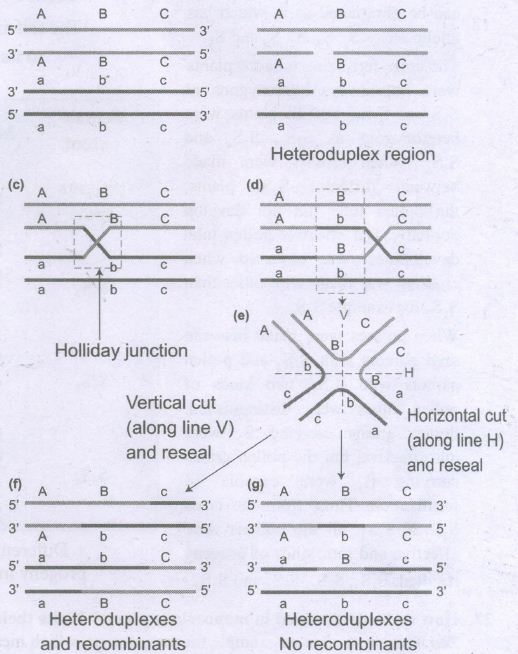
The widely accepted model of DNA recombination during crossing over is Holliday's hybrid DNA model.
Steps involved are:
1. Homologous DNA molecules are paired side by side with their duplicated copies of DNAs
2. One strand of both DNAs cut in one place by the enzyme endonuclease.
3. The cut strands cross and join the homologous strands forming the Holliday structure or Holliday junction.
4. The Holliday junction migrates away from the original site, a process called branch migration, as a result heteroduplex region is formed.
5. DNA strands may cut along through the vertical (V) line or horizontal (H) line.
6. The vertical cut will result in heteroduplexes with recombinants.
7. The horizontal cut will result in heteroduplex with non recombinants.
25.
Law of Dominance: The characters were controlled by discrete units called factors which occur in pairs. In a dissimilar pair of factors one member of the pair is dominant & the other is recessive.
(i) This law gives an explanation to the monohybrid cross.
(a) the expression of only one of the parental characters in F1 generation.
(b) the expression of both in the F2 generation
(ii) It also explains the proportion of 3:1 obtained at the F2
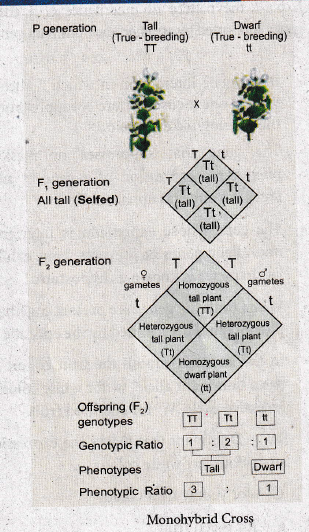
Monohybrid Cross
(i) Monohybrid inheritance is the inheritance of a single character i. e, plant height.
(ii) It involves the inheritance of two alleles of a single gene.
(iii) When the F1 generation was selfed Mendel noticed that 7847 of 1064 F2 plants were tall, while 277of 1064 were dwarf.
(iv) When tall pea plants were pollinated with the pollens from a true breeding dwarf plants, the result was all tall plants.
(v) Dwarf trait appears in the F2 generation.
(vi) When the parental types were reversed, the result was the same - All tall plants.
(vii) Tall (♀) \(\times\) Dwarf (♂) and Tall (♂) \(\times\) Dwarf (♀) mating's are done in both ways.
(viii) It was concluded that the trait is not sex dependent.
(xi) The gene for plant height has two alleles: Tall (T) \(\times\) Dwarf (t). (TT, Tt, Tt: tt)

12th Standard Syllabus & Materials
12th Standard
TN 12th Computer Applications களப்பெயர் முறைமை (DNS) Sample Question Papers Study Material - QB365 Set A
NEW12th Standard
TN 12th Computer Applications வலையமைப்பு எடுத்துக்காட்டுகள் மற்றும் நெறிமுறைகள் Sample Question Papers Study Material - QB365 Set A
NEW12th Standard
TN 12th Computer Applications கணினி வலையமைப்பு ஓர் அறிமுகம் Sample Question Papers Study Material - QB365 Set A
NEW12th Standard
TN 12th Computer Applications PHP-உடன் MySQL-ஐ இணைத்தல் Sample Question Papers Study Material - QB365 Set A



Tamilnadu Stateboard 12th Standard Subjects

Maths

Chemistry

Physics
Biology

Computer Science

Business Maths and Statistics

Economics

Commerce

Accountancy

History

Computer Applications
Biology
Computer Technology
Computer Applications
Computer Science
Business Maths and Statistics
Commerce
Economics
Maths
Chemistry
Physics
Computer Technology
History
Accountancy

Tamil

English

French
Tamilnadu Stateboard Standards



