
 100% FREE ACCESS
12th Standard Syllabus & Materials
12th Standard
TN 12th Maths Applications of Matrices and Determinants Sample Question Papers Study Material - QB365 Set A
NEW12th Standard
TN 12th Computer Applications மின்னணு தரவு பரிமாற்றம் Sample Question Papers Study Material - QB365 Set A
NEW12th Standard
TN 12th Computer Applications மின் - வணிக பாதுகாப்பு அமைப்புகள் Sample Question Papers Study Material - QB365 Set A
NEW12th Standard
TN 12th Computer Applications மின்னணு செலுத்தல் முறைகள் Sample Question Papers Study Material - QB365 Set A
NEW12th Standard
TN 12th Computer Applications மின் - வணிகம் Sample Question Papers Study Material - QB365 Set A
NEW12th Standard
TN 12th Computer Applications திறந்த மூல கருத்துருக்கள் Sample Question Papers Study Material - QB365 Set A

Published on: 13/05/2022
QB365 provides detailed and simple solution for every book back questions in class 12 Biology subject.It will helps to get more idea about question pattern in every book back questions with solution.
latest Book back QuestionsDownload Tamil Nadu 12th Standard Biology question papers, model tests, one-mark questions, important questions, and public exam papers in PDF format. Free study materials and answer keys for TN State Board students.
Questions + Answers key
Take MCQ Biology Test1.
Explain the best suited type followed by plant breeders at present?
2.
How do forests help in maintaining the climate?
3.
4.
What is myrmecophily?
5.
Why do submerged plants receive weak illumination than exposed floating plants in a lake?
6.
How does an orchid ophrys ensures its pollination by bees ?
7.
Lichen is considered as a good example of obligate mutualism. Explain.
8.

From the above figure identify the type of mutation and explain it.
9.
10.
“The endosperm of angiosperm is different from gymnosperm”. Do you agree. Justify your answer.
11.
List any two strategy adopted by bisexual flowers to prevent self-pollination.
12.
Which one gas is most abundant out of the four commonest greenhouse gases? Discuss the effect of this gas on the growth of plants?
13.
Shape of pyramid in a particular ecosystem is always different in shape. Explain with example.
14.
What is thermal stratification? Mention their types.
15.
List any two adaptive features evolved in parasites enabling them to live successfully on their host?
16.
How will you identify a vector ?
17.
What are restriction enzyme. Mention their type with role in Biotechnology.
18.
What do you know about the word pBR332?
19.
Differentiate incomplete dominance and codominance.
20.
List out the functions of tapetum.
21.
What is polyembryony. How it can commercially exploited.
22.
What is TSM? How does it classified and what does it focuses on?
23.
Explain the basic concepts involved in plant tissue culture
24.
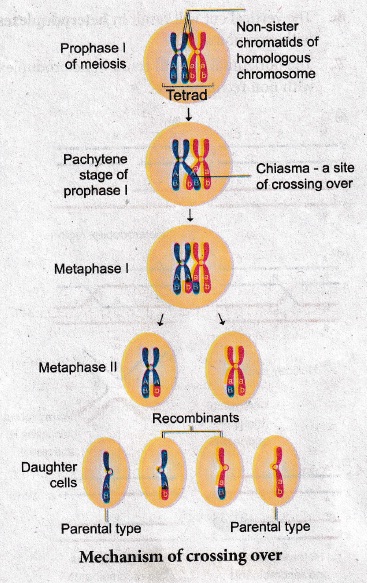
Explain the mechanism of crossing over.
25.
What are the reasons for Mendel’s successes in his breeding experiment?
1.
(i) Vegetative propagation is the best suited measure for maintaining hybrid vigour, since the desired characters are not lost and can persist over a Period of time.
(ii) Many breeders believe that its magnitude of heterosis is directly related to the degree of genetic diversity between the two parents.
2.
(a) Trees provide micro climate for crops and maintain O2 - CO2 balance atmospheric temperature & relative humidity
(b) Suitable for dry land where rainfall is minimum hence it is a good system for alternate land use pattern
3.
4.
1. Sometimes, ants take their shelter on some trees such as mango, litchi, jamun, acacia etc.
2. These ants act as body guards of the plants against any disturbing agent and the plants in turn provide food and shelter to these ants.
3. This phenomenon is known as Myrmecophily.
Example: Acacia and, Acacia ants.
5.
Submerged plants are unable to obtain full illumination because a lot of sunlight is absorbed by overlying layers of water this is not the case for exposed floating plants that receive sunlight directly.
6.
The plant, Ophrys orchid, the flower looks like a female insect to attract the make insect to get pollinated by the male insect.
7.
1. Lichen is a mutual association of an alga & a fungus.
2. It is an interaction between two species of organisms in which both are benefitted from the obligate association.
8.
(i) A type of structural chromosomal abbrevation.
Reverse tandem duplication
(ii) The duplicated segment is located immediately after the normal segment but the gene sequence order will be reversed.
9.
10.
The endosperm in gymnosperms is haploid because it is formed from the haploid megaspore. In angiosperm the endosperm is triploid, a product or triple fusion.
11.
Dichogamy stamens and stigmas mature at different times (protandry, Protogyny) Herkogamy - Stamens and stigmas are arranged in such a way, self pollination become impossible.
12.
Most abundant gas - CO2
Effect of CO2 on the growth of plants
(i) Change in flowering seasons and pollinators
(ii) Change in Species distributional ranges
(iii) Species extinction
(iv) Low agricultural productivity in tropics
(v) Frequent heat waves (Weeds, pests, fungi need warmer temperature)
(vi) Increase of vectors and epidemics
(vii) Strong storms and intense flood damage
(viii) Water crisis and decreased irrigation
13.
Pyramid of number
(i) In a forest ecosystem the pyramid of number is different in shape, it is because the base (T 1) of the pyramid occupies large sized trees (producer) which are lesser in number.
(ii) Herbivores (T2) occupying second trophic level, are more in number than the producers (T1).
(iii) In final trophic level (T4) tertiary consumers (lion) are lesser in number than the secondary consumers (T3).
(iv) Therefore, the pyramid of numbers in forest ecosystem looks spindle-shaped.
Pyramid of biomass
(i) In forest ecosystem, there is a gradual decrease in biomass of organisms at successive trophic levels from producers to top carnivores (Tertiary consumer). Therefore, the pyramid of biomass looks upright.
14.
Thermal Stratification
It is usually found in aquatic habitat. The change in the temperature profile with increasing depth in a water body is called thermal stratification. There are three kinds of thermal stratifications.
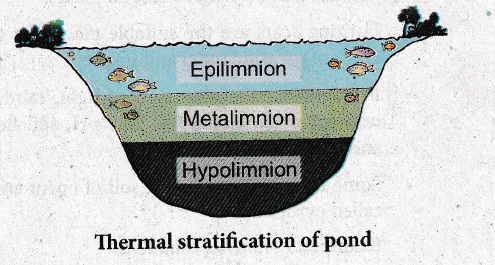
1. Epilimnion - The upper layer of warmer water.
2. Metalimnion - The middle layer with a zone of gradual decrease in temperature.
3. Hypolimnion - The bottom layer of colder water.
15.
1. Cuscuta is a total stem parasite of the host plant Acacia, Duranta and many other plants Cuscuta even gets flower inducing hormone from its host Plant.
2. Balanophora, orobanche and Refflesia are the total root parasites found on higher plants.
16.
Properties of Vectors:
1. Vectors are able to replicate autonomously to produce multiple copies of them along with their DNA insert in the host cell.
2. It should be small in size and of low molecular weight, less than 10 Kb (kilo base pair) in size so that entry/transfer into host cell is easy.
3. Vector must contain an origin of replication so that it can independently replicate within the host.
4. It should contain a suitable marker such as antibiotic resistance, to permit its detection in transformed host cell.
5. Vector should have unique target sites for integration with DNA insert and should have the ability to integrate with DNA insert it carries into the genome of the host cell. Most of the commonly used cloning vectors have more than one restriction site. These are Multiple Cloning Site (MCS) or polylinker. Presence of MCS facilitates the use of restriction enzyme of choice.
17.
A restriction enzyme or restriction endonuclease is an enzyme that cleaves DNA into fragments at or near specific recognition sites within the molecule known as restriction sites.
Types
(i) Exonucleases - which remove nucleotides one at a time from the end of a DNA molecule. e.g. Bal 31, Exonuclease III.
(ii) Endonucleases - which break the internal phosphodiester bonds within a DNA molecule. e.g. Hind II, EcoRI, PvulI, BamHI, TaqI.
(iii) The restriction enzymes are called as molecular scissors
(iv) They are used in recombinant DNA technology as they recognize & cut DNA within a specific sequence.
18.
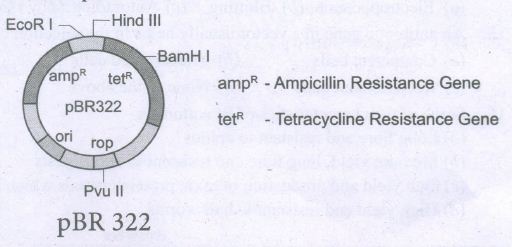
(i) pBR 322 plasmid is a reconstructed plasmid and most widely used as cloning vector;
(ii) It contains 4361 base pairs. In pBR, p denotes plasmid, Band R respectively the names of scientist Boliver and Rodriguez who developed this plasmid.
(iii) The number 322 is the number of plasmid developed from their laboratory.
(iv) It contains ampR and tetR two different antibiotic resistance genes and recognition sites for several restriction enzymes.
(v) ori and antibiotic resistance genes. Rop codes for the proteins involved in the replication of the plasmid.
19.
| Incomplete Dominance | Co-dominance |
| When one allele is not completely dominant to another allele. | lt occurs due to simultaneous expression of both alleles in the heterozygote. |
| E.g: Flowers colour of Mirabilis Jalapa | E.g: ABO blood group system in human beings. |
20.
Supplies nutrition to the developing microspores contributes sporopollenin through, ubisch bodies. This plays an important role in pollen wall formation. The pollen kit material is contributed by tapetal cells, and is later, transferred to the pollen surface. Exine protein responsible for rejection reaction are derived from tapetal cells.
21.
Occurrence of more than one embryo in a seed is called polyembryony.
The seedlings formed from the nucellar tissue in citrus are found better clones for orchards. Embryos derived through polyembryony are found virus free.
22.
TSM indicates Traditional Systems of Medicines. It has been classified into institutionalized and non institutionalized methods.
| S.No | Institutionalized | Non - Institutionalized |
| 1 | Two thousand years practice | No such records |
| 2 | Prescribed texts are available | Only oral form by rural and tribal peoples |
| 3 | Focuses on symptoms, disease diagnosis, drugs to cure, preparation of drugs, dosage | Focuses on healthy diet for maintaining good health and disease reversal. |
23.
Basic concepts of Tissue Culture
Basic concepts of plant tissue culture are totipotency, differentiation, dedifferentiation and redifferentiation.
Totipotency
The property of live plant cells that they have the genetic potential when cultured in nutrient medium to give rise to a complete individual plant.
Differentiation
The process of biochemical and structural changes by which cells become specialized in form and function.
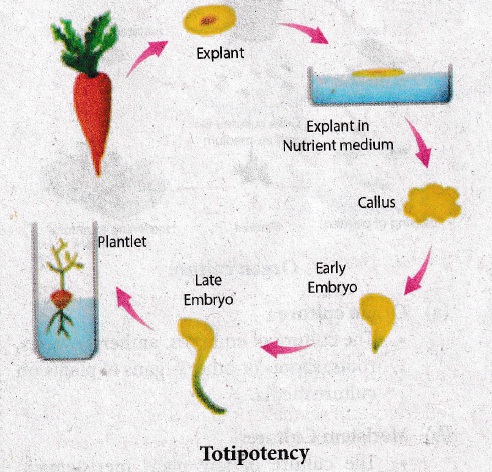
Redifferentiation
The further differentiation of already differentiated cell into another type of cell. For example, when the component cells of callus have the ability to form a whole plant in a nutrient medium, the phenomenon is called redifferentiation.
Dedifferentiation
The phenomenon of the reversion of mature cells to the meristematic state leading to the formation of callus is called dedifferentiation. These two phenomena of redifferentiation and dedifferentiation are the inherent capacities of living plant cells or tissue. This is described as totipotency.
24.
Crossing over is a process that includes four stages.
1. Synapsis
(i) Pairing between two homologous chromosomes is initiated during sub stage zygotene stage of prophase I of meiosis I
(ii) Homologous chromosomes are aligned side by side resulting in the formation of bivalents. It also occurs in zygotene sub-stage of prophase I of meiosis I tetrads.This pairing phenomenon is called synapsis.
2.Tetrad Formation
(i) Each homologous chromosome of a bivalent begin to form two identical sister chromatids.
(ii) They remain held together by a centromere at this stage each bivalent has four chromatids. This stage is called tetrad stage.
3. Cross Over
After tetrad formation, crossing over occurs in pachytene stage.
The non-sister chromatids of homologous pair make a contact at one or more points. These points of contact are called Chiasmata.
At chiasma, X-shaped structures are formed, where breaking and rejoining of two chromatids occur. This results in reciprocal exchange of equal and corresponding segments between them synapsis and chiasma formation are facilitated by protein filaments called synaptonemal complex.
4. Terminalisation
After crossing over, chiasma starts to move towards the terminal end of chromatids known as terminalisation. As a result, complete separation of homologous chromosomes occurs.
25.
i) He applied mathematics and statistical methods to biology and laws of probability to his breeding experiments.
ii) He followed scientific methods and kept accurate and detailed records that include quantitative data of the outcome of his crosses.
iii) His experiments were carefully planned and he used large samples.
iv) The pairs of contrasting characters which were controlled by factor (genes) were present on separate chromosomes.
v) The parents selected by Mendel were pure breed lines and the purity was tested by self crossing the progeny for many generations.

12th Standard Syllabus & Materials
12th Standard
TN 12th Computer Applications வலையமைப்பு வடமிடல் Sample Question Papers Study Material - QB365 Set A
NEW12th Standard
TN 12th Computer Applications களப்பெயர் முறைமை (DNS) Sample Question Papers Study Material - QB365 Set A
NEW12th Standard
TN 12th Computer Applications வலையமைப்பு எடுத்துக்காட்டுகள் மற்றும் நெறிமுறைகள் Sample Question Papers Study Material - QB365 Set A
NEW12th Standard
TN 12th Computer Applications கணினி வலையமைப்பு ஓர் அறிமுகம் Sample Question Papers Study Material - QB365 Set A



Tamilnadu Stateboard 12th Standard Subjects

Maths

Chemistry

Physics
Biology

Computer Science

Business Maths and Statistics

Economics

Commerce

Accountancy

History

Computer Applications
Biology
Computer Technology
Computer Applications
Computer Science
Business Maths and Statistics
Commerce
Economics
Maths
Chemistry
Physics
Computer Technology
History
Accountancy

Tamil

English

French
Tamilnadu Stateboard Standards



