
 100% FREE ACCESS
12th Standard Syllabus & Materials
12th Standard
TN 12th Maths Applications of Matrices and Determinants Sample Question Papers Study Material - QB365 Set A
NEW12th Standard
TN 12th Computer Applications மின்னணு தரவு பரிமாற்றம் Sample Question Papers Study Material - QB365 Set A
NEW12th Standard
TN 12th Computer Applications மின் - வணிக பாதுகாப்பு அமைப்புகள் Sample Question Papers Study Material - QB365 Set A
NEW12th Standard
TN 12th Computer Applications மின்னணு செலுத்தல் முறைகள் Sample Question Papers Study Material - QB365 Set A
NEW12th Standard
TN 12th Computer Applications மின் - வணிகம் Sample Question Papers Study Material - QB365 Set A
NEW12th Standard
TN 12th Computer Applications திறந்த மூல கருத்துருக்கள் Sample Question Papers Study Material - QB365 Set A

Published on: 13/05/2022
QB365 provides detailed and simple solution for every book back questions in class 12 Biology subject.It will helps to get more idea about question pattern in every book back questions with solution.
latest Book back QuestionsDownload Tamil Nadu 12th Standard Biology question papers, model tests, one-mark questions, important questions, and public exam papers in PDF format. Free study materials and answer keys for TN State Board students.
Questions + Answers key
Take MCQ Biology Test1.
Give an account of active principle and medicinal values of any two plants you have studied.
2.
What do you know about Germplasm conservation. Describe it.
3.
4.
5.
Distinguish tenuinucellate and crassinucellate ovules.
6.
List out the new breeding techniques involved in developing new traits in plant breeding.
7.
What are the effects of deforestation and benefits of agroforestry?
8.
9.
Draw a pyramid from following details and explain in brief.
Quantities of organisms are given-Hawks - 50, plants - 1000.rabbit and mouse - 250 + 250, pythons and lizard - 100 + 50 respectively.
10.
Describe dispersal of fruit and seeds by animals.
11.
12.
Explain different types of hydrophytes with examples.
13.
14.
15.
16.
17.
18.
19.
20.
Differentiate the structure of Dicot and Monocot seed.
21.
Give a concise account on steps involved in fertilization of an angiosperm plant.
22.
Discuss the steps involved in Microsporogenesis.
23.
Write short note on Heterostyly.
24.
Explain Raunkiaer classification in the world’s vegetation based on the temperature.
25.
How is anemochory differ from zoochory?
1.
1. It is a mixture of glucosides derived from Aloe vera.
2. Gel used as skin tonic. Gives cooling effect.
3. Creams, lotions, shampoos, shaving creams, after shave lotions. Rejuvenation of aging skin. Emollient, antibacterial, antioxidant, antifungal and antiseptic.
4. Capsaicin is an active component has pain relieving properties derived from Capsicum annum.
5. Good source of Vitamin C, A and E.
2.
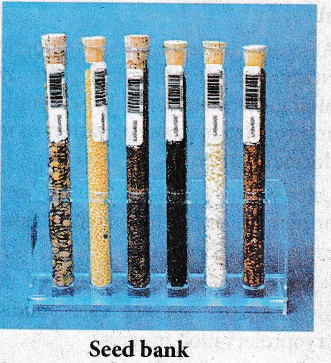
Germplasm Conservation
1. Germplasm conservation refers to the conservation of living genetic resources like pollen, seeds or tissue of plant material maintained for the purpose of selective plant breeding, preservation in live condition and used for many research works.
2. Germplasm conservation resources is a part of collection of seeds and pollen that are stored in seed or pollen banks, so as to maintain their viability and fertility for any later use such as hybridization and crop improvement.
3. Germplasm conservation may also involve a gene bank, DNA bank of elite breeding lines of plant resources for the maintenance of biological diversity and also for food security.
3.
4.
5.
ovule is divided into two types based on the position of the sporogenous cell
| Tenuinucellate type | Crassinucellate type |
|---|---|
| Sporogenous cell is hypodermal with a single layer of nucellar tissue around it. | Sporogenous cell is sub hypodermal |
| Have very small nucellus | Have fairly large nucellus. |
6.
(i) Hybridization, Mutation breeding, Polyploid breeding, Breeding for developing resistance to diseases, Biofortification, Breeding for resistance to insect pests, New Breeding Techniques (NBT) such as.
(ii) CRISPR/ Cas (Cutting and modifying the genome during the repair process by tool).
(iii) ODM: Oligonucleotide - directed mutagenesis
(iv) Transferring a gene from an identical or closely related species (Cisgenesis).
(v) Organising processes that alter gene activity without altering the DNA itself (Epigenetic methods).
7.
Effects of deforestation:
(i) Burning of forest wood release stored carbon, a negative impact just opposite of carbon sequestration,
(ii) Trees and plants bind the soil particles. The removal of forest cover increases soil erosion and decreases soil fertility. Deforestation in dry areas leads to the formation of deserts.
(iii) The amount of runoff water increases soil erosion and also creates flash flooding, thus reducing moisture and humidity.
(iv) The alteration of local precipitation patterns leading to drought conditions in many regions. It triggers adverse climatic conditions and alters water cycle in the ecosystem.
(v) It decreases the bio-diversity significantly as their habitats are disturbed and disruption of natural cycles.
(vi) Loss of livelihood for forest dwellers and rural people.
(vii) Increased global warming and account for one-third of total CO2 emission.
(viii) Loss of life support resources, fuel, medicinal herbs, and wild edible fruits.
Benefits of agroforestry:
(i) It is an answer to the problem of soil and water conservation and also to stabilize the soil (salinity and water table) reduce landslide and water run-off problem.
(ii) Nutrient cycling between species improves and organic matter is maintained.
(iii) Trees provide a micro climate for crops and maintain O2 - CO2 balanced, atmospheric temperature and relative humidity.
(iv) Suitable for dry land where rainfall is minimum and hence it is a good system for alternate land use pattern.
(v) Multipurpose tree varieties like Acacia are used for wood pulp, tanning, paper, and firewood industries.
(vi) Agroforestry is recommended for the following purposes. It can be used as Farm Forestry for the extension of forests, mixed forestry, shelterbelts, and linear strip plantation.
8.
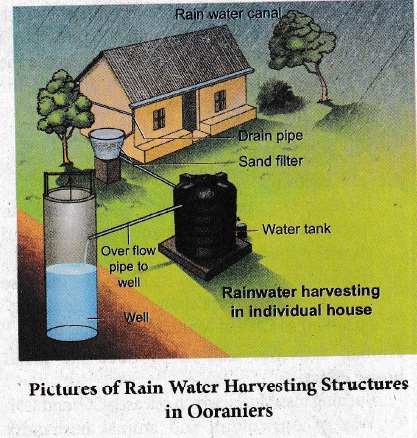
.jpg)
9.
Grassland ecosystem : There is a gradual decrease in the number of organisms in each trophic level from producers to primary consumers and then to secondary consumers, and finally to tertiary consumers. Therefore pyramids of number in grassland ecosystem are always upright.
10.
Dispersal by Animals (Zoochory)
Birds and mammals, including human beings play an efficient and important role in the dispersal of fruit and seeds. They have the following devices.
i. Hooked fruit: The surface of the fruit or seeds have hooks (Xanthium), barbs (Andropogon), spines (Aristida) by means of which they adhere to the body of animals or clothes of human beings and get dispersed.
ii. Sticky fruits and seeds:
a. Some fruits have sticky glandular hairs by which they adhere to the fur of grazing animals. Example: Boerhaavia and Cleome.
b. Some fruits have viscid layer which adhere to the beak of the bird which eat them and when they rub them on to the branch of the tree, they disperse and germinate. Example: Cordia and Alangium.
iii. Fleshy fruits: Some fleshy fruits with conspicuous colours are dispersed by human beings to distant places after consumption.
Example: Mango and Diplocyclos
11.
12.
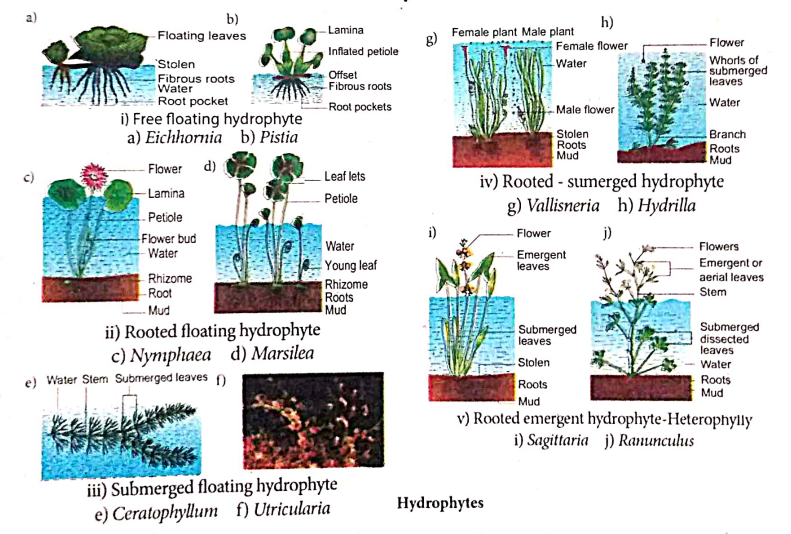
i. Free floating hydrophytes: These plants float freely on the surface of water. They remain in contact with water and air, but not with soil. Examples: Eichhornia, Pistia and Wolffia (smallest flowering plant).
ii. Rooted floating hydrophytes: In these plants, the roots are fixed in mud, but their leaves and flowers are floating on the surface of water. These plants are in contact with soil, water and air. Examples: Nelumbo, Nymphaea, Potomogeton and Marsilea. Lotus seeds showing highest longevity in plant kingdom.
iii. Submerged floating hydrophytes: These plants are completely submerged in water and not in contact with soil and air. Examples: Ceratophyllum and Utricularia.
iv. Rooted-submerged hydrophytes: These plants are completely submerged in water and rooted in soil and not in contact with air. Examples: Hydrilla, Vallisneria and Isoetes.
v. Amphibious hydrophytes (Rooted emergent hydrophytes): These plants are adapted to both aquatic and terrestrial modes of life. They grow in shallow water. Examples: Ranunculus, Typha and Sagittaria.
13.
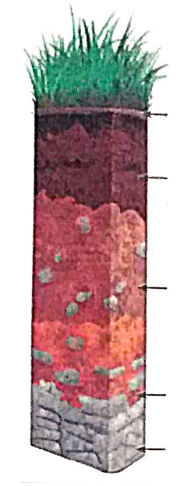 Horizon Description O-Horizon (Organic horizon) Humus It consists of fresh or partially decomposed organic matter.
14.
15.
16.
17.
18.
19.
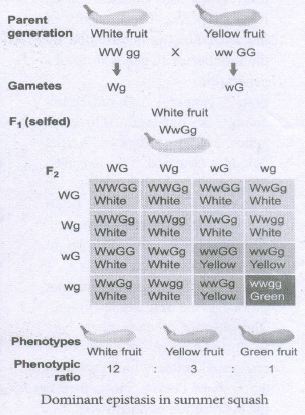
20.
| Dicot Seed | Monocot Seed |
|---|---|
| Seed coat differentiated into outer hard testa, inner thin membranous tegmen. | Seed coat brownish membranous unilayer closely adhered to the grain |
| Two cotyledons, laterally attached to the embryonic axis | Embryo consists of one shield shaped cotyledon, the scutellum |
| The reserve food materials stored either in cotyledon or in endosperm | The reserve food materials stored in the endosperm. |
| Embryonic axis is differentiated into radicle and plumule but not protected by any sheath | Embryonic axis is differentiated into radicle and plumule Radicle is protected by Coleorhiza Plumule is protected by Coleoptile |
| Example - Cicer arientinum | Example - Oryza sativa |
21.
The fusion of male and female gamete is called fertilization. Fertilization in angiosperms is double fertilization type.
Pollen germinates on the stigma. Pollen tube produced grows through the style towards the micropyle of the ovule pollen tubes enter into one of the synergids of the embryo sac.
Discharge of male gametes occur syngamy - one gamete and an egg cell fuses to form diploid zygote Triple fusion - The other male gamete fuses with the two haploid female polar nuclei. A triploid primary endosperm nucleus results.
22.
(i) The primary sporogeneous cells undergoes mitotic divisions to form sporogeneous tissue.
(ii) Each cell of the sporogenous tissue is a potential microspore mother cell.
(iii) The microspore mother cell divides meiotically to form four haploid microspores. Microspore soon separates from one another.
(iv) They remain free in the anther locule. Then they develop into pollen grains.
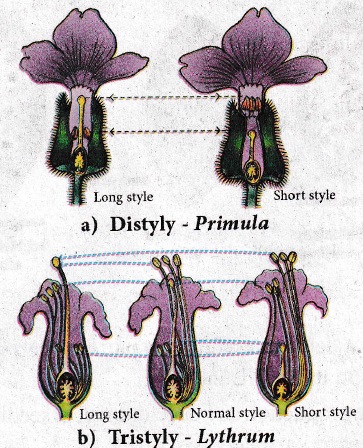
23.
(i) Some plants produce two or three different forms of flowers the length of stamen and style differ in them pollination will take place only between organs of same length.
(ii) So cross pollination is only possible. Distyly (eg) Primula-produces two forms of flowers.
| Pin or long style | Thrum eyed or short style |
| Long stamen | Short stamen |
| Long stigmatic papillae | Small stigmatic papillae |
| Small pollen grains | Large pollen grains |
(iii) Stigma of thrum eyed anther of the pin lie in same level, Anther of the thrum eyed stigma of the pin lie in same level.
(iv) So effective cross pollination occurs, Tristyly - (eg) Lythrum
(v) The plant produces three kinds of flowers having difference in length of stamen and style.
(vi) Pollen from flowers of one type pollinate only the other two types can but not their, own type.
24.
Based on the temperature prevailing in an area, Raunkiaer classified the world's vegetation into the following four types.
(i) Megatherms
(ii) Mesotherms
(iii) Microtherms
(iv) Hekistotherms
25.
| S. No | Anemochory | Zoochory |
| a | Dispersal of seeds or fruits by wind. | Dispersal of seeds or fruits by animals |
| b | Seeds are minute or may have wings. | Seeds or fruit surface may have hooks or sicky glandular hairs are seen. |

12th Standard Syllabus & Materials
12th Standard
TN 12th Computer Applications வலையமைப்பு வடமிடல் Sample Question Papers Study Material - QB365 Set A
NEW12th Standard
TN 12th Computer Applications களப்பெயர் முறைமை (DNS) Sample Question Papers Study Material - QB365 Set A
NEW12th Standard
TN 12th Computer Applications வலையமைப்பு எடுத்துக்காட்டுகள் மற்றும் நெறிமுறைகள் Sample Question Papers Study Material - QB365 Set A
NEW12th Standard
TN 12th Computer Applications கணினி வலையமைப்பு ஓர் அறிமுகம் Sample Question Papers Study Material - QB365 Set A



Tamilnadu Stateboard 12th Standard Subjects

Maths

Chemistry

Physics
Biology

Computer Science

Business Maths and Statistics

Economics

Commerce

Accountancy

History

Computer Applications
Biology
Computer Technology
Computer Applications
Computer Science
Business Maths and Statistics
Commerce
Economics
Maths
Chemistry
Physics
Computer Technology
History
Accountancy

Tamil

English

French
Tamilnadu Stateboard Standards



