
 100% FREE ACCESS
12th Standard Syllabus & Materials
12th Standard
TN 12th Computer Applications மின்னணு தரவு பரிமாற்றம் Sample Question Papers Study Material - QB365 Set A
NEW12th Standard
TN 12th Computer Applications மின் - வணிக பாதுகாப்பு அமைப்புகள் Sample Question Papers Study Material - QB365 Set A
NEW12th Standard
TN 12th Computer Applications மின்னணு செலுத்தல் முறைகள் Sample Question Papers Study Material - QB365 Set A
NEW12th Standard
TN 12th Computer Applications மின் - வணிகம் Sample Question Papers Study Material - QB365 Set A
NEW12th Standard
TN 12th Computer Applications திறந்த மூல கருத்துருக்கள் Sample Question Papers Study Material - QB365 Set A
NEW12th Standard
TN 12th Computer Applications வலையமைப்பு வடமிடல் Sample Question Papers Study Material - QB365 Set A

Published on: 13/05/2022
QB365 provides detailed and simple solution for every book back questions in class 12 Biology subject.It will helps to get more idea about question pattern in every book back questions with solution.
latest Book back QuestionsDownload Tamil Nadu 12th Standard Biology question papers, model tests, one-mark questions, important questions, and public exam papers in PDF format. Free study materials and answer keys for TN State Board students.
Questions + Answers key
Take MCQ Biology Test1.
2.
List out the effects of fire to plants.
3.
What is co evolution?
4.
5.
Write short note on Pollen kitt.
6.
Give an account on the role of Jasminum in perfuming
7.
‘Pollination in Gymnosperms is different from Angiosperms’ – Give reasons.
8.
9.
What are psychoactive drugs? Add a note Marijuana and Opium
10.
11.
12.
Various stages of succession are given bellow. From that rearrange them accordingly. Find out the type of succession and explain in detail.
Reed-swamp stage, phytoplankton stage, shrub stage, submerged plant stage, forest stage, submerged free floating stage, marsh meadow stage.
13.
Generally in summer the forest are affected by natural fire. Over a period of time it recovers itself by the process of successions .Find out the types of succession and explain.
14.
Enumerate the anatomical adaptations of xerophytes.
15.
16.
17.
Write the advantages of herbicide tolerant crops
18.
What is gene mapping? Write its uses
19.
How is Nicotiana exhibit self-incompatibility. Explain its mechanism.
20.
Explain with an example how single genes affect multiple traits and alleles the phenotype of an organism.
21.
Explain polygenic inheritance with an example.
22.
Give a detailed account on parthenocarpy. Add a note on its significance.
23.
What is endosperm. Explain the types.
24.
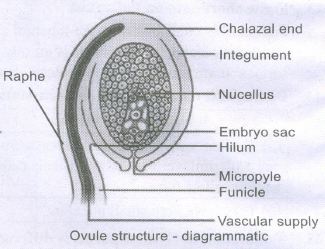
With a suitable diagram explain the structure of an ovule.
25.
1.
2.
(i) Ground fire: Which is flameless and subterranean.
(ii) Surface fire: Which consumes the herbs and shrubs.
(iii) Crown fire: Which burns the forest canopy.
Effects of fire
1. Fire has a direct lethal effect on plants.
2. Burning scars are the suitable places for the entry of parasitic fungi and insects.
3. It brings out the alteration of light, rainfall, nutrient cycle, fertility of soil, pH, soil flora and fauna.
4. Some fungi which grow in soil of burnt areas called pyrophilous.
Example: Pyronema confluens
3.
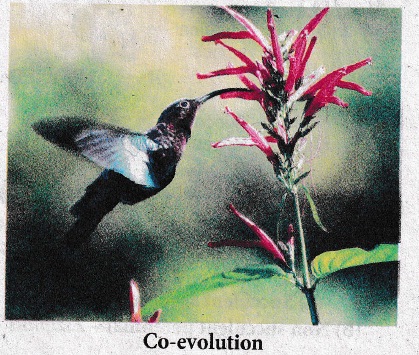
Co-evolution: The interaction between organisms, when continues for generations, involves reciprocal changes in genetic and morphological characters of both organisms. This type of evolution is called co-evolution. It is a kind of co-adaptation and mutual change among interactive species.
4.
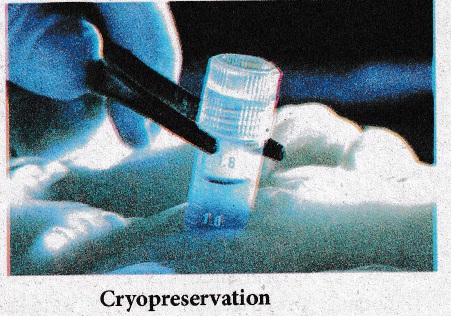
5.
| Source | Contributed by the tapetum |
| Colour | Yellow or orange |
| Content | Carotenoids or flavonoids |
| Nature | Oily layer forming a thick viscous coating over pollen surface |
| Use | Attracts insects protects damage from UV radiation. |
6.
1. Used for worship, ceremonial purposes, incense and fumigants, making perfumed hair oils, cosmetics and soaps.
2. Used for soothing, relaxing antidepressant qualities.
7.
Gymnosperms - Pollination is said to be direct as the pollen are deposited directly on the exposed ovules Angiosperms - Pollination is said to be indirect as the pollen are deposited on the stigma of the pistil.
8.
9.
| psychoactive drugs | ||||
| 1 | Opium Poppy | Papaver somniferun (Family: Papaveraceae) |
Native: South East Europe, Western Asia. Cultivated in MP, Rajasthan, UP (With license) | Morphine strong analgesic during surgery - sleep, relieving Pain. |
| 2 | Cannabis/ Marijuana | Cannabis sativa (Family: Cannabiaceae) | Native: Marijuana to China Cultivated in Gujarat, HP, Uttarkand, UR, MP [with license) |
1. Trans - tetrahydrocannabinol (THC) - cures hypertension, Glucoma, nausea of cancer patients of radio and chemotherapy. 2. Cures bronchial disorder, asthma. |
10.
11.
12.
Type of succession
Hydrosere
(i) The succession in a freshwater ecosystem is also referred to as hydrosere
(ii) Succession in a pond, begins with colonization of the pioneer's like phytoplankton and finally ends with the formation of climax community like forest stage. It includes the following stages
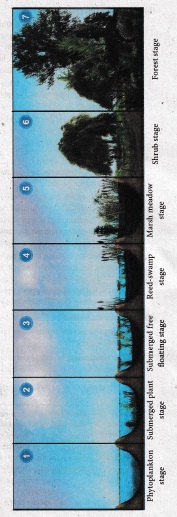
(a) Phytoplankton stage
It is the first stage of succession consisting of the pioneer Community like blue green algae, green algae, diatoms, bacteria, etc.,
The colonization of these organisms enrich the amount of organic matter and nutrients of pond due to their life activities and death.
This favors the development of the next several stages
(b) Submerged plant stage
As the result of death and decomposition of planktons, silt brought from land by rain water, lead to a loose mud formation at the bottom of the pond. Hence, the rooted submerged hydrophytes begin to appear on the new substratum.
Example: Chara, Utricularia, Vallisneria and Hydrilla etc.
The death and decay of these plants will build up the substratum of pond to become shallow. Therefore, this habitat now replaces another group of plants which are of floating type.
(c) Submerged free floating stage
During this stage, the depth of the pond will become almost 2-5 feet
Hence, the rooted hydrophytic plants and with floating large leaves start colonising the pond.
Example: Rooted floating plants like Nelumbo, Nymphaea and Trapa. Some free floating species like Azolla, Lemna, Wolffia and Pistia are also present in this stage.
By death and decomposition of these plants, further the pond becomes more shallow.
Due to this reason, floating plant species is gradually replaced by another species which makes new several stage.
(d) Reed-swamp stage
It is also called an amphibious stage.
During this stage, rooted floating plants are replaced by plants which can live successfully in aquatic as well as aerial environment.
Example: Typha, Phragmites, Sagittaria and Scirpus etc. At the end of this stage, water level is very much reduced, making it unsuitable for the continuous growth of amphibious Plants.
(e) Marsh meadow stage
When the pond becomes swallowed due to decreasing water level
Species of Cyperaceae and Poaceae such as Carex, Iuncus, Cyperus and Eleocharis colonise the area
They form a mat-like vegetation with the help of their much branched root system.
This leads to an absorption and loss of large quantity of water
At the end of this stage, the soil becomes dry and the marshy vegetation disappears gradually and leads to shurb stage
(d) Shrub stage
As the disappearance of marshy vegetation continues, soil becomes dry.
Hence, these areas are now invaded by terrestrial plants like shrubs (Salix and Cornus) and trees (Populus and Alnus).
These plants absorb large quantity of water and make the habitat dry.
Further, the accumulation of humus with a rich flora of microorganisms produce minerals in the soil, ultimately favouring the arrival of new tree species in the area
(e) Forest stage
It is the climax community of hydrosere.
A variety of trees invade the area and develop any one of the diverse type of vegetation.
Example: Temperate mixed forest (Ulmus, Acer and Quercus), Tropical rain forest (Artocarpus and Cinnamomum) and Tropical deciduous forest (Bamboo and Tectona).
In the 7 stages of hydrosere succession, stage 1 is occupied by pioneer community, while the stage 7 is occupied by the climax community. The stages 2 to 6 are occupied by several communities,
13.
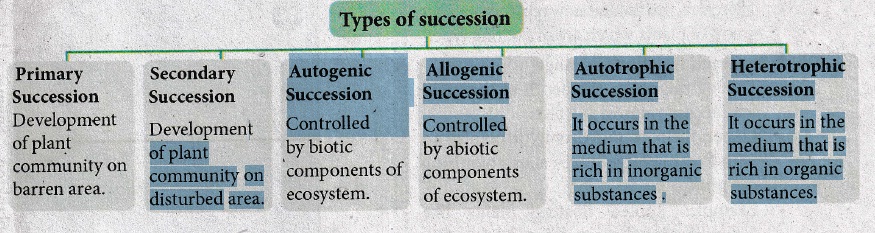
Types of succession
(a) Primary succession
The development of plant community in a barren area where no community existed before is called primary succession.
The plants which colonize first in a barren area is called pioneer species or primary community or primary colonies.
Generally, Primary succession takes a very, long time for the occurrence in any region.
Examples: Microbes, Lichen, Mosses.
The forest destroyed by fire and excessive lumbering may be re-occupied by herbs over period of times.
(b) Secondary succession
The development of a plant community in an area where an already developed community has been destroyed by some natural disturbance (Fire, flood, human activity) is known as secondary succession
Generally, this succession takes less time than the time taken for primary succession.
Example: The forest destroyed by fire and excessive lumbering may be re-occupied by herbs over Period of times.
(c) Autogenic succession
Autogenic succession occurs as a result of biotic factors
The vegetation reacts with its environment and modifies its own environment causing its own replacement by new communities. This is known as autogenic succession.
Example: In forest ecosystem, the larger trees produce broader leaves providing shade to the forest floor area. It affects the shrubs and herbs which require more light (heliophytes) but supports the shade tolerant species (sciophytes) to grow well.
(d) Allogenic succession
Allogeneic succession occurs as a result of abiotic factors.
The replacement of existing community is caused by other external factors (soil erosion, leaching, etc.,) and not by existing organisms.
Example: In a forest ecosystem soil erosion and leaching alter the nutrient value of the soil leading to the change of vegetation in that area.
(e) Autotrophic succession
If the autotrophic organisms like green plants are dominant during the early stages of succession it is called autotrophic succession, this occurs in the habitat which is rich in inorganic substances.
Since, green plants dominate in the beginning of this succession, there is a gradual increase in organic matter and subsequently the energy flow in the ecosystem.
(f) Heterotrophic succession
If heterotrophic organisms like bacteria, fungi, actinomycetes, and animals are dominant during the early stages of succession it is called heterotrophic succession.
Such a succession takes place in organic habitats.
Since heterotrophs dominate in the beginning of such succession, there will be a gradual decrease in the energy content.
14.
The plants which are living in dry or xeric condition are known as Xerophytes.
Xerophytic habitat can be of two different types They are:
(a) physical dryness: In these habitats, soil has a little amount of water due to the inability of the soil to hold water because of low rainfall.
(b) physiological dryness: In these habitats, water is sufficiently present but plants are unable to absorb it because of the absence of capillary spaces. Example: Plants in salty and acidic soil.
Based on adaptive characters xerophytes are classified into three categories. They are Ephemerals, Succulents and Non - succulent plants.
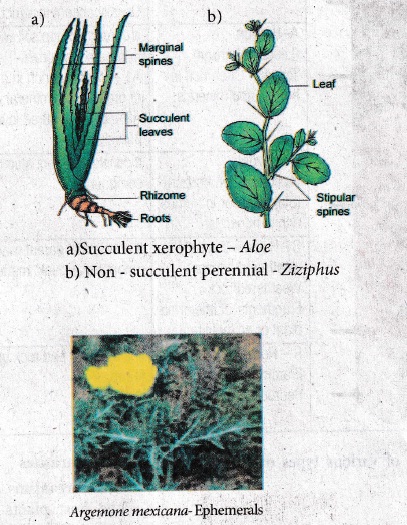
(i) Ephemerals: These are also called drought escapers or drought evaders. These plants complete their life cycle within a short period (single season). These are not true xerophytes. Examples: Argemone, Mollugo, Tribulus and Tephrosia.
(ii) Succulents: These are also called drought enduring plants. These plants store water in their plant parts during the dry period. These plants develop certain adaptive characters to resist extreme ,drought conditions. Examples: Opuntia, Aloe, Bryophyllum and Begonia.
(iii) Non succulents: These are also called drought resistant plants ( true xerophytes). They face both external and internal dryness. They have many adaptations to resist dry conditions. Examples: Casuarina, Nerium, Zizyphus and Acacia.
15.
16.
17.
Advantages of Herbicide Tolerant Crops:
1. Weed control improves higher crop yields;
2. Reduces spray of herbicide;
3. Reduces competition between crop plant and weed;
4. Use of low toxicity compounds which do not remain active in the soil; and
5. The ability to conserve soil structure and microbes.
18.
The diagrammatic representation of position of genes and related distances between the adjacent genes is called gene mapping.
Uses
(i) Used to determine gene order.
(i) Identify the locus of a gene.
(i) Calculate the distance between genes.
(i) Useful in predicting results of dihybrid and trihybrid crosses.
(i) Allows the geneticists to understand the overall genetic complexity of particular organism.
19.
(i) Multiple alleles are reported in Nicotiana which are responsible for self, incompatibility.
(ii) The gene for self-compatibility can be designated as S, which has allelic series S1, S2, S3, S4 and S5.
(iii) The cross-fertilizing tobacco plants were not homozygous as S1S1 or S2S2.
(iv) But, were heterozygous as S1S2, S3S4, S5S6.
(v) When crosses were made between different S1S2 plants, pollen tube did not develop normally.
(vi) But effective pollen tube developed when crossing was made with other than S1S2.
(vii) When crosses were made between S1S2 (seed parents) S2S3 (pollen parents), two kinds of pollen tubes were distinguished.
(viii) Pollen grains carrying S2 were not effective.
(ix) Pollen grains carrying S3 were capable of fertilization.
(x) In a cross between S1S2 X S3S4, all the pollens were effective.
(xi) So four kinds of progeny resulted. S1S3/S1S4/S2S3/S2S4.
20.
(i) The Pleiotropic gene-influences a number of characters simultaneously & such genes are called pleiotropic gene.
(ii) Mendel noticed pleiotropy while performing breeding experiment with peas (Pisum sativum).
(iii) Peas with purple flowers were cross with white flowers.
(iv) Brown seeds were crossed with light coloured seeds.
(v) Dark spot on the axils of the leaves were crossed with no spot on the axils of the leaves.
(vi) The above characters all were inherited together as a single unit.
(vii) This is due to the pattern on inheritance where the 3 traits were controlled by a single gene with dominant & recessive alleles.
(viii) E.g. Sickle cell anemia.
21.
(i) Polygenic inheritance - Several genes combine to affect a single trait.
(ii) A group of genes that together determine (contribute) a characteristic of an organism is called polygenic inheritance. It gives explanations to the inheritance of continuous traits which are compatible with Mendel's Law.
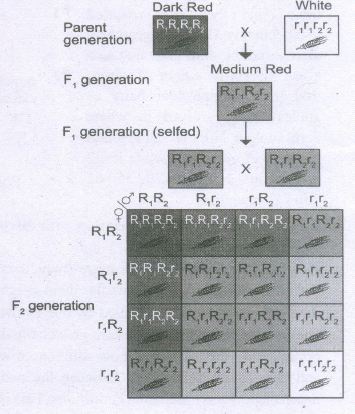
(iii) The first experiment was demonstrated by H. Nilsson - Ehle (1909) in wheat kernels.
(iv) He crossed the two pure breeding wheat varieties dark red & white.
(v) Dark red genotypes R1R1R2R2 and
(vi) white genotypes are r1r1r2r2
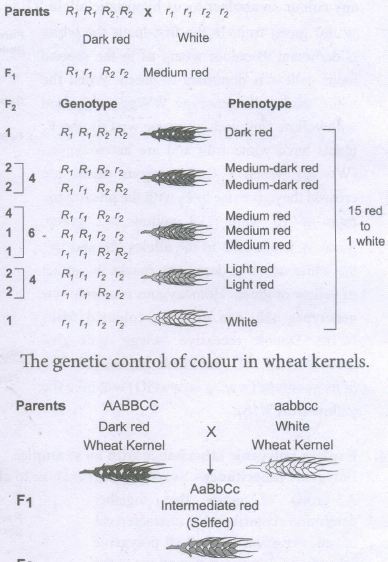
(vii) In the F1 generation medium red were obtained R1r1R2r2.
(viii) F1 wheat plant produces four types of gametes R1R2, R1r2, r1R2, r1r2.
(xi) The intensity of the red colour is determined by the number of R genes in the F2 generations.
(x) Four R genes - Dark red kernel.
(xi) Three R genes - Medium dark red kernel
(xii) Two R genes - Medium red kernel
(xiii) One R gene - Light red kernel.
(xiv) Absence of R gene - White kernel.
F2
| 1 | 6 | 15 | 20 | 15 | 6 | 1 |
| Dark red | Moderate red | Red | Intermediate red | light red | very light red | white |
(xv) In F2 generation plants have kernels with wide range of colour variation.
(xvi) This is due to that the genes are segregating and recombination takes place.
(xvii) The cumulative effect of several pairs of gene i interaction gives rise to many shades of kernel colour.
22.
(i) The production and development of seedless fruit is called parthenocarpy.
(ii) Fruit like structures may develop from the ovary without the act of fertilization. Such fruits are called parthenocarpic fruits
Examples: Seedless-Banana, Grapes, Papaya
(i) Parthenocarpy is of three types
1) Genetic Parthenocarpy
(i) Arises due to hybridization or mutation.
2) Environmental Parthenocarpy
Environmental conditions like frost, fog, low or high temperature induce Parthenocarpy.
Example - low temperature for 3-19 hours induces parthenocarpy in Pear.
3) Chemically induced Parthenocarpy
(i) By the application of growth promoting hormones like auxins and gibberellins.
Significance:
(i) Seedless fruits - Significance in Horticulture have commercial value useful for the preparation of jarns, jellies, sauces, fruit drinks,
(ii) High proportion of edible part is available
23.
(i) The primary endosperm nucleus divides immediately after fertilization and develops into an endosperm.
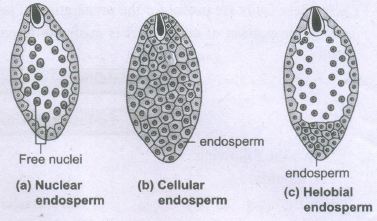
(ii) It is a nutritive tissue, and regulatory structure by undergoing repeated mitosis to form triploid (3n) endosperm that nourishes the developing embryo. Depending upon the mode of development three types of endosperm are recognized.
1) Nuclear endosperm:
(i) Primary endosperm, (PEN) nucleus undergoes several mitotic divisions. There is no cell wall formation So free nuclear condition exists in the endosperm.
Example:
Coccinia, Capsella, Arachis
2) Cellular endosperm:
(i) Primary endosperm nucleus divides into two nuclei There is cell wall formation.
(ii) Subsequent division also follows cell wall formation. It is said to be cellular endosperm
Example:
Adoxa, Helianthus, Scoparia.
3) Helobial endosperm:
(i) Primary Endosperm Nucleus moves towards the base of embryo sac.
(ii) Divides into two nuclei cell wall formation occurs forming a large micropylar chamber and a small chalazal chamber.
(iii) The nucleus of micropylar chamber further undergoes several free nuclear divisions. The nucleus of the chalazal chamber may or may not divide.
Example:
Hydrilla, Vallisneria.
24.
(i) A mature ovule (megasporangium) consist of a stalk and a body
(ii) Funicle - The stalk of the ovule by which it attaches the ovule to the placenta.
(iii) Integuments - one or two protective covering around the nucellus
(iv) Micropyle - Pore present at the tip of the ovule where the integument is absent
(v) Chalaza - The basal region of the body of the ovule where the nucellus, the integument and funicle meet or merge
(vi) Embryosac- The female gametophyte oval sac like structure in the nucellus, toward the micropylar end.
25.

12th Standard Syllabus & Materials
12th Standard
TN 12th Computer Applications களப்பெயர் முறைமை (DNS) Sample Question Papers Study Material - QB365 Set A
NEW12th Standard
TN 12th Computer Applications வலையமைப்பு எடுத்துக்காட்டுகள் மற்றும் நெறிமுறைகள் Sample Question Papers Study Material - QB365 Set A
NEW12th Standard
TN 12th Computer Applications கணினி வலையமைப்பு ஓர் அறிமுகம் Sample Question Papers Study Material - QB365 Set A
NEW12th Standard
TN 12th Computer Applications PHP-உடன் MySQL-ஐ இணைத்தல் Sample Question Papers Study Material - QB365 Set A



Tamilnadu Stateboard 12th Standard Subjects

Maths

Chemistry

Physics
Biology

Computer Science

Business Maths and Statistics

Economics

Commerce

Accountancy

History

Computer Applications
Biology
Computer Technology
Computer Applications
Computer Science
Business Maths and Statistics
Commerce
Economics
Maths
Chemistry
Physics
Computer Technology
History
Accountancy

Tamil

English

French
Tamilnadu Stateboard Standards



