
 100% FREE ACCESS
12th Standard Syllabus & Materials
12th Standard
TN 12th Maths Applications of Matrices and Determinants Sample Question Papers Study Material - QB365 Set A
NEW12th Standard
TN 12th Computer Applications மின்னணு தரவு பரிமாற்றம் Sample Question Papers Study Material - QB365 Set A
NEW12th Standard
TN 12th Computer Applications மின் - வணிக பாதுகாப்பு அமைப்புகள் Sample Question Papers Study Material - QB365 Set A
NEW12th Standard
TN 12th Computer Applications மின்னணு செலுத்தல் முறைகள் Sample Question Papers Study Material - QB365 Set A
NEW12th Standard
TN 12th Computer Applications மின் - வணிகம் Sample Question Papers Study Material - QB365 Set A
NEW12th Standard
TN 12th Computer Applications திறந்த மூல கருத்துருக்கள் Sample Question Papers Study Material - QB365 Set A

Published on: 21/06/2021
QB365 provides detailed and simple solution for every Creative Questions in class 12 Biology Subject. It will helps to get more idea about question pattern in every Creative questions with solution.
Download Tamil Nadu 12th Standard Biology question papers, model tests, one-mark questions, important questions, and public exam papers in PDF format. Free study materials and answer keys for TN State Board students.
Questions + Answers key
Take MCQ Biology Test1.
List out the significance of ploidy.
2.
Why crossing over is important?
3.
What is translocation? Write about its types.
4.
Explain hyperploidy with its types.
5.
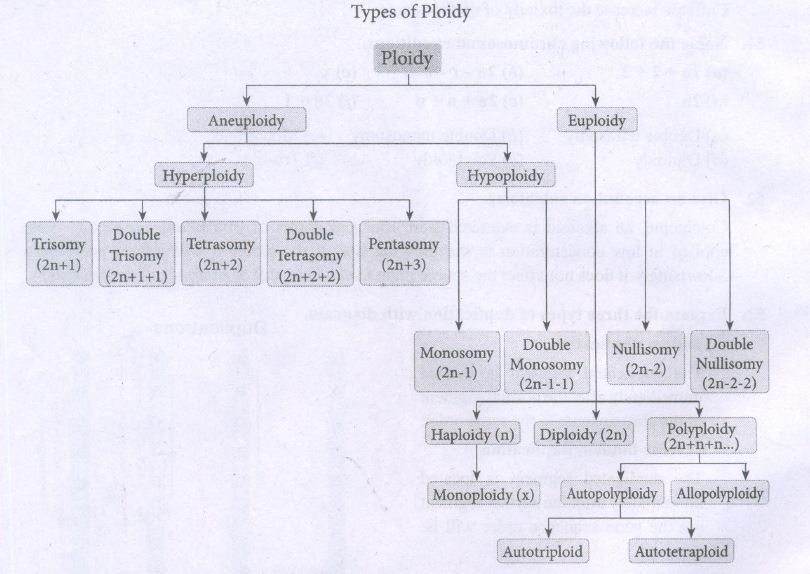
Draw a flow chart depicting the various types of ploidy.
1.
Many polyploids are more vigorous and more adaptable than diploids.
(i) Many ornamental plants are autotetraploids and have larger flower and longer flowering duration than diploids.
(ii) Autopolyploids usually have increase in fresh weight due to more water content.
(iii) Aneuploids are useful to determine the phenotypic effects of loss or gain of different chromosomes.
(iv) Many angiosperms are allopolyploids and they play a role in an evolution of plants.
2.
1. Exchange of segments leads to new gene combinations which plays an important role in evolution.
2. Studies of crossing over reveal that genes are arranged linearly on the chromosomes.
3. Genetic maps are made based on the frequency of crossing over.
4. Crossing over helps to understand the nature and mechanism of gene action.
5. If a useful new combination is formed it can be used in plant breeding.
3.
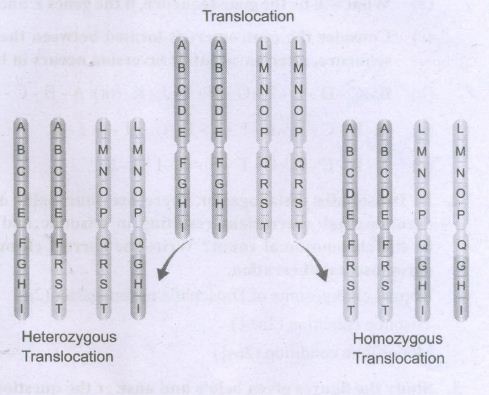
Translocation
The transfer of a segment of chromosome to a nonhomologous chromosome is called translocation. Translocation should not be confused with crossing over, in which an exchange of genetic material between homologous chromosome takes place. Translocation occurs as a result of interchange of chromosome segments in non-homologous chromosomes. There are three types:
i. Simple translocation
ii. Shift translocation
iii. Reciprocal translocation
i. Simple translocation
A single break is made in only one chromosome. The broken segment gets attached to one end of a non-homologous chromosome. It occurs very rarely in nature.
ii. Shift translocation
Broken segment of one chromosome gets inserted interstitially in a non-homologous chromosome.
iii. Reciprocal translocations
It involves mutual exchange of chromosomal segments between two non homologous chromosomes. It is also called illegitimate crossing over. It is further divided into two types.
a. Homozygous translocation: Both the chromosomes of two pairs are involved in translocation. Two homologous of each translocated chromosomes are identical.
b. Heterozygous translocation: Only one of the chromosome from each pair of two homologous are involved in translocation, while the remaining chromosome is normal.
Translocations playa major role in the formation of species.
4.
Hyperploidy
Addition of one or more chromosomes to diploid sets are called hyperploidy. Diploid set of chromosomes represented as Disomy. Hyperploidy can be divided into three types. They are as follows:
(a) Trisomy
Addition of single chromosome to diploid set is called Simple trisomy (2n+ 1). Trisomies were first reported by Blakeslee (1910) in Datura stramonium (Jimson weed). But later it was reported in Nicotiana, Pisum and Oenothera. Sometimes addition of two individual chromosome from different chromosomal pairs to normal diploid sets are called Double trisomy (2n+ 1+ 1).
(b) Tetrasomy
Addition of a pair or two individual pairs of chromosomes to diploid set is called tetrasomy (2n+2) and Double tetras6my (2n+2+2) respectively. All possible tetrasomics are available
in Wheat.
(c) Pentasomy
Addition of three individual chromosome from different chromosomal pairs to normal diploid set are called pentasomy (2n+3).
5.

12th Standard Syllabus & Materials
12th Standard
TN 12th Computer Applications வலையமைப்பு வடமிடல் Sample Question Papers Study Material - QB365 Set A
NEW12th Standard
TN 12th Computer Applications களப்பெயர் முறைமை (DNS) Sample Question Papers Study Material - QB365 Set A
NEW12th Standard
TN 12th Computer Applications வலையமைப்பு எடுத்துக்காட்டுகள் மற்றும் நெறிமுறைகள் Sample Question Papers Study Material - QB365 Set A
NEW12th Standard
TN 12th Computer Applications கணினி வலையமைப்பு ஓர் அறிமுகம் Sample Question Papers Study Material - QB365 Set A



Tamilnadu Stateboard 12th Standard Subjects

Maths

Chemistry

Physics
Biology

Computer Science

Business Maths and Statistics

Economics

Commerce

Accountancy

History

Computer Applications
Biology
Computer Technology
Computer Applications
Computer Science
Business Maths and Statistics
Commerce
Economics
Maths
Chemistry
Physics
Computer Technology
History
Accountancy

Tamil

English

French
Tamilnadu Stateboard Standards



