
 100% FREE ACCESS
12th Standard Syllabus & Materials
12th Standard
TN 12th Maths Applications of Matrices and Determinants Sample Question Papers Study Material - QB365 Set A
NEW12th Standard
TN 12th Computer Applications மின்னணு தரவு பரிமாற்றம் Sample Question Papers Study Material - QB365 Set A
NEW12th Standard
TN 12th Computer Applications மின் - வணிக பாதுகாப்பு அமைப்புகள் Sample Question Papers Study Material - QB365 Set A
NEW12th Standard
TN 12th Computer Applications மின்னணு செலுத்தல் முறைகள் Sample Question Papers Study Material - QB365 Set A
NEW12th Standard
TN 12th Computer Applications மின் - வணிகம் Sample Question Papers Study Material - QB365 Set A
NEW12th Standard
TN 12th Computer Applications திறந்த மூல கருத்துருக்கள் Sample Question Papers Study Material - QB365 Set A

Published on: 13/05/2022
QB365 provides detailed and simple solution for every Creative Questions in class 12 Biology Subject. It will helps to get more idea about question pattern in every Creative questions with solution.
latest Creative QuestionsDownload Tamil Nadu 12th Standard Biology question papers, model tests, one-mark questions, important questions, and public exam papers in PDF format. Free study materials and answer keys for TN State Board students.
Questions + Answers key
Take MCQ Biology Test1.
Name any 3 bacterial species used to generate polyhydroxybutyrates (PHB).
2.
What is RNA interference (RNAi)? How it is carried out?
3.
Agrobacterium - a natural genetic engineer of plants. Justify the statement.
4.
Why is it difficult for DNA to pass through cell membrane? How the bacterial cells can be made competent to take up DNA?
5.
Mention any three algal species used for SCP production.
6.
What are secondary metabolites? Give two examples.
7.
Give an account on colchicine.
8.
What are comutagens ?
9.
How and where chiasma is formed?
10.
State Coupling and Repulsion theory.
11.
Anemophilous Dowers produce abundant pollen grains. Give reason
12.
Write a short notes on Atavism.
13.
Define co-dominance. How it is proved by using Gossypium species?
14.
How the flowers of salvia are adopted for melittophily?
15.
Differentiate between chasmogamy and cleistogamy
16.
How many synergid cells are there in a mature embryo sac. Mention any two major roles of synergies.
17.
Point out any three mangrove ecosystem services.
18.
Observe the tabular column and complete it using proper terms.
| Species 1 | Species 2 | Type of interaction | |
| i | + | A | Mutualism |
| ii | + | O | B |
| iii | C | O | Amensalism |
| iv | + | - | D |
| v | - | E | Competition |
19.
Point out the Anatomical adaptations exhibited by the Halophytes.
20.
Loamy soil is ideal for crop cultivation - Justify.
21.
Given below are the list of components and accessories used in PTC technique. Sort them out according to their mode of sterilization.
(a) Glass wares
(b) Laminar air flow chamber
(c) Nutrient medium
(d) Explant
22.
What is cybrid?
23.
Point out the factors that determine success rate of tissue culturing.
24.
Write note on mimicry.
25.
List out the application of single-cell protein.
1.
Bacillus megaterium.
Corynebacterium glutamicum.
Alcaligenes eutrophus.
2.
RNA interference is a biological process in which RNA molecules inhibit gene expression or translation. This is done by neutralising targeted mRNA molecules. A simplified model for the RNAi pathway is based on two steps, each involving ribonuclease enzyme. In the first step, the trigger RNA (either dsRNA or miRNA primary transcript) is processed into a short interfering RNA (siRNA) by the RNase II enzymes called Dicer and Drosha. In the second step, siRNAs are loaded into the effector complex RNA-induced silencing complex (RISC). The siRNA is unwound during RISC assembly and the single stranded RNA hybridizes with mRNA target. This RNAi is seen in plant feeding nematodes.
3.
Among the various vectors used for plant transformation, the Ti-plasmid from Agrobacterium tumefaciens has been used extensively. This bacterium has a large size plasmid, known as Ti plasmid (Tumor inducing) and a portion of it referred as T-DNA (transfer DNA) is transferred to plant genome in the infected cells and cause plant tumors (crown gall). Since this bacterium has the natural ability to transfer T-DNA region of its plasmid into plant genome, upon infection of cells at the wound site, it is also known as the natural genetic engineer of plants.
4.
Since the DNA is a hydrophilic molecule, it cannot pass through cell membranes, In order to force bacteria to take up the plasmid, the bacterial cells must first be made competent to take up DNA. This is done by treating them with a specific concentration of a divalent cation such as calcium.
5.
Spirulina, Chlorella and Chlamydomonas.
6.
Secondary metabolites are those which are not required for the vital life process of microbes, but have value added nature, this includes antibiotics e.g. -Amphotericin-B (Streptomyces nodosus) and Penicillin (Penicillium chryosogenum).
7.
Colchicine, an alkaloid is extracted from root and corms of Colchicum autumnale, when applied in low concentration to the growing tips of the plants it will induce polyploidy. Surprisingly it does not affect the source plant Colchicum, due to presence of anti-colchicine.
8.
Comutagens:
The compounds which are not having own mutagenic properties but can enhance the effects of known mutagens are called comutagens.
Example: Ascorbic acid increase the damage caused by hydrogen peroxide.
9.
After tetrad formation, crossing over occurs in pachytene stage. The non-sister chromatids of homologous pair make a contact at one or more points. These points of contact between non-sister chromatids of homologous chromosomes are called Chiasmata (singular-Chiasma). At chiasma, cross-shaped or X-shaped structures are formed, where breaking and rejoining of two chromatids occur. This results in reciprocal exchange of equal and corresponding segments between them.
10.
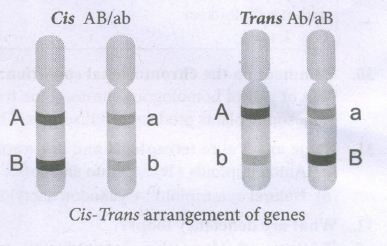
The two dominant alleles or recessive alleles occur in the same homologous chromosomes, tend to inherit together into same gamete are called coupling or cis configuration. If dominant or recessive alleles are present on two different, but homologous chromosomes they inherit apart into different gamete are called repulsion or trans configuration.
11.
Anemophily is a chance event. The liberated pollen mayor may not reach the target flower and are wasted during the transmission from one flower to another. Hence enormous pollen grains are produced to assure pollination.
12.
Atavism is a modification of a biological structure whereby an ancestral trait reappears after having been lost through evolutionary changes in the previous generations. Evolutionary traits that have disappeared phenotypically do not necessarily disappear from an organism's DNA. The gene sequence often remains, but is inactive. Such an unused gene may remain in the genome for many generations. As long as the gene remains intact, a fault in the genetic control suppressing the gene can lead to the reappearance of that character again. Reemergence of sexual reproduction in the flowering plant Hieracium pilosella is the best example for Atavism in plants.
13.
The phenomenon in which two alleles are both expressed in the heterozygous individual is known as codominance. The codominance was demonstrated in plants with the help of electrophoresis or chromatography for protein or flavonoid substance. Example: Gossypium hirsutum and Gossypium sturtianum, their F 1 hybrid (amphiploid) was tested for seed proteins by electrophoresis. Both the parents have different banding patterns for their seed proteins. In hybrids, additive banding pattern was noticed. Their hybrid shows the presence of both the types of proteins similar to their parents.
14.
Pollination in Salvia (Lever mechanism): The flower of Salvia is adapted for Bee pollination. The flower is protandrous and the corolla is bilabiate with 2 stamens. A lever mechanism helps in pollination. Each anther has an upper fertile lobe and lowers sterile lobe which is separated by a long connective which helps the anthers to swing freely. When a bee visits a flower, it sits on the lower lip which acts as a platform. It enters the flower to suck the nectar by pushing its head into the Corolla. During the entry of the bee into the flower, the body strikes against the sterile end of the connective. This makes the fertile part of the stamen to descend and strike at the back of the bee. The pollen gets deposited on the back of the bee. When it visits another flower, the pollen gets rubbed against the stigma and completes the act of pollination in Salvia
15.
| Chasmogamy | Cleistogamy |
|---|---|
| In chasmogamy, the flowers open and express its mature anthers and stigma for pollination. | In cleistogamy, the pollination occurs without opening of flowers and exposing their sex organs |
| Self-pollination is uncertain | Self-pollination is certain. |
| Depend on pollinating agents | No need of pollinating agents |
| Example: Hibiscus | Example: Commelina |
16.
The egg apparatus possess two synergids.
Synergids secrete chemotropic substances that attract the pollen tube.
Synergids also guides the pollen tube into the egg.
17.
(I) Act as bridge between sea and rivers by balancing sedimentation and soil erosion.
(II) Help to reduce water force during cyclones, tsunamis and high tide periods .
(III) Help in wind break, 02 production, carbon sequestration and prevents salt spray from waves.
18.
A = +
D = Parasitism
B = Commensalism
E = -
19.
Anatomical adaptations:
1. Epidermal cells of stem is heavily cutinized, almost squarish and are filled with oil and tannins.
2. 'Star' shaped sclereids and 'H' shaped heavy thickened spicules that provide mechanical strength to cortex are present in the stem.
3. The leaves may be dorsiventral or isobilateral with salt secreting glands.
20.
Loamy soil is ideal soil for cultivation, since it consists of 70% sand and 30% clay or silt or both. It ensures good retention and proper drainage of water. The porosity of soil provides adequate aeration and allows the penetration of roots.
21.
(a) Glass wares are sterilized by auto claving.
(b) Nutrient medium is sterilized by auto claving.
(c) Laminar air flow chamber is sterilized by UV radiation.
(d) Explant is surface sterilized using chemicals.
22.
The fusion product of protoplasts without nucleus of different cells is called a cybrid.
23.
The success of tissue culture lies in the composition of the growth medium, plant growth regulators and culture conditions such as temperature, pH, light and humidity.
24.
1. Here the living organism modifies its form, appearance structure or behavior & looks like another living organism as a self defence & increases the chance of their survival.
2. It is a result of evolutionary significance.
3. Due to shape, sudden heritable mutation & preservation of natural selection
25.
Applications of Single-Cell Protein:
1. It is used as protein supplement.
2. It is used in cosmetics, products for healthy hair and skin.
3. It is used in poultry as the excellent source of proteins and other nutrients, it is widely used for feeding cattle, birds and fishes, etc.
4. It is used in food industry as aroma carriers, vitamin carrier, emulsifying agents to improve the nutritive value of baked products, in soups, in ready-to-serve-meals, in diet recipes.
5. It is used in industries like paper processing and leather processing as foam stabilizers.

12th Standard Syllabus & Materials
12th Standard
TN 12th Computer Applications வலையமைப்பு வடமிடல் Sample Question Papers Study Material - QB365 Set A
NEW12th Standard
TN 12th Computer Applications களப்பெயர் முறைமை (DNS) Sample Question Papers Study Material - QB365 Set A
NEW12th Standard
TN 12th Computer Applications வலையமைப்பு எடுத்துக்காட்டுகள் மற்றும் நெறிமுறைகள் Sample Question Papers Study Material - QB365 Set A
NEW12th Standard
TN 12th Computer Applications கணினி வலையமைப்பு ஓர் அறிமுகம் Sample Question Papers Study Material - QB365 Set A



Tamilnadu Stateboard 12th Standard Subjects

Maths

Chemistry

Physics
Biology

Computer Science

Business Maths and Statistics

Economics

Commerce

Accountancy

History

Computer Applications
Biology
Computer Technology
Computer Applications
Computer Science
Business Maths and Statistics
Commerce
Economics
Maths
Chemistry
Physics
Computer Technology
History
Accountancy

Tamil

English

French
Tamilnadu Stateboard Standards



