
 100% FREE ACCESS
12th Standard Syllabus & Materials
12th Standard
TN 12th Maths Applications of Matrices and Determinants Sample Question Papers Study Material - QB365 Set A
NEW12th Standard
TN 12th Computer Applications மின்னணு தரவு பரிமாற்றம் Sample Question Papers Study Material - QB365 Set A
NEW12th Standard
TN 12th Computer Applications மின் - வணிக பாதுகாப்பு அமைப்புகள் Sample Question Papers Study Material - QB365 Set A
NEW12th Standard
TN 12th Computer Applications மின்னணு செலுத்தல் முறைகள் Sample Question Papers Study Material - QB365 Set A
NEW12th Standard
TN 12th Computer Applications மின் - வணிகம் Sample Question Papers Study Material - QB365 Set A
NEW12th Standard
TN 12th Computer Applications திறந்த மூல கருத்துருக்கள் Sample Question Papers Study Material - QB365 Set A

Published on: 22/06/2021
QB365 provides detailed and simple solution for every Creative Questions in class 12 Biology Subject. It will helps to get more idea about question pattern in every Creative questions with solution.
Download Tamil Nadu 12th Standard Biology question papers, model tests, one-mark questions, important questions, and public exam papers in PDF format. Free study materials and answer keys for TN State Board students.
Questions + Answers key
Take MCQ Biology Test1.
Explain the procedure of Southern Blotting Technique. Southern Blotting Techniques - DNA
2.
Write a note on Replica plating technique.
3.
What is translocation? Write about its types.
4.
Write in detail about Autogenic succession and Allogenic succession.
5.
List out the characteristics of ecological succession.
6.
Point out any five morphological adaptations of epiphytes.
7.
Explain various edaphic factors that affect vegetation.
8.
Enumerate the advantages of Artificial seeds.
9.
Point out the applications of plant tissue culture.
10.
Explain the steps involved in hybridization.
11.
How Eichhornia crassipes spoils the Indian ecosystem?
12.
List out the major effects of Ozone Depletion.
13.
Explain the stepwise preparation of Bio-pest repellent from the leaves of Azadirachta indica
14.
Give a detailed account on anyone fibre yielding plant.
15.
Write short notes on Bio-monitoring.
1.
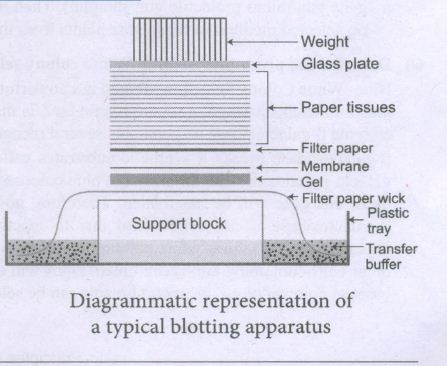
The transfer of denatured DNA from Agarose gel to Nitrocellulose Blotting or Filter Paper technique was introduced by Southern in 1975 and this technique is called Southern Blotting Technique.
steps
The transfer of DNA from agarose gel to nitrocellulose filter paper is achieved by Capillary Action. A buffer Sodium Saline Citrate (SSC) is used, in which DNA is highly soluble, it can be drawn up through the gel into the Nitrocellulose membrane By this process ss-DNA becomes 'Trapped' in the membrane matrix. This DNA is hybridized with a nucleic acid and can be detected by autoradiography. Autoradiography - A technique that captures the image formed in a photographic emulsion due to emission of light or radioactivity from a labelled component placed together with unexposed film.
2.
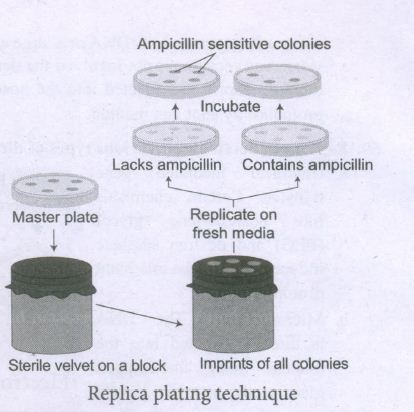
A technique in which the pattern of colonies growing on a culture plate is copied. A sterile filter plate is pressed against the culture plate and then lifted. Then the filter is pressed against a second sterile culture plate. This results in the new plate being infected with cell in the same relative positions as the colonies in the original plate. Usually, the medium used in the second plate will differ from that used in the first. It may include an antibiotic or without a growth factor. In this way, transformed cells can be selected
3.
Translocation
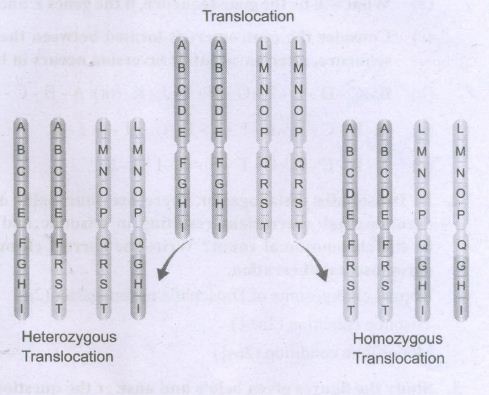
The transfer of a segment of chromosome to a nonhomologous chromosome is called translocation. Translocation should not be confused with crossing over, in which an exchange of genetic material between homologous chromosome takes place. Translocation occurs as a result of interchange of chromosome segments in non-homologous chromosomes. There are three types:
i. Simple translocation
ii. Shift translocation
iii. Reciprocal translocation
i. Simple translocation
A single break is made in only one chromosome. The broken segment gets attached to one end of a non-homologous chromosome. It occurs very rarely in nature.
ii. Shift translocation
Broken segment of one chromosome gets inserted interstitially in a non-homologous chromosome.
iii. Reciprocal translocations
It involves mutual exchange of chromosomal segments between two non homologous chromosomes. It is also called illegitimate crossing over. It is further divided into two types.
a. Homozygous translocation: Both the chromosomes of two pairs are involved in translocation. Two homologous of each translocated chromosomes are identical.
b. Heterozygous translocation: Only one of the chromosome from each pair of two homologous are involved in translocation, while the remaining chromosome is normal.
Translocations playa major role in the formation of species.
4.
Autogenic succession
Autogenic succession occurs as a result of biotic factors. The vegetation reacts with its environment and modifies its own environment causing its own replacement by new communities. This is known as autogenic succession.
Example: In forest ecosystem, the larger trees produce broader leaves providing shade to the forest floor area. It affects the shrubs and herbs which require more light (heliophytes) but supports the shade tolerant species (sciophytes) to grow well.
Allogenic succession
Allogenic succession occurs as a result of abiotic factors. The replacement of existing community is caused by other external factors (soil erosion and leaching, etc.,) and not by existing organisms.
Example: In a forest ecosystem soil erosion and leaching alter the nutrient value of the soil leading to the change of vegetation in that area.
5.
Characteristics of ecological succession
(I) It is a systematic process which causes changes in specific structure of plant community.
(II) It is resultant of changes of abiotic and biotic factors.
(III) It transforms unstable community into a stable community.
(IV) Gradual progression in species diversity, total biomass, niche specialisation, and humus content of soil takes place.
(V) It progresses from simple food chain to complex food web.
(VI) It modifies the lower and simple life form to the higher life forms.
(VII) It creates inter-dependence of plants and animals.
6.
Morphological adaptations:
Root system is extensively developed. These roots may be of two types. They are Clinging roots and Aerial roots.
Clinging roots fix the epiphytes firmly on the surface of the supporting objects.
Aerial roots are green coloured roots which may hang downwardly and absorb moisture from the atmosphere with the help of a spongy tissue called velamen.
1. Stem of some epiphytes are succulent and develop pseudo bulb or tuber.
2. Generally the leaves are lesser in number and may be fleshy and leathery.
3. Myrmecophily is a common occurrence in the epiphytic vegetation to prevent the predators
4. The fruits and seeds are very small and usually dispersed by wind, insects and birds.
7.
The important edaphic factors which affect vegetation are as follows:
1. Soil moisture: Plants absorbs rain water and moisture directly from the air.
2. Soil water: Soil water is more important than any other ecological factors affecting the distribution of plants. Rain is the main source of soil water. Capillary water held between pore spaces of soil particles and angles between them is the most important form of water available to the plants.
3. Soil reactions: Soil may be acidic or alkaline or neutral in their reaction. pH value of the soil solution determines the availability of plant nutrients. The best pH range of the soil for cultivation of crop plants is 5.5 to 6.8.
4. Soil nutrients: Soil fertility and productivity is the ability of soil to provide all essential plant nutrients such as minerals and organic nutrients in the form of ions.
5. Soil temperature: Soil temperature of an area plays an important role in determining the geographical distribution of plants. Low temperature reduces use of water and solute absorption by roots.
6. Soil atmosphere: The spaces left between soil particles are called pore spaces which contains oxygen and carbon-di-oxide.
7. Soil organisms: Many organisms existing in the soil like bacteria, fungi, algae, protozoans, nematodes, insects and earthworms, etc., are called soil organisms.
8.
Advantages of Artificial seeds
Artificial seeds have many advantages over the true seeds as follows:
1. Millions of artificial seeds can be produced at any time at low cost.
2. They provide an easy method to produce genetically engineered plants with desirable traits.
3. It is easy to test the genotype of plants.
4. They can potentially stored for long time under cryopreservation method.
5. Artificial seeds produce identical plants .
6. The period of dormancy of artificial seeds is greatly reduced, hence growth is faster with a shortened life cycle.
9.
Plant tissue culture techniques have several applications such as:
i. Improved hybrids production through somatic hybridization.
ii. Somatic embryoids can be encapsulated into synthetic seeds (synseeds). These encapsulated seeds or synthetic seeds help in conservation of plant biodiversity.
iii. Production of disease resistant plants through meristem and shoot tip culture.
iv. Production of stress resistant plants like herbicide tolerant, heat tolerant plants.
v. Micropropagation technique to obtain large numbers of plantlets of both crop and tree species useful in forestry within a short span of time and all through the year.
vi. Production of secondary metabolites from cell culture utilized in pharmaceutical, cosmetic and food industries.
10.
Steps involved in hybridization are as follows:
1. Selection of Parents: Male and female plants of the desired characters are selected. It should be tested for their homozygosity.
2. Emasculation: It is a process of removal of anthers to prevent self pollination before anthesis (period of opening of a flower).
3. Bagging: The stigma of the flower is protected against any undesirable pollen grains, by covering it with a bag.
4. Crossing: Transfer of pollen grains from selected male flower to the stigma of the female emasculated flower.
5. Harvesting seeds and raising plants: The pollination leads to fertilization and finally seed formation takes place. The seeds are grown into new generation which are called a hybrid.
11.
Eichhornia crassipes is an invasive weed native to South America. It was introduced as aquatic ornamental plant, which grows faster throughout the year. Its widespread growth is a major cause of biodiversity loss worldwide. It affects the growth of phytoplankton and finally changing the aquatic ecosystem.
It also decreases the oxygen content of the waterbodies which leads to eutrophication. It poses a threat to human health because it creates a breeding habitat for disease-causing mosquitoes (particularly Anopheles) and snails with its free-floating dense roots and semi submerged leaves. It also blocks sunlight entering deep and the water ways hampering agriculture, fisheries, recreation, and hydropower.
12.
The main ozone depletion effects are:
(i) Increases the incidence of cataract, throat and lung irritation and aggravation of asthma or emphysema, skin cancer and diminishing the functioning of the immune system in human beings.
(ii) Juvenile mortality of animals.
(iii) Increased incidence of mutations.
(iv) In plants, photosynthetic chemicals will be affected and therefore photosynthesis will be inhibited. Decreased photosynthesis will result in increased atmospheric CO2 resulting in global warming and also a shortage of food leading to a food crisis.
(v) Increase in temperature changes the climate and rainfall pattern which may result in flood/drought, sea water rise, imbalance in ecosystems affecting flora and fauna.
13.
Botanical pest repellent and insecticide made with the dried leaves of Azadirachta indica Preparation of Bio-pest repellent
(i) Pluck leaves from the neem tree and chop the leaves finely.
(ii) The chopped up leaves were put in a 50-liter container and fill to half with water; put the lid on and leave it for 3 days to brew.
(iii) Using another container, strain the mixture which has brewed for 3 days to remove the leaves, through fine mesh sieve. The filtrate can be sprayed on the plants to repel pests.
(iv) To make sure that the pest repellent sticks to the plants, add 100 ml of cooking oil and the same amount of soap water. (The role of the soap water is to break down the oil, and the role of the oil is to make it stick to the leaves).
(v) The stewed leaves from the mixture can be used in the compost heap or around the base of the plants.
14.
Jute
Botanical name : Corchorus spp.
Family: Malvaceae
Origin and Area of cultivation: Jute is derived from the two cultivated species (1) Core horns capsularis and (2) Colittorius is of African origin whereas C. Capsularis, is believed to Indo Burmaese origin. It is an important cultivated commercial crop in Gangetic plains of India and Bangladesh.
Uses: It is one of the largest exported fibre material of India. The jute industry occupies an important place in the national economy Of India. Jute is used for 'safe' packaging in view of being natural, renewable, bio-degradable and eco-friendly product. It is used in bagging and wrapping textile. About 75% of the jute produced is used for manufacturing sacks and bags. It is also used in manufacture of blankets, rags, curtains etc. It is also being used as a textile fibre in recent years.
15.
The act of observing and assessing the current state and ongoing changes in ecosystem, biodiversity components, landscape including natural habitats, populations and species. An agricultural drone is an unmanned aerial vehicle applied to farming in order to help increased crop production and monitor crop growth. Agricultural drones let farmers see their fields from the sky. This bird’s eye-view can reveal many issues such as irrigation problems, soil variation and pest and fungal infestations. It is also used for cost effective safe method of spraying pesticides and fertilizers, which proves very easy and non-harmful.

12th Standard Syllabus & Materials
12th Standard
TN 12th Computer Applications வலையமைப்பு வடமிடல் Sample Question Papers Study Material - QB365 Set A
NEW12th Standard
TN 12th Computer Applications களப்பெயர் முறைமை (DNS) Sample Question Papers Study Material - QB365 Set A
NEW12th Standard
TN 12th Computer Applications வலையமைப்பு எடுத்துக்காட்டுகள் மற்றும் நெறிமுறைகள் Sample Question Papers Study Material - QB365 Set A
NEW12th Standard
TN 12th Computer Applications கணினி வலையமைப்பு ஓர் அறிமுகம் Sample Question Papers Study Material - QB365 Set A



Tamilnadu Stateboard 12th Standard Subjects

Maths

Chemistry

Physics
Biology

Computer Science

Business Maths and Statistics

Economics

Commerce

Accountancy

History

Computer Applications
Biology
Computer Technology
Computer Applications
Computer Science
Business Maths and Statistics
Commerce
Economics
Maths
Chemistry
Physics
Computer Technology
History
Accountancy

Tamil

English

French
Tamilnadu Stateboard Standards



