
 100% FREE ACCESS
12th Standard Syllabus & Materials
12th Standard
TN 12th Maths Applications of Matrices and Determinants Sample Question Papers Study Material - QB365 Set A
NEW12th Standard
TN 12th Computer Applications மின்னணு தரவு பரிமாற்றம் Sample Question Papers Study Material - QB365 Set A
NEW12th Standard
TN 12th Computer Applications மின் - வணிக பாதுகாப்பு அமைப்புகள் Sample Question Papers Study Material - QB365 Set A
NEW12th Standard
TN 12th Computer Applications மின்னணு செலுத்தல் முறைகள் Sample Question Papers Study Material - QB365 Set A
NEW12th Standard
TN 12th Computer Applications மின் - வணிகம் Sample Question Papers Study Material - QB365 Set A
NEW12th Standard
TN 12th Computer Applications திறந்த மூல கருத்துருக்கள் Sample Question Papers Study Material - QB365 Set A

Published on: 13/05/2022
QB365 provides detailed and simple solution for every Creative Questions in class 12 Biology Subject. It will helps to get more idea about question pattern in every Creative questions with solution.
latest Creative QuestionsDownload Tamil Nadu 12th Standard Biology question papers, model tests, one-mark questions, important questions, and public exam papers in PDF format. Free study materials and answer keys for TN State Board students.
Questions + Answers key
Take MCQ Biology Test1.
Bring out the importance of plant succession.
2.
Differentiate Primary succession and Secondary succession.
3.
List out the characteristics of ecological succession.
4.
Write a note on the strategies of ecosystem management.
5.
Write an essay on pond ecosystem.
1.
Significance of Plant Succession
(I) Succession is a dynamic process. Hence an ecologist can access and study the seral stages of a plant community found in a particular area.
(II) The knowledge of ecological succession helps to understand the controlled growth of one or more species in a forest.
(III) Utilizing the knowledge of succession, even dams can be protected by preventing siltation.
(IV) It gives information about the techniques to be used during reforestation and afforestation.
(V) It helps in the maintenance of pastures.
(VI) Plant succession helps to maintain species diversity in an ecosystem.
(VII) Patterns of diversity during succession are influenced by resource availability and disturbance by various factors.
(VIII) Primary succession involves the colonization of habitat of an area devoid of life.
(IX) Secondary succession involves the re-establishment of a plant community in disturbed area or habitat.
(X) Forests and vegetation that we come across all over the world are the result of plant succession.
2.
| Primary succession | Secondary succession |
| Developing in an barren area. | Developing in disturbed area. |
| Initiated due to a biological or any other external factors. | Starts due to external factors only. |
| No soil, while primary succession starts | It starts where soil covers is already present. |
| Pioneer species come from outside environment. | Pioneer species develop from existing environment. |
| It takes more time to complete. | It takes comparatively less time to complete |
3.
Characteristics of ecological succession
(I) It is a systematic process which causes changes in specific structure of plant community.
(II) It is resultant of changes of abiotic and biotic factors.
(III) It transforms unstable community into a stable community.
(IV) Gradual progression in species diversity, total biomass, niche specialisation, and humus content of soil takes place.
(V) It progresses from simple food chain to complex food web.
(VI) It modifies the lower and simple life form to the higher life forms.
(VII) It creates inter-dependence of plants and animals.
4.
Strategy of ecosystem management
(I) It is used to maintain biodiversity of ecosystems.
(II) It helps in indicating the damaged ecosystem (Some species indicate the health of the ecosystem: such species are called a flagship species).
(III) It is used to recognize the inevitability of ecosystem change and plan accordingly.
(IV) It is one of the tools used for achieving sustainability of ecosystem through sustainable development programme (or projects).
(V) It is also helpful in identifying ecosystems which are in need of rehabilitation.
(VI) It involves collaborative management with government agencies, local population, communities and NGO's.
(VII) It is used to build the capacity of local institutions and community groups to assume responsibility for long term implementation of ecosystem management activities even after the completion of the project.
5.
Abiotic components
A pond ecosystem consists of dissolved inorganic (CO2, O2, Ca, N and Phosphate) and organic substances (amino acids and humic acid) formed from the dead organic matter. The function of pond ecosystem is regulated by few factors like the amount of light, temperature, pH value of water and other climatic conditions.
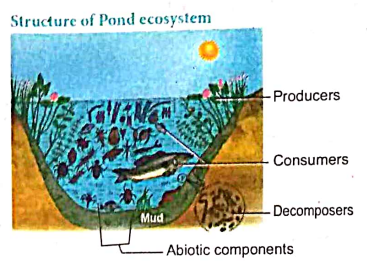
Biotic components
They constitute the producers, variety of consumers and decomposers (microorganisms).
(a) Producers
A variety of phytoplanktons like Oscillatoria, Anabaena, Eudorina, Volvox and Diatoms. Filamentous algae such as Ulothrix, Spirogyra, Cladophora and Oedogonium; floating plants Azolla, Salvia, Pistia, Wolffia and Eichhonia. Sub-merged plants Potamogeton and Phragmitis; Rooted floating plants Nymphaea and Nelumbo; Macrophytes like Typha and Ipomoea, constitute the major producers of a pond ecosystem.
(b) Consumers
The animals represent the consumers of a pond ecosystem include zooplanktons like Paramoecium and Daphnia (primary consumers); Benthos (bottom living animals) like mollusces and annelids; secondary consumers like water beetles and frogs; and tertiary consumers (carnivores) like duck, crane and some top carnivores which include large fish, hawk and man, etc.
(c) Decomposers
They are also called as microconsumers. They help to recycle the nutrients in the ecosystem. These are present in mud water and bottom of the ponds. Example: Bacteria and Fungi. Decomposers perform the process of decomposition in order to enrich the nutrients in the pond ecosystem.
The cycling of nutrients between abiotic and biotic components is evident in the pond ecosystem, making itself self sufficient and self regulating.

12th Standard Syllabus & Materials
12th Standard
TN 12th Computer Applications வலையமைப்பு வடமிடல் Sample Question Papers Study Material - QB365 Set A
NEW12th Standard
TN 12th Computer Applications களப்பெயர் முறைமை (DNS) Sample Question Papers Study Material - QB365 Set A
NEW12th Standard
TN 12th Computer Applications வலையமைப்பு எடுத்துக்காட்டுகள் மற்றும் நெறிமுறைகள் Sample Question Papers Study Material - QB365 Set A
NEW12th Standard
TN 12th Computer Applications கணினி வலையமைப்பு ஓர் அறிமுகம் Sample Question Papers Study Material - QB365 Set A



Tamilnadu Stateboard 12th Standard Subjects

Maths

Chemistry

Physics
Biology

Computer Science

Business Maths and Statistics

Economics

Commerce

Accountancy

History

Computer Applications
Biology
Computer Technology
Computer Applications
Computer Science
Business Maths and Statistics
Commerce
Economics
Maths
Chemistry
Physics
Computer Technology
History
Accountancy

Tamil

English

French
Tamilnadu Stateboard Standards



