
 100% FREE ACCESS
12th Standard Syllabus & Materials
12th Standard
TN 12th Computer Applications மின்னணு தரவு பரிமாற்றம் Sample Question Papers Study Material - QB365 Set A
NEW12th Standard
TN 12th Computer Applications மின் - வணிக பாதுகாப்பு அமைப்புகள் Sample Question Papers Study Material - QB365 Set A
NEW12th Standard
TN 12th Computer Applications மின்னணு செலுத்தல் முறைகள் Sample Question Papers Study Material - QB365 Set A
NEW12th Standard
TN 12th Computer Applications மின் - வணிகம் Sample Question Papers Study Material - QB365 Set A
NEW12th Standard
TN 12th Computer Applications திறந்த மூல கருத்துருக்கள் Sample Question Papers Study Material - QB365 Set A
NEW12th Standard
TN 12th Computer Applications வலையமைப்பு வடமிடல் Sample Question Papers Study Material - QB365 Set A

Published on: 02/06/2021
QB365 provides detailed and simple solution for every book back questions in class 12 Biology subject.It will helps to get more idea about question pattern in every book back questions with solution.
Download Tamil Nadu 12th Standard Biology question papers, model tests, one-mark questions, important questions, and public exam papers in PDF format. Free study materials and answer keys for TN State Board students.
Questions + Answers key
Take MCQ Biology Test1.
How will you identify a vector ?
2.
What are restriction enzyme. Mention their type with role in Biotechnology.
3.
What do you know about the word pBR332?
4.
Is there any possibilities to transfer a suitable desirable gene to host plant without vector? Justify your answer.
5.
Mention the application of Biotechnology.
1.
Properties of Vectors:
1. Vectors are able to replicate autonomously to produce multiple copies of them along with their DNA insert in the host cell.
2. It should be small in size and of low molecular weight, less than 10 Kb (kilo base pair) in size so that entry/transfer into host cell is easy.
3. Vector must contain an origin of replication so that it can independently replicate within the host.
4. It should contain a suitable marker such as antibiotic resistance, to permit its detection in transformed host cell.
5. Vector should have unique target sites for integration with DNA insert and should have the ability to integrate with DNA insert it carries into the genome of the host cell. Most of the commonly used cloning vectors have more than one restriction site. These are Multiple Cloning Site (MCS) or polylinker. Presence of MCS facilitates the use of restriction enzyme of choice.
2.
A restriction enzyme or restriction endonuclease is an enzyme that cleaves DNA into fragments at or near specific recognition sites within the molecule known as restriction sites.
Types
(i) Exonucleases - which remove nucleotides one at a time from the end of a DNA molecule. e.g. Bal 31, Exonuclease III.
(ii) Endonucleases - which break the internal phosphodiester bonds within a DNA molecule. e.g. Hind II, EcoRI, PvulI, BamHI, TaqI.
(iii) The restriction enzymes are called as molecular scissors
(iv) They are used in recombinant DNA technology as they recognize & cut DNA within a specific sequence.
3.
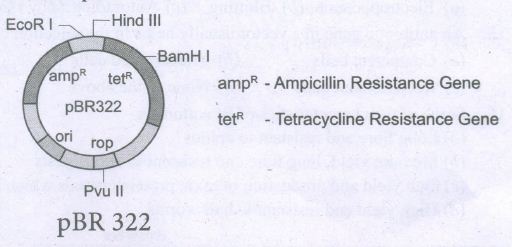
(i) pBR 322 plasmid is a reconstructed plasmid and most widely used as cloning vector;
(ii) It contains 4361 base pairs. In pBR, p denotes plasmid, Band R respectively the names of scientist Boliver and Rodriguez who developed this plasmid.
(iii) The number 322 is the number of plasmid developed from their laboratory.
(iv) It contains ampR and tetR two different antibiotic resistance genes and recognition sites for several restriction enzymes.
(v) ori and antibiotic resistance genes. Rop codes for the proteins involved in the replication of the plasmid.
4.
Direct or Vector less Gene Transfer
In the direct gene transfer methods, the foreign gene of interest is delivered into the host plant without the help of a vector, The following are some of the common methods of direct gene transfer in plants.
(i) Chemical mediated gene transfer: Certain chemicals like polyethylene glycol (PEG) and dextran sulphate induce DNA uptake into plant protoplasts.
(ii) Microinjection: The DNA is directly injected into the nucleus using fine tipped glass needle or micro pipette to transform plant cells. The protoplasts are immobilized on a solid support (agarose on a microscopic slide) or held with a holding pipette under section.
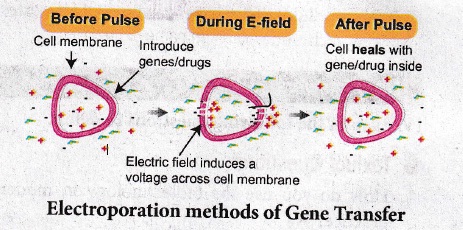
(iii) Electroporation Methods of Gene Transfer: A pulse of high voltage is applied to protoplasts, cells or tissues which makes transient pores in the plasma membrane through which uptake of foreign DNA occurs.
(iv) Liposome mediated method of Gene transfer: Liposomes the artificial phospholipid vesicles are useful in gene transfer. The gene or DNA is transferred from liposome into vacuole of plant cells. It is carried out by encapsulating DNA into the vacuole. This technique is advantageous because the liposome protects the introduced DNA from being damaged by the acidic pH and protease enzymes present in the vacuole. Liposome and tonoplast of vacuole fusion resulted in gene transfer. This process is called lipofection.
.jpg)
(v) Biolistics: The foreign DNA is coated onto the surface of minute gold or tungsten particles (1-3 \(\mu\)m) and bombarded onto the target tissue or cells using a particle gun (also called as gene gun/ micro projectile gun/shotgun) Then the bombarded cells or tissues are cultured on selected medium to regenerate plants from the transformed cells.
5.
Applications of Biotechnology
1. Biotechnology is one of the most important applied interdisciplinary sciences of the 21st century. It is the trusted area that enables us to find the beneficial way of life.
2. Biotechnology has wide applications in various sectors like agriculture, medicine, environment and commercial industries.
3. This science has an invaluable outcome like transgenic varieties of plants e.g. transgenic cotton (Bt-cotton), rice, tomato, tobacco, cauliflower, potato and banana.
4. The development of transgenics as pesticide resistant, stress resistant and disease resistant varieties of agricultural crops is the immense outcome of biotechnology.
5. The synthesis of human insulin and blood protein in E.coli and utilized for insulin deficiency disorder in human is a breakthrough in biotech industries in medicine.
6. The synthesis of vaccines, enzymes, antibiotics, dairy products and beverages are the products of biotech industries.
7. Biochip based biological computer is one of the successes of biotechnology.
8. Genetic engineering involves genetic manipulation, tissue culture involves aseptic cultivation of totipotent plant cell into plant clones under controlled atmospheric conditions.
9. Single cell protein from Spirulina is utilized in food industries.
10. Production of secondary metabolites, biofertilizers, biopesticides and enzymes.
11. Biomass energy, biofuel, bioremediation and phytoremediation for environmental biotechnology.

12th Standard Syllabus & Materials
12th Standard
TN 12th Computer Applications களப்பெயர் முறைமை (DNS) Sample Question Papers Study Material - QB365 Set A
NEW12th Standard
TN 12th Computer Applications வலையமைப்பு எடுத்துக்காட்டுகள் மற்றும் நெறிமுறைகள் Sample Question Papers Study Material - QB365 Set A
NEW12th Standard
TN 12th Computer Applications கணினி வலையமைப்பு ஓர் அறிமுகம் Sample Question Papers Study Material - QB365 Set A
NEW12th Standard
TN 12th Computer Applications PHP-உடன் MySQL-ஐ இணைத்தல் Sample Question Papers Study Material - QB365 Set A



Tamilnadu Stateboard 12th Standard Subjects

Maths

Chemistry

Physics
Biology

Computer Science

Business Maths and Statistics

Economics

Commerce

Accountancy

History

Computer Applications
Biology
Computer Technology
Computer Applications
Computer Science
Business Maths and Statistics
Commerce
Economics
Maths
Chemistry
Physics
Computer Technology
History
Accountancy

Tamil

English

French
Tamilnadu Stateboard Standards



