
 100% FREE ACCESS
12th Standard Syllabus & Materials
12th Standard
TN 12th Maths Applications of Matrices and Determinants Sample Question Papers Study Material - QB365 Set A
NEW12th Standard
TN 12th Computer Applications மின்னணு தரவு பரிமாற்றம் Sample Question Papers Study Material - QB365 Set A
NEW12th Standard
TN 12th Computer Applications மின் - வணிக பாதுகாப்பு அமைப்புகள் Sample Question Papers Study Material - QB365 Set A
NEW12th Standard
TN 12th Computer Applications மின்னணு செலுத்தல் முறைகள் Sample Question Papers Study Material - QB365 Set A
NEW12th Standard
TN 12th Computer Applications மின் - வணிகம் Sample Question Papers Study Material - QB365 Set A
NEW12th Standard
TN 12th Computer Applications திறந்த மூல கருத்துருக்கள் Sample Question Papers Study Material - QB365 Set A

Published on: 27/02/2021
12th Standard English Medium Biology Reduced Syllabus Creative Two mark Question with Answer key - 2021(Public Exam )
Download Tamil Nadu 12th Standard Biology question papers, model tests, one-mark questions, important questions, and public exam papers in PDF format. Free study materials and answer keys for TN State Board students.
Questions + Answers key
Take MCQ Biology Test1.
Define point mutation.
2.
Mention any four organs homologous to human hand.
3.
What is a Biome?
4.
Define deforestation.
5.
What is meant by accelerated eutrophication?
6.
Mention the dual functions of AUG.
7.
What are the properties that a molecule must possess to act as genetic material?
8.
Name few blue green algae (BGA).
9.
Compare Broad spectrum antibiotics with narrow-spectrum antibiotics
10.
Give the number of national parks in India. Name any two of them in Tamil Nadu.
11.
When a species is considered as locally extinct?
12.
Name the plant source of Cocaine and Heroin
13.
Why secondary immune response is more effective than primary immune response?
14.
Name the various kinds of ELISA.
15.
Observe the given flow chart and complete it.
16.
Explain the inheritance pattern of V-linked genes with example
17.
What does Blotting refers to?
18.
Define fermentation.
19.
Based on the effect on translation, classify mutations.
20.
Who coined the term crossing over? When does the crossing over occurs in a cell?
21.
Give the proper terminologies for the following statement
(a) Single gene affecting multiple traits
(b) Single trait affected by many genes.
22.
What is genotype & phenotype?
23.
Mention any two disadvantages of self-pollination.
24.
What is integumentary tapetum?
25.
What is pollinium? Give example
26.
What are Blue carbon ecosystems?
27.
Cite an example for partial stein parasite and partial root parasite.
28.
Write the composition of gases in atmosphere
29.
Name the two types of food chain.
30.
Define Grey carbon and Black carbon.
31.
How will you define decomposers?
32.
What does ELSI represents to?
33.
What is a protoplast? Which chemical stain is used to test its viability?
34.
State anyone advantage and one disadvantage of polyploid breeding.
35.
What are bio-pesticides? Why they are considered better than synthetic pesticides?
36.
Explain the term social forestry.
37.
What is Dobson unit?
38.
Compare Spices and Condiments.
39.
Eating millets is good for diabetic patients. How?
40.
Name the five basic factors involved is the process of organic evolution according to modern synthetic theory.
41.
Name two sexually transmitted infections and their casual agent.
42.
Give an equation for Species-Area relationship on a log scale
43.
What is rennet?
44.
What is oenology?
45.
What is competitive exclusion principle?
46.
In females a oogonia forms a single ovum only. What is the significance of the oogonia undergoing meiosis I & II when in a male, each spematogonia forms 4 sperms .
47.
What is denaturation?
48.
What is Placentation?
49.
What is haemozoin?
50.
Define regeneration mention the types.
1.
Gene mutation refers to the changes in the structure of the gene. It is also called gene / point mutation. It alters the phenotype of an organism and produces variations in their off springs.
2.
Flippers of whale, wings of bat, wings of bird and forelimb of a horse.
3.
Biomes are large regions of Earth that have similar or common vegetation and climatic conditions. They play a crucial role in sustaining life on Earth. They are defined by their soil, climate, flora, and fauna. Biomes have distinct biological communities that have been formed in response to a Shared physio-chemical climate.
4.
Deforestation is the destruction of forests in order to clear the land and make it available for other uses.
5.
Pollutants from anthropogenic activities like effluents from the industries and homes can radically accelerate the aging process. This phenomenon is known as Cultural or Accelerated Eutrophication
6.
AUG has dual functions. It acts as a initiator codon and also codes for the amino acid methionine.
7.
(a) Self replication
(b) Information storage
(c) Stability
(d) Variation through mutation
8.
Oscillatoria, Nostoc, Anabaena, Tolypothrix
9.
Broad-spectrum antibiotics act against a wide range of disease-causing bacteria.
Narrow-spectrum antibiotics are active against a selected group of bacterial types.
10.
India has 104 National Parks. Guindy National Park (Chennai) and Mudumalai National Park (Nilgiris) are located in Tamil Nadu.
11.
A species is considered to be locally extinct when it is no longer found in an area it once inhabited but is still found elsewhere in the wild.
12.
Cocaine is obtained from Erythroxylum coca.
Heroin is obtained from poppy plant.
13.
Due to the establishment of immunological memory of the first encounter, the secondary immune response highly intense and effective
14.
There are four kinds of ELISA namely, Direct ELISA, Indirect ELISA, sandwich ELISA and competitive ELISA
15.
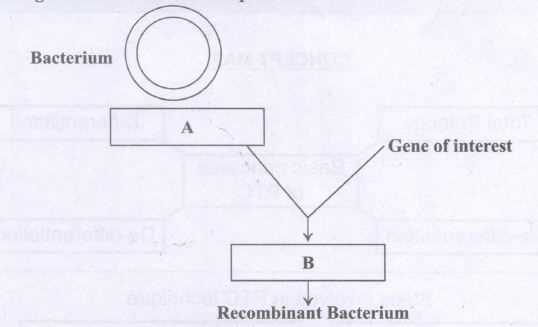
A. Plasmid
B. rDNA / chimeric DNA
16.
Genes in the non-homologous region of the Y-chromosome are inherited directly from male to male. In humans, the Y-linked or holandric genes for hypertrichosis (excessive development of hairs on pinna of the ear) are transmitted directly from father to son, because males inherit the Y chromosome from the father. Female inherits only X chromosome from the father and are not affected.
17.
Blotting refers to the process of immobilization of sample nucleic acids on solid support (nitrocellulose or nylon membranes). The blotted nucleic acids are then used as target in the hybridization experiments for their specific detection.
18.
Fermentation refers to the metabolic process in which organic molecules (normally glucose) are converted into acids, gases, or alcohol in the absence of oxygen or any electron transport chain with oxygen.
19.
(a) Silent mutation
(b) Mis-sense mutation
(c) Non-sense mutation
(d) Frameshift mutation
20.
The term 'crossing over' was coined by Morgan (1912). It takes place during pachytene stage of prophase I of meiosis.
21.
(a) Pleiotropism
(b) Poly genic inheritance
22.
The term genotype is the genetic constitution of an individual. The term phenotype refers to the observable characteristic of an organism.
23.
(i) Continuous self-pollination, generation after generation results in weaker progeny.
(ii) Chances of producing new species and varieties are meager.
24.
In Asteraceae species, the inner layer of integument get specialized for nourishing the embryosac and this is called integumentary tapetum or endothelium.
25.
A pollinium is a coherent mass of pollen grains of an anther
Example: Calotropis.
26.
Sea grasses and mangroves of Estuarine and coastal ecosystems are the most efficient in carbon sequestration. Hence, these ecosystems are called as "Blue carbon ecosystems".
27.
(a) Partial stem parasite - E.g: Loranthus.
(b) Partial root parasite - E.g: Santalum.
28.
Nitrogen -78% , Oxygen -21 %, Carbon-di-oxide -0.03%, Argon and other gases - 0.93%.
29.
(a) Grazing food chain
(b) Detritus food chain
30.
Grey carbon - carbon stored in fossil fuel (coal, oil and biogas deposits in the lithosphere).
Black carbon - carbon emitted from gas, diesel engine and coal fired power plants.
31.
Decomposers are organisms that decompose the dead plants and animals to release organic and inorganic nutrients into the environment which are again reused by plants. Example: Bacteria, Actinomycetes and Fungi.
32.
ELSI which represents ethical, legal and social implications of biotechnology broadly covers the relationship between biotechnology and society with particular reference to ethical and legal aspects.
33.
Protoplasts are the cells without a cell wall, bounded by cell membrane. Fluorescein diacetate (FDA) is used to test the viability of protoplast.
34.
Advantage: Polyploidy often exhibit hybrid vigour and increased tolerance to biotic and abiotic stresses.
Disadvantage: Polyploidy results in reduced fertility due to meiotic error resulting in seedless varieties.
35.
Bio-pesticides are biologically based agents used for the control of plant pests. They are in high use due to their non-toxic, cheaper and eco-friendly characteristics as compared to chemical or synthetic pesticides.
36.
Social forestry refers to the management of forests and afforestation on barren lands with the purpose of helping the environmental, social and rural development and benefits.
37.
Dobson Unit is the unit of measurement for total ozone. One DU is the number of molecules of ozone that would be required to create a layer of pure ozone 0.01 millimeter thick at a temperature of 0° C and a pressure of 1 atmosphere.
38.
Spices are accessory foods mainly used for flavouring during food preparation to improve their palatability. Spices are aromatic plant products and are characterized by sweet or bitter taste. Spices are added in minimal quantities during the cooking process. For example black pepper. Condiments, on the other hand, are flavouring substances having a sharp taste and are usually added to food after cooking. For example, curry leaves.
39.
Millets are gluten free and have less glycemic index, hence it is good for diabetic patients.
40.
Gene Mutation, Chromosomal mutation, Genetic recombination, Natural selection, Reproductive isolation.
41.
| Disease | Casual agent |
| Hepatitis-B | Hepatitis B virus |
| AIDS | HIV(Human Immunodeficiency Virus) |
42.
log S = log C + Z log A
where S = Species richness
A = Area
Z = Slope of the line (regression coefficient)
C = Y-intercept
43.
lt is an enzyme and can be used to separate milk into solid curds for cheese making
44.
Oenology is the science and study of wine and wine making.
45.
When resources are in more than adequate to meet the demands of the organisms seeking them, competition does not occur, but when inadequate to satisfy the need of the organisms seeking them, the weakest, least adapted, or least aggressive individuals are often forced to face challenges. This phenomenon is known as the competitive exclusion principle of Hardin.
46.
The meiotic divisions I & II take place in order to ensure that the ovum is haploid since normal chromosomal number is important for formation of normal zygote. Further polar bodies have less cellular contents and are small since they do not participate in fertilization most of the cellular contents lie in the ovum.
47.
In polymerase chain reaction, the double stranded DNA of interest is denatured to separate into two individual strands by high temperature. This is called denaturation
48.
The process of formation of placenta which is the intimate connection between foetus and uterine wall of the mother for exchange of nutrients is called Placentation.
49.
It is a toxin produced by lysis of insected red blood cells in a person affected with malaria. This causes malaria symptoms such as fever, chills, shivering etc.,
50.
(i) Regeneration is regrowth in the injured region.
(ii) Regeneration is of two types
(a) morphallaxis
(b) epimorphosis.

12th Standard Syllabus & Materials
12th Standard
TN 12th Computer Applications வலையமைப்பு வடமிடல் Sample Question Papers Study Material - QB365 Set A
NEW12th Standard
TN 12th Computer Applications களப்பெயர் முறைமை (DNS) Sample Question Papers Study Material - QB365 Set A
NEW12th Standard
TN 12th Computer Applications வலையமைப்பு எடுத்துக்காட்டுகள் மற்றும் நெறிமுறைகள் Sample Question Papers Study Material - QB365 Set A
NEW12th Standard
TN 12th Computer Applications கணினி வலையமைப்பு ஓர் அறிமுகம் Sample Question Papers Study Material - QB365 Set A



Tamilnadu Stateboard 12th Standard Subjects

Maths

Chemistry

Physics
Biology

Computer Science

Business Maths and Statistics

Economics

Commerce

Accountancy

History

Computer Applications
Biology
Computer Technology
Computer Applications
Computer Science
Business Maths and Statistics
Commerce
Economics
Maths
Chemistry
Physics
Computer Technology
History
Accountancy

Tamil

English

French
Tamilnadu Stateboard Standards

