
 100% FREE ACCESS
12th Standard Syllabus & Materials
12th Standard
TN 12th Computer Applications மின்னணு தரவு பரிமாற்றம் Sample Question Papers Study Material - QB365 Set A
NEW12th Standard
TN 12th Computer Applications மின் - வணிக பாதுகாப்பு அமைப்புகள் Sample Question Papers Study Material - QB365 Set A
NEW12th Standard
TN 12th Computer Applications மின்னணு செலுத்தல் முறைகள் Sample Question Papers Study Material - QB365 Set A
NEW12th Standard
TN 12th Computer Applications மின் - வணிகம் Sample Question Papers Study Material - QB365 Set A
NEW12th Standard
TN 12th Computer Applications திறந்த மூல கருத்துருக்கள் Sample Question Papers Study Material - QB365 Set A
NEW12th Standard
TN 12th Computer Applications வலையமைப்பு வடமிடல் Sample Question Papers Study Material - QB365 Set A

Published on: 27/02/2021
12th Standard English Medium Biology Reduced Syllabus Public Exam Model Question Paper - 2021
Download Tamil Nadu 12th Standard Biology question papers, model tests, one-mark questions, important questions, and public exam papers in PDF format. Free study materials and answer keys for TN State Board students.
Questions + Answers key
Take MCQ Biology Test1.
Explain the sex determination mechanism in Carica papaya.
2.
Observe the tabular column and complete it using proper terms.
| Species 1 | Species 2 | Type of interaction | |
| i | + | A | Mutualism |
| ii | + | O | B |
| iii | C | O | Amensalism |
| iv | + | - | D |
| v | - | E | Competition |
3.
Who am I?
(I) Father of Green Revolution.
(il) Father of Indian Green Revolution
4.
Give examples of any three Wild Life Sanctuaries in Tamilnadu.
5.
Write the key features of organic farming.
6.
What do you know about Germplasm conservation. Describe it.
7.
Differentiate between the eating habit and brain size of Australopithecus and Ramapithecus.
8.
The procedure of GIFT involves the transfer of female gametes into the fallopain tube, can gametes be transferred to the uterus to achieve the same result? Explain.
9.
Explain the role of oxytocin and relaxin in parturition and lactation.
10.
Why does the zygote divides only after the division of Primary endosperm cell.
11.
Explain Dihybrid cross in pea plant.
12.
What does competition refers to? Classify and describe it.
13.
Explain the stepwise preparation of Bio-pest repellent from the leaves of Azadirachta indica
14.
Describe the structure of tRNA with a diagram.
15.
16.
Draw a pyramid from following details and explain in brief.
Quantities of organisms are given-Hawks - 50, plants - 1000.rabbit and mouse - 250 + 250, pythons and lizard - 100 + 50 respectively.
17.
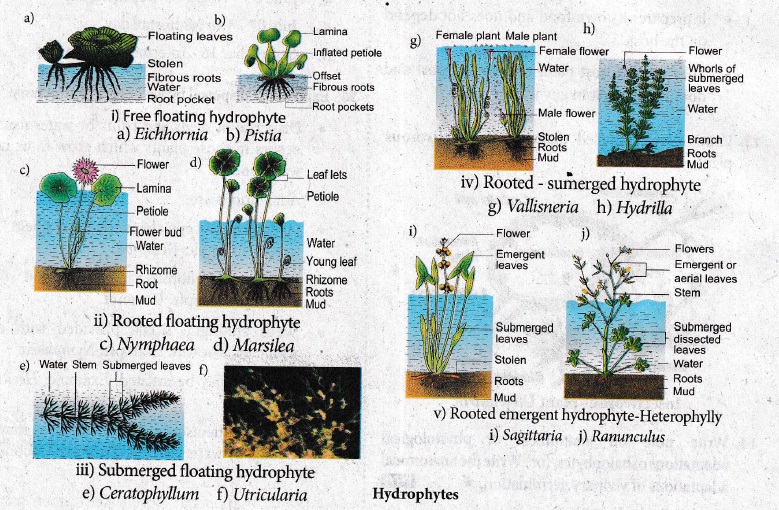
Classify the adaptive traits found in organisms
18.
Describe the mutual relationship between the fig and wasp and comment on the phenomenon that operates in this relationship.
19.
Give a detailed account on parthenocarpy. Add a note on its significance.
20.
Which among the following animals exhibit ovoviviparity?
frog
shark
sheep
hen
21.
Which of the following mRNA yields 6 amino acids after translation?
UCU UAU AGU CGA UGC AGU UGA AAA UUU
UGA AGA UAG GAG CAU CCC UAC UAU GAU
GUC UGC UGG GCU GAU UAA AGG AGC AUU
AUG UAC CAU UGC UGA UGC AGG AGC CCG
22.
Yamuna Action Plan was a bilateral project signed between ________________
India and Pakistan Government
India and Japan Government
India and China Government
India and Srilanka Government
23.
Statement 1: The widely accepted DNA replication model is Holliday's hybrid DNA model.
Statement 2: The vertical cut in the DNA results in heteroduplex with non-recombinants.
Statement 1 is correct and Statement 2 is incorrect
Statement 1 is incorrect and Statement 2 is correct
Both the statements are correct
Both the statements are incorrect
24.
Identify the correct adaptation that checks autogamy
Homogamy
Cleistogamy
Herkogamy
None of the above
25.
Assertion (A) : Plains and valleys are rich in vegetation
Reason (R): Slow drain of surface water and better water retention is noticed.
A is true R is false
R explains A
A and R are false
A and R are true. But R does not explains A
26.
If 1200 Joules of solar energy is trapped by producers, how much of Joules of energy does the organism in the third trophic level will receive?
120 Joules
12 Joules
1.2 Joules
0.12 Joules
27.
Total number of forestry extension centres in Tamil Nadu is ______________
16
32
18
51
28.
A population will not exist in Hardy- Weinberg equilibrium if
Individuals mate selectively
There are no mutations
There is no migration
The population is large
29.
Diapause is a type of response classified under_______.
Suspend
Migrate
Conform
Regulate
30.
31.
Predation and parasitism are which type of interactions?
(+,+)
(+, O)
(--, --)
(+, --)
32.
Micro propagation involves _____.
vegetative multiplication of plants by using micro-organisms.
vegetative multiplication of plants by using small explants.
vegetative multiplication of plants by using microspores.
Non-vegetative multiplication of plants by using microspores and megaspores.
33.
The approach which does not give the defined action of contraceptive is
Hormonal contraceptive-Prevents entry of sperms, prevent ovulation and fertilization
Vasectomy-Prevents spermatogenesis
Barrier method-Prevents fertilization
Intra uterine device-Increases phagocytosis of sperms, suppresses sperm motility and fertilizing capacity of sperms
34.
Which of the following sentences are correct?
1. The offspring exhibit only parental combinations due to incomplete linkage
2. The linked genes exhibit some crossing over in complete linkage
3. The separation of two linked genes are possible in incomplete linkage
4. Crossing over is absent in complete linkage
1 and 2
2 and 3
3 and 4
1 and 4
35.
Which type of bond is formed
(a) between a purine and pyrimidine base?
(b) between the pentose sugar and adjacent nucleotide?
36.
Point out any four peripheral lymphoid organs.
37.
Name any four Mendelian disorders
38.
Define Vivipary.
39.
Write the common name for (i) Vigna radiata (ii) Cajanus cajan
40.
Name and explain the type of barriers which involve macrophages.
41.
How do forests help in maintaining the climate?
42.
43.
Placenta is an endocrine tissue. Justify
1.
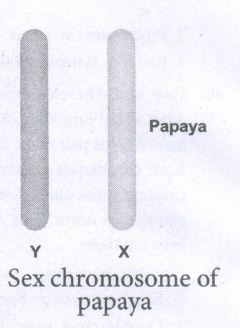
| Genotype | Dominant / recessive | Modification | Sex |
| mm | Homozygous recessive. | Restrict maleness | Female |
| Mlm | Heterozygous. | Induces maleness | Male |
| M2m | Heterozygous. | Induces both the sex | Bisexual (rare) |
| MIMI or M2M2 or MIM2 |
Homozygous / Heterozygous dominant. | Inviable plants | Sterile |
Carica papaya, 2n = 36 (Papaya) has 17 pairs of auto somes and one pair of sex chromosomes. Male papaya plants have XY and female plants have XX. Unlike human sex chromosomes, papaya sex chromosomes look like auto somes and it is evolved from autosome. The sex chromosomes are functionally distinct because the Y chromosome carries the. genes for male organ development and X bears the female organ developmental genes. In papaya sex determination is controlled by three alleles. They are m, M, and M2 of a single gene.
2.
A = +
D = Parasitism
B = Commensalism
E = -
3.
(i) Dr. Norman E. Borlaug.
(ii) Dr. M.S. Swaminathan.
4.
| S. No: |
Prominent WLS in Tamil Nadu | Districts |
|---|---|---|
| i. | Vedanthangal Lake Birds WLS | Chengalpet |
| ii | Mudumalai WLS | Nilgiris |
| iii. | Point Calimere WLS | Nagapattinam |
5.
(i) Protecting soil quality using organic materials and encouraging biological activity.
(ii) Indirect provision of crop nutrients using soil microorganisms.
(iii) Nitrogen fixation in soils using legumes.
(iv) Weed and pest control based on methods like crop rotation, biological diversity, natural predators, organic manures and suitable chemical, thermal and biological interventions.
6.
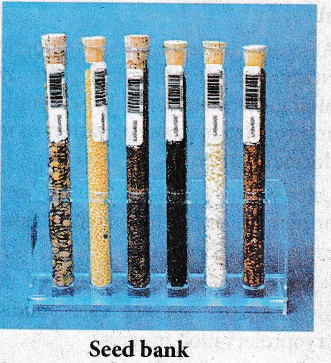
Germplasm Conservation
1. Germplasm conservation refers to the conservation of living genetic resources like pollen, seeds or tissue of plant material maintained for the purpose of selective plant breeding, preservation in live condition and used for many research works.
2. Germplasm conservation resources is a part of collection of seeds and pollen that are stored in seed or pollen banks, so as to maintain their viability and fertility for any later use such as hybridization and crop improvement.
3. Germplasm conservation may also involve a gene bank, DNA bank of elite breeding lines of plant resources for the maintenance of biological diversity and also for food security.
7.
(i) The earliest fossils of the prehistoric man like Ramapithecus lived some 14mya. They were hairy and walked like gorillas and chimpanzees.
(ii) They had a brain capacity of 1300cc.
(iii) They lived on tough food consisting of seeds and savannah grasses and had well developed grains and heavy molars.
(iv) Australopithecus had a brain capacity of 461cc, teeth consisted of small canines and large molars. Good are softer foods consisting of grass, leaves and fruits.
8.
1. Directly gametes cannot be transferred into the uterus, because the uterine environment is not suited for the survival of the gametes.
2. If the gametes directly transferred into the uterus, gametes will undergo degeneration (or) could be phagocytosed and viable zygotes will not be formed.
3. In this method, the own collected from a donor female is transferred to the fallopian tube of another woman.
4. The ovum has to be fertilized by the sperm of the woman's husband; the fallopian tube is the site for fertilization in a human female.
5. The gamete (ovum) if introduced into the uterus cannot move to the fallopian tube, the site of fertilization.
9.
Relaxin
(i) It is a hormone secreted by the placenta and also by the corpus luteum during pregnancy.
(ii) It promotes parturition by relaxing the pelvic joints and by dilation of cervical ligaments with continued powerful contractions.
Oxytocin:
(i) It causes the "Let-Down" reflex.
(ii) The actual ejection of milk from the alveoli of the mammary glands.
(iii) During lactation, oxytocin also stimulates the recently emptied uterus to contract, helping it to return to pre-pregnancy size..
10.
The primary endosperm nucleus divides immediately after fertilization. It develops into an endosperm which is a nutritive tissue and a regulatory structure. The zygote divides only after that to form an embryo so that it can get nourishment from the endosperm that has formed earlier.
11.
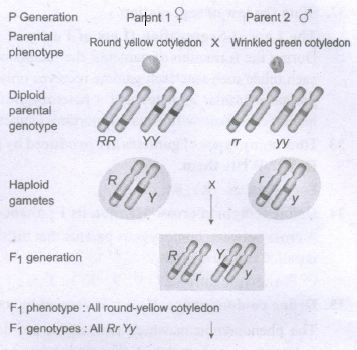
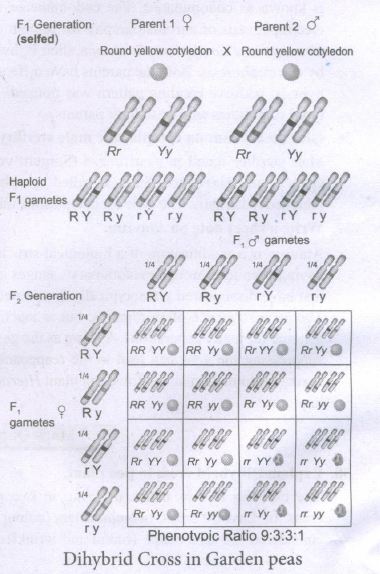
The crossing of two plants differing in two pairs of contrasting traits is called dihybrid cross. In a dihybrid cross, two characters (colour and shape) are considered at a time. Mendel considered the seed shape (round and wrinkled) and cotyledon colour (yellow & green) as the two characters. In seed shape round (R) is dominant over wrinkled (r); in cotyledon colour yellow (Y) is dominant over green (y). Hence the pure breeding round yellow parent is represented by the genotype RRYY and the pure breeding green wrinkled parent is represented by the genotype rryy. During gamete formation the paired genes of a character assort out independently of the other pair. During the F1 x F1 fertilization each zygote with an equal probability receives one of the four combinations from each parent. The resultant gametes thus will be genetically different and they are of the following four types:
1) Yellow round (YR)- 9/16
2) Yellow wrinkled (Yr)- 3/16
3) Green round (yR) - 3/16
4) Green wrinkled(yr) - 1/16
These four types of gametes of F1 dihybrids unite randomly in the process of fertilization and produce sixteen types of individuals in F2 in the ratio of 9 : 3 : 3 : 1 as shown in the figure. Mendel's 9:3:3:1 dihybrid ratio is an ideal ratio based on the probability including segregation, independent assortment and random fertilization. In sexually reproducing organism / plants from the garden peas to human beings, Mendel's findings laid the foundation for understanding inheritance and revolutionized the field of biology. The dihybrid cross and its result led Mendel to propose a second set of generalisations that we called Mendel's Law of independent assortment.
12.
Competition: It is an interaction between two organisms or species in which both the organisms or species are harmed. Competition is the severest in population that has irregular distribution. Competition is classified into intraspecific and interspecific.
1. Intraspecific competition: It is an interaction between individuals of the same species. This competition is very severe because all the members of species have similar requirements of food, habitat and pollination etc., and they also have similar adaptations to fulfill their needs.
2. Interspecific competition: It is an interaction between individuals of different species. In grassland, many species of grasses grow well as there is little competition when enough nutrients and water is available. During drought shortage of water occurs. A life and death competition starts among the different species of grass lands. Survival in both these competitions is determined by the quantity of nutrients, availability of water and migration to new areas. Different species of herbivores, larvae and grass hopper competing for fodder or forage plants. Trees, shrubs and herbs in a forest struggle for sunlight, water and nutrients and also for pollination and dispersal of fruits and seeds. The Utricularia (Bladderwort) competes with tiny fishes for small crustaceans and insects.
13.
Botanical pest repellent and insecticide made with the dried leaves of Azadirachta indica Preparation of Bio-pest repellent
(i) Pluck leaves from the neem tree and chop the leaves finely.
(ii) The chopped up leaves were put in a 50-liter container and fill to half with water; put the lid on and leave it for 3 days to brew.
(iii) Using another container, strain the mixture which has brewed for 3 days to remove the leaves, through fine mesh sieve. The filtrate can be sprayed on the plants to repel pests.
(iv) To make sure that the pest repellent sticks to the plants, add 100 ml of cooking oil and the same amount of soap water. (The role of the soap water is to break down the oil, and the role of the oil is to make it stick to the leaves).
(v) The stewed leaves from the mixture can be used in the compost heap or around the base of the plants.
14.
i) The transfer RNA, (tRNA) molecule of a cell acts as a vehicle that picks up the amino acids scattered through the cytoplasm and also reads specific codes of mRNA molecules. Hence it is called an adapter molecule This term was postulated by Francis Crick.
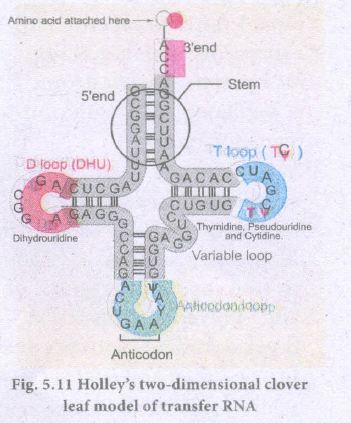
(ii) The two dimensional clover leaf model of tRNA was proposed by Robert Holley. The secondary structure of tRNA depicted in the following picture looks like a clover leaf.
(iii) In actual structure, the tRNA is a compact molecule which looks like an inverted I.
(iv) The clover leaf model of tRNA shows the presence of three arms namely DHU arm, middle arm and TΨC arm.
(v) These arms have loops such as amino acyl binding loop, anticodon loop and ribosomal binding loop at their ends. In addition it also shows a small lump called variable loop or extra arm.
(vi) The amino acid is attached to one end (amino acid acceptor end) and the other end consists of three anticodon nucleotides.
(vii) The anticodon pairs with a codon in mRNA ensuring that the correct amino acid is incorporated into the growing polypeptide chain.
(viii) Four different regions of double-stranded RNA are formed during the folding process. Modified bases are especially common in tRNA.
(ix) Wobbling between anticodon and codon allows some tRNA molecules to read more than one codon.
15.
.jpg)
16.
Grassland ecosystem : There is a gradual decrease in the number of organisms in each trophic level from producers to primary consumers and then to secondary consumers, and finally to tertiary consumers. Therefore pyramids of number in grassland ecosystem are always upright.
17.
Adaptation is a dynamic evolutionary process that fits organisms to their environment and enhancing their evolutionary fitness.
(a) Structural adaptations:
1. The external and internal structures of animals can help them to adapt better to their environment. Some of the most common examples are mammals growing thicker fur to survive freezing climates.
2. Some of the most attractive adaptations in nature occur for reasons of crypsis. (e.g: Camouflage) and mimicry.
3. Cryptic animals are those which camouflage perfectly with their environment and are almost impossible to detect. Certain reptiles and insects such as chameleons and stick insects show this type of adaptation, which helps in prey capture or to evade from predators. Likewise, horse legs are suitable for fast running and adapted for grasslands or plains and similar terrestrial environments.
(b) Behavioural adaptations:
1. Action and behaviour of animals are instinctive or learned. Animals develop certain behavioural traits or adaptations for survival.
2. Fleeing from a predator, hiding during sleep, seeking refuge from climate change or moving to find different food sources are all behavioural adaptations.
3. The two most characteristic forms of behavioural adaptations are migration and courtship.
4. Migration allows the animals to find better resources or evade threat.
5. Courtship is a set of behavioural patterns to find a made to reproduce.
6. Most nocturnal animals remain underground (or) inactive during daytime.
7. This is a modification of their feeding and activity pattern (or) habit (or) behaviour.
(c) Physiological adaptations:
1. The adaptations of organisms that help them to live and survive in their environment with unique niches.
2. Example: Lions have sharp canines to hunt and tear meat of preys and digestive system suitable for digesting raw meat.
3. The two most well-known physiological adaptations are hibernation and aestivation.
4. These are two different types of inactivity where the metabolic rate slows down so much that the animal can survive without eating or drinking.
5. Aquatic medium and terrestrial habitats have their own respective environmental conditions. Hence organisms have to evolve appropriate adaptations to select suitable habitats and niches.
18.
1. In many species of fig trees, there is a one-to one relationship with the pollinator species of wasp. It means that a given fig species can be pollinated only by its 'partner' wasp species & no other species.
2. The female wasp uses the fruit not only as an oviposition (egg, laying) site but uses the developing seeds within the fruit for nourishing its larvae.
3. The wasp pollinates the fig inflorescence while searching for suitable egg-laying sites.
4. In return for the favour of pollination the fig offers the wasp, some of its developing seeds, as food for the developing wasp larvae.
5. The relationship that operates here is co-evolution.
19.
(i) The production and development of seedless fruit is called parthenocarpy.
(ii) Fruit like structures may develop from the ovary without the act of fertilization. Such fruits are called parthenocarpic fruits
Examples: Seedless-Banana, Grapes, Papaya
(i) Parthenocarpy is of three types
1) Genetic Parthenocarpy
(i) Arises due to hybridization or mutation.
2) Environmental Parthenocarpy
Environmental conditions like frost, fog, low or high temperature induce Parthenocarpy.
Example - low temperature for 3-19 hours induces parthenocarpy in Pear.
3) Chemically induced Parthenocarpy
(i) By the application of growth promoting hormones like auxins and gibberellins.
Significance:
(i) Seedless fruits - Significance in Horticulture have commercial value useful for the preparation of jarns, jellies, sauces, fruit drinks,
(ii) High proportion of edible part is available
20.
(b)
shark
21.
(a)
UCU UAU AGU CGA UGC AGU UGA AAA UUU
22.
(b)
India and Japan Government
23.
(d)
Both the statements are incorrect
24.
(c)
Herkogamy
25.
(b)
R explains A
26.
(c)
1.2 Joules
27.
(b)
32
28.
(a)
Individuals mate selectively
29.
(a)
Suspend
30.
(b)
31.
(d)
(+, --)
32.
(b)
vegetative multiplication of plants by using small explants.
33.
(b)
Vasectomy-Prevents spermatogenesis
34.
(c)
3 and 4
35.
a) Purine and pyrimidine bases are linked by hydrogen bonds.
b) Pentose sugar is linked to adjacent nucleotide by phosphodiester bonds.
36.
Lymph nodes, spleen, tonsils, MALT
37.
(a) Thalassemia
(b) Albinism
(c) sickle cell anaemia
(d) Huntington's chorea
38.
Vivipary is a condition in which animals give rise to living young ones after being nourished in the uterus through the placenta. E.g. human
39.
(i) Vigna radiata - Green gram.
(ii) Cajanus cajan - Red gram or pigeon pea.
40.
The type of barrier that involves macrophages are the
(i) Phagocytic barriers which is a type of innate immunity.
(ii) In this mechanism, specialised cells such as monocytes, Neutrophils and tissue macro phages pha cytose and digest whole microorganisms.
41.
(a) Trees provide micro climate for crops and maintain O2 - CO2 balance atmospheric temperature & relative humidity
(b) Suitable for dry land where rainfall is minimum hence it is a good system for alternate land use pattern
42.
43.
Placenta during pregnancy secretes hormones such as human chorionic gonadotrophic (hcG) estrogen, progesterone and human placenta lactogen. So, placenta is regarded as an endocrine tissue.

12th Standard Syllabus & Materials
12th Standard
TN 12th Computer Applications களப்பெயர் முறைமை (DNS) Sample Question Papers Study Material - QB365 Set A
NEW12th Standard
TN 12th Computer Applications வலையமைப்பு எடுத்துக்காட்டுகள் மற்றும் நெறிமுறைகள் Sample Question Papers Study Material - QB365 Set A
NEW12th Standard
TN 12th Computer Applications கணினி வலையமைப்பு ஓர் அறிமுகம் Sample Question Papers Study Material - QB365 Set A
NEW12th Standard
TN 12th Computer Applications PHP-உடன் MySQL-ஐ இணைத்தல் Sample Question Papers Study Material - QB365 Set A



Tamilnadu Stateboard 12th Standard Subjects

Maths

Chemistry

Physics
Biology

Computer Science

Business Maths and Statistics

Economics

Commerce

Accountancy

History

Computer Applications
Biology
Computer Technology
Computer Applications
Computer Science
Business Maths and Statistics
Commerce
Economics
Maths
Chemistry
Physics
Computer Technology
History
Accountancy

Tamil

English

French
Tamilnadu Stateboard Standards

