
 100% FREE ACCESS
12th Standard Syllabus & Materials
12th Standard
TN 12th Computer Applications மின்னணு தரவு பரிமாற்றம் Sample Question Papers Study Material - QB365 Set A
NEW12th Standard
TN 12th Computer Applications மின் - வணிக பாதுகாப்பு அமைப்புகள் Sample Question Papers Study Material - QB365 Set A
NEW12th Standard
TN 12th Computer Applications மின்னணு செலுத்தல் முறைகள் Sample Question Papers Study Material - QB365 Set A
NEW12th Standard
TN 12th Computer Applications மின் - வணிகம் Sample Question Papers Study Material - QB365 Set A
NEW12th Standard
TN 12th Computer Applications திறந்த மூல கருத்துருக்கள் Sample Question Papers Study Material - QB365 Set A
NEW12th Standard
TN 12th Computer Applications வலையமைப்பு வடமிடல் Sample Question Papers Study Material - QB365 Set A

Published on: 27/02/2021
12th Standard English Medium Biology Reduced Syllabus Three mark Important Questions - 2021(Public Exam )
Download Tamil Nadu 12th Standard Biology question papers, model tests, one-mark questions, important questions, and public exam papers in PDF format. Free study materials and answer keys for TN State Board students.
Questions + Answers key
Take MCQ Biology Test1.
How does an orchid ophrys ensures its pollination by bees ?
2.

From the above figure identify the type of mutation and explain it.
3.
“The endosperm of angiosperm is different from gymnosperm”. Do you agree. Justify your answer.
4.
Name the absorbents or materials used to manage menstruation.
5.
Write the hormonal composition of oral contraceptive pills. Also, explain their action mode
6.
Explain briefly on the nature of Ovovivipary.
7.
What is LH surge?
8.
What is strobilation?
9.
What is euthenics?
10.
What are millets? What are its types? Give example for each type.
11.
How do sacred groves help in the conservation of biodiversity?
12.
Name of the food chain which is generally present in all type of ecosystem. Explain and write their significance.
13.
14.
Where are biodiversity hotspots normally located? Why?
15.
Explain the role of cry-genes in genetically modified crops.
16.
What are the strategies to be implemented in India to attain total reproductive health?
17.
What are the cells involved innate immune system.
18.
Differentiate incomplete dominance and codominance.
19.
How can we control eutrophication?
20.
What are stem cells? Explain its role in the field of medicine
21.
Explain the basic concepts involved in plant tissue culture
22.
How does Mutation theory of De Vries differ from Lamarck and Darwin’s view in the origin of new species.
23.
What are the three structural differences between RNA and DNA?
24.
What is male heterogamety?
25.
Give reasons for the following:
(a) Some organisms like honey bees are called parthenogenetic animals
(b) A male honey bee has 16 chromosomes where as its female has 32 chromosomes
1.
The plant, Ophrys orchid, the flower looks like a female insect to attract the make insect to get pollinated by the male insect.
2.
(i) A type of structural chromosomal abbrevation.
Reverse tandem duplication
(ii) The duplicated segment is located immediately after the normal segment but the gene sequence order will be reversed.
3.
The endosperm in gymnosperms is haploid because it is formed from the haploid megaspore. In angiosperm the endosperm is triploid, a product or triple fusion.
4.
Clean and safe absorbable clothing materials, sanitary napkins, pads, tampons, and menstrual cups have been identified as materials used to manage menstruation
5.
Oral contraceptive pills are enriched with synthetic progesterone and oestrogen hormones. These pills prevent the ovulation by inhibiting the secretion of LH and FSH hormones.
6.
In Ovoviviparous animals, the embryo develops inside the egg and remains in the mother's body until they are ready to hatch. This method of reproduction is similar to viviparity but the embryos have no placental connection with the mother and receive their nourishment from the egg yolk. Ovoviviparity is seen in fishes like shark
7.
During the ovulatory phase of the menstrual cycle, maximum secretion of leutinising hormone occurs during the mid cycle (about 14th day) which is called LH surge and induces ovulation.
8.
(i) In some metazoan animals, a special type of transverse fission called strobilation occurs.
(ii) In the process of strobilation, several transverse fissions occur simultaneously giving rise to a number of individuals which often do not separate immediately from each other. E.g. Aurelia.
9.
(i) The science of improvement of existing human race by improving the environmental conditions is called euthenics.
(ii) It can be achieved by subjecting them to better nutrition, better unpolluted ecological conditions, better education and sufficient medical facilities.
10.
| S.No | Common name | Botanical name |
| 1 | Foxtail Millet | Staria italica |
| 2 | Kodo Millet | Paspalum scrobiculatum |
11.
(i) They help for detailed floristic and faunistic studies
(ii) These groves provide a number of ecosystem services to the neighborhood like protecting watershed, fodder, medicinal plants and microclimate control
12.
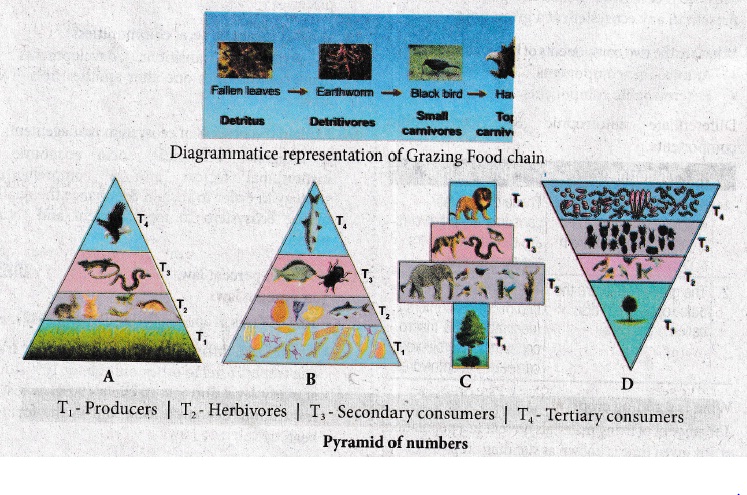
Detritus food chain
(i) This type of food chain begins with dead organic matter which is an important source of energy.
(ii) A large amount of organic matter is derived from the dead plants, animals and their excreta.
(iii) This type of food chain is present in all ecosystems
(iv) The transfer of energy from the dead organic matter is transferred through a series of organisms called detritus consumers. (detrivores)-Small carnivores -large (top) carnivores with repeated eating and being eaten respectively.
13.
14.
(i) Hotspots are areas characterized with high concentration of endemic species experiencing unusual rapid rate of habitat modification loss. Norman Myers defined hot spots as "regions that harbour a great diversity of endemic species and at the same tie, have been significantly impacted and altered by human activities."
(ii) A hotspot is a region that supports at least 1500 endemic vascular plant species (0.5% of the global total) has lost more than 70% of its original vegetation.
(iii) There are 35 biodiversity hotspots in the world. India is home to four biodiversity hotspots. They are:
(1) Himalaya: Entire Indian Himalayan region.
(2) Western Ghats
(3) Indo - Burma: Entire North-eastern India, except Assam and Andaman group of Islands (and Myanmar, Thailand, Vietnam, Laos, Cambodia and Southern China)
(4) Sundarlands: Includes Nicobar group of Islands (and Indonesia, Malaysia, Singapore, Brunei, Philippines).
15.
(i) Bacillus thuringiensis is a soil dwelling bacterium which is commonly used as a biopesticide and contains a toxin called cry toxin. Scientists have introduced this toxin producing genes into plants and have raised genetically engineered insect resistant plants. Eg. Bt-cotton.
(ii) When the insects ingest the toxin crystals their alkaline digestive tract denatures the insoluble crystals making them soluble. The cry toxin then gets inserted into the gut cell membrane and paralyzes the digestive tract. The insect then stops eating and starves to death.
16.
(i) Creating awareness and providing medical assistance to build a healthy society.
(ii) Introducing sex education in schools to provide information about adolescence and adolescence related changes.
(iii) Educating couples and those in the marriageable age groups about the available birth control methods and family planning norms.
17.
(i) Certain types of leukocytes (WBCs), such as polymorphonuclear leucocytes (PMNL), neutrophils, monocytes, and natural killer cells [NK cells] (a type of lymphocytes) in the blood as well as macrophages in tissues can phagocytose and destroy microbes
(ii) Besides the phagocytes there are natural killer cells (NK cells) in the body which kills virus infected and some tumor cells.
(iii) These cells are categorized under the cellular barriers.
18.
| Incomplete Dominance | Co-dominance |
| When one allele is not completely dominant to another allele. | lt occurs due to simultaneous expression of both alleles in the heterozygote. |
| E.g: Flowers colour of Mirabilis Jalapa | E.g: ABO blood group system in human beings. |
19.
1. Improvement of the purifying performance of waste water treatment plants, installing tertiary treatment systems to reduce nutrient concentration.
2. Implementation of effective filter ecosystems to remove nitrogen and phosphorus present in the run-off water.
3. Reduction of phosphorus in detergents.
4. Rationalisation of agricultural techniques through proper planning of fertilization and use of slow release fertilizers.
5. Use of alternative practices in animal husbandry to limit the production of waste water.
20.
(i) Stem cells are undifferentiated cells found in most of the multicellular animals.
(ii) These cells maintain their undifferentiated state even after undergoing repeated mitotic divisions.
(iii) Stem cells research has the potential to revolutionize the future of medicine with the ability to regenerate damaged and diseased organs.
(iv) Stem cell research has the potential to revolutionize the future of medicine with the ability to regenerate damaged and diseased organs.
(v) They are capable of self renewal and exhibit 'cellular potency'.
(vi) They can differentiate into all types of cells that are derived from any of the three germ layers ecto, endo and mesoderms.
(vii) In mammals there are two types of stem cells namely embryonic stem cells & adult stem cells (ES).
(viii) ES are pleuripotent and can produce the three primary germ layers ectoderm, Mesoderm and endoderm.
(ix) Embryonic stem cells are multipotent stem cells that can differentiate into a number of type of cells.
(x) ES cells are isolated from the epiblast tissue of the inner cell mass of a blastocyst.
(xi) When stimulated ES can develop into more than 200 cells Qpes of the adult body.
(xii) ES cells are immortal i.. e they can proliferate in a sterile culture medium and maintain their undifferentiated state.
(xiii) Adult stem cells are found in various tissues of children as well as adults.
(xiv) An adult stem cell or somatic stem cell can divide and create another cell similar to it.
(xv) Most of the adult stem cells are multipotent and can act as a repair system of the body and replenishing adult tissues.
(xvi) The red bone marrow is a rich source of adult stem cells.
(xvii) The most important and potential application of human stem cells is the generation of cells and tissues that could be used for cell based therapies.
(xviii) Human stem cells could be used to test new drugs.
21.
Basic concepts of Tissue Culture
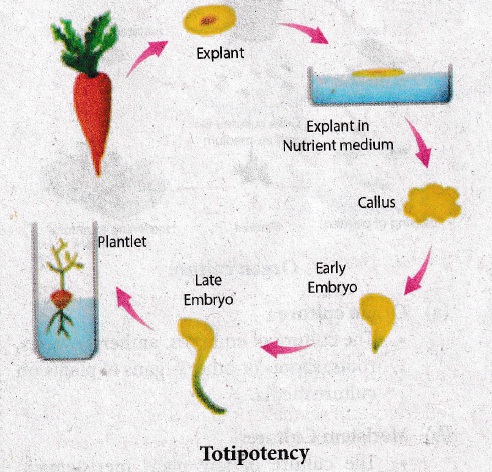
Basic concepts of plant tissue culture are totipotency, differentiation, dedifferentiation and redifferentiation.
Totipotency
The property of live plant cells that they have the genetic potential when cultured in nutrient medium to give rise to a complete individual plant.
Differentiation
The process of biochemical and structural changes by which cells become specialized in form and function.
Redifferentiation
The further differentiation of already differentiated cell into another type of cell. For example, when the component cells of callus have the ability to form a whole plant in a nutrient medium, the phenomenon is called redifferentiation.
Dedifferentiation
The phenomenon of the reversion of mature cells to the meristematic state leading to the formation of callus is called dedifferentiation. These two phenomena of redifferentiation and dedifferentiation are the inherent capacities of living plant cells or tissue. This is described as totipotency.
22.
1. Hugo de Vries by his experiment suggest that variations is caused due to mutation among the genetic sequence of an individual.
2. Hugo de vries for the first time gave the term saltation which stands for huge mutation in a single step resulting in speciation.
3. Darwin during his voyage in H.M.S. Beagle he found that living organism share similar features existed from million of years.
4. Evolution is a sequential process that leads to betterment of life forms to cope with change in environment and that is passed to successive generation called as natural selection.
5. Mutation is a random process and direction which is not specific.
23.
Structural difference between DNA and RNA.
| DNA | RNA |
| It is double stranded with exception of some viruses | It is generally single stranded |
| It is the genetic material in all living organism | It is genetic material in some viruses only |
| The sugar is deoxy ribose (pentose) | The sugar is ribose (pentose) |
| Nitrogenous bases present are adenine, guanine, thymine and cytosine | Nitrogenous bases present are adenine, guanine, cytosine and uracil |
| It is less reactive, chemically and structurally more stable. | It is more reactive chemically and structurally less stable |
| It usually occurs inside the nucleus and in some cell organelles like mitochondria and chloroplasts. |
Very little RNA occurs inside the nucleus. most of its found in the cytoplasm |
24.
Heterogametic Males:
In this method of sex determination the males are heterogametic producing dissimilar gametes while females are homogametic producing similar gametes.
It is of kinds XX-XO type and XX-XY type.
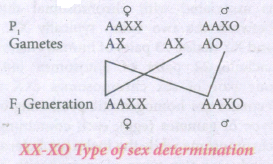
(i) XX-XO Type
(a) This method of sex determination is seen in bugs and some insects such as cockroaches and grasshoppers.
(b) The female with two X chromosomes are homogametic (XX) while the males with only one X chromosome are heterogametic (XO).
(c) The presence of an unpaired X chromosomes determines the male sex. The males with unpaired 'X' chromosome produce two types of sperms, one half with X chromosome and other half without X chromosome.
(d) The sex of the offspring depends upon the sperm that fertilizes the egg.
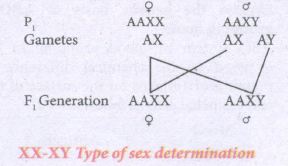
(ii) XX-XV type (Lygaeu Type):
This method of sex determination is seen in human beings and in Drosophila.
(a) The females are homogametic with XX chromosome, while the males are heterogametic with X and Y chromosome.
(b) Homogametic females produce only one kind of egg, each with one X chromosome, while the heterogametic males produce two kinds of sperms some with X chromosome and some with Y chromosome.
(c) The sex of the embryo depends on the fertilizing sperm. An egg fertilized by an 'X' bearing sperm produces a female, if fertilized by a 'Y' bearing sperm, a male is produced.
25.
(a) Some organisms like honeybees are called parthenogenetic animals.
1. In case of honeybees both haploid and diploid individuals formed, as a result of incomplete parthenogenesis.
2. Both sexual reproduction and parthenogenesis are inclusive.
3. Fertilized eggs (zygote) give rise to queen and workers (both are females) by the process of sexual reproduction.
4. Unfertilized eggs (ova) of females develop into drones (males) by the process of parthenogenesis.
(b) A male honeybee has 16 chromosomes where as its female has 32 chromosomes
1. It is because of haplodiploidy which is a sex determination system, in which males develop from unfertilized eggs (parthenogenesis) and are haploid (16n) and females develop frorn fertilized eggs and are diploid (32n) (sexual reproduction).
2. As unfertilized egg carries only half number of chromosome as compared to fertilized egg.
Therefore male honeybees have 16 chromosomes where as female has 32 chromosomes.

12th Standard Syllabus & Materials
12th Standard
TN 12th Computer Applications களப்பெயர் முறைமை (DNS) Sample Question Papers Study Material - QB365 Set A
NEW12th Standard
TN 12th Computer Applications வலையமைப்பு எடுத்துக்காட்டுகள் மற்றும் நெறிமுறைகள் Sample Question Papers Study Material - QB365 Set A
NEW12th Standard
TN 12th Computer Applications கணினி வலையமைப்பு ஓர் அறிமுகம் Sample Question Papers Study Material - QB365 Set A
NEW12th Standard
TN 12th Computer Applications PHP-உடன் MySQL-ஐ இணைத்தல் Sample Question Papers Study Material - QB365 Set A



Tamilnadu Stateboard 12th Standard Subjects

Maths

Chemistry

Physics
Biology

Computer Science

Business Maths and Statistics

Economics

Commerce

Accountancy

History

Computer Applications
Biology
Computer Technology
Computer Applications
Computer Science
Business Maths and Statistics
Commerce
Economics
Maths
Chemistry
Physics
Computer Technology
History
Accountancy

Tamil

English

French
Tamilnadu Stateboard Standards

