
 100% FREE ACCESS
12th Standard Syllabus & Materials
12th Standard
TN 12th Computer Applications மின்னணு தரவு பரிமாற்றம் Sample Question Papers Study Material - QB365 Set A
NEW12th Standard
TN 12th Computer Applications மின் - வணிக பாதுகாப்பு அமைப்புகள் Sample Question Papers Study Material - QB365 Set A
NEW12th Standard
TN 12th Computer Applications மின்னணு செலுத்தல் முறைகள் Sample Question Papers Study Material - QB365 Set A
NEW12th Standard
TN 12th Computer Applications மின் - வணிகம் Sample Question Papers Study Material - QB365 Set A
NEW12th Standard
TN 12th Computer Applications திறந்த மூல கருத்துருக்கள் Sample Question Papers Study Material - QB365 Set A
NEW12th Standard
TN 12th Computer Applications வலையமைப்பு வடமிடல் Sample Question Papers Study Material - QB365 Set A

Published on: 27/02/2021
12th Standard English Medium Biology Reduced Syllabus Three mark Important Questions with Answer key - 2021(Public Exam )
Download Tamil Nadu 12th Standard Biology question papers, model tests, one-mark questions, important questions, and public exam papers in PDF format. Free study materials and answer keys for TN State Board students.
Questions + Answers key
Take MCQ Biology Test1.
Differentiate foeticide and infanticide
2.
Define the term Diplospory
3.
Is there any possibilities to transfer a suitable desirable gene to host plant without vector? Justify your answer.
4.
Write a brief note on Chipko movement.
5.
Write a brief note on Habitat fragmentation.
6.
Comment on Golden rice.
7.
What is the naming procedure for restriction endonuclease? Give an example
8.
What is frame shift mutation?
9.
How crossing over differs from linkage?
10.
Cleistogamous flower and chasmogamous flower. In which type does the autogamy is certain? why?
11.
Write a short notes on Atavism.
12.
Give a brief account on pollination process in Zea mays.
13.
Nutrients are retained in the ecosystem. Discuss how and name the process through which it is achieved?
14.
Write a brief note on Detritus food chain.
15.
Point out the Anatomical adaptations exhibited by the Halophytes.
16.
What are the adverse effects of temperature on plant?
17.
Comment on Biosafety.
18.
What are the optimal conditions that favours the induction of callus from nutrient medium?
19.
Mention any three advantages of Arbuscular mycorrhizal association.
20.
Prosopis juliflora, though an alien invasive species to India, it is beneficial to certain extent. Give reason.
21.
Write a note on origin and area of cultivation of cotton.
22.
Mention ways of controlling depletion of ozone layer
23.
What are DNA vaccines?
24.
Why do we find a decrease in biodiversity distribution, if we move from the tropics towards the poles?
25.
Who disproved Lamarck’s Theory of acquired characters? How?
1.
| Foeticide | Infanticide |
| It refers to aborting the female in the mother's womb. |
It refers to killing the female child after her birth |
2.
A diploid embryosac is formed from megaspore mother cell without a regular meiotic division
Example:
Eupatorium, Aerva
3.
Direct or Vector less Gene Transfer
In the direct gene transfer methods, the foreign gene of interest is delivered into the host plant without the help of a vector, The following are some of the common methods of direct gene transfer in plants.
(i) Chemical mediated gene transfer: Certain chemicals like polyethylene glycol (PEG) and dextran sulphate induce DNA uptake into plant protoplasts.
(ii) Microinjection: The DNA is directly injected into the nucleus using fine tipped glass needle or micro pipette to transform plant cells. The protoplasts are immobilized on a solid support (agarose on a microscopic slide) or held with a holding pipette under section.
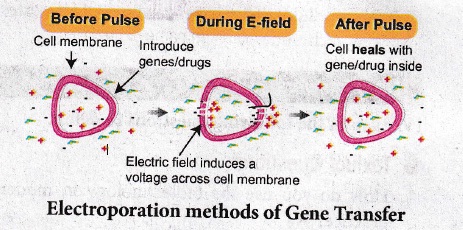
(iii) Electroporation Methods of Gene Transfer: A pulse of high voltage is applied to protoplasts, cells or tissues which makes transient pores in the plasma membrane through which uptake of foreign DNA occurs.
(iv) Liposome mediated method of Gene transfer: Liposomes the artificial phospholipid vesicles are useful in gene transfer. The gene or DNA is transferred from liposome into vacuole of plant cells. It is carried out by encapsulating DNA into the vacuole. This technique is advantageous because the liposome protects the introduced DNA from being damaged by the acidic pH and protease enzymes present in the vacuole. Liposome and tonoplast of vacuole fusion resulted in gene transfer. This process is called lipofection.
.jpg)
(v) Biolistics: The foreign DNA is coated onto the surface of minute gold or tungsten particles (1-3 \(\mu\)m) and bombarded onto the target tissue or cells using a particle gun (also called as gene gun/ micro projectile gun/shotgun) Then the bombarded cells or tissues are cultured on selected medium to regenerate plants from the transformed cells.
4.
The Bishnois, who are known conservators of their forest, were inspiration to many people's participatory movements for Environmental protection in India. The Chipko movement resisted the destruction of forests of India in the 1970s. Sunderlal Bahuguna was the leader of this movement. People in the movement hugged the trees, and prevented felling of trees by contractors.
5.
Habitat fragmentation is the process where a large, continuous area of habitat is both, reduced in area and divided into two or more fragments. Fragmentation of habitats like forest land into crop lands, orchard lands, plantations, urban areas, industrial estates, transport and transit systems has resulted in the destruction of complex interactions amongst species, (food chain and webs) destruction of species in the cleared regions, annihilation of species restricted to these habitats (endemic) and decreased biodiversity in the habitat fragments. Animals requiring large territories such as mammals and birds are severely affected. The elephant corridors and migratory routes are highly vulnerable. The dwindling of-many well-known birds (sparrows) and animals can be attributed to this.
6.
Golden rice is a variety of Oryza sativa (rice) produced through genetic engineering of biosynthesized beta-carotene, a precursor of Vitamin-A in the edible parts of rice developed by Ingo Potrykus and his group. The aim is to produce a fortified food to be grown and consumed in areas with a shortage of dietary Vitamin-A, which kills so many children under five year age. Golden rice differs from its parental strain by the addition of three beta-carotene biosynthesis genes namely 'psy' (phytoene synthase) from daffodil plant Narcissus pseudonarcissus and 'crt-I' gene from the soil bacterium Erwinia uredovora and 'lyc' (lycopene cyclase) gene from wild-type rice endosperm. The endosperm of normal rice, does not contain beta-carotene. Golden-rice has been genetically altered so that the endosperm now accumulates Beta-carotene. This has been done using Recombinant DNA technology. Golden rice can control childhood blindness - Xerophthalmia.
7.
(i) Restriction endonucleases are named by a standard procedure.
(ii) The first letter of the enzymes indicates the genus name, followed by the first two letters of the species, then comes the strain of the organism and finally a roman numeral indicating the order of discovery.
For example, EeoRl is from Escherichia (E) coli (co), strain RY 13 (R) and first endonuclease (I) to be discovered.
8.
Mutations that result in the addition or deletion of a single base pair of DNA that changes the reading frame for the translation process as a result of which there is complete loss of normal protein structure and function are called Frameshift mutations.
9.
| S.No. | Linkage | Crossing over |
| 1. | The genes present on chromosome stay close together. | It leads to separation of linked genes. |
| 2. | It involves same chromosome of homologous chromosome. | It involves exchange of segments between non-sister chromatids of homologous chromosome |
| 3. | It reduces new gene combinations. | It increases variability by forming new gene combinations. Leading to formation of new organism. |
10.
Autogamy is certain in cleistogamous flowers since they never open and expose the reproductive organs.
11.
Atavism is a modification of a biological structure whereby an ancestral trait reappears after having been lost through evolutionary changes in the previous generations. Evolutionary traits that have disappeared phenotypically do not necessarily disappear from an organism's DNA. The gene sequence often remains, but is inactive. Such an unused gene may remain in the genome for many generations. As long as the gene remains intact, a fault in the genetic control suppressing the gene can lead to the reappearance of that character again. Reemergence of sexual reproduction in the flowering plant Hieracium pilosella is the best example for Atavism in plants.
12.
The maize is monoecious and unisexual. The male inflorescence (tassel) is borne terminally and female inflorescence (cob) laterally at lower levels. Maize pollens are large and heavy and cannot be carried by a light breeze. However, the mild wind shakes the male inflorescence to release the pollen which falls vertically below. The female inflorescence has a long stigma (silk) measuring up to 23 mm in length, which projects beyond leaves. The pollens drop from the tassel is caught by the stigma.
13.
Nutrients will retain in the ecosystem through biogeochemical cycles. Various nutrients present in soil and atmosphere enter the organism at various trophic levels through food and other process and are cycled back to their origin. Thus the nutrients are not lost but retained in the ecosystem.
14.
Detritus food chain is a type of food chain which begins with dead organic matter which is an important source of energy. A large amount of organic matter is derived from the dead plants, animals and their excreta. This- type of food chain is present in all ecosystems. The transfer of energy from the dead organic matter, is transferred through a series of organisms called detritus consumers (detritivores)- small carnivores -large (top) carnivores with repeated eating arid being eaten respectively. This is called the detritus food chain.
Fallen leaves ➝ Earth worm ➝ Black bird ➝ Hawk
Detritus Detritivores Small carnivores Top carnivores
15.
Anatomical adaptations:
1. Epidermal cells of stem is heavily cutinized, almost squarish and are filled with oil and tannins.
2. 'Star' shaped sclereids and 'H' shaped heavy thickened spicules that provide mechanical strength to cortex are present in the stem.
3. The leaves may be dorsiventral or isobilateral with salt secreting glands.
16.
1. Temperature affects the enzymatic action of all the bio-chemical reactions in a plant body.
2. Low temperature with high humidity can spread diseases to plants.
3. The varying temperature with moisture determines the distribution of the vegetation types.
17.
Biosafety is the prevention of large-scale loss of biological integrity, focusing both on ecology and human health. These prevention mechanisms include conduction of regular reviews of the biosafety in laboratory settings, as well as strict guidelines to follow. Biosafety is used to protect from harmful incidents. Many laboratories handling biohazards employ an ongoing risk management assessment and enforcement process for biosafety. Failures to follow such protocols can lead to increased risk of exposure to biohazards or pathogens. Human error and poor techniques contribute to unnecessary exposure to hazards arid compromise the best safeguards set into place for protection.
18.
After the inoculation of explant in the nutrient medium supplemented with auxins and incubated at 25°C ± 2°C in an alternate light and dark period of 12 hours with light intensity of 1000 lux, induces cell division leading to the development of callus from the surface of explant.
19.
i) Arbuscular mycorrhizae have the ability to dissolve the phosphate found in soil.
ii) Provides resistance against diseases, germs, and unfavorable weather conditions.
iii) It assures water availability.
20.
Prosopis juliflora is used to arrest wind erosion and stabilize sand dunes on coastal and desert areas. It can absorb hazardous chemicals from soil and it is the main source of charcoal.
21.
Cotton is one of the oldest cultivated crops of the world. It has been cultivated for about 8000 years both in new world and in old world. Commercial cotton comes from four cotton species: two from the new world and two from the old world.
(1) Gossypium hirsutum
(2) G.barbadense are the New world species and
(3) G. arboretum
(4) G. herbaceum are the old world species.
In India, cotton is cultivated in Gujarat, Maharashtra, Andhra Pradesh and Tamil Nadu.
22.
(i) Phase down or ban the use of CFCs (CFC free refrigerants).
(ii) Minimizing the use of chemicals such as halons and halocarbons.
(iii) Creating awareness about ozone depleting agents.
23.
(i) Genetic immunization by using DNA vaccines is a novel approach that came into being in 1990.
(ii) The immune response of the body is stimulated by a DNA molecule.
(iii) A DNA vaccine consists of a gene encoding an antigen protein, inserted on to a plasmid, and then incorporated into the cells in a target animal.
(iv) DNA instructs the cells to make antigenic molecules which are displayed on its surfaces. This would evoke an antibody response to the free floating antigen secreted by the cells.
(v) The DNA vaccine cannot cause the disease as it contains only copies of a few of its genes.
(vi) DNA vaccines are relatively easy and inexpensive to design and produce.
(vii) Vaccines produced by these new techniques have definite advantages like producing target proteins, long lasting immunity and trigger immune response only against specific pathogens with less toxic effects.
24.
The term biodiversity was introduced by Walter Rosen (1986). Biodiversity is the assemblage of different life forms. Each species is adapted to live in its specific environments.
The changes in climatic conditions are reflected in the distribution and pattern of biodiversity on our planet. The number of species per unit area declines as we move from tropics towards the poles. The Tundra and Taiga of northern Canada, Alaska, northern Europe and Russia possess less than 12 species of trees. The temperate forests of the United states have 20-35 species of trees, while the tropical forests of Panama have over 110 species of trees in a relatively small area.
25.
Lamarcks 'theory of acquired character's was disproved by August Weismann who conducted experiments on mice for twenty generations by cutting their tails and Weismann proved that change in the somatoplasm will not be transferred to the next generation but changes in the germplasm will be inherited.

12th Standard Syllabus & Materials
12th Standard
TN 12th Computer Applications களப்பெயர் முறைமை (DNS) Sample Question Papers Study Material - QB365 Set A
NEW12th Standard
TN 12th Computer Applications வலையமைப்பு எடுத்துக்காட்டுகள் மற்றும் நெறிமுறைகள் Sample Question Papers Study Material - QB365 Set A
NEW12th Standard
TN 12th Computer Applications கணினி வலையமைப்பு ஓர் அறிமுகம் Sample Question Papers Study Material - QB365 Set A
NEW12th Standard
TN 12th Computer Applications PHP-உடன் MySQL-ஐ இணைத்தல் Sample Question Papers Study Material - QB365 Set A



Tamilnadu Stateboard 12th Standard Subjects

Maths

Chemistry

Physics
Biology

Computer Science

Business Maths and Statistics

Economics

Commerce

Accountancy

History

Computer Applications
Biology
Computer Technology
Computer Applications
Computer Science
Business Maths and Statistics
Commerce
Economics
Maths
Chemistry
Physics
Computer Technology
History
Accountancy

Tamil

English

French
Tamilnadu Stateboard Standards

