
 100% FREE ACCESS
12th Standard Syllabus & Materials
12th Standard
TN 12th Maths Applications of Matrices and Determinants Sample Question Papers Study Material - QB365 Set A
NEW12th Standard
TN 12th Computer Applications மின்னணு தரவு பரிமாற்றம் Sample Question Papers Study Material - QB365 Set A
NEW12th Standard
TN 12th Computer Applications மின் - வணிக பாதுகாப்பு அமைப்புகள் Sample Question Papers Study Material - QB365 Set A
NEW12th Standard
TN 12th Computer Applications மின்னணு செலுத்தல் முறைகள் Sample Question Papers Study Material - QB365 Set A
NEW12th Standard
TN 12th Computer Applications மின் - வணிகம் Sample Question Papers Study Material - QB365 Set A
NEW12th Standard
TN 12th Computer Applications திறந்த மூல கருத்துருக்கள் Sample Question Papers Study Material - QB365 Set A

Published on: 27/02/2021
12th Standard English Medium Biology Reduced Syllabus Two mark Important Questions with Answer key - 2021(Public Exam )
Download Tamil Nadu 12th Standard Biology question papers, model tests, one-mark questions, important questions, and public exam papers in PDF format. Free study materials and answer keys for TN State Board students.
Questions + Answers key
Take MCQ Biology Test1.
Discuss the gross primary productivity is more efficient than net primary productivity.
2.
How is the amplification of a gene sample of interest carried out using PCR?
3.
‘Red data book’-What do you know about it?
4.
5.
Correct the following statements
a) Transfer of an ovum collected from donor into the fallopian tube is called ZIFT.
b) Transfering of an embryo with more than 8 blastomeres into uterus is called GIFT.
c) Multiload 375 is a hormone releasing IUD.
6.
7.
Mention any two differences between Homo habilis and Homo erectus
8.
Atavistic organs - comment.
9.
What are UTR's?
10.
What is Q10 value? How it is calculated?
11.
Define the term eutrophication.
12.
Name the various types of prokaryotic DNA polymerase. State their role in replication process.
13.
Expand and define BOD
14.
Give reason. (a) Flavour in Yogurt
(b) Large holes in Swiss Cheese
15.
What does IUCN stand for?
16.
Name the antibody responsible for allergic reaction. Also, mention two chemicals released during allergic response.
17.
Name the Agranulocytes involved in immune response
18.
Comment on SCID
19.
What causes shivering in malarial patient?
20.
Differentiate between infectious and non-infections disease.
21.
What is the phenotype of (a) IAlO (b) 1O1O
22.
Name the discoverers of antigen A, B, and AB.
23.
What are the components that make up external genitalia female?
24.
Point out any four STD's caused by viruses
25.
Repeated fission is a type of multiple fission. Yes or No? Why?
26.
Coconut is an albuminous seed. Why?
27.
How self-pollination is avoided in Abutilon?
28.
What is Nucellus
29.
Point out the advantages of natural vegetative reproduction
30.
What are actual remains?
31.
Name two major International environmental conventions.
32.
What is the purpose of barrier method of contraception?
33.
What is ecosystem/community diversity?
34.
What are the aims of National River conservation plan (NRCP)?
35.
How are antibiotics classified?
36.
StateIordon's rule.
37.
What is significance of lactalbumin?
38.
What is azospermia?
39.
Name the types of cells found in seminiferous tubule.
40.
Name two RNA viruses which cause diseases in humans.
41.
What is genophore?
42.
What is paedogenesis?
43.
What are exogenous buds?
44.
Name the humors that are responsible for the health of human beings.
45.
What is Zero Stress?
46.
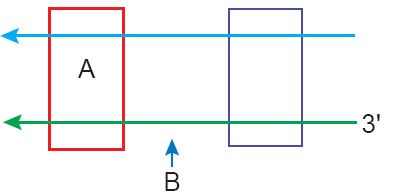
Name the parts marked ‘A’ and ‘B’ in the given transcription unit:
47.
What are interferons? Mention their role.
48.
Name an organism where cell division is itself a mode of reproduction.
49.
Explain how mutations, natural selection and genetic drift affect Hardy Weinberg equilibrium.
50.
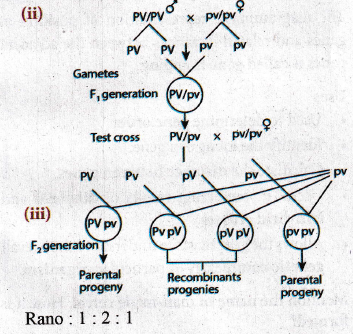
If you cross dominant genotype PV/PV male Drosophila with double recessive female and obtain F1 hybrid. Now you cross F1 male with double recessive female.
i) What type of linkage is seen?
ii) Draw the cross with correct genotype.
iii) What is the possible genotype in F2 generation?
1.
Gross Primary Productivity (GPP) is the total amount of food energy or biomass produced in an ecosystem by autotrophs through the process of photosynthesis whereas Net Primary Productivity (NPP) is the proportion of energy which remains after respiration loss in the plant. When we compare GPP with NPP more energy is present in former than in latter.
2.
(i) Polymerase chain Reaction
(ii) In this process, multiple copies of the gene/ DNA of interest are synthesized in vitro using two sets of primers.
(iii) Primers are the chemically synthesized obligonucleotides that are complementory to the regions of DNA strands, where they will be annelated
(iv) The two strands of DNA have been separated by denaturation.
(v) The enzyme DNA polymerase extends the primers using the nucleotides provided in the medium on the genomic DNA as template.
(vi) To achieve repeated amplification, a thermostable DNA polymerase, called Taq polymerase obtained from Thermus aquaticus is used; it can withstand the high temperature used for the denaturation of DNA.
3.
(i) Red Data Book or Red list is a catalogue of taxa facing risk of extinction.
(ii) IUCN - International Union of Conservation of Nature and Natural Resources
(iii) WCU - World Conservation Union maintains the Red Data Book.
(iv) The concept of Red list was mooted in 1963.
The purpose of preparation of Red List are:
(i) To create awareness on the degree of threat to biodiversity
(ii) Identification and documentation of species at high risk of extinction
(iii) Provide global index on declining biodiversity
(iv) Preparing conservation priorities and help in conservation of action
(v) Information on international agreements on conservation of biological diversity
Red list has eight categories of species:
(i) Extinct
(ii) Extinct in wild
(iii) Critically Endangered
(iv) Endangered
(v) Vulnerable
(vi) Lower risk
(vii) Data deficiency
(viii) Not evaluated.
4.
5.
(a) Transfer of an ovum collected from donor into the fallopian tube is called GIFT (Gamete Intra-fallopian transfer)
(b) Transferring of an embryo with more than 8 blastomeres into uterus is called IUT (Intra uterine transfer)
(c) Multi load 375 is a copper releasing IUD
6.
7.
| Homo habilis | Homo erectus |
|---|---|
| The brain capacity was between 650-800 cc. They were probably vegetarians. | The brain capacity was around 900 cc. They probably ate meat. |
8.
Sudden appearance of vestigial organs in highly evolved organisms is called atavistic organs. Example, presence of tail in human baby is an atavistic organ
9.
mRNA also have some additional sequences that are not translated and are referred to as Untranslated Regions (UTR). UTRs are present at both 5' end (before start codon) and at 3' end (after stop codon).
10.
The effect of temperature on the rate of reaction is expressed in terms of temperature coefficient or Q10 value. The Q10 values are estimated taking the ratio between the rate of reaction at XoC and rate of reaction at (X-10°C).
11.
When run-off from land containing nutrients reaches water bodies like lakes, it results in dense growth of plant life. This phenomenon is called Eutrophication.
12.
DNA polymerase I }
DNA polymerase II } Involved in DNA repair mechanism
DNA polymerase III} Involved in DNA replication
13.
BOD - Biological Oxygen Demand (or) Biochemical Oxygen Demand
BOD refers to the amount of the oxygen that would be consumed if all the organic matter in one litre of water were oxidized by bacteria.
14.
(a) The flavor in yogurt is due to acetaldehyde formation.
(b) Large holes in Swiss Cheese is due to more CO2 production by Propionibacterium shermanii
15.
IUCN - International Union for Conservation of Nature and Natural resources:
16.
IgE (epsilon) antibody is responsible for allergic reaction.
Histamine and serotonin are the chemicals released during allergic reaction.
17.
(a) Lymphocyte
(b) Monocytes
18.
ADA deficiency or SCID (Severe Combined Immuno Deficiency) is an autosomal recessive metabolic disorder. It is caused by the deletion or dysfunction of the gene coding for ADA enzyme. In these patients the nonfunctioning T-Lymphocytes cannot elicit immune responses against invading pathogens
19.
After infection of RBC with sporozoite, when the RBC ruptures a toxic substance haemozoin is released which causes shivering chills and high fever followed by sweating
20.
| Infectious disease | Non-infectious disease |
|---|---|
| Disease which are transmitted form one person to another are called infectious disease. e.g. Common cold | Disease which do not transmitted form one person to another are called non-infectious disease. e.g. Anaemia |
21.
(a) IAlO - A blood group person
(b) 1O1O - O blood group person
22.
Antigens A and Antigen B was discovered by Karl Landsteiner. Antigen AB was discovered by Von De Castelle and Sturli.
23.
Labia Majora, Labia Minora, Hymen and Clitoris
24.
1. Genital herpes
2. Hepatitis -B
3. Genital warts
4. AIDS
25.
Yes. If multiple fission produces four or many daughter individuals by equal cell division and the young ones do not separate until the process is complete, then this division is called repeated fission e.g. Vorticella
26.
Since coconut seed possesses endosperm, It is called as albmunious seed. Endosperm nourishes the embryo during seed germination.
27.
In Abutilon, the self-pollination is avoided by self sterility or self-incompatibility, in which if the pollen grain reaches the stigma of the same flower, it will be prevented from germination. It is a genetic mechanism.
28.
The body of the ovule is made up of a central mass of parenchymatous tissue called nucellus which has large reserve food materials.
29.
(a) Only one parent is required.
(b) New individuals are genetically similar
(c) Rapid spreading
(d) Large scale production
30.
The original hard parts such as bones, teeth or shells are preserved as such in the earth's atmosphere. This is the most common method of fossilization.
31.
(i) 1992: Earth summit, Rio de Janeiro. Agenda 21, otherwise called Rio conference, Brazil
(ii) 1997: Kyoto Protocol, Japan.
32.
In these methods, the ovum and sperm are prevented from meeting so that fertilization does not occur.
33.
Community/ecosystem diversity is the variety of habitats, biotic communities and ecological processes in the biosphere.
34.
The aims of NRCP are:
(i) To capture the raw sewage flowing into the river through open drains and divert them for treatment.
(ii) Setting up sewage treatment plants for treating the diverted sewage.
(iii) Construction of low cost sanitation toilets to prevent open defecation on river banks
35.
Antibiotics are classified as:
Broad-spectrum antibiotics: They act against a wide range of disease-causing bacteria.
Eg.streptomycin
Narrow-spectrum antibiotics They are active against a selected group of bacterial types
36.
In some aquatic environments, an inverse relationship between water temperature and fish meristic characters is observed - lower the temperature, more the vertebrae.
37.
It is a protein which is most abundant in human milk. It is synthesized by the mammary glands. It binds calcium and zinc ions and possesses bactericidal and antitumour properties
38.
Azospermia refers to the failure of spermatogenesis. It is seen in males.
39.
(i) Sertoli cells or nurse cell
(ii) Spermatogonic cells
40.
Rubella Virus - causes Measles
Polio virus - causes Poliomyelitis
41.
The DNA as a nucleoid is organized into large loops held by protein. DNA of prokaryotes is almost circular and lacks chromatin organization, hence termed genophore.
42.
(i) In paedogenetic parthenogenesis (paedogenesis) the larvae produce a new generation oflarvae by parthenogenesis.
(ii) It occurs in the sporocysts and Redia larvae of liver fluke.
43.
When buds are formed on the outer surface of the parent body, it is known as exogenous budding. E.g. Hydra.
44.
Vatam, Pittam and Kapam.
45.
This is the level of exposure of plants to environmental factors that leads to neither injury nor reduction in growth and yield of crops.
46.
A - \(5^{\prime} \rightarrow 3^{\prime}\) is called a coding strand.
B - \(3^{\prime} \rightarrow 5^{\prime}\) is called a template strand.
47.
Interferons: These are the proteins made and released by host cells in response to the presence of pathogens such as viruses, bacteria, parasites etc
RoIe: They inhibit viral infections and stimulate the entire immune system to fight disease. They also regulate many kinds of cell functions
48.
In monocellular organs cell division is itself a mode of reproduction. (e.g:) Bacteria, Euglena and Amoeba.
49.
1. There are five basic processes that affect the Hardy-Weinberg equilibrium and cause variations at genetic level.
2. These include (i) Mutation (ii) recombination (iii) Gene migration (iv) Genetic drift and (v) natural selection.
3. Among the above five processes, lets discuss how mutation, natural selection and genetic drift affect Hardy Weinberg equilibrium.
(a) Mutation:
1. Mutation are sudden heritable changes in the characteristics of the organisms.
2. These mutations are random (indiscriminate) with respect to the adoptive needs of organisms.
3. Most mutations are harmful or with no effects (neutral) on their bearers.
4. However under changed environmental conditions, the alleles, which were previously harmful or neutral may become advantageous.
5. The rate of mutation is very slow usually one mutation occurs in a million still these mutation rates are sufficient to create considerable genetic variation.
6. Mutations help in maintaining variations within population.
7. Mutation also introduce new genes and alleles into the gene pool (sum total of all genotypes or alleles found in a population).
8. It is the gene pool in which new genes are added or removed. This variability of genes (or) alleles in a gene pool, then serve as a raw material for evolutionary changes.
9. The accumulation of many mutations over hundreds of generation cause large scale changes.
(b) Natural selection
1. Natural selection is the most important evolutionary process that brings about changes in allele frequencies.
Definition
1. The process of differential reproduction that lead to differential contribution of genotypes to the gene pool of the next generation.
2. Natural selection results a change in allele frequencies of a population.
(c) Genetic drift
1. It refers to the elimination of certain genes in a small isolated population either due to intensive inbreeding causing permanent fixation of some genes or death of a small section of population by natural calamity.
Definition
1. The random changes in the allele frequency occurring by chance alone are called genetic drift.
2. This means that the alleles that form the gene pool of the next generation are a sample of the allele from current generation.
3. Sampling errors (chances) often lead to the elimination of certain alleles and fixation by others thus reducing the genetic variability of the population.
4. The effect of genetic drift is very small in large but can be large in a small population.
5. Thus these forces that change the allele and genotypic frequencies in a population and so called evolutionary agents.
6. As long as Hardy-Weinberg Equilibrium remains constant the evolution cannot occur since the genetic equilibrium is a sort of inertia whose tendency is rather conservative. Evolution become possible only if the inertia is overcome or the equilibrium is broken.
50.
(i) Incomplete linkage
Rano : 1:2:1

12th Standard Syllabus & Materials
12th Standard
TN 12th Computer Applications வலையமைப்பு வடமிடல் Sample Question Papers Study Material - QB365 Set A
NEW12th Standard
TN 12th Computer Applications களப்பெயர் முறைமை (DNS) Sample Question Papers Study Material - QB365 Set A
NEW12th Standard
TN 12th Computer Applications வலையமைப்பு எடுத்துக்காட்டுகள் மற்றும் நெறிமுறைகள் Sample Question Papers Study Material - QB365 Set A
NEW12th Standard
TN 12th Computer Applications கணினி வலையமைப்பு ஓர் அறிமுகம் Sample Question Papers Study Material - QB365 Set A



Tamilnadu Stateboard 12th Standard Subjects

Maths

Chemistry

Physics
Biology

Computer Science

Business Maths and Statistics

Economics

Commerce

Accountancy

History

Computer Applications
Biology
Computer Technology
Computer Applications
Computer Science
Business Maths and Statistics
Commerce
Economics
Maths
Chemistry
Physics
Computer Technology
History
Accountancy

Tamil

English

French
Tamilnadu Stateboard Standards

