
 100% FREE ACCESS
12th Standard Syllabus & Materials
12th Standard
TN 12th Maths Applications of Matrices and Determinants Sample Question Papers Study Material - QB365 Set A
NEW12th Standard
TN 12th Computer Applications மின்னணு தரவு பரிமாற்றம் Sample Question Papers Study Material - QB365 Set A
NEW12th Standard
TN 12th Computer Applications மின் - வணிக பாதுகாப்பு அமைப்புகள் Sample Question Papers Study Material - QB365 Set A
NEW12th Standard
TN 12th Computer Applications மின்னணு செலுத்தல் முறைகள் Sample Question Papers Study Material - QB365 Set A
NEW12th Standard
TN 12th Computer Applications மின் - வணிகம் Sample Question Papers Study Material - QB365 Set A
NEW12th Standard
TN 12th Computer Applications திறந்த மூல கருத்துருக்கள் Sample Question Papers Study Material - QB365 Set A

Published on: 13/05/2022
QB365 provides detailed and simple solution for every Creative Questions in class 12 Biology Subject. It will helps to get more idea about question pattern in every Creative questions with solution.
latest Creative QuestionsDownload Tamil Nadu 12th Standard Biology question papers, model tests, one-mark questions, important questions, and public exam papers in PDF format. Free study materials and answer keys for TN State Board students.
Questions + Answers key
Take MCQ Biology Test1.
Mention the reasons for the richness biodiversity in the tropics.
2.
Explain in detail about various types of extinctions.
3.
What is the significance of slope of regression in a species area relationship?
4.
Give an account on genetic diversity and community diversity.
5.
Write a note on gene banks
1.
(i) The reasons for the richness of biodiversity the tropics are: Warm tropical regions between the tropics of Cancer and Capricorn on either of equator possess congenial habitats living organisms.
(ii), Environmental conditions of the tropics are favorable not only for special but also for supporting both variety number of organisms. J
(iii) The temperatures vary between 25o to 35oC, a range in which most meta activities of living organisms occur ease and efficiency.
(iv)The average rainfall is often more 200 mm per year. .
(v) Climate, seasons, temperature, humid photoperiods are more or less stable encourage both variety and numbers.
(vi) Rich resource and nutrient availability.
(vii) Rich resource and nutrient availability.
2.
There are three types of Extinctions
i. Natural extinction: It is a slow process of replacement of existing species with better adapted species due to changes in environmental conditions, evolutionary changes, predators and diseases. A small population can get extinct sooner than the large population due to inbreeding depression (less adaptivity and variation)
ii. Mass extinction: The Earth has experienced quite a few mass extinctions due to environmental catastrophes. Amass extinction occurred about 225 million years ago during the Permian, where 90% of shallow water marine invertebrates disappeared .
iii. Anthropogenic extinctions: These are abetted by human activities like hunting, habitat destruction, over exploitation, urbanization and industrialization. Some examples of extinctions are Dodo of Mauritius and Steller's sea cow of Russia. Amphibians seem to be at higher risk of extinction because of habitat destruction. The most serious aspect of the loss of biodiversity is the extinction of species. The unique information contained in its genetic material (DNA) and the niche it possesses are lost forever.
3.
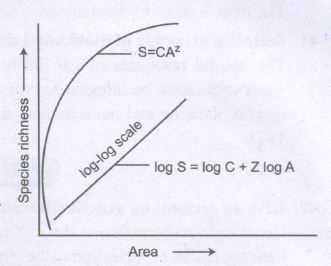
German Naturalist and Geographer Alexander von Humboldt explored the wilderness of south American jungles and found that within a region the species richness increased with increasing area but upto a certain limit. The relationship between species richness and area for a wide variety of taxa (angiosperm plants, birds, bats and freshwater fishes) turned out to be the rectangular hyperbola. On a logarithmic scale, the relationship is a straight line described by the equation.
where
log S = log C + Z log A
S = Species richness
A = Area
Z = Slope of the line
(regression coefficient)
C = Y-intercept
Regression coefficient Z generally has a value of 0.1-0.2 regardless of taxonomic group or region. However, in case of the species - area relationship in very large areas like entire continents; the slope of the line appears to be much steeper (Z-value in the range of 0.6-1.2). For example, in case of the fruit eating (frugivorous) birds and mammals in the tropical forests of different continents, the slope is found to be a steeper line.
4.
Genetic diversity refers to the differences in genetic make-up (number and types of genes) between distinct species and to the genetic variation within a single species, also covers genetic variation between distinct populations of the same species. Genetic diversity can be measured using a variety of molecular techniques. India has more than 50,000 genetic variants of Paddy and 1000 variants of Mango. Variation of genes of a species increases with diversity in size and habitat. It results in the formation of different races, varieties and subspecies. Rouwolfia vomitaria, a medicinal plant growing in different ranges of the Himalayas shows differences in the potency and concentration of the active ingredient reserpine due to genetic diversity Genetic diversity helps in developing adaptations to changing environmental conditions. Community/Ecosystem diversity is the variety of habitats, biotic communities, and ecological processes in the biosphere. It is the diversity at ecosystem level due to diversity of niches, trophic levels and ecological processes like nutrient cycles, food webs, energy flow and several biotic interactions. India with its alpine meadows, rain forests, mangroves, coral reefs, grass lands and deserts has one of the greatest ecosystem diversity on Earth.
5.
(i) Gene banks are a type of biorepository which preserve genetic materials. Seeds of different genetic strains of commercially important plants can be stored in long periods in seed banks, gametes of threatened species can be preserved in viable and fertile condition for long periods using cryopreservation techniques.
(ii) However, it is not economically feasible to conserve all biological wealth and all the ecosystems. The number of species required to be saved from extinction far exceeds the conservation efforts.

12th Standard Syllabus & Materials
12th Standard
TN 12th Computer Applications வலையமைப்பு வடமிடல் Sample Question Papers Study Material - QB365 Set A
NEW12th Standard
TN 12th Computer Applications களப்பெயர் முறைமை (DNS) Sample Question Papers Study Material - QB365 Set A
NEW12th Standard
TN 12th Computer Applications வலையமைப்பு எடுத்துக்காட்டுகள் மற்றும் நெறிமுறைகள் Sample Question Papers Study Material - QB365 Set A
NEW12th Standard
TN 12th Computer Applications கணினி வலையமைப்பு ஓர் அறிமுகம் Sample Question Papers Study Material - QB365 Set A



Tamilnadu Stateboard 12th Standard Subjects

Maths

Chemistry

Physics
Biology

Computer Science

Business Maths and Statistics

Economics

Commerce

Accountancy

History

Computer Applications
Biology
Computer Technology
Computer Applications
Computer Science
Business Maths and Statistics
Commerce
Economics
Maths
Chemistry
Physics
Computer Technology
History
Accountancy

Tamil

English

French
Tamilnadu Stateboard Standards



