
 100% FREE ACCESS
12th Standard Syllabus & Materials
12th Standard
TN 12th Computer Applications மின்னணு தரவு பரிமாற்றம் Sample Question Papers Study Material - QB365 Set A
NEW12th Standard
TN 12th Computer Applications மின் - வணிக பாதுகாப்பு அமைப்புகள் Sample Question Papers Study Material - QB365 Set A
NEW12th Standard
TN 12th Computer Applications மின்னணு செலுத்தல் முறைகள் Sample Question Papers Study Material - QB365 Set A
NEW12th Standard
TN 12th Computer Applications மின் - வணிகம் Sample Question Papers Study Material - QB365 Set A
NEW12th Standard
TN 12th Computer Applications திறந்த மூல கருத்துருக்கள் Sample Question Papers Study Material - QB365 Set A
NEW12th Standard
TN 12th Computer Applications வலையமைப்பு வடமிடல் Sample Question Papers Study Material - QB365 Set A

Published on: 02/06/2021
QB365 provides detailed and simple solution for every book back questions in class 12 Biology subject.It will helps to get more idea about question pattern in every book back questions with solution.
Download Tamil Nadu 12th Standard Biology question papers, model tests, one-mark questions, important questions, and public exam papers in PDF format. Free study materials and answer keys for TN State Board students.
Questions + Answers key
Take MCQ Biology Test1.
What is soil permeability?
2.
Define ecological niche.
3.
What would Earth be like without the greenhouse effect?
4.
Expand
(i) CFC
(ii) AQI
(iii) PAN
5.
Why do animals have greater diversification than plant diversity?
6.
Name the active chemical found in the medicinal plant Rauwolfia vomitoria. What type of diversity it belongs to?
7.
8.
Mention any two ways in which single nucleotide polymorphism (SNPs) identified in human genome can bring revolutionary change in biological and medical science.
9.
Give reasons: ‘Genetic code is universal’.
10.
11.
12.
What are interferons? Mention their role.
13.
Name an organism where cell division is itself a mode of reproduction.
14.
Explain hibernation and aestivation with examples.
15.
16.
What is genetically engineered Insulin?
17.
‘Red data book’-What do you know about it?
18.
19.
Which method do you suggest the couple to have a baby, if the male partner fails to inseminate the female or due to very low sperm count in the ejaculate?
20.
Select the correct term from the bracket and complete the given branching tree
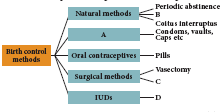
(Barriers, Lactational amenorrhoea, CuT, Tubectomy)
21.
In E.coli, three enzymes β- galactosidase, permease and transacetylase are produced in the presence of lactose. Explain why the enzymes are not synthesized in the absence of lactose.
22.
What is colostrum? Write its significance.
23.
24.
25.
Given below are some human organs. Identify one primary and one secondary lymphoid organ. Explain its role. Liver, thymus, stomach, thyroid, tonsils.
1.
1. The characteristic of soil that determines the movement of water through pore spaces is known as soil permeability.
2. Soil permeability is directly dependent on the pore size. Water holding capacity of the soil is inversely dependent on soil porosity.
2.
Ecological niche is a term for the position of a species within an ecosystem, describing both the range of conditions necessary for persistence of species, and is ecological role in the ecosystem.
3.
The naturally occurring greenhouse gases in the air, mainly carbon dioxide, methane and water vapour trap radiation from the sun and act like a thermal blanket around our planet earth. Without the greenhouse gases, the earth would have an average temperature of -180 c and be covered in ice. The greenhouse effect keeps the earth warm enough to sustain life.
4.
(i) CFC - Chloro fluoro carbon
(ii) AQI - National Air Quality Index
(iii) PAN - Peroxyacetyl Nitrate
5.
More than 70% of species recorded on earth are animals and 22% are planted. This is because the animals have adapted themselves to ensure their survival in changing environments in comparison to plants. Eg. Presence of nervous system helps animals to control and coordinate their body structures. Therefore diversification in animals is more than in plants.
6.
(i) The chemical found in the medicinal plant Rauwolfia vomitoria is reserpine.
(ii) It belong to Genetic diversity.
7.
8.
There are 1.4 million locations where single base DNA differences (Called SNPs - Single Nucleotide Polymorphism - pronounce as snips) occurs in human's genome.
(i) By tracing human history
(ii) By finding chromosomal locations for disease associated sequences
9.
1. The genetic code is universal. It means that all known living systems use nucleic acids and the same three base codons (triplet codon) direct the synthesis of protein from amino acids. E.g, mRNA ,(UUU) codon codes for phenylalanine in all cells of all organisms.
2. Some exceptions are reported in prokaryotic, mitochondrial and chloroplast genomes. However similarities are more common than differences.
10.
11.
12.
Interferons: These are the proteins made and released by host cells in response to the presence of pathogens such as viruses, bacteria, parasites etc
RoIe: They inhibit viral infections and stimulate the entire immune system to fight disease. They also regulate many kinds of cell functions
13.
In monocellular organs cell division is itself a mode of reproduction. (e.g:) Bacteria, Euglena and Amoeba.
14.
Hibernation:
Spending the winter in an inactive dormant state to escape in time, is called hibernation. E.g: Bears and Frogs.
Aestivation:
Spending the dry, hot period in an inactive state to escape in time is called aestivation .E.g: Snails and Fish.
15.
16.
1. Production of insulin by recombinant DNA technology started in the late 1970s.
2. This technique involved the insertion of human insulin gene on the plasmids of E. coli.
3. The polypeptide chains are synthesized as a precursor called pre-pro insulin, which contains A and B segments linked by a third chain (C) and preceded by a leader sequence.
4. The leader sequence is removed after translation and the C chain is excised, leaving the A and B polypeptide chains.
5. Insulin was the first eyer pharmaceutical product of recombinant DNA technology administered to human. In 1986 human insulin was marketed under the trade name humulin.
17.
(i) Red Data Book or Red list is a catalogue of taxa facing risk of extinction.
(ii) IUCN - International Union of Conservation of Nature and Natural Resources
(iii) WCU - World Conservation Union maintains the Red Data Book.
(iv) The concept of Red list was mooted in 1963.
The purpose of preparation of Red List are:
(i) To create awareness on the degree of threat to biodiversity
(ii) Identification and documentation of species at high risk of extinction
(iii) Provide global index on declining biodiversity
(iv) Preparing conservation priorities and help in conservation of action
(v) Information on international agreements on conservation of biological diversity
Red list has eight categories of species:
(i) Extinct
(ii) Extinct in wild
(iii) Critically Endangered
(iv) Endangered
(v) Vulnerable
(vi) Lower risk
(vii) Data deficiency
(viii) Not evaluated.
18.
19.
The method I suggest is Artificial lnsemination Technique (AI)
1. In AI, the semen is collected either from the husband or a healthy donor and then artificially introduced into the vagina or into the uterus (IUI- Intra Uterine Insemination) of the female.
2. It is commonly used in cases where male partner are unable to inseminate the female due to very low sperm counts in the ejaculate.
20.
A - Barrier methods
B - Lactational amenorrhoea
C - Tubectomz
D - CuT
21.
When lactose is absent "i" gene regulates and produces repressor mRNA in the absence of lactose, which blocks the transcription. The repressor protein binds to the operator region of the operon and as a result prevents RNA polymerase from binding to the operon. The operon will be switched off (stop) in this situation.
22.
Colostrum is the yellowish fluid produced from the mother's mammary glands during initial few days of location, after parturition.
Significance:
1. It has less lactose than milk and almost no fat, but it contains more proteins, vitamin A and minerals.
2. Colostrum is also rich in IgA antibodies.
3. This helps to protect the infant's digestive tract against bacterial infection.
4. Breast milk is the ideal food for infants as it contains all the constituents in suitable concentration and is easily digestable.
5. It is fully sufficient till about 6 months of age and all infants must be breast fed by the mother to ensure the growth of a healthy baby.
23.
24.
25.
(i) The primary lymphoid organ is thymus.
(ii) The secondary lymphoid organ is tonsils.
Role of Primary lymphoid organ: Thymus
(i) Thymus is most active during the neonatal and pre-adolescent periods.
(ii) The thymus is a flat and bilobed organ located behind the sternum, above the heart.
(iii) Each lobe of the thymus contains numerous lobules, separated from each other by connective tissue called septa (cross walls).
(iv) Each lobule is differentiate into an outer cortex and an inner medulla. Within each lobule, the developing T cells called thymocytes are arranged into an outer cortex and an inner medulla
(v) An inner medulla contains immature thymocytes and outer cortex has matured thymocyte
(vi) One of its main secretions is the hormone thymosin. It stimulates the T cells to become mature and immunocompetent. By the early teens, (upto 12-13 years) the thymus begins to atrophy and is replaced by adipose tissue (binding tissue).
Secondary lymphoid organ :
(i) The tonsils (palatine tonsils) are a pair of soft tissue masses located at the back of the throat (pharynx ).
(ii) The tonsils are part of the lymphatic system which help to fight against the infections. They stop invading germs including bacterin and viruses.

12th Standard Syllabus & Materials
12th Standard
TN 12th Computer Applications களப்பெயர் முறைமை (DNS) Sample Question Papers Study Material - QB365 Set A
NEW12th Standard
TN 12th Computer Applications வலையமைப்பு எடுத்துக்காட்டுகள் மற்றும் நெறிமுறைகள் Sample Question Papers Study Material - QB365 Set A
NEW12th Standard
TN 12th Computer Applications கணினி வலையமைப்பு ஓர் அறிமுகம் Sample Question Papers Study Material - QB365 Set A
NEW12th Standard
TN 12th Computer Applications PHP-உடன் MySQL-ஐ இணைத்தல் Sample Question Papers Study Material - QB365 Set A



Tamilnadu Stateboard 12th Standard Subjects

Maths

Chemistry

Physics
Biology

Computer Science

Business Maths and Statistics

Economics

Commerce

Accountancy

History

Computer Applications
Biology
Computer Technology
Computer Applications
Computer Science
Business Maths and Statistics
Commerce
Economics
Maths
Chemistry
Physics
Computer Technology
History
Accountancy

Tamil

English

French
Tamilnadu Stateboard Standards



