
 100% FREE ACCESS
12th Standard Syllabus & Materials
12th Standard
TN 12th Maths Applications of Matrices and Determinants Sample Question Papers Study Material - QB365 Set A
NEW12th Standard
TN 12th Computer Applications மின்னணு தரவு பரிமாற்றம் Sample Question Papers Study Material - QB365 Set A
NEW12th Standard
TN 12th Computer Applications மின் - வணிக பாதுகாப்பு அமைப்புகள் Sample Question Papers Study Material - QB365 Set A
NEW12th Standard
TN 12th Computer Applications மின்னணு செலுத்தல் முறைகள் Sample Question Papers Study Material - QB365 Set A
NEW12th Standard
TN 12th Computer Applications மின் - வணிகம் Sample Question Papers Study Material - QB365 Set A
NEW12th Standard
TN 12th Computer Applications திறந்த மூல கருத்துருக்கள் Sample Question Papers Study Material - QB365 Set A

Published on: 13/05/2022
QB365 provides detailed and simple solution for every book back questions in class 12 Biology subject.It will helps to get more idea about question pattern in every book back questions with solution.
latest Book back QuestionsDownload Tamil Nadu 12th Standard Biology question papers, model tests, one-mark questions, important questions, and public exam papers in PDF format. Free study materials and answer keys for TN State Board students.
Questions + Answers key
Take MCQ Biology Test1.
One of the applications of biotechnology is ‘gene therapy” to treat a person born with a hereditary disease
i) What does “gene therapy” mean?
ii) Name the hereditary disease for which the first clinical gene therapy was used.
iii) Mention the steps involved in gene therapy to treat this disease.
2.
Differentiate between Somatic cell gene therapy and germline gene therapy
3.
What are transgenic animals? Give examples
4.
Write the key features of organic farming.
5.
6.
What are the strategies to be implemented in India to attain total reproductive health?
7.
Distinguish between structural gene, regulatory gene and operator gene
8.
Give a schematic representation of spermatogenesis and oogenesis in humans.
9.
What is the composition of semen?
10.
Brief about female heterogamety.
11.
Differentiate Intersexes from Supersexes
12.
13.
Why are the offsprings of oviparous animal at a greater risk as compared to offsprings of viviparous organisms?
14.
The unicellular organisms which reproduce by binary fission are considered immortal. Justify
15.
Explain how ADA deficiency can be corrected
16.
How does Mutation theory of De Vries differ from Lamarck and Darwin’s view in the origin of new species.
17.
Darwin's finches and Australian marsupials are suitable examples of adaptive radiation – Justify the statement
18.
Describe the major STDs and their symptoms.
19.
Why the human genome project is called a mega project?
20.
How is sex determined in human beings?
21.
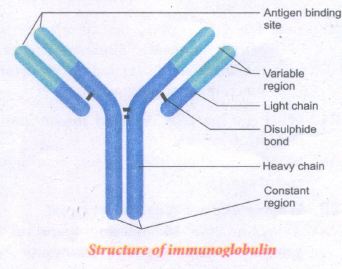
What is vaccine? What are its types?
22.
Name the anticodon required to recognize the following codons: AAU, CGA, UAU, and GCA.
23.
Why tRNA is called an adapter molecule?
24.
Define gametogenesis.
25.
1.
(i) Gene therapy:
1. Gene therapy is the treatment of heredity disorders by replacing a faulty gene by a normal healthy functional gene.
(ii) The first clinical gene therapy was given in 1990 by French Anderson to a four year old girl with adenosine deaminase (ADA) deficiency.
(iii) The lymphocytes from the blood of the patient are removed and grown in a nutrient culture medium.
1. A healthy and functional human gene, ADA cDNA encoding this enzyme is introduced into the lymphocytes using a retrovirus.
2. The genetically engineered lymphocytes are subsequently returned to the patient.
3. These cells are not immortal, the patient requires a periodic infusion of such genetically engineered lymphocytes.
2.
| S.No. | SOMATIC CELL GENE THERAPY | GERMLINE GENE THERAPY |
|---|---|---|
| i. | Therapeutic genes transferred into the somatic cells. | Therapeutic genes transferred into the germ cells. |
| ii. | Introduction of genes into bone marrow cells, blood cells, skin cells, etc., | Genes introduced into eggs and sperms. |
| iii. | Will not be inherited in later generations. | Heritable and passed on to later generations. |
3.
1. The foreign DNA that is introduced is called the transgene and the animals that are produced by DNA manipulations are called transgenic animals or the genetically engineered or genetically modified organisms.
2. Transgenic animals are also used for producing products useful for mankind. E.g: Transgenic cow (rosie), which produced human protein enriched milk (2.4 g/L).
3. The milk contained the human alpha lactalbumin and was nutritionally a more balanced product for human babies than natural cow's milk.
4.
(i) Protecting soil quality using organic materials and encouraging biological activity.
(ii) Indirect provision of crop nutrients using soil microorganisms.
(iii) Nitrogen fixation in soils using legumes.
(iv) Weed and pest control based on methods like crop rotation, biological diversity, natural predators, organic manures and suitable chemical, thermal and biological interventions.
5.
6.
(i) Creating awareness and providing medical assistance to build a healthy society.
(ii) Introducing sex education in schools to provide information about adolescence and adolescence related changes.
(iii) Educating couples and those in the marriageable age groups about the available birth control methods and family planning norms.
7.
| Structural gene | Regulatory gene | operator gene |
| They are concerned with the transcription of mRNA for the synthesis of particular polypeptide |
It controls the functioning of operator gene |
It determines the functioning of operator gene |
| They function only when RNA polymerases join |
It produces a repressor or apo- repressor for blocking operator gene |
It works only when it is not blocked by repressor |
| They function by forming mRNA for specific polypeptide |
It functions through the formation of mRNA of repressor or apo-repressor |
It functions through the presence (or) absence of repressor |
8.
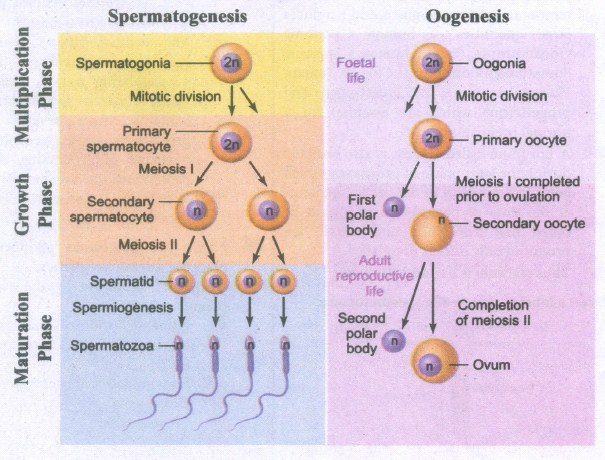
9.
Semen or seminal fluid is a milky white fluid which contains sperms and the seminal plasma, which is secreted from the seminal vesicles, prostate glands and bulbo urethal glands or Cowper's gland.
The semen comprises of Fructose, ascorbic acid, zinc, cholesterol, protein, calcium, chlorine, blood group antigens, citric acid, DNA, magnesium, Vitamin B12, phosphorous, sodium, potassium, uric acid,lactic acid, nitrogen, and other nutrients for the sperms.
10.
1. In this method of sex determination, the homogametic male possesses two 'X' chromosomes as in certain insects and certain vertebrates like fishes, reptiles and birds producing a single type of gamete.
2. The female sex consists of a single 'Y' chromosome. Thus the females are heterogametic and produce two types of eggs.
3. To avoid confusion with the XX-XO and XX-XY trues of sex determination, the alphabets 'Z' and 'W 'are used here instead of X and Y respectively.
4. Heterogametic females are of two types, ZO-ZZ type and ZW-ZZ type.
11.
Intersexes:
1. Intersexes refers to the individuals having the characteristics of both female and male sexes and their sexual anatomy does not seem to fit the typical definition of male or female.
Supersexes:
1. Supersexes ar formed as a result of abnormal combination of sex chromosomes.
2. Example : Super males in humans human beings have 44+XYY
12.
13.
Oviparous animals lay eggs outside their body. These eggs are exposed to various environmental conditions and may be eaten by predators also. They face lot of risks until the young ones hatche. But the offsprings of viviparous animals are more safe and protected in the maternal womb until they are born.
14.
1. In unicellular organism there is no special structure for reproduction.
2. In binary fission the entire parent body constitute the reproductive unit and disappears when its division into two daughter unicellular cell is completed.
3. These two daughter cells function as two new individuals.
4. There is no remains of parent body cell and parent cannot be said to have died.
5. In fact after binary fission parent continues living as two daughter individual.
Hence, the unicellular organisms which undergo binary fission are called immortal (no natural death).
15.
1. A patient is suffering from ADA deficiency can be caused by using "gene therapy''.
2. Gene therapy is a correction of a genetic defect that has been diagnosed in a child embryo.
3. ADA enzyme is crucial fol the immune system to function.
4. Deletion of the gene for adenosine deaminase results into ADA deficiency.
5. In some children, ADA deficiency can be cured by bone. Marrow transplantation While in others it can be treated by enzyme replacement therapy, in which functional ADA is given to the patient by injection. But the problem with both of these approaches is that they are not completely curative.
6. It may recurrent in nature as in the process of gene therapy, Lymphocytes used are found not to be immortal in nature and the patient requires a periodic infusion of such genetically engineered lymphocytes.
7. For permanent cure, gene isolated from the bone-marrow-cells producing ADA is introduced into cells at early embryonic stages.
16.
1. Hugo de Vries by his experiment suggest that variations is caused due to mutation among the genetic sequence of an individual.
2. Hugo de vries for the first time gave the term saltation which stands for huge mutation in a single step resulting in speciation.
3. Darwin during his voyage in H.M.S. Beagle he found that living organism share similar features existed from million of years.
4. Evolution is a sequential process that leads to betterment of life forms to cope with change in environment and that is passed to successive generation called as natural selection.
5. Mutation is a random process and direction which is not specific.
17.
Adaptive radiation is the process of evolution of different species in a given geographical area starting from a point and literally radiating to other geographical area habitats.
1. Darwins finches were the small black birds which Darwin observed in Galapagos islands.
2. There were many varities of these birds in the same island.
3. Darwin reasoned that after originating from a common ancestral seed eating stock the finches must have radiated to different geographical areas and undergone adaptive changes especially in their breaks enabling some of them to become insectivorous.
4. Living isolation for long new kinds of finches must have evolved which could survive in the new habitats.
5. Australian marsupials (Kangaroos) also show adaptive radiation
6. Marsupials in Australia and placental mammals in north America are two subclasses of mammals they adapted in similar way to a particular food resources, locomotary skill or climate.
7 They were separated from the ori-on ancestor more than 100 million year ago and each lineage continued to evolve independently despite temporal and geographical separation marsupials in Australia and placenta mammals in North America have reduced varieties of species living in similar habitats with similar way of life their overall resemblance in shape, locomotary mode, feeding and foraging are superimposed upon different modes of reproduction.
18.
The major sexually transmitted diseases are
(i) Gonorrhoea
1. Causative agent: Neisseria gonorrhoeae
2. Symptoms: Affects the urethra, rectum and throat and in females the cervix also get affected
3. Pain and pus discharge in the genital tract and burning sensation during urination.
4. Incubation period: 2 to 5 days
(ii) Syphilis
Causative agent : Treponema pallidum
Symptoms:
1. Primary stage: Formation of painless ulcer on the external genitalia.
2. Secondary stage : Skin lesions, rashes, swollen joints and fever and hair loss.
3. Tertiary stage : Appearance of chronic ulcers on nose. Lower legs and palate, loss of movement mental disorder visual impairment, heart problems, gummas (soft non-cancerous growths) etc.
(iii) Hepatitis B
1. Causative agent: Hepatitis B virus (HBV) with DNA.
2. Symptoms: Fatigue, jaundice, fever, rash and stomach pain.
3. Liver cirrhosis and liver failure occur in the later stage.
4. Incubation period: 30-80 days
(iv) AIDS:
1. Causative agent: Human immuno deficiency Virus (HIV) .
2. Symptoms: Enlarged lymph nodes, prolonged fever, prolonged diarrhoea, weight reduction, night sweating.
3. Incubation periods: 2 to 6 weeks even more than 10 years
19.
Human genome project was considered to be a mega project because
1. It had a specific goal to sequence for everybase pair present in the human genome. (Human Genome has 3.1647 billion nucleotide base pairs).
2. It took around 13 years of completion and got accomplished in year 2006.
3. It was a large-scale project, which aimed at developing new technology and generating new information in the field of genomic studies.
4. As a result of it, several news areas and avenues have opened up in the field of genetics, biotechnology and medical sciences.
5. It provided clues regarding the understanding of human biology.
20.
1. The sex determining mechanism of humans is XX-XY type.
2. In humans, out of 23 pairs of chromosomes present, 22 pairs are exactly same in both males and females known as autosomes (body).
3. The 23rd chromosome is the sex chromosome. (i.e) Pair of X-chromosome (XX) is present in females and males having one X and one Y chromosome (XY).
4. During, spermatogenesis, in case of males two types of gametes are produced (x and y).
5. The 50% total sperms produced carry X-chromosomes and the rest 50% carry Y - chromosomes besides autosomes. This condition is called male diagamety.
6. The Y containing sperms and X containing sperms are called androsperms and gynosperms respectively.
7. Female produces only one type of ovum with an X-chromosome. If an ovum fertilizes with a sperm carrying X chromosome the zygote develops into a female (XX) and if an ovum is fertilized with sperm carrying Y-chromosome, zygote thus, formed will be male (YY).
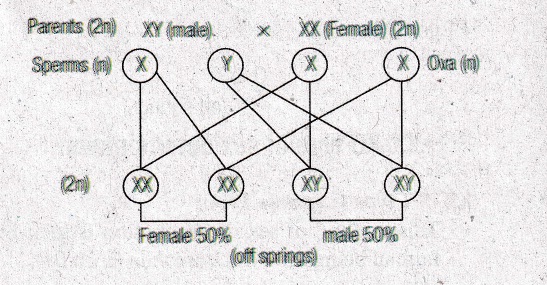
8. Hence, the genetic makeup of sperm, which fertilizes the ovum determines the sex of a child there are 50% chances of having either a male or female in each progeny.
9. Thus, it is by chance phenomenon, so women should not be blamed for giving birth to a girl child
21.
(i) A vaccine is a biological preparation that provides active acquired immunity to a particular disease and resembles a disease-causing microorganism and is often made from weakened or attenuated or killed forms of the microbes, their toxins, or one of its surface proteins.
(ii) Vaccines "teach" our body how to defend itself when viruses or bacteria, invade it.
(iii) Vaccine initiates the immunization process. The vaccines are classified as first, second and third generation vaccines.
First generation vaccine:
(i) First generation vaccine is further subdivided into live attenuated vaccine, killed vaccine and toxoids.
(ii) Live attenuated live vaccines use the weakened (attenuated), aged, less virulent form of the virus
(iii) Eg. Measles, Mumps and Rubella (MMR) vaccine and the Varicella (chickenpox) vaccine, killed (inactivated) vaccines are killed or inactivated by heat and other methods. Eg. Salk's polio vaccine.
(iv) Toxoid vaccines contain a toxin or chemical secreted by the bacteria or virus.
(v) They make us immune to the harmful effects of the infection, instead of to the infection itself.
(vi) Eg. DPT vaccine (Diphtheria, pertussis and Tetanus), (Triple antigen).
Second generation vaccine: contains the pure surface antigen of the Pathogen. :
Eg. Hepatitis-B vaccine
Third generation vaccine: contains the purest and the highest potency vaccines which are synthetic in generation. The latest revolution in vaccine is DNA vaccine (or) recombinant vaccine
22.
(i) AAU - UUA
(ii) CGA - GCU
(iii) UAU - AUA
(iv) GCA - CGU
23.
tRNA on one hand binds to specific amino acids and on the other hand reads the codon of the amino acid bound to it through its anticodon, it is called as adapter molecule.
24.
Gametogenesis is the process of formation of gametes i.e., Sperms from primary spermatocytes and ova from primary oocyte in testes and ovaries respectively. Meiosis plays the most significant role in the process of gametogenesis.
25.

12th Standard Syllabus & Materials
12th Standard
TN 12th Computer Applications வலையமைப்பு வடமிடல் Sample Question Papers Study Material - QB365 Set A
NEW12th Standard
TN 12th Computer Applications களப்பெயர் முறைமை (DNS) Sample Question Papers Study Material - QB365 Set A
NEW12th Standard
TN 12th Computer Applications வலையமைப்பு எடுத்துக்காட்டுகள் மற்றும் நெறிமுறைகள் Sample Question Papers Study Material - QB365 Set A
NEW12th Standard
TN 12th Computer Applications கணினி வலையமைப்பு ஓர் அறிமுகம் Sample Question Papers Study Material - QB365 Set A



Tamilnadu Stateboard 12th Standard Subjects

Maths

Chemistry

Physics
Biology

Computer Science

Business Maths and Statistics

Economics

Commerce

Accountancy

History

Computer Applications
Biology
Computer Technology
Computer Applications
Computer Science
Business Maths and Statistics
Commerce
Economics
Maths
Chemistry
Physics
Computer Technology
History
Accountancy

Tamil

English

French
Tamilnadu Stateboard Standards



