
 100% FREE ACCESS
12th Standard Syllabus & Materials
12th Standard
TN 12th Maths Applications of Matrices and Determinants Sample Question Papers Study Material - QB365 Set A
NEW12th Standard
TN 12th Computer Applications மின்னணு தரவு பரிமாற்றம் Sample Question Papers Study Material - QB365 Set A
NEW12th Standard
TN 12th Computer Applications மின் - வணிக பாதுகாப்பு அமைப்புகள் Sample Question Papers Study Material - QB365 Set A
NEW12th Standard
TN 12th Computer Applications மின்னணு செலுத்தல் முறைகள் Sample Question Papers Study Material - QB365 Set A
NEW12th Standard
TN 12th Computer Applications மின் - வணிகம் Sample Question Papers Study Material - QB365 Set A
NEW12th Standard
TN 12th Computer Applications திறந்த மூல கருத்துருக்கள் Sample Question Papers Study Material - QB365 Set A

Published on: 02/06/2021
QB365 provides detailed and simple solution for every book back questions in class 12 Biology subject.It will helps to get more idea about question pattern in every book back questions with solution.
Download Tamil Nadu 12th Standard Biology question papers, model tests, one-mark questions, important questions, and public exam papers in PDF format. Free study materials and answer keys for TN State Board students.
Questions + Answers key
Take MCQ Biology Test1.
What are the ways by which organisms respond to abiotic factors?
2.
Discuss the role of an individual to reduce environmental pollution.
3.
How can we control eutrophication?
4.
What are stem cells? Explain its role in the field of medicine
5.
Explain stabilizing, directional and disruptive selection with examples
6.
Taking the example of Peppered moth, explain the action of natural selection. What do you call the above phenomenon?
7.
What are the three structural differences between RNA and DNA?
8.
What is male heterogamety?
9.
Give reasons for the following:
(a) Some organisms like honey bees are called parthenogenetic animals
(b) A male honey bee has 16 chromosomes where as its female has 32 chromosomes
10.
Give an account of population regulation
11.
12.
Give the characters of a Biome ?
13.
Mention the causes of enhanced use of ultraviolet radiation
14.
What are DNA vaccines?
15.
If a person thinks he is infected with HIV, due to unprotected sex, and goes for a blood test. Do you think a test such as ELISA will help? If so why? If not, why?
16.
Where are biodiversity hotspots normally located? Why?
17.
What are the factors that drive habitat loss?
18.
What are called endangered species?
19.
Explain the role of cry-genes in genetically modified crops.
20.
Who disproved Lamarck’s Theory of acquired characters? How?
21.
A low level of expression of lac operon occurs at all the windows for treatment of various genetic disorders. Justify the statement
22.
What are the cells involved innate immune system.
23.
From their examination of the structure of DNA, What did Watson and Crick infer about the probable mechanism of DNA replication, coding capability and mutation?
24.
Name the hormones produced from the placenta during pregnancy.
25.
A person is infected by HIV. How will you diagnose for AIDS?
1.
Every living organism responds to its environment. There are various ways by which organisms respond to abiotic conditions. The types of response observed are:
Regulate:
1. Some organisms are able to maintain homeostasis by physiological means which ensures constant body temperature, ionic/ osmotic balance. Birds, mammals and a fewer lower vertebrate and invertebrate species are capable of such regulation.
Conform:
1. Most animals cannot maintain a constant internal environment.
2. Their body temperature changes with the ambient temperature.
3. In aquatic animals like fishes, the osmotic concentration of the body fluids changes with that of the ambient water osmotic concentration. Such animals are called conformers. In case of extreme condition, the inhabitants relocate themselves as in-migration
Migrate:
1. Organisms tend to move away temporarily from a stressful habitat to a new, hospitable area and return when the stressful period is over.
2. Birds migrate from Siberia to Vedanthangal in Tamilnadu to escape from the severe winter periods.
Suspend:
1. In certain conditions, if the organism is unable to migrate, it may avoid the stress by becoming inactive.
2. This is seen commonly in bears going into hibernation during winter.
3. Some snails and fish go into aestivation to avoid summer related problems like heat and desiccation.
4. Some lower animal suspend a certain phase of their life cycle which is to as diapause.
2.
(i) Less use of fossil fuels.
(ii) Planting more and more trees.
(iii) Recycling of the wastes to reduce their quantity and produce useful materials.
(iv) Less or no use of fertilizers and pesticides.
(v) Dispose off the solid wastes in landfills.
3.
1. Improvement of the purifying performance of waste water treatment plants, installing tertiary treatment systems to reduce nutrient concentration.
2. Implementation of effective filter ecosystems to remove nitrogen and phosphorus present in the run-off water.
3. Reduction of phosphorus in detergents.
4. Rationalisation of agricultural techniques through proper planning of fertilization and use of slow release fertilizers.
5. Use of alternative practices in animal husbandry to limit the production of waste water.
4.
(i) Stem cells are undifferentiated cells found in most of the multicellular animals.
(ii) These cells maintain their undifferentiated state even after undergoing repeated mitotic divisions.
(iii) Stem cells research has the potential to revolutionize the future of medicine with the ability to regenerate damaged and diseased organs.
(iv) Stem cell research has the potential to revolutionize the future of medicine with the ability to regenerate damaged and diseased organs.
(v) They are capable of self renewal and exhibit 'cellular potency'.
(vi) They can differentiate into all types of cells that are derived from any of the three germ layers ecto, endo and mesoderms.
(vii) In mammals there are two types of stem cells namely embryonic stem cells & adult stem cells (ES).
(viii) ES are pleuripotent and can produce the three primary germ layers ectoderm, Mesoderm and endoderm.
(ix) Embryonic stem cells are multipotent stem cells that can differentiate into a number of type of cells.
(x) ES cells are isolated from the epiblast tissue of the inner cell mass of a blastocyst.
(xi) When stimulated ES can develop into more than 200 cells Qpes of the adult body.
(xii) ES cells are immortal i.. e they can proliferate in a sterile culture medium and maintain their undifferentiated state.
(xiii) Adult stem cells are found in various tissues of children as well as adults.
(xiv) An adult stem cell or somatic stem cell can divide and create another cell similar to it.
(xv) Most of the adult stem cells are multipotent and can act as a repair system of the body and replenishing adult tissues.
(xvi) The red bone marrow is a rich source of adult stem cells.
(xvii) The most important and potential application of human stem cells is the generation of cells and tissues that could be used for cell based therapies.
(xviii) Human stem cells could be used to test new drugs.
5.
(i) Stabilizing selection (centripetal selection):
1. This type of selection operates in a stable environment.
2. The organisms with average phenotypes survive where as the extreme individuals from both the ends are eliminated.
3. There is no speciation but the phenotypic stability is maintained within the population over generation.
4. For example, measurements of sparrows that survived the storm clustered around the mean and the sparrows that failed to survive the storm clustered around the extremes of the variation showing stabilizing selection.
(ii) Directional selection:
1. The environment which undergoes gradual change is subjected to directional selection.
2. This type of selection removes the individuals from one end towards the other end of phenotypic distribution.
3. For example size differences between male and female alike extremely but different in body weight.
4. Females show directional selection in reflection to body weight.
(iii) Disruptive selection (centrifugal selection)
1. Under homogenous environmental changes into heterogenous environment this type of selection is operational.
2. The organisms of both the extreme phenotypes are selected whereas individuals with average phenotypes are eliminated. This results in splitting of the population into sub-population/species. This is rare form of selection but leads to the formation of two or more different species.
3. It is also called adaptive radiation (e. g.) Darwin finches -beak size in relation to seed size inhabiting Galapagos islands.
6.
1. Natural selection can be explained clearly through Industrial melanism.
2. Industrial melanism is classical case of natural selection exhibited by the peppered moth.
Biston Betularia
1. These were available in two colours, white and black. Before industrialization peppered moth both white and black coloured were common in England (Manchester).
2. Pre-industrialization witnessed white coloured background of the wall of buildings hence the white coloured moths escaped from their predators.
3. Post Industrialization the tree trunks become dark due to smoke and soot let out from the lndustries.
4. The black moths camouflaged on the dark bark of the trees and the white moths were easily identified by their predators (birds).
5. Hence the dark coloured moth population was selected and their number increased when compared to the white moths nature offered positive selection pressure to the black coloured moths.
6. The above proof shows that in a population organisms that can adapt will service and produce more progenies resulting in increase in population through natural selection.
7.
Structural difference between DNA and RNA.
| DNA | RNA |
| It is double stranded with exception of some viruses | It is generally single stranded |
| It is the genetic material in all living organism | It is genetic material in some viruses only |
| The sugar is deoxy ribose (pentose) | The sugar is ribose (pentose) |
| Nitrogenous bases present are adenine, guanine, thymine and cytosine | Nitrogenous bases present are adenine, guanine, cytosine and uracil |
| It is less reactive, chemically and structurally more stable. | It is more reactive chemically and structurally less stable |
| It usually occurs inside the nucleus and in some cell organelles like mitochondria and chloroplasts. |
Very little RNA occurs inside the nucleus. most of its found in the cytoplasm |
8.
Heterogametic Males:
In this method of sex determination the males are heterogametic producing dissimilar gametes while females are homogametic producing similar gametes.
It is of kinds XX-XO type and XX-XY type.
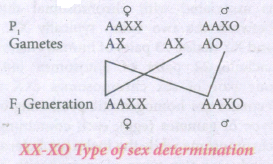
(i) XX-XO Type
(a) This method of sex determination is seen in bugs and some insects such as cockroaches and grasshoppers.
(b) The female with two X chromosomes are homogametic (XX) while the males with only one X chromosome are heterogametic (XO).
(c) The presence of an unpaired X chromosomes determines the male sex. The males with unpaired 'X' chromosome produce two types of sperms, one half with X chromosome and other half without X chromosome.
(d) The sex of the offspring depends upon the sperm that fertilizes the egg.
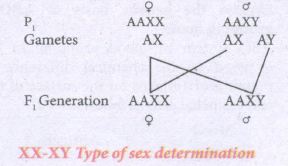
(ii) XX-XV type (Lygaeu Type):
This method of sex determination is seen in human beings and in Drosophila.
(a) The females are homogametic with XX chromosome, while the males are heterogametic with X and Y chromosome.
(b) Homogametic females produce only one kind of egg, each with one X chromosome, while the heterogametic males produce two kinds of sperms some with X chromosome and some with Y chromosome.
(c) The sex of the embryo depends on the fertilizing sperm. An egg fertilized by an 'X' bearing sperm produces a female, if fertilized by a 'Y' bearing sperm, a male is produced.
9.
(a) Some organisms like honeybees are called parthenogenetic animals.
1. In case of honeybees both haploid and diploid individuals formed, as a result of incomplete parthenogenesis.
2. Both sexual reproduction and parthenogenesis are inclusive.
3. Fertilized eggs (zygote) give rise to queen and workers (both are females) by the process of sexual reproduction.
4. Unfertilized eggs (ova) of females develop into drones (males) by the process of parthenogenesis.
(b) A male honeybee has 16 chromosomes where as its female has 32 chromosomes
1. It is because of haplodiploidy which is a sex determination system, in which males develop from unfertilized eggs (parthenogenesis) and are haploid (16n) and females develop frorn fertilized eggs and are diploid (32n) (sexual reproduction).
2. As unfertilized egg carries only half number of chromosome as compared to fertilized egg.
Therefore male honeybees have 16 chromosomes where as female has 32 chromosomes.
10.
(i) The inherent tendency of all animal populations is to increase in number. But it does not increase indefinitely.
(ii) Once the carrying capacity of the environment is reached, population numbers remain static or fluctuate depending on environmental conditions.
(iii) This is regulated by many factors which are:
1. Density independent - Extrinsic factors
2. Density dependent - Intrinsic factors
(iv) Extrinsic factors include the availability of space, shelter, weather, food, etc.
(v) Intrinsic factors include competition, predation, emigration, immigration, and diseases.
11.
12.
Characters of biome
(i) Location, geographical position (Latitude, Longitude)
(ii) Climate and physiochemical environment
(iii) Predominant plant and animal life
(iv) Boundaries between biomes are not always sharply defined. Transition or transient zones are seen as in case of grassland and forest biomes.
13.
Effects: UV rays may penetrate deep into the skin and can lead to premature skin aging and wrinkling of skin; suppression of the immune system, skin cancer (melanoma) and chronic effects leading to eye damage. DNA damage can result from free radicals and reactive oxygen and photons can damage the DNA itself.
14.
(i) Genetic immunization by using DNA vaccines is a novel approach that came into being in 1990.
(ii) The immune response of the body is stimulated by a DNA molecule.
(iii) A DNA vaccine consists of a gene encoding an antigen protein, inserted on to a plasmid, and then incorporated into the cells in a target animal.
(iv) DNA instructs the cells to make antigenic molecules which are displayed on its surfaces. This would evoke an antibody response to the free floating antigen secreted by the cells.
(v) The DNA vaccine cannot cause the disease as it contains only copies of a few of its genes.
(vi) DNA vaccines are relatively easy and inexpensive to design and produce.
(vii) Vaccines produced by these new techniques have definite advantages like producing target proteins, long lasting immunity and trigger immune response only against specific pathogens with less toxic effects.
15.
1. Yes the test ELISA helps.
2. ELlSA stands for Enzyme linked lmmuno Sorbent Assay.
3. It is used for the detection of (HIV) AIDS disease.
4. ELISA is based on the principle of antigen antibody interaction, by pathogen can be detected by the presence of antigens (Proteins, glycoproteins etc). or by detecting the antibodies synthesized by the host against the pathogen.
5. Thus it helps to identify the infection of HIV leads to AIDS.
6. The foreign DNA that is introduced is called the transgene and the animals that are produced by DNA manipulations are called transgenic animals or the genetically engineered or genetically modified organisms.
16.
(i) Hotspots are areas characterized with high concentration of endemic species experiencing unusual rapid rate of habitat modification loss. Norman Myers defined hot spots as "regions that harbour a great diversity of endemic species and at the same tie, have been significantly impacted and altered by human activities."
(ii) A hotspot is a region that supports at least 1500 endemic vascular plant species (0.5% of the global total) has lost more than 70% of its original vegetation.
(iii) There are 35 biodiversity hotspots in the world. India is home to four biodiversity hotspots. They are:
(1) Himalaya: Entire Indian Himalayan region.
(2) Western Ghats
(3) Indo - Burma: Entire North-eastern India, except Assam and Andaman group of Islands (and Myanmar, Thailand, Vietnam, Laos, Cambodia and Southern China)
(4) Sundarlands: Includes Nicobar group of Islands (and Indonesia, Malaysia, Singapore, Brunei, Philippines).
17.
(i) Development of human society is inevitable. Natural habitats are destroyed for the purpose of settlement, agriculture, mining, Industries and construction of highways
(ii) As a result species are forced to adapt to the changes in the environment or move to other places. If not, they become victim to predation, starvation, disease and eventually die or results in human animal conflict.
(iii) Over population, urbanization, Industrialization and agricultural advancements require additional land, water and raw materials every year.
(iv) This is made possible only through fragmentation or destruction of natural habitats by filling wetlands, ploughing grasslands, cutting down trees, forest, desilting rivers, constructing transport ways, caving mountains, extracting, ores, changing the course of rivers and filling of seashore.
18.
(i) A species that has been categorized as very likely to become extinct is an endangered species. Endangered (EN), as categorized by the International Union for Conservation of Nature (IUCN)
(ii) Red List, is the second most severe conservation status for wild populations in the IUCN's scheme after Critically Endangered (CR).
(iii) Example: In 1998 there were 1102 animal and 1197 plant species in the IUCN Red List
(iv) In 2012, the list features 3079 animal and 2655 plant species as endangered (EN) worldwide.
19.
(i) Bacillus thuringiensis is a soil dwelling bacterium which is commonly used as a biopesticide and contains a toxin called cry toxin. Scientists have introduced this toxin producing genes into plants and have raised genetically engineered insect resistant plants. Eg. Bt-cotton.
(ii) When the insects ingest the toxin crystals their alkaline digestive tract denatures the insoluble crystals making them soluble. The cry toxin then gets inserted into the gut cell membrane and paralyzes the digestive tract. The insect then stops eating and starves to death.
20.
Lamarcks 'theory of acquired character's was disproved by August Weismann who conducted experiments on mice for twenty generations by cutting their tails and Weismann proved that change in the somatoplasm will not be transferred to the next generation but changes in the germplasm will be inherited.
21.
In the complete absence of lac operon permease will not be synthesized which is essential for transport of lactose from the medium into the cells, then it cannot act as an inducer. Hence, cannot relieve the lac operon from its repressed state.
22.
(i) Certain types of leukocytes (WBCs), such as polymorphonuclear leucocytes (PMNL), neutrophils, monocytes, and natural killer cells [NK cells] (a type of lymphocytes) in the blood as well as macrophages in tissues can phagocytose and destroy microbes
(ii) Besides the phagocytes there are natural killer cells (NK cells) in the body which kills virus infected and some tumor cells.
(iii) These cells are categorized under the cellular barriers.
23.
They inferred each strand of the double strands helps was used as a template for the formation of a new, daughter strand having a complementary sequence of bases.
24.
Human Chorionic Gonadotropin (hCG), Human Chorionic Somatotropin (hCS) (or) Human Placental Lactogen (hPL), oestrogens and progesterone.
25.
(i) A simple blood test is available that can determine whether the person has been infected with HIV.
(ii) The ELISA test (Enzyme Linked Immuno Sorbent Assay) detects the presence of HIV antibodies.
(iii) It is a preliminary test. Western blot test is more reliable and a confirmatory test.
(iv) It detects the viral core proteins. If both tests detect the presence of the antibodies, the person is considered to be HIV positive.

12th Standard Syllabus & Materials
12th Standard
TN 12th Computer Applications வலையமைப்பு வடமிடல் Sample Question Papers Study Material - QB365 Set A
NEW12th Standard
TN 12th Computer Applications களப்பெயர் முறைமை (DNS) Sample Question Papers Study Material - QB365 Set A
NEW12th Standard
TN 12th Computer Applications வலையமைப்பு எடுத்துக்காட்டுகள் மற்றும் நெறிமுறைகள் Sample Question Papers Study Material - QB365 Set A
NEW12th Standard
TN 12th Computer Applications கணினி வலையமைப்பு ஓர் அறிமுகம் Sample Question Papers Study Material - QB365 Set A



Tamilnadu Stateboard 12th Standard Subjects

Maths

Chemistry

Physics
Biology

Computer Science

Business Maths and Statistics

Economics

Commerce

Accountancy

History

Computer Applications
Biology
Computer Technology
Computer Applications
Computer Science
Business Maths and Statistics
Commerce
Economics
Maths
Chemistry
Physics
Computer Technology
History
Accountancy

Tamil

English

French
Tamilnadu Stateboard Standards



