
 100% FREE ACCESS
12th Standard Syllabus & Materials
12th Standard
TN 12th Maths Applications of Matrices and Determinants Sample Question Papers Study Material - QB365 Set A
NEW12th Standard
TN 12th Computer Applications மின்னணு தரவு பரிமாற்றம் Sample Question Papers Study Material - QB365 Set A
NEW12th Standard
TN 12th Computer Applications மின் - வணிக பாதுகாப்பு அமைப்புகள் Sample Question Papers Study Material - QB365 Set A
NEW12th Standard
TN 12th Computer Applications மின்னணு செலுத்தல் முறைகள் Sample Question Papers Study Material - QB365 Set A
NEW12th Standard
TN 12th Computer Applications மின் - வணிகம் Sample Question Papers Study Material - QB365 Set A
NEW12th Standard
TN 12th Computer Applications திறந்த மூல கருத்துருக்கள் Sample Question Papers Study Material - QB365 Set A

Published on: 02/06/2021
QB365 provides detailed and simple solution for every book back questions in class 12 Biology subject.It will helps to get more idea about question pattern in every book back questions with solution.
Download Tamil Nadu 12th Standard Biology question papers, model tests, one-mark questions, important questions, and public exam papers in PDF format. Free study materials and answer keys for TN State Board students.
Questions + Answers key
Take MCQ Biology Test1.
In what way Peyang conserves the forest?
2.
Mention the advantages (3) and disadvantages of cloning (3).
3.
‘Stability of a community depends upon its species diversity’ Justify the statement.
4.
5.
Explain the formation of a nucleosome.
6.
The following is the illustration of the sequence of ovarian events (a-i) in a human female.
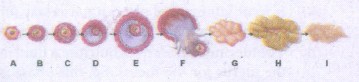
a) Identify the figure that illustrates ovulation and mention the stage of oogenesis it represents.
b) Name the ovarian hormone and the pituitary hormone that have caused the above-mentioned events.
c) Explain the changes that occurs in the uterus simultaneously in anticipation.
d) Write the difference between C and H.
7.
What is extra chromosomal inheritance?
8.
Differentiate between the following:
(a) Binary fission in amoeba and multiple fission in Plasmodium
(b) Budding in yeast and budding in Hydra
(c) Regeneration in lizard and Planaria
9.
How does recycling help reduce pollution?
10.
11.
How does Neanderthal man differ from the modern man in appearance?
12.
13.
What is the difference between syngamy and fertilization?
14.
Describe Population Age Distribution
15.
Differentiate between Tundra and Taiga Biomes.
16.
What are some solutions to toxic dumping in our oceans?
17.
18.
Alien species invasion is a threat to endemic species – substantiate this statement.
19.
Amniocentesis, the foetal sex determination test, is banned in our country, Is it necessary? Comment.
20.
Explain the role of oxytocin and relaxin in parturition and lactation.
21.
What are the applications of Karyotyping?
22.
Explain the mode of sex determination in honeybees.
23.
(i) Write the scientific name of the filarial worm that causes filariasis.
(ii) Write the symptoms of filariasis.
(iii) How is this disease transmitted?
24.
List the causative agent, mode of transmission and symptoms for Diptheria and Typhoid.
1.
The 'Forest man of India', Jadav Payeng who created 1,360 acres of dense and defiant forest was born in Arunasapori (a river island on the Brahmaputra). He had just completed his Class X exams in 1979 when he started to sow the seeds and shoots on the eroded island covered with sand and silt. Thirty-six years later he had converted the once unproductive land into a forest. Payeng's forest is now home to five Royal Bengal tigers, over a hundred deer, wild boar, vultures, and several species of birds. For his remarkable initiative, the Jawaharlal Nehru University invited Payeng in 2012 on Earth Day and honored him with the title of the 'Forest Man of India'. Later, the President APJ Abdul Kalam felicitated him with a cash award in Mumbai. The same year, he received the 'Padma Shri'.
2.
Advantages
1. Offers benefits for clinical traits and medical research.
2. It can help in the production of help in the production of proteins and drugs in the field of medicine.
3. Aids in stem cell research
4. Animal cloning could help to save endangered species.
Disadvantages
1. In animal and human activities, it as a threat to biodiversity saying that this alters evolution which will have an impact on populations and ecosystem.
2. The process is tedious and very expensive.
3. It can cause animals to suffer
4. Reports show that animal surrogates were manifesting adverse outcomes and cloned animals were affected with disease and have high mortality rate.
5. It might compromises human health through consumption of cloned animal meat.
6. Cloned animals age faster than normal animals and are less healthy than the parent organisms as discovered in Dolly.
7. Cloning can lead to occurrence of genetic disorders in animals.
8. More than 90% of cloning attempts fail to produce a viable offspring.
3.
(i) Species have been evolving and becoming extinct since the origin of life. But species are now becoming extinct at a faster rate. This is destabilizing the ecological stability and the distribution of biological diversity on earth.
(ii) The current rate of biodiversity loss is 100-1000 times higher than the naturally occurring extinction rate. This loss of biodiversity will lead to a loss in diversity of species. It has a huge impact on plant, animal and human life. The negative effect includes dramatic influence on food web. Even a reduction in one species can affect the entire Food chain. This will affect the food sources of many species and will affect the stability of a community.
(iii) Many species may die due to lack of food. Thus species diversity will stabilize a community and also help the community to rebuild in case of any changes/ challenges faced by the community.
4.
5.
(i) In eukaryotes, chromatin is formed by a series of repeating units called nucleosomes.
(ii) Korenberg proposed a model for the nucleosome, in which 2 molecules of the four histone proteins H2A, H2B, H3 AND H4 are organized to form a unit of eight molecules called histone octamere.
(iii) The negatively charged DNA is wrapped around the positively charged histone octamer to form a structure called nucleosome. A typical nucleosome contains 200 bp of DNA helix.
(iv) The histone octameres are in close contact and DNA is coiled on the outside of nucleosome.
(v) Neighbouring nucleosomes are connected by linker DNA (Hl) that is exposed to enzymes. The DNA makes two complete turns around the histone octameres and the two turns are sealed off by an HI molecule
(vi) Chromatin lacking HI has beads on a string appearance in which DNA enters and leaves the nucleosomes at random places.
(vii) HI of one nucleosome can interact with HI of the neighbouring nucleosomes resulting in the further folding of the fibre.
6.
(a) The figure 'F' represent ovulation.
Stage of oogenesis - Ovulatory or luteal stage of oogenesis
(b) (i) The ovarian hormone is progesterone which is released during ovulation.
(ii) The pituitary hormones are the follicle-stimulating hormone (FSH) and Luteinizing hormone (LSH) which are released during and ovulation from anterior pituitary gland.
(c) The endometrium of the uterus gets thickened and blood supply to the endometrium increase.
(d) Figure 'C' represents the secondary follicle and figure h represents the degenerating corpus luteum.
| Secondary follicle | Corpus luteurn |
| lt is surrounded by layers of granulosa cells | Absence of granulosa cells |
| Theca layer is present | Theca layer is absent. |
7.
(i) Certain characters are controlled by nonnuclear genomes found in chloroplast, mitochondria, infective agents and plasmids. These characters do not reveal Mendelian pattern of inheritance.
(ii) The inheritance of the extra chromosomal genes are found to exhibit maternal influence.
(iii) Although both male and female parents contribute equally to the zygote in terms of chromosomal genes, the female parent usually contributes the zygote's initial cytoplasm and organelles, since the sperms contain very little cytoplasm. If there are hereditary units in the cytoplasm, these will be transmitted to the offsprings through the egg, so the offsprings exhibit maternal effect.
(iv) The cytoplasmic extranuclear genes have a characteristic pattern of inheritance which do not resemble the genes of nuclear chromosomes and is known as extra chromosomal or extra nuclear or cytoplasmic inheritance and exhibit maternal influence.
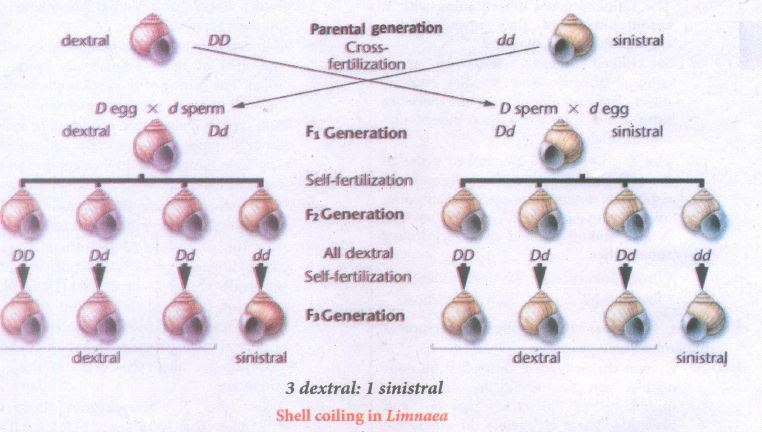
(v) In extra nuclear inheritance, male and female parents contribute equally their nuclear genes to the progeny but do not make equal contribution of' extra chromosomal genes hence, the crosses can yield different (or) non Mendelian results. Extra chromosomal inheritance in Limnaea peregra.
(vi) Limnaea peregra is a freshwater snail. The shell of these animals are spirally coiled. The coiling of the shell is clockwise (dextral) or anticlockwise (sinistral).
(vii) Both type of coilings are produced by two. different types of genetically controlled cleavages namely, dextral cleavage and sinistral cleavage.
(viii) In Limnaea, dextral coiling is normal and Sinistral coiling is a mutant character.
(ix) Direction of coiling is determined by a pair of nuclear genes, D( dextral) and d (sinistral). The gene for dextral (D) being dominant over sinistral coiling (d). In Fig. a dextral snail provides the eggs and a sinistral snail provides the sperm. The offsprings are all dextral (Dd), in the F1 generation.
(x) When the F1 heterozygous dextral individual (Dd) were self crossed the F2 generation showed dextral coiling with genotype of IDD, 2Dd and l dd.
(xi) When a reciprocal cross is made the F1 individuals have Dd genotype but are coiled sinistrally, as in the female parent. In both the crosses the Flare phenotypically similar to the female parent, though the offsprings in both crosses have the same genotype Dd. This is because the genotype of the maternal parent determines the phenotype of the offspring.
(xii) When the F1 sinistral individuals were self crossed, the shell coiling in the F2 generation, were all dextral. This is because the genes do not segregate in the F2 generation. Only in the F3 generation segregation occurs in the ratio of 3 dextral: 1 sinistral.
(xiii) Reasons: The type of cleavage depends on the organization of the egg which is established before the maturation division of the oocyte nucleus and by the influence of the maternal genotype.
(xiv) The direction of coiling of the shell depends upon the orientation of the mitotic spindle during the first cleavage.
(xv) Obviously, maternal control affects only one generation. In each generation the coiling is dependent on the maternal genotype.
8.
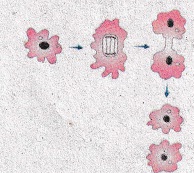
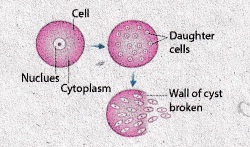
(a)
| Binary Fission in Amoeba | Multiple fission in Plasmodium |
| lt results in the production of two individuals from a single parent. | It results in the production of several individuals |
| lt occurs under favourable conditions | It occurs both under favourable and unfavourable conditions |
| Nucleus of the parent cell divides only once to form two daughter nuclei | Nucleus of the parent cell undergoes repeated divisions to form a number of daughter nuclei |
| Cytoplasm divides after nuclear division | Cytoplasm does not divide after each nuclear division but divides during favourable condition |
| No part of parent body is left unused (e,g: Amoeba) | A part of the body (covering and residuai cytoplasm) is left unused. (e,g: Paramecium) |
 |
 |
(b) Budding in yeast and budding in hydra
| Budding in Yeast | Budding in Hydra |
| During budding the cell wall of the parent cell bulges out in the form of an out growth as bud | During budding the ectoderm cells increase and form a small elevation on the body surface as bud. |
| The parent nucleus divides into two daughter nuclei one of which migrates into bud. | Ectoderm and endoderm are pushed out to form the bud. The bud contains an interior lumen in continuation with parent's gastro vascular cavity (coelenteron) |
| As the bud enlarges and is fully formed, it is separated from the parentcell and grows into mature yeast. Sometimes a bud may produce another bud over it which is still attached to parent cell forming a false mycelium (or) pseudomycelium | The bud enlarges, develops a mouth and a circle of tentacles at its free end. When fully grown, the bud constricts at the base and finally separates from the parent body and leads an independent life |
(c) Regeneration is regrowth in the injured region
| Regeneration in Lizard | Regeneration in Planaria |
| This type of regeneration comes under epimorphosis type. | This type of regeneration comes under morphallaxis type |
| Several body parts can develop. | When the body is cut into several pieces, each piece can regenerate the lost parts and develops into a whole individual |
9.
1. Recycling prevents emissions of many greenhouse gases and water pollutants, and saves energy.
2. Using recovered material generates less solid waste.
3. Recycling helps to reduce the pollution caused by the extraction and processing of virgin materials
10.
11.
(i) Neanderthal human was found in Neander Valley, Germany with a brain size of 1400 cc and lived between 34,000 - 1,00,000 years ago.
(ii) They differ from the modern. human in having semierect posture, flat cranium, sloping forehead, thin large orbits, heavy brow ridges, protruding jaws and no chin.
12.
13.
| syngamy | fertilization |
| It is the fusion of two haploid gametes to form a diploid zygote | It is the act (or) process of rendering fertile zygote as the result of Fertilization |
14.
(i) The proportion of the age groups in a population is its age distribution attribute.
(ii) This determines the reproductive status of the population at the given time and is an indicator of the future population size.
(iii) Usually a rapidly growing population will have larger proportion of young individuals.
(iv) A stable population will have an even distribution of various age classes.
(v) A declining population tends to have a larger proportion of older individuals
15.
| No. | Tundra Biome | Taiga Biomes |
|---|---|---|
| 1. | This is almost treeless plain in the northern parts of Asia, Europe, and North America. | Taiga is a forest of coniferous trees such as spruce, fir and pine. |
| 2. | Winters are long with little daylight, summers are short, with long daylight hours. | Summer temperature ranges from 10octo 21oPc. |
| 3. | Because of the severe winters, many of the animals are migratory. For E g: the many shore birds and water fowl such as ducks and geese, nest in the Tundra during the summer and migrate south for the winter. |
Important migratory herbivores include moose, elk, deer and reindeer. Moose and reindeer migrate to the Taiga for winter and to Tundra for summers. |
16.
1. Farmers need to be made aware about organic farming which does not require any kind of fertilizers and pesticides usage.
2. Crop rotation can be practiced by farmers which reduces the need for fertilizers and improves the fertility of the soil.
3. Ships and tankers that carry oil can be supervised earlier and ensured that they are not damaged in any way and through this oil will not be split in the ocean water.
17.
18.
(i) The introduction of the Nile Perch into Lake Victoria led to the extinction of more than 200 species of cichlid fish in that lake.
(ii) Introduction of African catfish Clarias gariepinus for aquaculture poses a threat to the indigenous catfishes in indian rivers.
19.
1. Amniocentesis is the pre-natal diagnostic technique in which a sample of amniotic fluid from the womb of a pregnant woman is taken during early stages of embryonic development and the cells are cultured and analysed synthetically.
2. Any chromosomal disorder or a metabolic error can be detected and if necessary MTP can be advised.
3. But this technique is misused for knowing the sex of the foetus followed by female foeticide.
4. Female foeticide refers to aborting the female in the mother's womb.
5. In order to prevent female foeticide and infanticide, Government of India has taken various steps like PCPNDT Act .(preconception and prenatal diagnostic technique act-1994) enacted to ban the identification of sex and to prevent the use of prenatal diagnostic techniques for selective abortion.
20.
Relaxin
(i) It is a hormone secreted by the placenta and also by the corpus luteum during pregnancy.
(ii) It promotes parturition by relaxing the pelvic joints and by dilation of cervical ligaments with continued powerful contractions.
Oxytocin:
(i) It causes the "Let-Down" reflex.
(ii) The actual ejection of milk from the alveoli of the mammary glands.
(iii) During lactation, oxytocin also stimulates the recently emptied uterus to contract, helping it to return to pre-pregnancy size..
21.
(i) It helps in gender identification.
(ii) It is used to detect the chromosomal aberrations like deletion, duplication, translocation, invasion and nondisjunction of chromosomes.
(iii) It helps to identify the abnormalities of chromosomes like aneuploidy.
(iv) It is also used in predicting the evolutionary relationships between species.
(v) Genetic diseases in human beings can be detected by this technique.
22.
Sex determination in honeybees
sex determination is as follows
1. Haploid sex determination is seen in honeybees, it is based on the number of sets of chromosome, an individual receives.
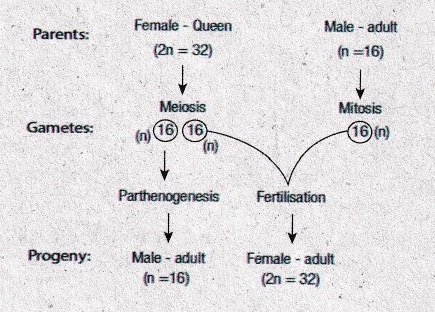
2. When the ovum is fertilized by a male gamete the zygote (2n = 32) develops into a female i.e., a queen or worker.
3. When the haploid ovum develops by parthenogenesis. i.e., without fertilization, a male individual, called drone is formed as adult male.
4. The male honeybees (drone) is haploid (with n = 16) and forms sperms by mitosis.
23.
(i) "Wuchereria bancrofti".
(ii) Chronic inflammation of the lymph nodes. Obstruction of lymph in the vessels of the lower limb.
(iii) Transmitted through an agent/vector called Female Culex mosquito.
24.
(i) For Diphtheria:
Causal agent: Corynebacterium diphtheria.
Mode of Transmission: Droplet infection through breathing.
Symptoms: Fever, sore throat, hoarseness and difficulty in breathing
(ii) For Typhoid:
Causal agent: Salmonella typhi
Mode of Transmission: Through contaminated food and water
Symptoms: Headache, abdominal discomfort, fever and diarrhea.

12th Standard Syllabus & Materials
12th Standard
TN 12th Computer Applications வலையமைப்பு வடமிடல் Sample Question Papers Study Material - QB365 Set A
NEW12th Standard
TN 12th Computer Applications களப்பெயர் முறைமை (DNS) Sample Question Papers Study Material - QB365 Set A
NEW12th Standard
TN 12th Computer Applications வலையமைப்பு எடுத்துக்காட்டுகள் மற்றும் நெறிமுறைகள் Sample Question Papers Study Material - QB365 Set A
NEW12th Standard
TN 12th Computer Applications கணினி வலையமைப்பு ஓர் அறிமுகம் Sample Question Papers Study Material - QB365 Set A



Tamilnadu Stateboard 12th Standard Subjects

Maths

Chemistry

Physics
Biology

Computer Science

Business Maths and Statistics

Economics

Commerce

Accountancy

History

Computer Applications
Biology
Computer Technology
Computer Applications
Computer Science
Business Maths and Statistics
Commerce
Economics
Maths
Chemistry
Physics
Computer Technology
History
Accountancy

Tamil

English

French
Tamilnadu Stateboard Standards



