
 100% FREE ACCESS
12th Standard Syllabus & Materials
12th Standard
TN 12th Maths Applications of Matrices and Determinants Sample Question Papers Study Material - QB365 Set A
NEW12th Standard
TN 12th Computer Applications மின்னணு தரவு பரிமாற்றம் Sample Question Papers Study Material - QB365 Set A
NEW12th Standard
TN 12th Computer Applications மின் - வணிக பாதுகாப்பு அமைப்புகள் Sample Question Papers Study Material - QB365 Set A
NEW12th Standard
TN 12th Computer Applications மின்னணு செலுத்தல் முறைகள் Sample Question Papers Study Material - QB365 Set A
NEW12th Standard
TN 12th Computer Applications மின் - வணிகம் Sample Question Papers Study Material - QB365 Set A
NEW12th Standard
TN 12th Computer Applications திறந்த மூல கருத்துருக்கள் Sample Question Papers Study Material - QB365 Set A

Published on: 13/05/2022
QB365 provides detailed and simple solution for every Creative Questions in class 12 Biology Subject. It will helps to get more idea about question pattern in every Creative questions with solution.
latest Creative QuestionsDownload Tamil Nadu 12th Standard Biology question papers, model tests, one-mark questions, important questions, and public exam papers in PDF format. Free study materials and answer keys for TN State Board students.
Questions + Answers key
Take MCQ Biology Test1.
On analysis, a person's karyotype reveals an extra one chromosome of twenty-first pair. What does this condition represent? which type of symptoms can be noticed in the person?
2.
Complete the following cross.
AAZW x AAZZ
(female) (male)
3.
Give an account on uterine wall layers.
4.
Compare gametogenesis with organogenesis.
5.
Dr. Sheela is a famous Gynaecologist at Poes garden. However illegally she performed amniocentesis for several pregnant illiterates and did MTP if identified as female foetus, on request. Under which act will she get arrested, if a complaint is filed against her.
6.
Complete the table by filling the gaps.
| Disease | Causative agent | Symptoms |
| Gonnorrhea | A | Affects urethra & cervix, painful urination |
| B | Human Immuno Virus | Enlarged lymph node, night sweat, weight reduction |
| Hepatitis | Hepatitis-B- Virus | C |
7.
Complete the flow chart by mentioning the ploidy of cells in boxes.
8.
Differentiate between asexual and sexual reproduction
9.
Explain briefly on the nature of Ovovivipary.
10.
Give the definition for (a) Arrhenotoky (b) Thelytoky (c) Amphitoky
11.
What is embryo transfer technique?
12.
In the diagram given below.
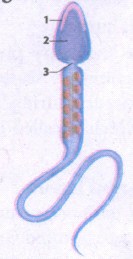
(a) Identify the diagram
(b) Label the parts indicated.
13.
What is Polycystic ovary syndrome (PCOS)?
14.
What is the function of Sertoli cells?
15.
What are okazaki fragments?
16.
Why did the use of RNase not affect transformation in the experiment conducted by Avery et aI.
17.
Distinguish replication and transcription.
18.
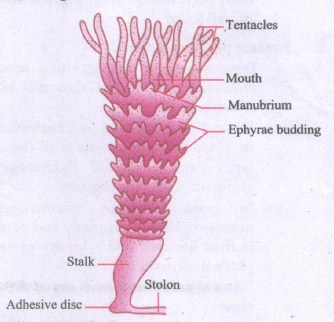
(i) Identify the animal
(ii) What is significant about the animal.
19.
Describe the different phases of life cycle in an organism.
20.
How does budding occurs is hydra?
21.
What are Mendelian disorders?
22.
What is the role of the gene responsible for colour blindness in a normal human beings?
23.
What is sex Index?
24.
What is null allele?
1.
Trisomy-2l or Down's syndrome.
Symptoms - Mental retardation, malformed ears, protruded tongue, mouth is constantly open, etc.
2.
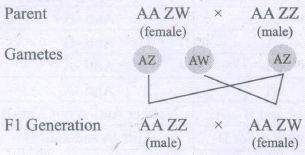
3.
The wall of the uterus has three layers of tissues. The outermost thin membranous serous layer called the perimetrium, the middle thick muscular layer called myometrium and the inner glandular layer called endometrium. The endometrium undergoes cyclic changes during the menstrual cycle while myometrium exhibits strong contractions during parturition.
4.
| S.No. | Gametogenesis | Organogenesis |
|---|---|---|
| 1 | Formation of gametes i.e., Sperm and Ova. | Formation of tissues, organs, and organ system. |
| 2 | It takes place in gonads. | It takes place in the embryonic germ layers. |
5.
Dr. Sheela will be be arrested under PCPNDT Act - preconception and prenatal diagnostic technique Act-1994.
6.
A - Neisseria Gonorrhoea
B - AIDS
C - Jaundice
7.
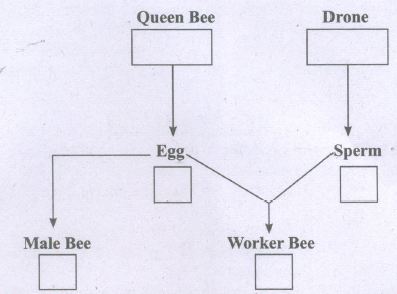
Queen Bee, Worker Bee - Diploid (2n)
Drones (Male Bee), Egg, sperm - Haploid (n)
8.
| Asexual Reproduction | Sexual Reproduction | |
|---|---|---|
| a | Involves only one parent | Involves two parents (male & female) |
| b | Only mitotic cell division takes place | Both mitosis & meiosis takes place |
| c | Offsprings are genetically identical to the parent. | Offsprings genetically differ from the parents. |
| d | Gametes are not produced | Gametes are produced |
9.
In Ovoviviparous animals, the embryo develops inside the egg and remains in the mother's body until they are ready to hatch. This method of reproduction is similar to viviparity but the embryos have no placental connection with the mother and receive their nourishment from the egg yolk. Ovoviviparity is seen in fishes like shark
10.
(a) Arrhenotoky: In this type, only males are produced by parthenogenesis. eg: honey bees
(b) Thelytoky: In this type of parthenogenesis only females are produced by parthenogenesis. e.g: Solenobia
(c) Amphitoky: In this type parthenogenetic egg may develop into individuals of any sex. e.g: Aphis.
11.
The transfer of an embryo with more than 8 blastomeres stage into uterus is called embryo transfer technique.
12.
(a) Human Sperm
(b) 1- Acrosome 2 - Nucleus 3 - Neck
13.
PCOS is a complex endocrine system disorder that affects women in their reproductive years. Polycystic means 'many cysts'. It refers to many partially formed follicles on the ovaries, which contain an egg each. But they do not grow to maturity or produce eggs that can be fertilized. Women with PCOS may experience irregular menstrual cycles, increased androgen levels, excessive facial or body hair growth (hirsutism), acne, obesity, reduced fertility and increased risk of diabetes. Treatment for PCOS includes a healthy lifestyle,weight loss and targeted hormone therapy.
14.
(i) Sertoli cells are elongated and pyramidal and provide nourishment to the sperms till maturation.
(ii) They also secrete inhibin, a hormone which is involved in the negative feedback control of sperm production.
15.
During replication in DNA, in the template strand, replication is continuous and is called the leading strand. In the coding strand with polarity 5' ➝ 3', replication is discontinuous and DNA is synthesized in fragments called okazaki fragments which are joined by the enzyme DNA ligase. This is called the lagging strand.
16.
The RNase is an enzyme that destroys protein. Therefore DNA, RNA and proteins from heat killed S-strand of bacteria when added to 'R'strain changed surface character and also made them pathogenic. The DNA is the transforming principle and not the proteins.
17.
| Replication | Transcription |
| 1) Replication is a process by which a DNA molecule makes as a copy of itself. | 1) The process of copying genetic information from one strand of DNA into RNA is called transcription. |
| 2) It takes place during phase of cell cycle. | 2) It takes place during protein synthesis. |
| 3) It requires DNA and enzymes like DNA polymerases and Ligases. | 3) It requires DNA and enzymes like RNA Polymerases |
18.
(i) Aurelia
(ii) The Significance is that Aurelia reproduces asexually by a special type of transverse fission called strobilation.
19.
Organisms have three phases in its life cycle.
(i) Juvenile phase/ vegetative phase is the period of growth between the birth of the individual upto reproductive maturity.
(ii) Reproductive phase/maturity phase the organisms reproduce and their offsprings reach maturity period.
(iii) Senescent phase begins at the end of reproductive phase when degeneration sets in the structure and functioning of the body.
20.
(i) Buds are formed on the outer surface of the parent body, it is known as exogenous budding e.g. Hydra.
(ii) In Hydra when food is plenty, the ectoderm cells increase and form a small elevation on the body surface.
(iii) Ectoderm and endoderm are pushed out to form the bud. The bud contains an interior lumen in continuation with parent's gastrovascular cavity.
(iv) The bud enlarges, develops a mouth and a circle of tentacles at its free end.
(v) When fully grown, the bud constricts at the base and finally separates from the parent body and leads an independent life.
21.
(i) Alteration or mutation in a single gene causes Mendelian disorders. These disorders are transmitted to the offsprings on the same line as the Mendelian pattern of inheritance.
(ii) Some examples for Mendelian disorders are Thalassemia, albinism, phenylketonuria, etc. These disorders may be dominant or recessive and autosomal or sex linked.
22.
(i) A dominant X - linked gene is necessary for the formation of colour sensitive cells, the cones. which helps to distinguish colours.
(ii) A recessive form of the gene is incapable of producing the cones. Hence the affected person is unable to distinguish red and green colour.
23.
(i) In Drosophila the sex is determined by the balance between the genes'for femaleness located on the 'X' chromosome and those for maleness located on the 'auto somes' (A).
(ii) Hence the sex of an individual is determined by the ratio of its X chromosome to that of the autosome A sets. This ratio is termed as sex index and is expressed as
Sex Index \(=\frac{Number\ of\ X\ chromosomes(X)}{Number\ of\ X\ automosome}\)
change in this ratio leads to a changed sex phenotype Eg: Drosophila
24.
In ABO blood group, each allele (IA and IB) produces a transferase enzyme. IA allele produces N-acetyl galactose transferase and can add N-acetyl galactosamine (NAG) and Ballele encodes for the enzyme galactose transferase that adds galactose to the precursor (i.e. H substances) In the case of Io/Io allele no terminal transferase enzyme is produced and therefore called "null" allele arid hence cannot add NAG or galactose to the precursor.

12th Standard Syllabus & Materials
12th Standard
TN 12th Computer Applications வலையமைப்பு வடமிடல் Sample Question Papers Study Material - QB365 Set A
NEW12th Standard
TN 12th Computer Applications களப்பெயர் முறைமை (DNS) Sample Question Papers Study Material - QB365 Set A
NEW12th Standard
TN 12th Computer Applications வலையமைப்பு எடுத்துக்காட்டுகள் மற்றும் நெறிமுறைகள் Sample Question Papers Study Material - QB365 Set A
NEW12th Standard
TN 12th Computer Applications கணினி வலையமைப்பு ஓர் அறிமுகம் Sample Question Papers Study Material - QB365 Set A



Tamilnadu Stateboard 12th Standard Subjects

Maths

Chemistry

Physics
Biology

Computer Science

Business Maths and Statistics

Economics

Commerce

Accountancy

History

Computer Applications
Biology
Computer Technology
Computer Applications
Computer Science
Business Maths and Statistics
Commerce
Economics
Maths
Chemistry
Physics
Computer Technology
History
Accountancy

Tamil

English

French
Tamilnadu Stateboard Standards



