
 100% FREE ACCESS
12th Standard Syllabus & Materials
12th Standard
TN 12th Maths Applications of Matrices and Determinants Sample Question Papers Study Material - QB365 Set A
NEW12th Standard
TN 12th Computer Applications மின்னணு தரவு பரிமாற்றம் Sample Question Papers Study Material - QB365 Set A
NEW12th Standard
TN 12th Computer Applications மின் - வணிக பாதுகாப்பு அமைப்புகள் Sample Question Papers Study Material - QB365 Set A
NEW12th Standard
TN 12th Computer Applications மின்னணு செலுத்தல் முறைகள் Sample Question Papers Study Material - QB365 Set A
NEW12th Standard
TN 12th Computer Applications மின் - வணிகம் Sample Question Papers Study Material - QB365 Set A
NEW12th Standard
TN 12th Computer Applications திறந்த மூல கருத்துருக்கள் Sample Question Papers Study Material - QB365 Set A

Published on: 13/05/2022
QB365 provides detailed and simple solution for every Creative Questions in class 12 Biology Subject. It will helps to get more idea about question pattern in every Creative questions with solution.
latest Creative QuestionsDownload Tamil Nadu 12th Standard Biology question papers, model tests, one-mark questions, important questions, and public exam papers in PDF format. Free study materials and answer keys for TN State Board students.
Questions + Answers key
Take MCQ Biology Test1.
Recently E-Waste and plastic wastes have created dangerous effects in the environment. In order to protect the environment what will be the solution? (or) Recently E-waste created dangerous effects in the environment. How will you find solution to avoid the effects due to these wastes?
2.
Give a detailed account of Modern Synthetic Theory.
3.
How the DNA is packed in an eukaryotic cell?
4.
Write in detail about Temperate forest and its types.
5.
Write in detail about various types of antigen-antibody reactions.
6.
Describe the structure of lymph node with a labeled diagram
7.
Give comparative account on ex-situ conservation.
8.
Explain in detail about stem cell therapy. (or) What are the multipotent cells involved in replenishing adult tissue ? What is the rich source for it?
9.
Explain in detail about Erythroblastosis foetalis.
10.
Write a note on embryonic membranes
11.
Describe the spermatogenesis with diagram.
12.
What are IUD's? Explain its way of functioning. Also describe their types.
13.
Describe the regeneration process noticed in living organism.
14.
Explain about the objections to Darwinism.
15.
What is ART? Explain any two for ART.
16.
Explain any five techniques of Assisted Reproductive Technology (ART).
17.
List out the properties of soil
18.
Explain the process of fertilization in human beings.
19.
Explain the creation of Dolly
20.
Explain the negative control of transcription initiation as described by Jacob and Monod.
21.
22.
List the salient features of classical concept of gene.
23.
24.
Write a note on any 2 Mendelian disorders occurring in human beings.
25.
Explain criss-cross pattern of inheritance with an example. (or) Explain Inheritance of colour blindness.
1.
E-Waste:
(i) Electronic waste or e-waste describes discarded electrical electronic devices as well as any refuse created by discarded electronic devices and components and substances involved in their manufacture or use.
(ii) Their disposal is a growing problem because electronic equipment frequently contains hazardous substances.
(iii) In a personal computer, there may be lead (Pb) in the cathode ray tube (CRT) and soldering, compound, mercury (Hg) in switches and housing, and cobalt (Co) in steel components, among other equally toxic substances.
(iv) E-wastes are basically PCB (Polychlorinated biphenyl) based, which are non-degradable.
(v) Used electronics which are destined for I reuse, resale, salvage, recycling or disposal are also considered e-waste.
(vi) Unauthorised processing of e-waste in developing countries can lead to adverse I human health effects and environmental pollution.
(vii) Recycling and disposal of e-waste may involve Significant risk to the health of workers and communities in developed countries and great care must be taken to avoid unsafe exposure in recycling operations and leaking of materials such as heavy metals from landfills and incinerator ashes.
Plastic Waste:
(i) Remedies: '4R' - Refuse, Reduce Reuse and Recycle mantra is the best available remedy for plastic waste pollution.
(ii) Tamil Nadu State government succes implemented the ban on single use plastics from 1st January 2019.
2.
Sewell Wright, Fisher, Mayer, Huxley, Dobzhansky, Simpson and Haeckel explained Natural Selection in the light of Post-Darwinian discoveries. According to this theory gene mutations, chromosomal mutations, genetic recombinations, natural selection, and reproductive isolation are the five basic factors involved in the process of organic evolution.
i. Gene mutation refers to the changes in the structure of the gene. It is also called gene/ point mutation. It alters the phenotype of an organism and produces variations in their offsprings.
ii. A chromosomal mutation refers to the changes in the structure of chromosomes due to deletion, addition, duplication, inversion or translocation. This too alters the phenotype . of an organism and produces variations in their offspring.
iii. Genetic recombination is due to crossing over of genes during meiosis. This brings about genetic variations in the individuals of the same species and leads to heritable variations.
iv. Natural selection does not produce any genetic variations but once such variations occur it favors some genetic changes while rejecting others (driving force of evolution).
v. Reproductive isolation helps in preventing interbreeding between related organisms.
3.
In eukaryotes, organization is more complex. Chromatin is formed by a series of repeating units called nucleosomes. Kornberg proposed a model for the nucleosome, in which 2 molecules of the four histone proteins H2A, H2B, H3 and H4 are organized to form a unit of eight molecules called histone octamere. The negatively charged DNA is wrapped around the positively charged histone octamere to form a structure called nucleosome. A typical nucleosome contains 200 bp of DNA helix. The histone octameres are in close contact and DNA is coiled on the outside of nucleosome. Neighbouring nucleosomes are connected by linker DNA (HI) that is exposed to enzymes. The DNA makes two complete turns around the histone octameres and the two turns are sealed off by an HI molecule. Chromatin lacking HI has a beads-on-a-string appearance in which DNA enters and leaves the nucleosomes at random places. HI of one nucleosome can interact with HI of the neighbouring nucleosomes resulting in the further folding of the fibre. The chromatin fiber in interphase nuclei and mitotic chromosomes have a diameter that vary between 200-300 nm and represents inactive chromatin. 30 nm fibre arises from the folding of nucleosome, chains into a solenoid structure having six nucleosomes per turn. This structure is stabilized by interaction between different HI molecules. DNA is a solenoid and packed about 40 folds. The hierarchical nature of chromosome structure is illustrated. Additional set of proteins are required for packing of chromatin at higher level and are referred to as non-histone chromosomal proteins (NHC). In a typical nucleus, some regions of chromatin are loosely packed (lightly stained) and are referred to as euchromatin. The chromatin that is tightly packed (stained darkly) is called heterochromatin. Euchromatin is transcriptionally active and heterochromatin is transcriptionally inactive.
4.
(i) These forests occur in eastern North America, northeastern Asia, and western and central Europe.
(ii) Have well-defined seasons with a distinct winter. Moderate climate and a growing season of 140-200 days during 4-6 frost-free months distinguish temperate forests.
(iii) Annual temperature varies from -300 C to 300 C.
(iv) Precipitation (750-1500 mm) is distributed evenly throughout the year.
(v) Soil is fertile, enriched with decaying litter.
(vi) Canopy is moderately dense and allows light to penetrate, resulting in well-developed and richly diversified under storey vegetation and stratification of animals.
(vii) Flora is characterized by 3-4 tree species per km2. Trees have broad leaves that are lost annually such as oak, hickory, beech, hemlock, maple, basswood, cottonwood, elm, willow, and spring-flowering herbs.
(viii) Fauna consists of squirrels, rabbits, skunks, birds, deer, mountain lion, bobcat, timber wolf, fox, and black bear. Based on seasonal distribution of rainfall, the types of temperate forests are:
(ix) Moist conifer and evergreen broad-leaved forests: wet winters and dry summers.
(x) Dry conifer forests: dominate higher elevation zones; low precipitation.
(xi) Mediterranean forests: precipitation is concentrated in winter (1000 mm /year).
(xii) Temperate coniferous forests: mild winters, high annual precipitation (> 2000 mm /year).
(xiii) Temperate broad-leaved rainforests: mild, frost-free winters, high precipitation (> 1500 mm/ year), evenly distributed throughout the year.
5.
Different types of antigen and antibody reactions: The reaction between soluble antigen and antibody leads to the visible precipitate formation, which is called a precipitin reaction. Antibodies that bring about precipitate formation on reacting with antigens are called as precipitins. Whenever a particulate antigen interacts with its antibody, it would result in clumping or agglutination of the particulate antigen, which is called agglutination reaction. The antibody 'involved in bringing about agglutination reaction is called agglutinin. Opsonisation or enhanced attachment is the process by which a pathogen is marked of ingestion and destruction by a phagocyte. Opsonization involves the binding of an opsonin i.e., antibody, to a receptor on the pathogens. cell membrane. After opsonin binds to the membrane, phagocytes are attracted to the pathogen. So, opsonization is a process in which pathogens are coated with a substance called an opsonin, marking the pathogen out for destruction by the immune system. This results in a much more efficient phagocytosis. The neutralization reactions are the reactions of antigen-antibody that involve the elimination of the harmful effects of bacterial exotoxins or a virus by specific antibodies. These neutralizing substances i.e. antibodies are known. as antitoxins. This specific antibody is produced by a host cell in response to a bacterial exotoxin or corresponding toxoid (inactivated toxin).
6.
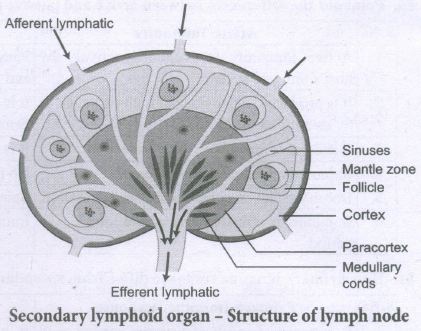
Lymph node has three zones. They are the cortex, paracortex, and medulla. The outer most layer of the lymph node is called cortex, which consists of B-lymphocytes, macrophages, and follicular dendritic cells. The paracortex zone is beneath the cortex, which is richly populated by T lymphocytes and interdigitating dendritic cells. The innermost zone is called the medulla which is sparsely populated by lymphocytes, but many of them are plasma cells, which actively secrete antibody molecules. As the lymph enters, it slowly percolates through the cortex, paracortex, and medulla, giving sufficient chance for the phagocytic cells and dendritic cells to trap the antigen brought by the lymph. The lymph leaving a node carries enriched antibodies secreted by the medullary plasma cells against the antigens that enter the lymph node. Sometimes visible swelling of lymph nodes occurs due to active immune response and increased the concentration of lymphocytes. Thus swollen lymph nodes may signal an infection. There are several groups of lymph nodes. The most frequently enlarged lymph nodes are found in the neck, under the chin, in the armpits, and in the groin.
7.
Ex-Situ Conservation :
It is conservation of selected rare plants/ animals in places outside their natural homes. It includes offsite collections and gene banks. Offsite Collections: They are live collections of wild and domesticated species in Botanical gardens, Zoological parks, Wildlife safari parks, Arborata (gardens with trees and shrubs). The organisms are well maintained for captive breeding programmes. As a result, many animals which have become extinct in the world continue to be maintained in Zoological Parks. As the number increases in captive breeding, the individuals are selectively released in the wild. In this way the Indian crocodile and gangetic dolphin have been saved from extinction.
Gene Banks:
Gene banks are a type of biorepository which preserve genetic materials. Seeds of different genetic strains of commercially important plants can be stored for long periods in seed banks, gametes of threatened species can be preserved in viable and fertile condition for long periods using cryopreservation techniques. However, it is not economically feasible to conserve all biological wealth and all the ecosystems. The number of species required to be saved from extinction far exceeds the conservation efforts.
8.
Stem cells are undifferentiated cells found in most of the multi cellular animals. These cells maintain their undifferentiated state even after undergoing numerous mitotic divisions. Stem cell research has the potential to revolutionize the future of medicine with the ability to regenerate damaged and diseased organs. Stem cells are capable of self renewal and exhibit 'cellular potency'. Stem cells can differentiate into all types of cells that are derived from any of the three germ layers ectoderm, endoderm and mesoderm.
In mammals there are two main types of stem cells - embryonic stem cells (ES cells) and adult stem cells. ES cells are pluripotent and can produce the three primary germ layers ectoderm, mesoderm and endoderm. Embryonic stem cells are multipotent stem cells that can differentiate into a number of types of cells. ES cells are isolated from the epiblast tissue of the inner cell mass of a blastocyst. When stimulated ES can develop into more than 200 cells types of the adult body. ES cells are immortal ie. they can proliferate in a sterile culture medium and maintain their undifferentiated state. Adult stem cells are found in various tissues of children as well as adults. An adult stem cell or somatic stem cell can divide and create another cell similar to it. Most of the adult stem cells are multipotent and can act as a repair system of the body, replenishing adult tissues. The red bone marrow is a rich source of adult stem cells.
The most important and potential application of human stem cells is the generation of cells and tissues that could be used for cell based therapies. Human stem cells could be used to test new drugs.
9.
Rh incompatability has great significance in childbirth. If a woman is Rh negative and the man is Rh positive, the foetus may be Rh positive having inherited the factor from its father. The Rh negative mother becomes sensitized by carrying Rh-positive foetus within her body. Due to damage of blood vessels, during childbirth, the mother's immune system recognizes the Rh antigens and gets sensitized. The sensitized mother produces Rh antibodies. The antibodies are IgG type which are small and can cross placenta and enter the foetal circulation. By the time the mother gets sensitized and produce anti 'D' antibodies, the child is delivered.
Usually, no effects are associated with exposure of the mother to Rh positive antigen during· the first childbirth, subsequent Rh positive children carried by the same mother may be exposed to antibodies produced by the mother against Rh antigen, which are carried across the placenta into the foetal blood circulation. This causes haemolysis of foetal RBCs resulting in haemolytic jaundice and anaemia. This condition is known as Erythroblastosis foetalis or Haemolytic disease of the newborn (HDN).
10.
The extra embryonic membranes include amnion, yolk sac, allantois, and chorion. They protect the embryo from desiccation, mechanical shock, absorption of nutrients, gaseous exchange and placental formation.
| Embryonic membrane | Function | |
| a. | Amnion | Innermost two-layered membrane with amniotic fluid providing buoyancy to embryo from injury regulates temperature and acts as a medium for fetal movement. |
| b. | Chorion | Outermost layer covering and protecting the embryo. |
| c. | Allantois | Forms an outpocketing of embryonic tissue at the tail of yolk sac which forms umbilical cord that links embryo to placenta and finally becomes the part of urinary bladder |
| d. | Yolk sac | Forms a part of gut and acts a source of earliest blood cells and blood vessels |
11.
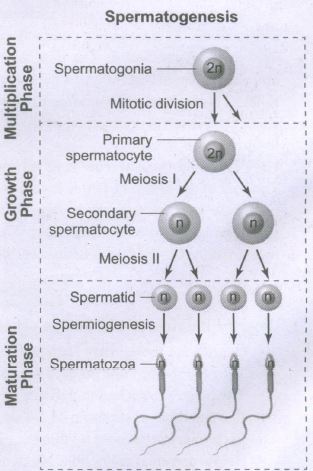
Spermatogenesis is the sequence of events in the seminiferous tubules of the testes that produce the male gametes, the sperms. During development, the primordial germ cells migrate into the testes and become immature germ cells called sperm mother cells or spermatogonia in the inner surfaces of the seminiferous tubules. The spermatogonia begin to undergo mitotic division at puberty and continue throughout life. In the first stage of spermatogenesis, the spermatogonia migrate among Sertoli cells towards the central lumen of the seminiferous tubule and become modified and enlarged to form primary spermatocytes which are diploid with 23 pairs i.e., 46 chromosomes. Some of the primary spermatocytes undergo first meiotic division to form two secondary spermatocytes which are haploid with 23 chromosomes each. The secondary spermatocytes undergo second meiotic division to produce four haploid spermatids. The spermatids are transformed into mature spermatozoa (sperms) by the process called spermiogenesis. Sperms are finally released into the cavity of seminiferous tubules by a process called spermiation. The whole process of spermatogenesis takes about 64 days. At any given time, different regions of the seminiferous tubules contain spermatocytes in different stages of development. The sperm production remains nearly constant at a rate of about 200 million sperms per day. Spermatogenesis starts at the age of puberty and is initiated due to the increase in the release of Gonadotropin-Releasing Hormone (GnRH) by the hypothalamus. GnRH acts on the anterior pituitary gland and stimulates the secretion of two gonadotropins namely Follicle Stimulating Hormone (FSH) and Luteinizing Hormone (LH). FSH stimulates testicular growth and enhances the production of Androgen Binding Protein (ABP) by the Sertoli cells and helps in the process of spermiogenesis. LH acts on the Leydig cells and stimulates the synthesis of testosterone which in turn stimulates the process of spermatogenesis.
12.
Intrauterine Devices (IUDs) are inserted by medical experts in the uterus through the vagina. These devices are available as copper releasing IUDs, hormone-releasing IUDs and nonmedicated IUDs. IUDs increase phagocytosis of sperm within the uterus. IUDs are the ideal contraceptives for females who want to delay pregnancy. It is one of the popular methods of contraception in India and has a success rate of 95 to 99%.
Copper releasing IUDs differ from each other by the amount of copper. Copper IUDs such as Cu T-380 A, Nova T, Cu 7, Cu T 380 Ag, Multiload 375, etc. release free copper and copper salts into the uterus and suppress sperm motility. They can remain in the uterus for five to ten years.
Hormone-releasing IUDs such as Progestasert and LNG - 20 are often called as intrauterine systems (IUS). They increase the viscosity of the cervical mucus and thereby prevent sperms from entering the cervix.
Non-medicated IUDs are made of plastic or stainless steel. Lippes loop is a double S-shaped plastic device.
13.
Regeneration is regrowth in the injured region. Regeneration was first studied in Hydra by Abraham Trembley in 1740. Regeneration is of two types, morphallaxis, and epimorphosis. In morphallaxis, the whole body grows from a small fragment e.g. Hydra and Planaria. When Hydra is accidentally cut into several pieces, each piece can regenerate the lost parts and develop into a whole new individual. The parts usually retain their original polarity, with oral ends, by developing tentacles .and aboral ends, by producing basal discs. Epimorphosis is the replacement of lost body parts. It is of two types, namely reparative and restorative regeneration. In reparative regeneration, only certain damaged tissue can be regenerated, whereas in restorative regeneration severed body parts can develop. e.g. starfish, the tail of wall lizard.
14.
Objections to Darwinism: Some objections raised against Darwinism were -
(i) Darwin failed to explain the mechanism of variation.
(ii) Darwinism explains the survival of the fittest but not the arrival of the fittest.
(iii) He focused on small fluctuating variations that are mostly non-heritable.
(iv) He did not distinguish between somatic and germinal variations.
(v) He could not explain the occurrence of vestigial organs, over specialization of some organs like large tusks in extinct mammoths, oversized antlers in the extinct Irish deer, etc.,
15.
A collection of procedures, which includes the handling of gametes and/or embryos outside the body to achieve a pregnancy as known as Assisted Reproductive Technology. It increases the chance of pregnancy in infertile couples. ART includes intra-uterin insemination (IUI), in vitro fertilization, (IVF) Embryo transfer, (ET), Zygote intra-fallopian transfer (ZIPT), Gamete intrafallopian transfer (GIFT), Intra-cytoplasmic, sperm Injection (ICSI), .Preimplantation genetic diagnosis, oocyte and sperm donation and surrogacy.
(i) Intra-cytoplasmic sperm injection (ICSI): In this method only one sperm is injected into the focal point of the egg to fertilize. The sperm is carefully injected into the cytoplasm of the egg. Fertilization , occurs in 75 - 85% of eggs injected with the sperms. The zrgote is allowed to divide to form an 8 celled blastomere and then transferred to the uterus to develop a productive pregnancy.
(ii) Surrogacy: Surrogacy is a method of assisted reproduction or agreement whereby a woman agrees to carry a Pregnancy for another person, who will become the newborn child's parent after birth. Through in vitro fertilization (IVF), embryesz are created in a lab and are transferred into the surrogate mother's uterus.
16.
A collection of procedures which includes the handling of gametes and/or embryos outside the body to achieve a pregnancy is known as Assisted Reproductive Technology. ART includes
(i) Intra - uterine insemination : This is a procedure to treat infertile men with low sperm count. The semen is collected either from the husband or from a healthy donor and is introduced into the uterus through the vagina by a catheter after stimulating the ovaries to produce more ova. The sperms swim towards the fallopian tubes to fertilize the egg, resulting normal pregnancy.
(ii) Zygote intra - fallopian transfer(ZIFT)
The zygote is allowed to divide to form 8 celled blastomere and transferred to the fallopian tube by laparoscopy. The zygote continues its natural divisions and migrates towards the uterus where it gets implanted.
(iii) Intra uterine transfer (iUT)
Embryo with more than 8 blastomeres is inserted into uterus to complete its further development.
(iv) Gamete Intra-falloplan transfer(GIFT)
Transfer of an ovum collected from a donor into the fallopian tube. In this, the eggs are collected from the ovaries and placed with the sperms in one of the fallopian tubes. The zygote travels toward the uterus and gets implanted in the inner lining of the uterus.
(v) Intra-cytoplasmic sperm injection (ICS):
In this method, only one sperm is injected into the focal point of the egg to fertilize. The sperm is carefully injected into the
cytoplasm of the egg. Fertilization occursin 75% - 85% of eggs injected with the sperms. The zygote is allowed to divide to form an 8 celled blastomere and then transferred to the uterus to develop a protective pregnancy.
17.
(i) Texture of soil - The texture of soil is determined by the size of the soil particles. The types of soil include sand, silt and clay on the basis of their size differences.
(ii) Porosity - The space present between soil particles in a given volume of soil are called pore spaces., The percentage of soil volume occupied by pore space or by the interstitial spaces is called porosity of the soil.
(iii) Permeability of soil - The characteristic of soil that determines the movement of water through pore spaces is known as soil permeability. Soil permeability is directly dependent on the pore size. Water holding capacity of the soil is inversely dependent on soil porosity.
(iv) Soil Temperature - Soil gets its heat energy from solar radiation, decomposing organic matter, and heat from the interior of earth. Soil temperature effects the germination of seeds, growth of roots and biological activity of soil-inhabiting micro and macro-organisms.
(v) Soil water - In soil, water is not only important as a solvent and transporting agent, but also maintains soil texture, arrangement and compactness of soil particles, making soil habitable for plants and animals impactness of soil particles, making soil habitable for plants and animals.
18.
(i) Fertilisation occurs when a haploid sperm fuses with a haploid ovum to form a fertilized egg or diploid zygote.
(ii) The sperms deposited in the female reproductive tract undergo capacitation, which is a biochemical event that enables the sperm to penetrate and fertilise the egg.
(iii) Fertilization occurs only if the ovum and sperms are transported simultaneously to the ampullary isthmic junction of the fallopian tube.
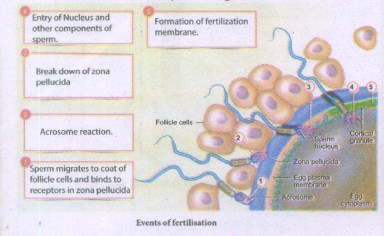
(Iv) Before a sperm can enter the egg, it must penetrate the multiple layers of granulosa (follicular) cells which are around the ovum forming the corona radiata. The follicular cells are held together by an adhesive cementing substance called hyaluronic acid.
(v) The acrosomal membrane disintegrates releasing the proteolytic enzyme, hyaluronidase during sperm entry through the corona radiata and zona pellucida. This is called acrosomal reaction.
(vi) Once fertilisation is accomplished, cortical granules from the cytoplasm of the ovum form a barrier called the fertilisation membrane around the ovum preventing further penetration of other sperms. Thus polyspermy is prevented.
This is followed by cleavage
19.
(i) Dolly was the first mammal (Sheep) clone developed by Ian Wilmut and Campbell in 1997. Dolly, the transgenic clone was developed by the nuclear transfer technique and the phenomenon of totipotency. Totipotency refers to the potential of a cell to develop different cells, tissues, organs and finally an organism
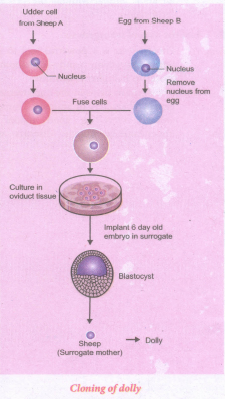
(ii) The mammary gland udder cells (somatic cells) from a donor sheep (ewe) were isolated and subjected to starvation for 5 days. The udder cells could not undergo normal growth cycle, entered a dormant stage and became totipotent. An ovum (egg cell) was taken from another sheep (ewe)) and its nucleus was removed to form an enucleated ovum. The dormant mammary gland cell/udder cell and the enucleated ovum were fused. The outer membrane of the mammary cell was ruptured allowing the ovum to envelope the nucleus. The fused cell was implanted into another ewe which served as a surrogate mother. Five months later dolly was born. Dolly was the first animal to be cloned from a differentiated somatic cell taken from an adult animal without the process.
20.
i) JAcob and Monod proposed the classical model of Lac operon to explain gene expression and regulation in E.coli. In lac operon, a polycistronic structural gene is regulated by a common promoter and regulatory gene.
ii) When the cell is using its normal energy source as glucose, the gene transcribes a repressor mRNA and after its translation, are pressor protein is produced. It binds to the operator region of the operon and prevents translation, as a result, β-galactosidase is not produced.
iii) In the absence of preferred carbon source such as glucose, if lactose is available as an energy source for the bacteria then lactose enters the cell as a result of permease enzyme. Lactose acts as an inducer and interacts with the repressor to inactivate it.
iv) The repressor protein binds to the operator of the operon and prevents RNA polymerase from transcribing the operon.
v) In the presence of inducer, such as lactose, or allolactose, the repressor is inactivated by interaction with the inducer. This allows RNA polymerase to bind to the promoter site and transcribe the operon to produce lac mRNA which enables formation of all the required enzymes needed for lactose metabolism.
vi) This regulation of lac operon by the repressor is an example of negative control of transcription initiation.
21.
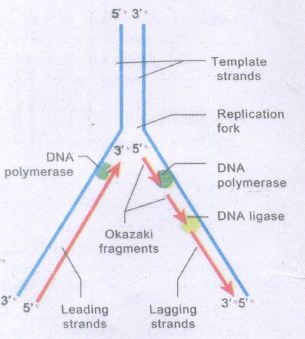
22.
According to the classical concept of gene introduced by Sutton in 1902, genes have been defined as discrete particles that follow Mendelian rules of inheritance, occupy a definite locus in the chromosome and are responsible for the expression of specific phenotypic character. They show the following properties:
(i) Number of genes in each organism is more than the number of chromosomes; hence several genes are located on the same chromosome.
(ii) The genes are arranged in a single linear order like beads on a string.
(iii) Each gene occupies a specific position called locus.
(iv) Genes may exist in several alternate forms called alleles.
(v) Genes may undergo sudden change in positions and composition called mutations.
(vi) Genes are capable of self-duplication producing their own copies.
23.
24.
The Mendelian disorders in human beings are
(a) Thalassemia
(b) Sickle cell anaemia
(c) Huntington chorea
(d) Phenylketonuria
(e) Albinism
(a) Thalassemia
(i) Thalassemia is an autosomal recessive disorder. It is caused by gene mutation resulting in excessive destruction of RBC's due to the formation of abnormal haemoglobin molecules.
Normally haemoglobin is composed of four polypeptide chains, two alpha and two beta globin chains.
(ii) Thalassemia patients have defects in either the alpha or beta globin chain causing the production of abnormal haemoglobin molecules resulting in anaemia.
Classified based on heaemoglobin
Alpha Thalassemia:
(i) Mutation or deletion of one or more of the four alpha gene alleles.
(ii) It is controlled by two closely linked genes HBAI and HBA2 on chromosome 16.
Beta Thalassemia:
(i) Production of beta globin chain is affected
(ii) It is controlled by a single gene (HBB) on chromosome 11.
(iii) It's is also known as Cocley's anemia.
(iv) It increases the alpha chain production and damages the membranes of RBC.
Huntington's chorea:
(i) It is inherited as an autosomal dominant lethal gene in man.
(ii) It is characterized by involuntary jerking of the body and progressive degeneration of the nervous system, accompanied by gradual mental and physical deterioration.
(iii) The patients with this disease usually die between the age of 35 and 40.
25.
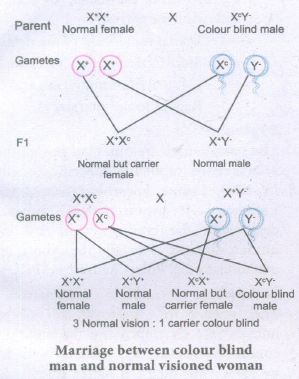
In human beings a dominant X - linked gene is necessary for the formation of colour sensitive cells, the cones. The recessive form of this gene is incapable of producing colour sensitive cone cells. Homozygous recessive females (XcXc) and hemizygous recessive males (XcY) are unable to distinguish red and green colour. The inheritance of colour blindness can be studied in the following two types of marriages.
(i) Marriage between colour blind man and normal visioned woman:
A marriage between a colour blind man and a normal visioned woman will produce normal visioned male and female individuals in Fl generation but the females are carriers. The marriage between a Fl normal visioned carrier woman and a normal visioned male will produce one normal visioned female, one carrier female, one normal visioned male and one colour blind male. Colour blind trait is inherited from the male parent to his grandson through carrier daughter, which is an example of criss-cross pattern of inheritance.
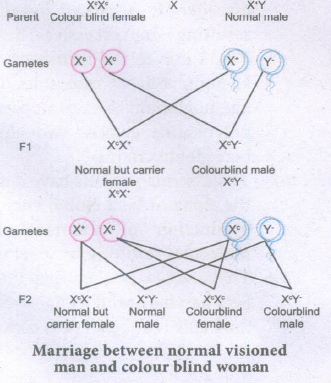
(ii) Marriage between normal visioned man and colour blind woman:
a) If a colour blind woman (XCXC) marries a normal visioned male (XCy), all F1 sons will be colourblind and daughters will be normal visioned but are carriers.
b) Marriage between F1 carrier female with a colour blind male will produce normal visioned carrier daughter, colourblind daughter, normal visioned son and a colourblind son in the F2 generation.

12th Standard Syllabus & Materials
12th Standard
TN 12th Computer Applications வலையமைப்பு வடமிடல் Sample Question Papers Study Material - QB365 Set A
NEW12th Standard
TN 12th Computer Applications களப்பெயர் முறைமை (DNS) Sample Question Papers Study Material - QB365 Set A
NEW12th Standard
TN 12th Computer Applications வலையமைப்பு எடுத்துக்காட்டுகள் மற்றும் நெறிமுறைகள் Sample Question Papers Study Material - QB365 Set A
NEW12th Standard
TN 12th Computer Applications கணினி வலையமைப்பு ஓர் அறிமுகம் Sample Question Papers Study Material - QB365 Set A



Tamilnadu Stateboard 12th Standard Subjects

Maths

Chemistry

Physics
Biology

Computer Science

Business Maths and Statistics

Economics

Commerce

Accountancy

History

Computer Applications
Biology
Computer Technology
Computer Applications
Computer Science
Business Maths and Statistics
Commerce
Economics
Maths
Chemistry
Physics
Computer Technology
History
Accountancy

Tamil

English

French
Tamilnadu Stateboard Standards



