
 100% FREE ACCESS
12th Standard Syllabus & Materials
12th Standard
TN 12th Computer Applications மின்னணு தரவு பரிமாற்றம் Sample Question Papers Study Material - QB365 Set A
NEW12th Standard
TN 12th Computer Applications மின் - வணிக பாதுகாப்பு அமைப்புகள் Sample Question Papers Study Material - QB365 Set A
NEW12th Standard
TN 12th Computer Applications மின்னணு செலுத்தல் முறைகள் Sample Question Papers Study Material - QB365 Set A
NEW12th Standard
TN 12th Computer Applications மின் - வணிகம் Sample Question Papers Study Material - QB365 Set A
NEW12th Standard
TN 12th Computer Applications திறந்த மூல கருத்துருக்கள் Sample Question Papers Study Material - QB365 Set A
NEW12th Standard
TN 12th Computer Applications வலையமைப்பு வடமிடல் Sample Question Papers Study Material - QB365 Set A

Published on: 22/06/2021
QB365 provides detailed and simple solution for every Creative Questions in class 12 Biology Subject. It will helps to get more idea about question pattern in every Creative questions with solution.
Download Tamil Nadu 12th Standard Biology question papers, model tests, one-mark questions, important questions, and public exam papers in PDF format. Free study materials and answer keys for TN State Board students.
Questions + Answers key
Take MCQ Biology Test1.
Explain the events in life cycle of Plasmodium in the secondary host/Man.
2.
Explain Oparin - Haldane hypothesis on evolution.
3.
Meselson and Stahl's experiment proved the semi-conservation mode of DNA replication. Explain.
4.
Describe in detail on population interaction.
5.
Point out the adaptive traits of aquatic animals
6.
How radioactive waste are managed? Suggest few methods of disposal of radioactive waste.(or) write an essay on Radioactive waste management.
7.
8.
How air pollution can be controlled?
9.
Describe the structure of HIV with a diagram
10.
Explain in detail about various types of extinctions.
11.
Give an account on genetic diversity and community diversity.
12.
What are the ethical issues about cloning.
13.
List out the uses of Transgenesis
14.
Describe the role of PCR in clinical field.
15.
Name the three primary germ layers of embryo. Also, mention any three organs or organ systems developing from each layer.
16.
Explain the structure and function of mammary glands.
17.
Give a detailed account on various natural methods of contraception.
18.
What is the impact of agrochemicals on the living organisms?
19.
How can air pollution be controlled?
20.
Write a note on gene banks
21.
List the differences between R selected and K selected species.
22.
Describe the structure of a sperm. (or) Describe the structure of human sperm with a neat labelled diagram.
23.
Describe the steps involved in DNA finger printing.
24.
Discuss the methods adopted for the improvement of human race.
25.
Write a note on thalassemia.
1.
Life cycle of Plasmodium :
(i) The life cycle of Plasmodium involves three phases namely schizogony,gamogony and sporogony.
(ii) The parasite enters the human blood stream through the bite of an infected female Anopheles mosquito.
(iii) As it feeds, the mosquito injects the saliva containing the sporozoties.
(iv) The sporozoite within the blood stream enter the hepatic cells of the liver.
(v) It undergoes multiple asexual fission (schizogony) and produces merozoties which are released from liver cells.
(vi) The merozoites penetrate the RBC's. Inside the RBC of blood, the merozoite begins to develop unicellular trophozoites. The trophozoite grows in size and a central vacuole develops p them to one side of cytoplasm and becomes the signet ring stage.
(vii) The trophozoite nucleus divides asexually to produce the schizont.
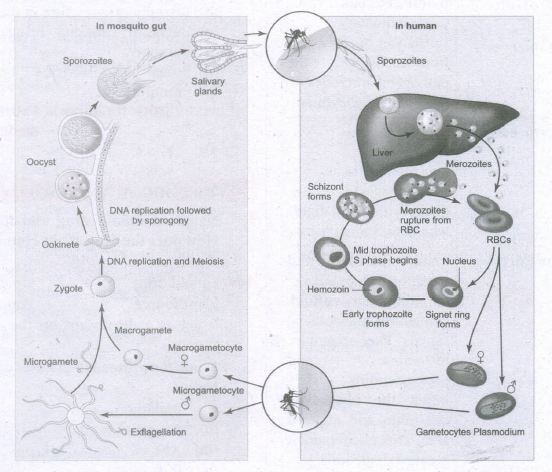
(viii) The schizont divides and produces mononucleated merozoites.
(ix) Eventually the erythrocyte lyses, releasing the merozoites and haemozoin toxin into the blood stream to infect other erythrocytes.
(x) Lysis of red blood cells results in fever and other symptoms.
(xi) This erythrocytic stage is cyclic and repeats itself approximately every 48 to 72 hours or longer depending on the species of Plasmodium involved.
(xii) The sudden release of merozoites triggers an attack on the RBCs.
(xiii) Occasionally, merozoites differentiate into macrogametocytes and microgametocytes. when these are ingested by a mosquito, they develop into male and female gametes respectively.
2.
According to the theory of chemical evolution, primitive organisms in the primordial environment of the Earth evolved spontaneously from inorganic substances and physical forces such as lightning, UV radiations, volcanic activities, etc. Oparin (1924) suggested that the organic compounds could have undergone a series of reactions leading to more complex molecules. He proposed that the molecules formed colloidal aggregates or 'coacervates' in an aqueous environment. The coacervates were able to absorb and assimilate organic compounds from the environment. Haldane (1929) proposed that the primordial sea served as a vast chemical laboratory powered by solar energy. The atmosphere was oxygen free and the combination of CO2, NH3 and UV radiations gave rise to organic compounds. The sea became a 'hot' dilute soup containing large populations of organic monomers and polymers. They envisaged that groups of monomers and polymers acquired lipid membranes and further developed into the first living cell. Haldane coined the term prebiotic soup and this became the powerful symbol of the Oparin-Haldane view on the origin of life (1924-1929). Oparin and Haldane independently suggested that if the primitive atmosphere was reducing and if there was appropriate supply of energy such as lightning or UV light then a wide range of organic compounds can be synthesized.
3.
The mode of DNA replication was determined in 1958 by Meselson and Stahl. They designed an experiment to distinguish between semi-conservative, conservative and dispersive replications. In their experiment, they grew two cultures of E.coli for many generations in separate media. The 'heavy' culture was grown in a medium in which the nitrogen source (NH4CI) contained the heavy isotope 15N and the 'light' culture was grown in a medium in which the nitrogen source contained light isotope 14N for many generations. At the end of growth, they observed that the bacterial DNA in the heavy culture contained only 14N and in the light culture only 14N. The heavy DNA could be distinguished from light DNA (15N from 14N)with a technique called Cesium Chloride (CsCI) density gradient centrifugation. In this process, heavy and light DNA extracted from cells in the two cultures settled into two distinct and separate bands (hybrid DNA).
The heavy culture (15N) was then transferred into a medium that had only NH4CI and took samples at various definite time intervals (20 minutes duration). After the first replication, they extracted DNA and subjected it to density gradient centrifugation. The DNA settled into a band that was intermediate in position between the previously determined heavy and light bands. After the second replication (40 minutes duration), they again extracted DNA samples, and this time found the DNA settling into two bands, one at the light band position and one at intermediate position. These results confirm Watson and Crick's semi-conservative replication hypothesis.
4.
Organisms belonging to different populations interact for food, shelter, mating or for other necessities. Interaction may be intra specific (interaction within the members of same species) or interspecific (among organisms of different species).
Intraspecific association is observed for all livelihood processes like feeding, territoriality, breeding, and protection.
Interspecific associations or interactions can be:
Neutral: Where different species live together but do not affect each other.
Positive: It is a symbiotic relationship ill which no organism in association is harmed and either one or both may be benefitted. It is of two types - Mutualism and Commensalism.
Negative: One or both of the interacting organisms will be affected as in case of competition, predation, and parasitism.
5.
1. The pectoral fins and dorsal fins act as stabilizers or balancers and the caudal fin helps in changing the direction as a rudder.
2. Arrangement of body muscles in the form of bundles (myotomes) help in locomotion.
3. Stream lined structure helps in the swift movement of the animals in water.
4. Respiration by gills making use of gases dissolved in water.
5. Presence of air-bladders filled with air for buoyancy.
6. Presence of lateral-line system. They function as chemoreceptors which is helpful in echolocating objects in water.
7. Integuments rich in mucous glands are protected by scales.
8. Maintain water and ionic balance in its body with excretory structures.
6.
Radioactive waste management involves the treatment, storage, and disposal of liquid, airborne, and solid effluents from the nuclear industry. Methods of disposal of radioactive wastes are:
1. Limit generation - Limiting the generation of waste is the first and most important consideration in managing radioactive wastes.
2. Dilute and disperse - For wastes having low radioactivity, dilution and dispersion are adopted.
3. Delay and decay - Delay and decay is frequently an important strategy because much of the radioactivity in nuclear reactors and accelerators is very short lived.
4. Concentrate and confine process - Concentrating and containing is the objective of treatment activities for longer-lived radioactivity. The waste is contained in corrosion resistant containers and transported to disposal sites. Leaching of heavy metals and radionuclides from these sites is a problem of growing concern.
7.
8.
Certain measures help to remove pollutants, reduce their presence or prevent their entry into the atmosphere.
1. Trees are the best remedy for urban particulate and gaseous pollution.
2. Forests act as carbon sinks and lungs of the planet.
3. Catalytic converters in vehicles help to reduce polluting gases drastically.
4. Diesel exhaust filters in automobiles cuts particulates.
5. Electrostatic precipitators reduce release of industrial pollutants.
6. Cost effective air pollution treatment systems like indoor plants and high performance biofilters can improve indoor air quality.
9.
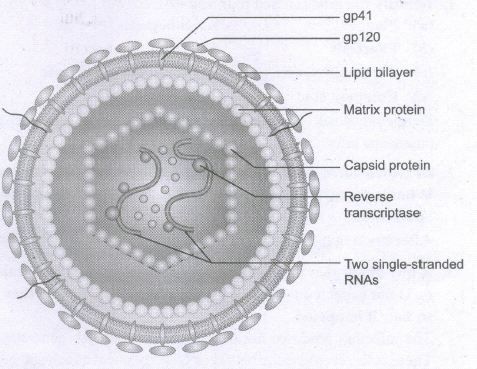
The human immunodeficiency virus belongs to the genus Lentivirus. When observed under the electron microscope, HIV is seen as a spherical virus, 100-120 nm in diameter, containing a dense core surrounded by a lipoprotein envelope. The envelope has .glycoprotein (GP) spikes termed GP 41 and GP 120. At the core, there are two large single-stranded RNA. Attached to the RNA are molecules of reverse transcripte. It also contains enzymes like protease and ribonuclease. The core is covered by a capsid made of proteins. This is followed by another layer of matrix proteins as shown above.
10.
There are three types of Extinctions
i. Natural extinction: It is a slow process of replacement of existing species with better adapted species due to changes in environmental conditions, evolutionary changes, predators and diseases. A small population can get extinct sooner than the large population due to inbreeding depression (less adaptivity and variation)
ii. Mass extinction: The Earth has experienced quite a few mass extinctions due to environmental catastrophes. Amass extinction occurred about 225 million years ago during the Permian, where 90% of shallow water marine invertebrates disappeared .
iii. Anthropogenic extinctions: These are abetted by human activities like hunting, habitat destruction, over exploitation, urbanization and industrialization. Some examples of extinctions are Dodo of Mauritius and Steller's sea cow of Russia. Amphibians seem to be at higher risk of extinction because of habitat destruction. The most serious aspect of the loss of biodiversity is the extinction of species. The unique information contained in its genetic material (DNA) and the niche it possesses are lost forever.
11.
Genetic diversity refers to the differences in genetic make-up (number and types of genes) between distinct species and to the genetic variation within a single species, also covers genetic variation between distinct populations of the same species. Genetic diversity can be measured using a variety of molecular techniques. India has more than 50,000 genetic variants of Paddy and 1000 variants of Mango. Variation of genes of a species increases with diversity in size and habitat. It results in the formation of different races, varieties and subspecies. Rouwolfia vomitaria, a medicinal plant growing in different ranges of the Himalayas shows differences in the potency and concentration of the active ingredient reserpine due to genetic diversity Genetic diversity helps in developing adaptations to changing environmental conditions. Community/Ecosystem diversity is the variety of habitats, biotic communities, and ecological processes in the biosphere. It is the diversity at ecosystem level due to diversity of niches, trophic levels and ecological processes like nutrient cycles, food webs, energy flow and several biotic interactions. India with its alpine meadows, rain forests, mangroves, coral reefs, grass lands and deserts has one of the greatest ecosystem diversity on Earth.
12.
Biotechnology has given to the society cheap drugs, better fruits and vegetables, pest resistant crops, indigenious cure to diseases and lot of controversy. This is mainly because the major part of the modem biotechnology deals with genetic manipulations. People fear that these genetic manipulations may lead to unknown consequences. The major apprehension of recombinant DNA technology is that unique microorganisms either inadvertently or deliberately for the purpose of war may be developed that could cause epidemics or environmental catastrophies. Although many are concerned about the possible risk of genetic engineering, the risks are in fact slight and the potential benefits are substantial.
13.
1. Transgenesis is a powerful tool to study gene expression and developmental processes in higher organisms.
2. Transgenesis helps in the improvement of genetic characters in animals. Transgenic animals serve as good models for understanding human diseases which help in the investigation of new treatments for diseases. Transgenic models exist for many human diseases such as cancer, Alzheimer's, cystic fibrosis, rheumatoid arthritis and sickle cell anemia.
3. Transgenic animals are used to produce proteins which are important for medical and pharmaceutical applications.
4. Transgenic mice are used for testing the safety of vaccines.
5. Transgenic animals are used for testing toxicity in animals that carry genes which make them sensitive to toxic substances than non-transgenic animals exposed to toxic substances and their effects are studied.
6. Transgenesis is important for improving the quality and quantity of milk, meat, eggs and wool production in addition to testing drug resistance.
14.
PCR In Clinical Diagnosis: The specificity and sensitivity of PCR is useful for the diagnosis of inherited disorders (genetic diseases), viral diseases, bacterial diseases, etc., The diagnosis and treatment of a particular disease often requires identifying a particular pathogen. Traditional methods of identification involve culturing these organisms from clinical specimens and performing metabolic and other tests to identify them.
The concept behind PCR based diagnosis of infectious diseases is simple - if the pathogen is present in a clinical specimen its DNA will be present. Its DNA has unique sequences that can be detected by PCR, often using the clinical specimen (for example, blood, stool, spinal fluid, or sputum) in the PCR mixture. PCR is also employed in the prenatal diagnosis of inherited diseases by using chorionic villi samples or cells from amniocentesis. Diseases like sickle cell anemia, p-thalassemia and phenylketonuria can be detected by PCR in these samples. cDNA from PCR is a valuable tool for diagnosis and monitoring retroviral infections - egoTuberculosis by Mycobacterium tuberculosis.
Several virally induced cancers, like cervical cancer caused by Papilloma virus can be detected by peR. Sex of human beings and live stocks, embryos fertilized invitro can be determined by PCR by using primers and DNA probes specific for sex chromosomes. PCR technique is also used to detect sexlinked disorders in fertilized embryos.
15.
| Germ Layers | Organ (or) Organ Systems | |
|---|---|---|
| a. | Ectoderms | Central nervous system, peripheral nervous system, and mammary gland. |
| b. | Mesoderm | Cartilage and bones, muscles, urinogenital organs |
| c | Endoderm | Epithelium of respiratory tract, liver, thyroid gland. |
16.
The mammary glands are modified sweat glands present in both sexes. It is rudimentary in the males and functional in the females. A pair of mammary glands is located in the thoracic region. It contains glandular tissue and variable quantities of fat with a median nipple surrounded by a pigmented area called the areola. Several sebaceous glands called the areolar glands are found on the surface and they reduce cracking of the skin of the nipple. Internally each mammary gland consists of 2-25 lobes, separated by fat and connective tissues. Each lobe is made up of lobules which contain acini or alveoli lined by epithelial cells. Cells of the alveoli secrete milk. The alveoli open into mammary tubules. The tubules of each lobe join to form a mammary duct. Several mammary ducts join to form wider mammary ampulla which is connected to the lactiferous duct in the nipple. Under the nipple, each lactiferous duct expands to form the lactiferous sinus which serves as a reservoir of milk. Each lactiferous duct opens separately by a minute pore on the surface of the nipple.
Normal development of the breast begins at puberty and progresses with changes during each menstrual cycle. In non-pregnant women, the glandular structure is largely underdeveloped and the breast size is largely due to amount of fat deposits. The size of the breast does not have an influence on the efficiency of lactation.
17.
Natural method is used to prevent meeting of sperm with ovum. i.e., Rhythm method (safe period), coitus interruptus, continuous abstinence and lactational amenorrhoea.
a. Periodic abstinence/rhythm method: Ovulation occurs at about the 14th day of the menstrual cycle. Ovum survives for about two days and sperm remains alive for about 72 hours in the female reproductive tract. Coitus is to be avoided during this time.
b. Continuous abstinence is the simplest and most reliable way to avoid pregnancy is not to have coitus for a defined period that facilitates conception.
c. Coitus interruptus is the oldest family planning method. The male partner withdraws his penis before ejaculation, thereby preventing deposition of semen into the vagina.
d. Lactational amenorrhoea : Menstrual cycles resume as early as 6 to 8 weeks from parturition. However, the reappearance of normal ovarian cycles may be delayed for six months during breast-feeding. This delay in ovarian cycles is called lactational amenorrhoea. It serves as a natural, but an unreliable form of birth control. Suckling by the baby during breast-feeding stimulates the pituitary to secrete increased prolactin hormone in order to increase milk production. This high prolactin concentration in the mother's blood may prevent menstrual cycle by suppressing the release of GnRH (Gonadotropin Releasing Hormone) from hypothalamus .and gonadotropin secretion from the pituitary.
18.
Chemicals which are used in agriculture for growth of plants and pest control are called agrochemicals or agrichemicals. Overuse of agrochemicals have been observed to generate residues that cause nutrient imbalance, and
(i) May kill beneficial bacteria and soil organisms.
(ii) Can cause eutrophication in water bodies.
(iii) Affect aquatic animals and their productivity.
(iv) Pesticide containing water, even in trace quantities is unfit for human consumption.
(v) Particles (aerosols) and residues of these chemicals cause air pollution.
(vi) Inhalation of contaminated air can cause respiratory problems.
(vii) Consumption can lead to poisoning, side effects and after effects.
(viii) Chemicals can cause skin rashes and irritation of eyes.
(ix) Many of these chemicals are reported to be carcinogenic.
(x) They can trigger hormonal disorders and neurotoxicity.
(xi) Beneficial insects and animals can be affected.
19.
Certain measures help to remove pollutants, reduce their presence or prevent their entry into the atmosphere.
(i) Trees are the best remedy for urban particulate and gaseous pollution.
(ii) Forests act as carbon sinks and lungs of the planet.
(iii) Catalytic converters in vehicles help to reduce polluting gases drastically.
(iv) Diesel exhaust filters in automobiles cuts particulates
(v) Electrostatic precipitators reduce, release of industrial pollutants.
(vi) Cost effective air pollution treatment systems like indoor plants and high performance biofertilizers can improve indoor air quality.
(vii) Road traffic rationing, encourage public transport, carpooling.
(viii) Increase green cover alongside roads (planting avenue trees).
(ix) Promoting 'Swachh Bharat Abhiyan'.
(x) Enactment and Enforcement of stricter environmental laws
(xi) Maintenance of air standards by proper enforcement and monitoring
(xii) Reducing carbon emissions
(xiii) Encourage use of renewable energy
(xiv) Limiting the sale of firecrackers and developing eco-friendly crackers
(xv) Make Environmental Impact Assessment mandatory
(xvi) Air Quality Index (AQI) is a number used by government agencies to communicate to the public how polluted the air is at a given time.
20.
(i) Gene banks are a type of biorepository which preserve genetic materials. Seeds of different genetic strains of commercially important plants can be stored in long periods in seed banks, gametes of threatened species can be preserved in viable and fertile condition for long periods using cryopreservation techniques.
(ii) However, it is not economically feasible to conserve all biological wealth and all the ecosystems. The number of species required to be saved from extinction far exceeds the conservation efforts.
21.
| S.No | R selected species | K selected species |
|---|---|---|
| 1. | Smaller sized organisms. | Larger sized organisms. |
| 2. | Produce many offspring | Produce few offspring |
| 3. | Mature early | Late maturity with extended parental care |
| 4. | Short life expectancy | Long life expectancy |
| 5. | Each individual reproduces only once or few times in their life time | Can reproduce more than once in lifetime |
| 6. | Only few reach adulthood | Most individual reach maximum life span |
| 7. | Unstable environment density independent | Stable environment, density dependent |
22.
Structure of human spermatozoan:
(i) The human sperm is a microscopic, flagellated and motile gamete. The whole body of the sperm is enveloped by plasma membrane and is composed of a head, neck and a tail.
(ii) The head comprises of two parts namely acrosome and nucleus.
(iii) Acrosome is a small cap like pointed structure present at the tip of the nucleus and is formed mainly from the golgi body of the spermatid.
(iv) It contains hyaluronidase, a proteolytic enzyme, popularly known as sperm lysin which helps to penetrate the ovum during fertilisation.
(v) The neck is very short and is present between the head and the middle piece. It contains the proximal centriole towards the nucleus which plays a role in the first division of zygote and the distal centriole gives rise to the axial filament of the sperm.
(vi) The middle piece possesses mitochondria spirally twisted around the axial filament called mitochondrial spiral or nebenkern. It produces energy in the form of ATP molecules for the movement of sperms.
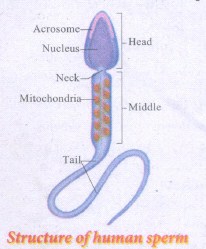
(vii) The tail is the longest part of the sperm and is slender and tapering.
(viii) It is formed of a central axial filament or axoneme and an outer protoplasmic sheath. The lashing movements of the tail push the sperm forward.
23.
Steps in DNA printing:
i) Extraction of DNA: The process of DNA fingerprinting starts with obtaining a sample of DNA from blood, semen, vaginal fluids, hair roots, teeth, bones, etc.,
ii) Polymerase chain reaction (PCR) In many situations, there is only a small amount of DNA available for fingerprinting. If needed many copies / f the DNA can be produced by PCR (DNA amplification).
iii) Fragmenting DNA: DNA is treated with restriction enzymes which cut the DNA into smaller fragments at specific sites.
iv) Separation of DNA electrophoresis: During electrophoresis in an agarose gel, the DNA fragments are separated into bands of different sizes. The bands of separated DNA are sieved out of the gel using a nylon membrane (treated with chemicals that allow for it to break the hydrogen bonds of DNA so there are single strands).
v) Denaturing DNA: The DNA on gels is denatured by using alkaline chemicals or by heating.
vi) Blotting: The DNA band pattern in the gel is transferred to a thin nylon membrane placed over the 'size fractionated DNA strand' by Southern blotting.
vii) Using probes to identify specific DNA: A radioactive probe (DNA labeled with a radioactive substance) is added to the DNA bands. The probe attaches by base pairing to those restriction fragments that are complementary to its sequence. The probes can also be prepared by using either. 'fluorescent substance' or 'radioactive isotopes'.
viii) Hybridization with probe: After the probe hybridizes and the excess probe washed off, a photographic film is placed on the membrane containing 'DNA hybrids'.
ix) Exposure film to make a genetic/ DNA Fingerprint: The radioactive label exposes the film to form an image (image of bands) corresponding to specific DNA bands. The thick and thin dark bands form a pattern of bars which constitutes a genetic fingerprint.
24.
The methods adopted for the improvement of human beings are
(i) Eugenics
(ii) Euthenics
(iii) Euphenics
Eugenics:
Application of the laws of genetics for the improvement of human race is called eugenics. The term eugenics means "well born" and was coined by Francis Galton in 1885. For the betterment of future generations it is necessary to increase the population of outstanding people and to decrease the population of abnormal and defective people by applying the principles of eugenics.
Two methods of Eugenics
(i) Constructive method or Positive eugenics
(ii) Restrictive method or Negative eugenics
(i) Positive eugenics: Positive eugenics attempts to increase consistently better or desirable germplasm and to preserve the best germplasm of the society. The desirable traits can be increased by adopting the following measures:
a) Early marriage of those having desirable traits
b) Subsiding the fit and establishing sperm and egg banks of precious germplasm
c) Educating the basic principles of genetics and eugenics
d) Improvement of environmental conditions
e) Promotion of genetic research
(ii) Negative eugenics: Negative Eugenics attempts to eliminate the defective germplasm of the society by adopting the following measures:
(a) Sexual separation of the defectives
(b) Sterilization of the defectives
(c) Control of immigration and
(d) Regulation of marriages
Euphenics:
man is called Euphenics or Medical engineering. In 1960, Joshua Lederberg coined the term Euphenics. It means normal appearing. It deals with the control of several inherited human diseases especially the inborn errors of metabolism. Eg. Phenylketonuria (PKU)
Euthenics:
The science of improvement of existing human race by improving the environmental conditions is called euthenics. It can be achieved by subjecting them to better nutrition, better unpolluted ecological conditions, better education and sufficient medical facilities
25.
(i) Thalassemia is an autosomal recessive disorder. It is caused by gene mutation resulting in excessive destruction of RBC's due to the formation of abnormal haemoglobin molecules. Normally haemoglobin is composed of four polypeptide chains, two ph and two bet globin chains. Thalassemia patients have defects in either the alpha or beta globin chain causing the production of abnormal haemoglobin molecules resulting in anaemia.
(ii) Thalassemia. is classified into alpha and beta based on which chain of haemoglobin molecule is affected. It is controlled by two closely linked genes HBAI and HBA2 on chromosome 16.Mutation or deletion of one or more of the four alpha gene alleles causes Alpha Thalassemia. In Beta Thalassemia, production of beta globin chain is affected. It is controlled by a single gene (HBB) on chromosome 11. It is the most common type of Thalassemia and is also known as Cooley's anaemia. In this disorder the alpha chain production is increased and damages the membranes of RBC

12th Standard Syllabus & Materials
12th Standard
TN 12th Computer Applications களப்பெயர் முறைமை (DNS) Sample Question Papers Study Material - QB365 Set A
NEW12th Standard
TN 12th Computer Applications வலையமைப்பு எடுத்துக்காட்டுகள் மற்றும் நெறிமுறைகள் Sample Question Papers Study Material - QB365 Set A
NEW12th Standard
TN 12th Computer Applications கணினி வலையமைப்பு ஓர் அறிமுகம் Sample Question Papers Study Material - QB365 Set A
NEW12th Standard
TN 12th Computer Applications PHP-உடன் MySQL-ஐ இணைத்தல் Sample Question Papers Study Material - QB365 Set A



Tamilnadu Stateboard 12th Standard Subjects

Maths

Chemistry

Physics
Biology

Computer Science

Business Maths and Statistics

Economics

Commerce

Accountancy

History

Computer Applications
Biology
Computer Technology
Computer Applications
Computer Science
Business Maths and Statistics
Commerce
Economics
Maths
Chemistry
Physics
Computer Technology
History
Accountancy

Tamil

English

French
Tamilnadu Stateboard Standards



