
 100% FREE ACCESS
12th Standard Syllabus & Materials
12th Standard
TN 12th Computer Applications மின்னணு தரவு பரிமாற்றம் Sample Question Papers Study Material - QB365 Set A
NEW12th Standard
TN 12th Computer Applications மின் - வணிக பாதுகாப்பு அமைப்புகள் Sample Question Papers Study Material - QB365 Set A
NEW12th Standard
TN 12th Computer Applications மின்னணு செலுத்தல் முறைகள் Sample Question Papers Study Material - QB365 Set A
NEW12th Standard
TN 12th Computer Applications மின் - வணிகம் Sample Question Papers Study Material - QB365 Set A
NEW12th Standard
TN 12th Computer Applications திறந்த மூல கருத்துருக்கள் Sample Question Papers Study Material - QB365 Set A
NEW12th Standard
TN 12th Computer Applications வலையமைப்பு வடமிடல் Sample Question Papers Study Material - QB365 Set A

Published on: 13/05/2022
QB365 provides detailed and simple solution for every Creative Questions in class 12 Biology Subject. It will helps to get more idea about question pattern in every Creative questions with solution.
latest Creative QuestionsDownload Tamil Nadu 12th Standard Biology question papers, model tests, one-mark questions, important questions, and public exam papers in PDF format. Free study materials and answer keys for TN State Board students.
Questions + Answers key
Take MCQ Biology Test1.
Give a detailed account of Modern Synthetic Theory.
2.
Explain Oparin - Haldane hypothesis on evolution.
3.
Explain about the objections to Darwinism.
4.
Explain Urey & Miller's experiment.
5.
Explain the theory of chemical evolution.
1.
Sewell Wright, Fisher, Mayer, Huxley, Dobzhansky, Simpson and Haeckel explained Natural Selection in the light of Post-Darwinian discoveries. According to this theory gene mutations, chromosomal mutations, genetic recombinations, natural selection, and reproductive isolation are the five basic factors involved in the process of organic evolution.
i. Gene mutation refers to the changes in the structure of the gene. It is also called gene/ point mutation. It alters the phenotype of an organism and produces variations in their offsprings.
ii. A chromosomal mutation refers to the changes in the structure of chromosomes due to deletion, addition, duplication, inversion or translocation. This too alters the phenotype . of an organism and produces variations in their offspring.
iii. Genetic recombination is due to crossing over of genes during meiosis. This brings about genetic variations in the individuals of the same species and leads to heritable variations.
iv. Natural selection does not produce any genetic variations but once such variations occur it favors some genetic changes while rejecting others (driving force of evolution).
v. Reproductive isolation helps in preventing interbreeding between related organisms.
2.
According to the theory of chemical evolution, primitive organisms in the primordial environment of the Earth evolved spontaneously from inorganic substances and physical forces such as lightning, UV radiations, volcanic activities, etc. Oparin (1924) suggested that the organic compounds could have undergone a series of reactions leading to more complex molecules. He proposed that the molecules formed colloidal aggregates or 'coacervates' in an aqueous environment. The coacervates were able to absorb and assimilate organic compounds from the environment. Haldane (1929) proposed that the primordial sea served as a vast chemical laboratory powered by solar energy. The atmosphere was oxygen free and the combination of CO2, NH3 and UV radiations gave rise to organic compounds. The sea became a 'hot' dilute soup containing large populations of organic monomers and polymers. They envisaged that groups of monomers and polymers acquired lipid membranes and further developed into the first living cell. Haldane coined the term prebiotic soup and this became the powerful symbol of the Oparin-Haldane view on the origin of life (1924-1929). Oparin and Haldane independently suggested that if the primitive atmosphere was reducing and if there was appropriate supply of energy such as lightning or UV light then a wide range of organic compounds can be synthesized.
3.
Objections to Darwinism: Some objections raised against Darwinism were -
(i) Darwin failed to explain the mechanism of variation.
(ii) Darwinism explains the survival of the fittest but not the arrival of the fittest.
(iii) He focused on small fluctuating variations that are mostly non-heritable.
(iv) He did not distinguish between somatic and germinal variations.
(v) He could not explain the occurrence of vestigial organs, over specialization of some organs like large tusks in extinct mammoths, oversized antlers in the extinct Irish deer, etc.,
4.
(i) Urey and Miller (1953), paved way for understanding the possible synthesis of organic compounds that led to the appearance of living organisms.
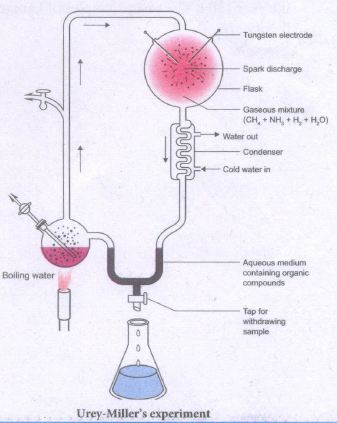
(ii) In their experiment, a mixture of gases was allowed to circulate over electric discharge from a tungsten electrode.
(iii) A small flask was kept boiling and the steam emanating from it was made to mix with the mixture of gases (ammonia, methane, and hydrogen) in the large chamber that was connected to the boiling water. The steam condensed to form water which ran down the 'U' tube.
(iv) The experiment was conducted continuously for a week and the liquid was analyzed. Glycine, alanine, beta-alanine, and aspartic A acid were identified. Thus Miller's experiments highlighted the possibility of abiogenetic synthesis of a large amount of variety of organic compounds in nature from a mixture of sample gases in which the only source of carbon was methane. Later in similar experiments, formation of all types of amino acids, and nitrogen bases were noticed.
5.
(i) According to the theory of chemical evolution primitive organisms in the primordial environment of the earth evolved spontaneously from inorganic substances and physical forces such, as lightning, UV radiations, volcanic activities, etc.
(ii) Oparin (1924) suggested that the organic compounds could have undergone a series of reactions leading to more complex molecules. He proposed that the molecules formed colloidal aggregates or 'coacervates' in an aqueous environment. The coacervates were able to absorb and assimilate organic compounds from the environment.
(iii) Haldane (1929) proposed that the primordial sea served as a vast chemical laboratory powered by solar energy. The atmosphere was oxygen free and the combination of CO2, NH3 and UV radiations gave rise to organic compounds.
(iv) The sea became a 'hot' dilute soup containing large populations of organic monomers and polymers. They proposed that groups of monomers and polymers acquired lipid membranes and further developed into the first living cell. Haldane coined the term prebiotic soup and this became the powerful symbol of the Oparin-Haldane view on the origin of life (1924-1929).
(v) Oparin and Haldane independently suggested that if the primitive atmosphere was reducing and if there was appropriate supply of energy such as lightning or UV light then a wide range of organic compounds can be synthesized.

12th Standard Syllabus & Materials
12th Standard
TN 12th Computer Applications களப்பெயர் முறைமை (DNS) Sample Question Papers Study Material - QB365 Set A
NEW12th Standard
TN 12th Computer Applications வலையமைப்பு எடுத்துக்காட்டுகள் மற்றும் நெறிமுறைகள் Sample Question Papers Study Material - QB365 Set A
NEW12th Standard
TN 12th Computer Applications கணினி வலையமைப்பு ஓர் அறிமுகம் Sample Question Papers Study Material - QB365 Set A
NEW12th Standard
TN 12th Computer Applications PHP-உடன் MySQL-ஐ இணைத்தல் Sample Question Papers Study Material - QB365 Set A



Tamilnadu Stateboard 12th Standard Subjects

Maths

Chemistry

Physics
Biology

Computer Science

Business Maths and Statistics

Economics

Commerce

Accountancy

History

Computer Applications
Biology
Computer Technology
Computer Applications
Computer Science
Business Maths and Statistics
Commerce
Economics
Maths
Chemistry
Physics
Computer Technology
History
Accountancy

Tamil

English

French
Tamilnadu Stateboard Standards



