
 100% FREE ACCESS
12th Standard Syllabus & Materials
12th Standard
TN 12th Maths Applications of Matrices and Determinants Sample Question Papers Study Material - QB365 Set A
NEW12th Standard
TN 12th Computer Applications மின்னணு தரவு பரிமாற்றம் Sample Question Papers Study Material - QB365 Set A
NEW12th Standard
TN 12th Computer Applications மின் - வணிக பாதுகாப்பு அமைப்புகள் Sample Question Papers Study Material - QB365 Set A
NEW12th Standard
TN 12th Computer Applications மின்னணு செலுத்தல் முறைகள் Sample Question Papers Study Material - QB365 Set A
NEW12th Standard
TN 12th Computer Applications மின் - வணிகம் Sample Question Papers Study Material - QB365 Set A
NEW12th Standard
TN 12th Computer Applications திறந்த மூல கருத்துருக்கள் Sample Question Papers Study Material - QB365 Set A

Published on: 21/06/2021
QB365 provides detailed and simple solution for every Creative Questions in class 12 Biology Subject. It will helps to get more idea about question pattern in every Creative questions with solution.
Download Tamil Nadu 12th Standard Biology question papers, model tests, one-mark questions, important questions, and public exam papers in PDF format. Free study materials and answer keys for TN State Board students.
Questions + Answers key
Take MCQ Biology Test1.
Write in detail about various types of antigen-antibody reactions.
2.
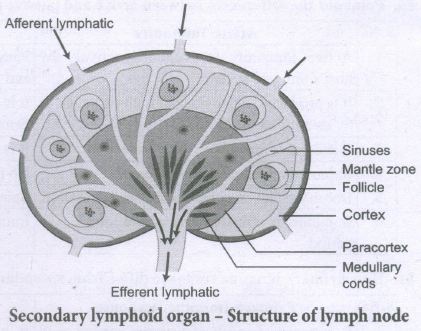
Describe the structure of lymph node with a labeled diagram
3.
How primary immune response differ from secondary immune response?
4.
Tabulate the various types of innate immunity and their action mechanism
5.
List any five viral diseases, their causative agents, site of infection, mode of transmission and symptoms
1.
Different types of antigen and antibody reactions: The reaction between soluble antigen and antibody leads to the visible precipitate formation, which is called a precipitin reaction. Antibodies that bring about precipitate formation on reacting with antigens are called as precipitins. Whenever a particulate antigen interacts with its antibody, it would result in clumping or agglutination of the particulate antigen, which is called agglutination reaction. The antibody 'involved in bringing about agglutination reaction is called agglutinin. Opsonisation or enhanced attachment is the process by which a pathogen is marked of ingestion and destruction by a phagocyte. Opsonization involves the binding of an opsonin i.e., antibody, to a receptor on the pathogens. cell membrane. After opsonin binds to the membrane, phagocytes are attracted to the pathogen. So, opsonization is a process in which pathogens are coated with a substance called an opsonin, marking the pathogen out for destruction by the immune system. This results in a much more efficient phagocytosis. The neutralization reactions are the reactions of antigen-antibody that involve the elimination of the harmful effects of bacterial exotoxins or a virus by specific antibodies. These neutralizing substances i.e. antibodies are known. as antitoxins. This specific antibody is produced by a host cell in response to a bacterial exotoxin or corresponding toxoid (inactivated toxin).
2.
Lymph node has three zones. They are the cortex, paracortex, and medulla. The outer most layer of the lymph node is called cortex, which consists of B-lymphocytes, macrophages, and follicular dendritic cells. The paracortex zone is beneath the cortex, which is richly populated by T lymphocytes and interdigitating dendritic cells. The innermost zone is called the medulla which is sparsely populated by lymphocytes, but many of them are plasma cells, which actively secrete antibody molecules. As the lymph enters, it slowly percolates through the cortex, paracortex, and medulla, giving sufficient chance for the phagocytic cells and dendritic cells to trap the antigen brought by the lymph. The lymph leaving a node carries enriched antibodies secreted by the medullary plasma cells against the antigens that enter the lymph node. Sometimes visible swelling of lymph nodes occurs due to active immune response and increased the concentration of lymphocytes. Thus swollen lymph nodes may signal an infection. There are several groups of lymph nodes. The most frequently enlarged lymph nodes are found in the neck, under the chin, in the armpits, and in the groin.
3.
| S.No | Primary Immune Response | Secondary Immune Response |
|---|---|---|
| 1. | It occurs as a result of primary contact with an antigen. | It occurs as a result of second and subsequent contacts with the same antigen |
| 2. | Antibody level reaches peak in 7 to 10 days | Antibody level reaches peak in 3 to 5 days. |
| 3. | Prolonged period is required to establish immunity | It establishes immunity in a short time. |
| 4. | There is rapid decline in antibody level | Antibody level remains high for longer period. |
| 5. | It appears mainly in the lymph nodes and spleen. | It appears mainly in the bone marrow followed by the spleen and lymph nodes |
4.
| Type of innate immunity | Mechanism |
|---|---|
| 1. Anatomical barriers Skin Mucus membrane |
Prevents the entry' of microbes. Its acidic environment (pH 3-5) retards the growth of microbes Mucus entraps foreign microorganisms and competes with microbes for attachment. |
| 2. Physiological barriers Temperature Low pH Chemical mediators |
Normal body temperature inhibits the growth of pathogens. Fever also inhibits the growth of pathogens The acidity of gastric secretions (HCI) kills most ingested microbes Lysozyme acts as antibacterial agent and cleaves the bacterial cell wall. Interferons induce antiviral state in the uninfected cells. Complementary substances produced from leucocytes lyse the pathogenic microbes or facilitate phagocytosis. |
| 3. Phagocytic barriers | Specialized cells (Monocytes, neutrophils, tissue macrophages) phagocytose and digest whole microorganisms |
| 4. Inflammatory barriers | Tissue damage and infection induce leakage of vascular fluid, containing chemotactic signals like serotonin, histamine, and prostaglandins. They influx the phagocytic cells into the affected area. This phenomenon is called diapedesis. |
5.
| S.No | Diseases | Caustive agent | Site of infection | Mode of transmission | Symptoms |
|---|---|---|---|---|---|
| 1. | Common cold | Rhino viruses | Respiratory tract | Droplet infection | Nasal congestion and discharge sore throat, cough and headache |
| 2. | Mumps | Mumps cirus (RNA virus)Paramyxa cirus |
Salivary glands | Saliva and droplet infection | Enlargement of the parotid glands |
| 3. | Measles | Rubella virus (RNA virus Parmyxco), | Skin and respiratory tract | Droplet infection | Sore throat, running nose cough and fever. reddish rashes on the skin, neck and ears |
| 4. | Viral hepatitis | Hepatitis - B virus | Liver | Parenteral route blood transfusion | Liver damage, jaundice, nausea yellowish eyes, fever and pain in the abdomen |
| 5. | Chicken pox | Varicella-Zoster virus (DNA Virus | Respiratory tract,skin and nervous | Droplet infection and direct contact | Mild fever with itchy skin, rash and blisters |

12th Standard Syllabus & Materials
12th Standard
TN 12th Computer Applications வலையமைப்பு வடமிடல் Sample Question Papers Study Material - QB365 Set A
NEW12th Standard
TN 12th Computer Applications களப்பெயர் முறைமை (DNS) Sample Question Papers Study Material - QB365 Set A
NEW12th Standard
TN 12th Computer Applications வலையமைப்பு எடுத்துக்காட்டுகள் மற்றும் நெறிமுறைகள் Sample Question Papers Study Material - QB365 Set A
NEW12th Standard
TN 12th Computer Applications கணினி வலையமைப்பு ஓர் அறிமுகம் Sample Question Papers Study Material - QB365 Set A



Tamilnadu Stateboard 12th Standard Subjects

Maths

Chemistry

Physics
Biology

Computer Science

Business Maths and Statistics

Economics

Commerce

Accountancy

History

Computer Applications
Biology
Computer Technology
Computer Applications
Computer Science
Business Maths and Statistics
Commerce
Economics
Maths
Chemistry
Physics
Computer Technology
History
Accountancy

Tamil

English

French
Tamilnadu Stateboard Standards



