
 100% FREE ACCESS
12th Standard Syllabus & Materials
12th Standard
TN 12th Maths Applications of Matrices and Determinants Sample Question Papers Study Material - QB365 Set A
NEW12th Standard
TN 12th Computer Applications மின்னணு தரவு பரிமாற்றம் Sample Question Papers Study Material - QB365 Set A
NEW12th Standard
TN 12th Computer Applications மின் - வணிக பாதுகாப்பு அமைப்புகள் Sample Question Papers Study Material - QB365 Set A
NEW12th Standard
TN 12th Computer Applications மின்னணு செலுத்தல் முறைகள் Sample Question Papers Study Material - QB365 Set A
NEW12th Standard
TN 12th Computer Applications மின் - வணிகம் Sample Question Papers Study Material - QB365 Set A
NEW12th Standard
TN 12th Computer Applications திறந்த மூல கருத்துருக்கள் Sample Question Papers Study Material - QB365 Set A

Published on: 13/05/2022
QB365 provides detailed and simple solution for every Creative Questions in class 12 Biology Subject. It will helps to get more idea about question pattern in every Creative questions with solution.
latest Creative QuestionsDownload Tamil Nadu 12th Standard Biology question papers, model tests, one-mark questions, important questions, and public exam papers in PDF format. Free study materials and answer keys for TN State Board students.
Questions + Answers key
Take MCQ Biology Test1.
Describe the principle involved in DNA fingerprinting technique.
2.
Explain the mechanism of lac-operon of the E-coli.
3.
Describe the structure of tRNA with a diagram.
4.
List the salient features of genetic code.
5.
Explain the properties of genetic material.
1.
The DNA fingerprinting technique was first developed by Alec Jeffreys in 1985. The DNA of a person and fingerprints are unique. There are 23 pairs of human chromosomes with 1.5 million pairs of genes. It is a well-known fact that genes are segments of DNA which differ in the sequence of their nucleotides. Not all segments of DNA code for proteins, some DNA segments have a regulatory function, while others are intervening sequences (introns) and still others are repeated DNA sequences. In DNA fingerprinting, short repetitive nucleotide sequences are specific for a person. These nucleotide sequences are called as variable number tandem repeats (VNTR). The VNTRs of two persons generally show variations and are useful as genetic markers. DNA fingerprinting involves identifying differences in some specific regions in DNA sequence called repetitive DNA because, in these sequences, a small stretch of DNA is repeated many times. These repetitive DNA are separated from bulk genomic DNA as different peaks during density gradient centrifugation. The bulk DNA forms a major peak and the other small peaks are referred to as satellite DNA. Depending on base composition (A : T rich or G: C rich), length of segment and number of repetitive units, the satellite DNA is classified into many sub-categories such as microsatellites and minisatellites, etc. These sequences do not code for any proteins, but they form a large portion of human genome. These sequences show high degree of polymorphism and form the basis of DNA fingerprinting. DNA isolated from blood, hair, skin cells or other genetic evidences left at the scene of a crime can be compared through VNTR patterns, with the DNA of a criminal suspect to determine guilt or innocence. VNTR patterns are also useful in establishing the identity of a homicide victim, either from DNA found as evidence or from the body itself.
2.
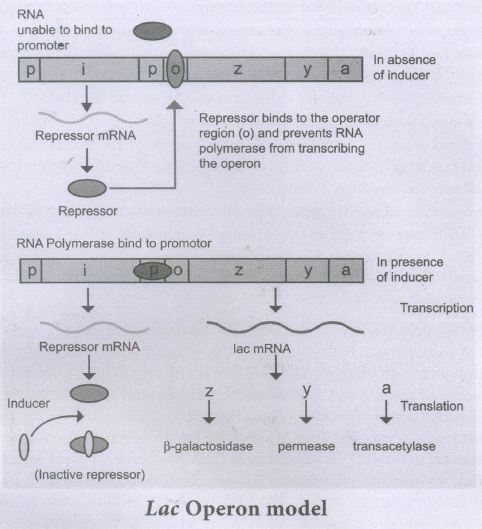
The Lac (Lactose) operon: The metabolism of lactose in E-coli requires three enzymes - permease, β-galactosidase (β-gal) and transacetylase. The enzyme permease is needed for entry of lactose into the cell, β-galactosidase brings about hydrolysis of lactose to glucose and galactose, while transacetylase transfers acetyl group from acetyl Co A to β-galactosidase. The lac operon consists of one regulator gene ('i' gene refers to inhibitor) promoter sites (P), and operator site (o). Besides these, it has three structural genes namely lac z, y and lac a. The lac 'z' gene codes for β-galactosidase, lac 'y' gene codes for permease and 'a' gene codes for transacetylase.
Jacob and Monod proposed the classical model of Lac operon to explain gene expression and regulation in E-coli. In lac operon, a polycistronic structural gene is regulated by a common promoter and regulatory gene. When the cell is using its normal energy source as glucose; the 'i' gene transcribes a repressor mRNA and after its translation, a repressor protein is produced. It binds to the operator region of the operon and prevents translation, as a result, β-galactosidase is not produced. In the absence of preferred carbon source such as glucose, if lactose is available as an energy source for the bacteria then lactose enters the cell as a result of permease enzyme. Lactose acts as an inducer and interacts with the repressor to inactivate it. The repressor protein binds to the operator of the operon and prevents RNA polymerase from transcribing the operon. In the presence of inducer, such as lactose or allolactose, the repressor is inactivated by interaction with the inducer. This allows RNA polymerase to bind to the promotor site and transcribe the operon to produce lac mRNA which enables formation of all the required enzymes needed for lactose metabolism. This regulation of lac operon by the repressor is an example of negative control of transcription initiation.
3.
i) The transfer RNA, (tRNA) molecule of a cell acts as a vehicle that picks up the amino acids scattered through the cytoplasm and also reads specific codes of mRNA molecules. Hence it is called an adapter molecule This term was postulated by Francis Crick.
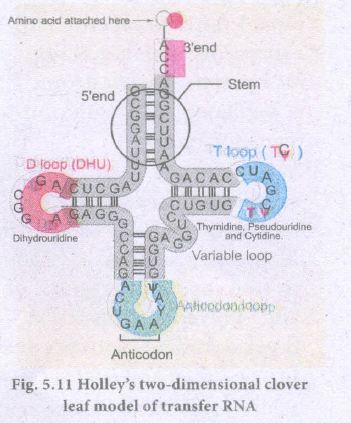
(ii) The two dimensional clover leaf model of tRNA was proposed by Robert Holley. The secondary structure of tRNA depicted in the following picture looks like a clover leaf.
(iii) In actual structure, the tRNA is a compact molecule which looks like an inverted I.
(iv) The clover leaf model of tRNA shows the presence of three arms namely DHU arm, middle arm and TΨC arm.
(v) These arms have loops such as amino acyl binding loop, anticodon loop and ribosomal binding loop at their ends. In addition it also shows a small lump called variable loop or extra arm.
(vi) The amino acid is attached to one end (amino acid acceptor end) and the other end consists of three anticodon nucleotides.
(vii) The anticodon pairs with a codon in mRNA ensuring that the correct amino acid is incorporated into the growing polypeptide chain.
(viii) Four different regions of double-stranded RNA are formed during the folding process. Modified bases are especially common in tRNA.
(ix) Wobbling between anticodon and codon allows some tRNA molecules to read more than one codon.
4.
The salient features of genetic code are as follows:
(i) The genetic codon is a triplet code and 61 codons code for amino acids and 3 codons do not code for any amino acid and function as stop codon (Termination).
(ii) The genetic code is universal. It means that all known living systems use nucleic acids and the same three base codons (triplet codon) direct the synthesis of protein from amino acids. for example, the mRNA (UUU) codon codes for phenylalanine in all cells of all organisms. some exceptions are reported in prokaryotic, mitochondrial and chloroplast genomes. However similarities are more common than differences. Most part of the genetic code is universal in prokaryotes and eukaryotes.
(iii) A non-overlapping codon means that the same letter is not used for two different codons. for instance, the nucleotide sequence GUU GUC represents only two codons.
(iv) It is comma less, which means that the message would be read directly from one end to the other i.e., no punctuation are needed between two codes.
(v) A degenerate code means that more than one triplet codon could code for a specific amino acid. for example, codons GUU, GCU, GUA and GUG code for valine.
(vi) Non-ambiguous code means that one codon will code for one amino acid.
(vii) The code is always read in a fixed direction i.e. from 5'⟶3' direction called polarity.
(viii) AUG has dual functions. It acts as a initiator codon and also codes for the amino acid methionine.
(ix) UAA, UAG (tyrosine) and UGA (tryptophan) codons are designated as termination (stop) codons and also are known as "non-sense" codons.
5.
(i) DNA acts as a genetic material. However, in some viruses like Tobacco mosaic virus (TMV), bacteriophage θB, RNA acts as the genetic material. A molecule that can act as a genetic material should have the following properties:
(ii) Self Replication: It should be able to replicate. According to the rule of base pairing and complementarity, both nucleic acids (DNA and RNA) have the ability to direct duplications. Proteins fail to fulfill this criteria.
(iii) It should be stable structurally and chemically. The genetic material should be stable enough not to change with different stages of life cycle, age or with change in physiology of the organism.
(iv) Griffith's transforming principle, Heat which killed the bacteria did not destroy some of the properties of genetic material. In DNA the two strands being complementary, if separated (denatured) by heating can come together (renaturation) when appropriate condition is provided.
(v) Further 2' OH group present at every nucleotide in RNA is a reactive group that makes RNA liable and easily degradable. RNA is also known to be catalytic and reactive.
(vi) Hence DNA is chemically more stable and chemically less reactive when compared to RNA.
(vii) Presence of thymine instead of uracil in DNA confers additional stability to DNA.
(viii) It should be able to express itself in the form of Mendelian characters ', RNA can directly code for protein synthesis DNA, however depends on RNA for synthesis of proteins.
(ix) Both DNA and RNA can act as a genetic material, but DNA- being more stable stores the genetic information and RNA transfers the genetic information
(x) Variation through mutation: It should be able to mutate. Both DNA and RNA are able to mutate. RNA being unstable, mutates at a faster rate.

12th Standard Syllabus & Materials
12th Standard
TN 12th Computer Applications வலையமைப்பு வடமிடல் Sample Question Papers Study Material - QB365 Set A
NEW12th Standard
TN 12th Computer Applications களப்பெயர் முறைமை (DNS) Sample Question Papers Study Material - QB365 Set A
NEW12th Standard
TN 12th Computer Applications வலையமைப்பு எடுத்துக்காட்டுகள் மற்றும் நெறிமுறைகள் Sample Question Papers Study Material - QB365 Set A
NEW12th Standard
TN 12th Computer Applications கணினி வலையமைப்பு ஓர் அறிமுகம் Sample Question Papers Study Material - QB365 Set A



Tamilnadu Stateboard 12th Standard Subjects

Maths

Chemistry

Physics
Biology

Computer Science

Business Maths and Statistics

Economics

Commerce

Accountancy

History

Computer Applications
Biology
Computer Technology
Computer Applications
Computer Science
Business Maths and Statistics
Commerce
Economics
Maths
Chemistry
Physics
Computer Technology
History
Accountancy

Tamil

English

French
Tamilnadu Stateboard Standards



