
 100% FREE ACCESS
12th Standard Syllabus & Materials
12th Standard
TN 12th Maths Applications of Matrices and Determinants Sample Question Papers Study Material - QB365 Set A
NEW12th Standard
TN 12th Computer Applications மின்னணு தரவு பரிமாற்றம் Sample Question Papers Study Material - QB365 Set A
NEW12th Standard
TN 12th Computer Applications மின் - வணிக பாதுகாப்பு அமைப்புகள் Sample Question Papers Study Material - QB365 Set A
NEW12th Standard
TN 12th Computer Applications மின்னணு செலுத்தல் முறைகள் Sample Question Papers Study Material - QB365 Set A
NEW12th Standard
TN 12th Computer Applications மின் - வணிகம் Sample Question Papers Study Material - QB365 Set A
NEW12th Standard
TN 12th Computer Applications திறந்த மூல கருத்துருக்கள் Sample Question Papers Study Material - QB365 Set A

Published on: 13/05/2022
QB365 provides detailed and simple solution for every book back questions in class 12 Biology subject.It will helps to get more idea about question pattern in every book back questions with solution.
latest Book back QuestionsDownload Tamil Nadu 12th Standard Biology question papers, model tests, one-mark questions, important questions, and public exam papers in PDF format. Free study materials and answer keys for TN State Board students.
Questions + Answers key
Take MCQ Biology Test1.
What is ecological density, crude density and population density?
2.
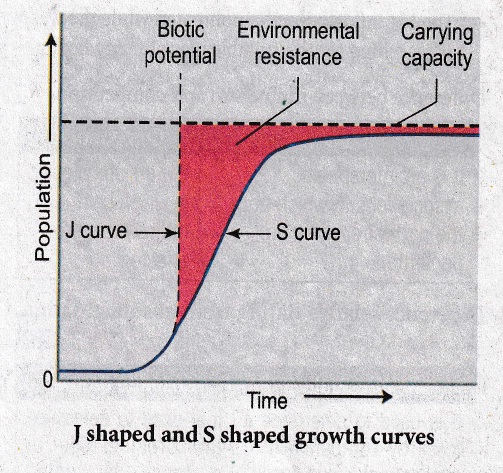
Differentiate J and S shaped curve
3.
Give the characters of a Biome ?
4.
Classify the aquatic biomes of Earth.
5.
Classify the adaptive traits found in organisms
1.
(i) Ecological density: It is the size of a population in relation to the numbers per unit of habitat space. (Available area or volume that can be colonized by a population). Eg. 1000 fish in the volume of water in the pond.
(ii) Crude density: It is the size of a population in relation to the numbers per unit of total space. Eg. 1000 fish in a pond.
(iii) Population density: It is usually expressed as the number of individuals per unit area or volume. Eg. 100 trees per acre.
2.
| S. No. | J shaped curve | S shaped curve |
|---|---|---|
| 1. | When a population increases rapidly in an exponential fashion and then stops abruptly due to environmental resistance or due to sudden appearance of a limiting factor, they are said to exhibit J-shaped growth form, |
Some populations, as in a population of small mammals, increase lowly at first then more rapidly & gradually slow down as environmental resistance increases where by equilibrium is reached and maintained |
| 2. | Many insects show explosive increase in number during the rainy season followed by their disappearance at the end of season. | Their growth is represented by s shaped growth curve. |
3.
Characters of biome
(i) Location, geographical position (Latitude, Longitude)
(ii) Climate and physiochemical environment
(iii) Predominant plant and animal life
(iv) Boundaries between biomes are not always sharply defined. Transition or transient zones are seen as in case of grassland and forest biomes.
4.
(i) Freshwater (Lakes, ponds, and rivers)
(ii) Brackish water (Estuaries and Wetlands)
(iii) Marine (Coral reefs, pelagic zones, and abyssal zones)
5.
Adaptation is a dynamic evolutionary process that fits organisms to their environment and enhancing their evolutionary fitness.
(a) Structural adaptations:
1. The external and internal structures of animals can help them to adapt better to their environment. Some of the most common examples are mammals growing thicker fur to survive freezing climates.
2. Some of the most attractive adaptations in nature occur for reasons of crypsis. (e.g: Camouflage) and mimicry.
3. Cryptic animals are those which camouflage perfectly with their environment and are almost impossible to detect. Certain reptiles and insects such as chameleons and stick insects show this type of adaptation, which helps in prey capture or to evade from predators. Likewise, horse legs are suitable for fast running and adapted for grasslands or plains and similar terrestrial environments.
(b) Behavioural adaptations:
1. Action and behaviour of animals are instinctive or learned. Animals develop certain behavioural traits or adaptations for survival.
2. Fleeing from a predator, hiding during sleep, seeking refuge from climate change or moving to find different food sources are all behavioural adaptations.
3. The two most characteristic forms of behavioural adaptations are migration and courtship.
4. Migration allows the animals to find better resources or evade threat.
5. Courtship is a set of behavioural patterns to find a made to reproduce.
6. Most nocturnal animals remain underground (or) inactive during daytime.
7. This is a modification of their feeding and activity pattern (or) habit (or) behaviour.
(c) Physiological adaptations:
1. The adaptations of organisms that help them to live and survive in their environment with unique niches.
2. Example: Lions have sharp canines to hunt and tear meat of preys and digestive system suitable for digesting raw meat.
3. The two most well-known physiological adaptations are hibernation and aestivation.
4. These are two different types of inactivity where the metabolic rate slows down so much that the animal can survive without eating or drinking.
5. Aquatic medium and terrestrial habitats have their own respective environmental conditions. Hence organisms have to evolve appropriate adaptations to select suitable habitats and niches.

12th Standard Syllabus & Materials
12th Standard
TN 12th Computer Applications வலையமைப்பு வடமிடல் Sample Question Papers Study Material - QB365 Set A
NEW12th Standard
TN 12th Computer Applications களப்பெயர் முறைமை (DNS) Sample Question Papers Study Material - QB365 Set A
NEW12th Standard
TN 12th Computer Applications வலையமைப்பு எடுத்துக்காட்டுகள் மற்றும் நெறிமுறைகள் Sample Question Papers Study Material - QB365 Set A
NEW12th Standard
TN 12th Computer Applications கணினி வலையமைப்பு ஓர் அறிமுகம் Sample Question Papers Study Material - QB365 Set A



Tamilnadu Stateboard 12th Standard Subjects

Maths

Chemistry

Physics
Biology

Computer Science

Business Maths and Statistics

Economics

Commerce

Accountancy

History

Computer Applications
Biology
Computer Technology
Computer Applications
Computer Science
Business Maths and Statistics
Commerce
Economics
Maths
Chemistry
Physics
Computer Technology
History
Accountancy

Tamil

English

French
Tamilnadu Stateboard Standards



