
 100% FREE ACCESS
12th Standard Syllabus & Materials
12th Standard
TN 12th Maths Applications of Matrices and Determinants Sample Question Papers Study Material - QB365 Set A
NEW12th Standard
TN 12th Computer Applications மின்னணு தரவு பரிமாற்றம் Sample Question Papers Study Material - QB365 Set A
NEW12th Standard
TN 12th Computer Applications மின் - வணிக பாதுகாப்பு அமைப்புகள் Sample Question Papers Study Material - QB365 Set A
NEW12th Standard
TN 12th Computer Applications மின்னணு செலுத்தல் முறைகள் Sample Question Papers Study Material - QB365 Set A
NEW12th Standard
TN 12th Computer Applications மின் - வணிகம் Sample Question Papers Study Material - QB365 Set A
NEW12th Standard
TN 12th Computer Applications திறந்த மூல கருத்துருக்கள் Sample Question Papers Study Material - QB365 Set A

Published on: 21/06/2021
QB365 provides detailed and simple solution for every Creative Questions in class 12 Biology Subject. It will helps to get more idea about question pattern in every Creative questions with solution.
Download Tamil Nadu 12th Standard Biology question papers, model tests, one-mark questions, important questions, and public exam papers in PDF format. Free study materials and answer keys for TN State Board students.
Questions + Answers key
Take MCQ Biology Test1.
(i) Define Chromosomal Abnormality
(ii) Explain any two Autosomal Aneuploidy in human beings.
2.
Write elaborately about the following Mendelian disorders.
(a) Thalassemia (b) Albinism
3.
Write notes on chromosomal abnormalities in human beings. (or) What is aneuploidy? Explain it
4.
Discuss the methods adopted for the improvement of human race.
5.
Write a note on thalassemia.
1.
(i) A chromosomal abnormality is a genetic disorder that occurs when there is a change in the number or structure of chromosomes. Chromosomes are carriers of genetic information, and a normal human cell has 23 pairs of chromosomes, or 46 chromosomes total. Chromosomal abnormalities can affect autosomes, sex chromosomes, or both.
(ii) Two examples of autosomal aneuploidies in humans are trisomy 21 (Down syndrome) and trisomy 18 (Edwards syndrome):
Trisomy 21 (Down syndrome)
This is the most common autosomal aneuploidy in infants and affects about 1 in 800 births. It's associated with high rates of morbidity and mortality, but people with Down syndrome can live to be about 50 years old.
Trisomy 18 (Edwards syndrome)
This aneuploidy affects about 1 in 6,000 births. Fetuses with trisomy 18 survive to term but are only viable for weeks or months.
Most aneuploidies that affect autosomal chromosomes are incompatible with life and often result in spontaneous abortions in the first few weeks of pregnancy.
2.
(a) Thalassemia
Thalassemia is an autosomal recessive disorder. It is caused by gene mutation resulting in excessive destruction of RBC's due to the formation of abnormal hemoglobin molecules. Normally haemoglobin is composed of four polypeptide chains, two alpha, and two beta globin chains. Thalassemia patients have defects in either the alpha or beta globin chain causing the production of abnormal haemoglobin molecules resulting in anaemia.
Thalassemia is classified into alpha and beta based on which chain of haemoglobin molecule is affected. It is controlled by two closely linked genes HBA1 and HBA2 on chromosome 16. Mutation or deletion of one or more of the four alpha gene alleles causes Alpha Thalassemia. In Beta Thalassemia, production of beta globin chain is affected. It is controlled by a single gene (RBB) on chromosome 11. It is the most common type of Thalassemia and is also known as Cooley's anaemia. In this disorder, the alpha chain production is increased and damages the membranes of RBC.
(b) Albinism
Albinism is an inborn error of metabolism, caused due to an autosomal recessive gene. Melanin pigment is responsible for skin colour. Absence of melanin results in a condition called albinism. A person with the recessive allele lacks the tyrosinase enzyme system, which is required for the conversion of dihydroxyphenyl alanine (DOPA) into melanin pigment inside the me1anocytes. In an albino, melanocytes are present in normal numbers in their skin, hair, iris, etc., but lack melanin pigment.
3, 4 - dihydroxy phenylalanine (DOPA) \(\underrightarrow { Tyrosinase } \) Melanin
3.
In human beings the diploid (2n) body cell has 46 chromosomes (23 pairs).
i) chromosomal abnormalities are caused by errors is the number or structure of chromosome.
ii) Failure of chromatids to segregate during cell division resulting in the gain or loss of of one or more choromosomes called aneuploidy. It is caused by the nondisjunction of chromosomes.
iii) There abnormalities causes various syndromes in human beings. They are
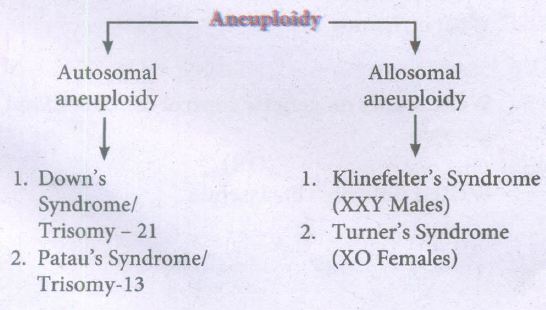
1. Down's Syndrome/ Trisomy-21:
Trisomic condition of chromosome - 21
Symptoms :
(i) severe mental retardation,
(ii) Defective development of the central nervous system,
(iii) increased separation between the eyes,
(iv) flattened nose, ears are malformed,
(v) mouth is constantly open and the tongue protrudes.
2. Patau's Syndrome/ Trisomy-13
i) Trisomic condition of chromosome l3 results in Patau's syndrome.
ii) Meiotic non disjunction is thought to be the cause for this chromosomal abnormality.
ii) It is characterized by
symptoms
(i) multiple and severe body malformations as well as profound mental deficiency.
(ii) Small head with small eyes,
(iii) cleft palate,
(iv) malformation of the brain
(v) internal organs
b. Allosomal abnormalities is human beings:
Mitotic or meiotic non-disjunction of sex chromosomes causes allosomal abnormalities. Several sex chromosomal abnormalities have been detected. Eg. Klinefelter's syndrome and Turner's syndrome.
1. Klineletter's Syndrome(XXY Males):
(i) It is due to the presence of an additional copy of the X chromosome resulting in a karyotype of 47, XXY.
(ii) Persons with this syndrome have 47 chromosomes (44AA+XXY).
symptoms
sterile males, tall, obese, with long limbs, high pitched voice, under developed genitalia and have feeble breast (gynaecomastia) development.
2. Turner's Syndrome (XO Females):
(i) It is due to the loss of a X chromosome resulting in a karyotype of 45, X.
(ii) Persons with this syndrome have 45 chromosomes (44 autosomes and one X chromosome) (44AA + XO) and are sterile females.
symptoms
Low stature, webbed neck, under developed breast, rudimentary gonads lack of menstrual cycle during puberty, are the main symptoms of this syndrome.
4.
The methods adopted for the improvement of human beings are
(i) Eugenics
(ii) Euthenics
(iii) Euphenics
Eugenics:
Application of the laws of genetics for the improvement of human race is called eugenics. The term eugenics means "well born" and was coined by Francis Galton in 1885. For the betterment of future generations it is necessary to increase the population of outstanding people and to decrease the population of abnormal and defective people by applying the principles of eugenics.
Two methods of Eugenics
(i) Constructive method or Positive eugenics
(ii) Restrictive method or Negative eugenics
(i) Positive eugenics: Positive eugenics attempts to increase consistently better or desirable germplasm and to preserve the best germplasm of the society. The desirable traits can be increased by adopting the following measures:
a) Early marriage of those having desirable traits
b) Subsiding the fit and establishing sperm and egg banks of precious germplasm
c) Educating the basic principles of genetics and eugenics
d) Improvement of environmental conditions
e) Promotion of genetic research
(ii) Negative eugenics: Negative Eugenics attempts to eliminate the defective germplasm of the society by adopting the following measures:
(a) Sexual separation of the defectives
(b) Sterilization of the defectives
(c) Control of immigration and
(d) Regulation of marriages
Euphenics:
man is called Euphenics or Medical engineering. In 1960, Joshua Lederberg coined the term Euphenics. It means normal appearing. It deals with the control of several inherited human diseases especially the inborn errors of metabolism. Eg. Phenylketonuria (PKU)
Euthenics:
The science of improvement of existing human race by improving the environmental conditions is called euthenics. It can be achieved by subjecting them to better nutrition, better unpolluted ecological conditions, better education and sufficient medical facilities
5.
(i) Thalassemia is an autosomal recessive disorder. It is caused by gene mutation resulting in excessive destruction of RBC's due to the formation of abnormal haemoglobin molecules. Normally haemoglobin is composed of four polypeptide chains, two ph and two bet globin chains. Thalassemia patients have defects in either the alpha or beta globin chain causing the production of abnormal haemoglobin molecules resulting in anaemia.
(ii) Thalassemia. is classified into alpha and beta based on which chain of haemoglobin molecule is affected. It is controlled by two closely linked genes HBAI and HBA2 on chromosome 16.Mutation or deletion of one or more of the four alpha gene alleles causes Alpha Thalassemia. In Beta Thalassemia, production of beta globin chain is affected. It is controlled by a single gene (HBB) on chromosome 11. It is the most common type of Thalassemia and is also known as Cooley's anaemia. In this disorder the alpha chain production is increased and damages the membranes of RBC

12th Standard Syllabus & Materials
12th Standard
TN 12th Computer Applications வலையமைப்பு வடமிடல் Sample Question Papers Study Material - QB365 Set A
NEW12th Standard
TN 12th Computer Applications களப்பெயர் முறைமை (DNS) Sample Question Papers Study Material - QB365 Set A
NEW12th Standard
TN 12th Computer Applications வலையமைப்பு எடுத்துக்காட்டுகள் மற்றும் நெறிமுறைகள் Sample Question Papers Study Material - QB365 Set A
NEW12th Standard
TN 12th Computer Applications கணினி வலையமைப்பு ஓர் அறிமுகம் Sample Question Papers Study Material - QB365 Set A



Tamilnadu Stateboard 12th Standard Subjects

Maths

Chemistry

Physics
Biology

Computer Science

Business Maths and Statistics

Economics

Commerce

Accountancy

History

Computer Applications
Biology
Computer Technology
Computer Applications
Computer Science
Business Maths and Statistics
Commerce
Economics
Maths
Chemistry
Physics
Computer Technology
History
Accountancy

Tamil

English

French
Tamilnadu Stateboard Standards



