
 100% FREE ACCESS
12th Standard Syllabus & Materials
12th Standard
TN 12th Maths Applications of Matrices and Determinants Sample Question Papers Study Material - QB365 Set A
NEW12th Standard
TN 12th Computer Applications மின்னணு தரவு பரிமாற்றம் Sample Question Papers Study Material - QB365 Set A
NEW12th Standard
TN 12th Computer Applications மின் - வணிக பாதுகாப்பு அமைப்புகள் Sample Question Papers Study Material - QB365 Set A
NEW12th Standard
TN 12th Computer Applications மின்னணு செலுத்தல் முறைகள் Sample Question Papers Study Material - QB365 Set A
NEW12th Standard
TN 12th Computer Applications மின் - வணிகம் Sample Question Papers Study Material - QB365 Set A
NEW12th Standard
TN 12th Computer Applications திறந்த மூல கருத்துருக்கள் Sample Question Papers Study Material - QB365 Set A

Published on: 01/03/2021
12th Standard English Medium Business Maths Reduced Syllabus Annual Exam Model Question Paper - 2021
Download Tamil Nadu 12th Standard Business Maths and Statistics question papers, model tests, one-mark questions, important questions, and public exam papers in PDF format. Free study materials and answer keys for TN State Board students.
Questions + Answers key
Take MCQ Business Maths and Statistics Test
1.
A sample poll of 100 voters chosen at random from all voters in a given district indicated that 55% of them were in favour of a particular candidate. Find
(a) 95% confidence limits
(b) 99% confidence limits for the proportion to all voters in favour of this candidate.
2.
If the height of 300 students are normally distributed with mean 64.5 inches and standard deviation 3.3 inches find the height below which 99% of the student lie?
3.
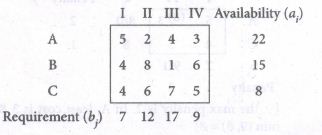
Obtain an initial basic feasible solution to the following transportation problem using Vogels' approximation method.
4.
Evaluate \(\int { \frac { 1 }{ { 3x }^{ 2 }+13x-10 } } dx\)
5.
The rate of increase in the cost Cof ordering holding as the size q of the order increases is given by the differential equation \(\frac { dc }{ dq } =\frac { { c }^{ 2 }+2cq }{ { q }^{ 2 } } \). Find the relationship between c and q if c = 1 when q = 1.
6.
The population of a certain town is as follows
| Year : x | 1941 | 1951 | 1961 | 1971 | 1981 | 1991 |
| Population in lakhs:y | 20 | 24 | 29 | 36 | 46 | 51 |
Using appropriate interpolation formula, estimate the population during the period 1946.
7.
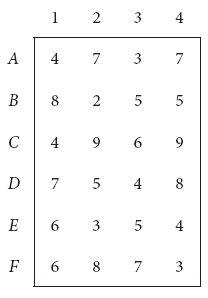
Assign four trucks 1, 2, 3 and 4 to vacant spaces A, B, C, D, E and F so that distance travelled is minimized. The matrix below shows the distance.
8.
Calculate price index number for 2005 by
(a) Laspeyre’s
(b) Paasche’s method
| Commodity | 1995 | 2005 | ||
| Price | Quantity | Price | Quantity | |
| A | 5 | 60 | 15 | 70 |
| B | 4 | 20 | 8 | 35 |
| C | 3 | 15 | 6 | 20 |
9.
The following data gives readings of 10 samples of size 6 each in the production of a certain product. Draw control chart for mean and range with its control limits.
| Sample | 1 | 2 | 3 | 4 | 5 | 6 | 7 | 8 | 9 | 10 |
| Mean | 383 | 508 | 505 | 582 | 557 | 337 | 514 | 614 | 707 | 753 |
| Range | 95 | 128 | 100 | 91 | 68 | 65 | 148 | 28 | 37 | 80 |
10.
The mean breaking strength of cables supplied by a manufacturer is 1,800 with a standard deviation 100. By a new technique in the manufacturing process it is claimed that the breaking strength of the cables has increased. In order to test this claim a sample of 50 cables is tested. It is found that the mean breaking strength is 1,850. Can you support the claim at 0.01 level of significance.
11.
Evaluate the following using properties of definite integrals:
\(\int _{ 0 }^{ 1 }{ \frac { x }{ ({ 1-x) }^{ \frac { 3 }{ 4 } } } dx } \)
12.
Forty percent of business travellers carry a laptop. In a sample of 15 business travelers,
(i) what is the probability that 3 will have a laptop?
(ii) what is the probability that 12 of the travelers will not have a laptop?
(iii) what is the probability that atleast three of the travelers have a laptop?
13.
If the marginal cost (MC) of a production of the company is directly proportional to the number of units (x) produced, then find the total cost function, when the fixed cost is Rs. 5,000 and the cost of producing 50 units is Rs. 5,625.
14.
Construct the distribution function for the discrete random variable X whose probability distribution is given below. Also draw a graph of p(x) and F(x).
| X = x | 1 | 2 | 3 | 4 | 5 | 6 | 7 |
| P(x) | 0.10 | 0.12 | 0.20 | 0.30 | 0.15 | 0.08 | 0.05 |
15.
Show that the equations 5x + 3y + 7z = 4, 3x + 26y + 2z = 9, 7x + 2y + 10z = 5 are consistent and solve them by rank method.
16.
A random sample of 500 apples was taken from large consignment and 45 of them were found to be bad. Find the limits at which the bad apples lie at 99% confidence level.
17.
If a random variable. X has the probability distribution
| X | 0 | 1 | 2 | 3 | 4 | 5 |
| P(X=x) | a | 2a | 3a | 4a | 5a | 6a |
then find F(4)
18.
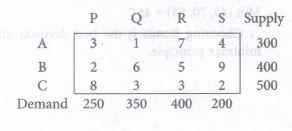
Determine an initial basic feasible solution to the following transportation problem using North West corner rule.
19.
Evaluate \(\int { \frac { { { x }^{ 4 }+{ x }^{ 4 }+1 } }{ { x }^{ 2 }-x+1 } } \)
20.
Solve: cos2x dy + y.etanx dx = 0
21.
A second degree polynomial passes though the point (1,-1) (2,-1) (3,1) (4,5). Find the polynomial.
22.
Suppose A and B are two equally strong table tennis players. Which of the following two events is more probable:
(a) A beats B exactly in 3 games out of 4 or
(b) A beats B exactly in 5 games out of 8 ?
23.
A company has determined that the marginal cost function for a product of a particular commodity is given by MC = 125 +10x - \(\frac{x^2}{9}\) where C rupees is the cost of producing x units of the commodity. If the fixed cost is Rs.250 what is the cost of producing 15 units.
24.
A total of Rs. 8,600 was invested in two accounts. One account earned \(4\frac { 3 }{ 4 } %\)% annual interest and the other earned \(6\frac { 1 }{ 2 } %\)% annual interest. If the total interest for one year was Rs. 431.25, how much was invested in each account? (Use determinant method).
25.
Time series consists of data arranged
Statistical methods
Chronologically
Order oftheir occurrence
increasing or decreasing order
26.
Probability of rejecting null hypothesis. when it is true is _______
Type I error
Type II error
Sampling error
Standard error
27.
A coin is tossed 3 times. The probability of getting exactly 2 heads is _________
\(\frac{1}{2}\)
\(\frac{1}{8}\)
\(\frac{3}{8}\)
\(\frac{1}{4}\)
28.
If X is a continuous random variable. then P(X≥a)= _________.
P(C
1-P(X>a)
P(X>a)
1-P(X≤a-1)
29.
The least cost method is more economical than North West Corner Rule, since it starts with the ___________
least cost
minimum cost
maximum cost
lower beginning cost
30.
The I.F. of \(\frac { dy }{ dx } \)- y tan x = cos x is _____
sec x
cos x
etanx
cot x
31.
\(\int { { \left| x \right| }^{ 3 } } \)dx = ________________ +c
\(\frac { { -x }^{ 4 } }{ 4 } \)
\(\frac { { \left| x \right| }^{ 4 } }{ 4 } \)
\(\frac { { x }^{ 4 } }{ 4 } \)
none of these
32.
If A is a singular matrix, then Adj A is ___________
non-singular
singular
symmetric
not defined
33.
For the given set of values, the value of ∇2y is ______________
| x | 75 | 80 | 85 | 90 |
| y | 2459 | 2018 | 1180 | 402 |
402
-778
60
457
34.
The area of the region bounded by the line 2y = -x + 8, X - axis and the lines x = 2 and x = 4 is ________ sq.units.
\(\frac{1}{5}\)
\(\frac{2}{5}\)
5
\(\frac{5}{2}\)
35.
∇ f(a) = _______.
f (a) + f(a−h)
f (a) − f(a + h)
f (a) − f(a − h)
f (a)
36.
Decision theory is concerned with _______.
analysis of information that is available
decision making under certainty
selecting optimal decisions in sequential problem
All of the above
37.
The variable separable form of \(\frac { dy }{ dx } =\frac { y(x-y) }{ x(x+y) } \) by taking y = vx and \(\frac { dy }{ dx } =v+x\frac { dv }{ dx } \) is ______.
\(\frac { 2{ v }^{ 2 } }{ 1+v } dv=\frac { dx }{ x } \)
\(\frac { 2{ v }^{ 2 } }{ 1+v } dv=-\frac { dx }{ x } \)
\(\frac { 2{ v }^{ 2 } }{ 1-v } dv=\frac { dx }{ x } \)
\(\frac { 1+v }{ 2{ v }^{ 2 } } dv=-\frac { dx }{ x } \)
38.
A typical control charts consists of ________.
CL, UCL
CL, LCL
CL, LCL, UCL
UCL, LCL
39.
A finite subset of statistical individuals in a population is called ________.
a sample
a population
universe
census
40.
\(\int _{ 0 }^{ 1 }{ (2x+1) } dx\) is _______.
1
2
3
4
41.
The average percentage of failure in a certain examination is 40. The probability that out of a group of 6 candidates atleast 4 passed in the examination are ________.
0.5443
0.4543
0.5543
0.4573
42.
A variable which can assume finite or countably infinite number of values is known as ________.
continuous
discrete
qualitative
none of them
43.
Area bounded by the curve y = x (4 − x) between the limits 0 and 4 with x − axis is ________.
\(\frac{30}{3}\) sq.units
\(\frac{31}{2}\)sq.units
\(\frac{32}{3}\) sq.units
\(\frac{15}{2}\) sq.units
44.
Which of the following is not an elementary transformation?
\({ R }_{ i }\leftrightarrow { R }_{ j }\)
\({ R }_{ i }\rightarrow { 2R }_{ i }+{ 2C }_{ j }\)
\({ R }_{ i }\rightarrow { 2R }_{ i }-{ 4R }_{ j}\)
\({ C }_{ i }\rightarrow { C }_{ i }+{ 5C }_{ j }\)
45.
Find the order and degree of the following differential equation
\(\frac { { d }^{ 2 }y }{ { dx }^{ 3 } } -3{ \left( \frac { dy }{ dx } \right) }^{ 6 }+2y={ x }^{ 2 }\)
46.
The following data shows the value of sample mean (\(\bar{X}\)) and the range R for 10 samples of size 5 each. Calculate the control limits for : mean chart and range chart.
| Sample No. | 1 | 2 | 3 | 4 | 5 | 6 | 7 | 8 | 9 | 10 |
| Mean \(\bar{X}\) | 11.2 | 11.8 | 10.8 | 11.6 | 11.0 | 9.6 | 10.4 | 9.6 | 10.6 | 10.0 |
| Range | 7 | 4 | 8 | 5 | 7 | 4 | 8 | 4 | 7 | 9 |
(Given for n = 5, A2 = .577, D3 = 0, D4 = 2.115)
47.
If the mean of the binomial distribution with 9 trial is 6, then find the variance.
48.
Find the missing term from the following data
| x | 1 | 2 | 3 | 4 |
| f(x) | 100 | - | 126 | 157 |
49.
If the marginal revenue for a commodity is MR = 9 - 6x2 + 2x, find the total revenue function.
50.
Find the rank of the matrix \(\left( \begin{matrix} 2 & -4 \\ -1 & 2 \end{matrix} \right) \)
51.
What do you mean by balanced transportation problem?
52.
Define critical region.
53.
Evaluate the following:
\(\Gamma (4)\)
54.
Prove that if E(X) = 0, then V(X) = E(X2)
1.
Given p = \(\frac { 55 }{ 100 } \)
∴ q = \(\frac { 45 }{ 100 } \) and n = 100
Standard error = \(\sqrt { \frac { pq }{ n } } =\sqrt { \frac { \frac { 55 }{ 100 } \times \frac { 45 }{ 100 } }{ 100 } } \)
= 0.0497
(a) As the level of significance α = 0.05 \(Z_{ \frac { \alpha }{ 2 } }\) = 1.96
∴ 95% confidence limits for proportion is given by \(p-Z_{ \frac { \alpha }{ 2 } }(S.E)\le p\ge p+Z_{ \frac { \alpha }{ 2 } }(S.E)\)
⇒ 0.55 - (1.96) (0.0497) ≤ p ≤ 0.55 + (1.96) (0.0497)
⇒ 0.453 ≤ p ≤ 0.647
∴ 95% confidence interval for proportion is (0.45, 0.65)
(b) As the level of significance is α = 0.01, \(Z_{ \frac { \alpha }{ 2 } }\) = 2.58
∴ 99% confidence limits for proportion is given by \(p-Z_{ \frac { \alpha }{ 2 } }(S.E)\le p\ge p+Z_{ \frac { \alpha }{ 2 } }(S.E)\)
⇒ 0.55 - (2.58) (0.0497) ≤ p ≤ 0.55 + (2.58) (0.0497)
⇒ 0.422 ≤ p ≤ 0.678
Hence, 99% confidence interval for proportion is (0.42, 0.68).
2.
Let X denote the height of the student
Given μ = 64.5 inches and σ = 3.3 inches
Given that P(-∞ < Z < C) = 0.99
⇒ P( -∞ < Z < 0) + P (0 < Z < C) = 0.99
⇒ 0.5 + P (0 < Z < C) = 0.99
⇒ P(0 < Z < C) = 0.99 - 0.5 = 0.49...(1)
From the standard normal distribution table
P(0 < Z < 2.33) = 0.49...(2)
From (1) & (2), C = 2.33
we know that Z = \(\frac { X-\mu }{ \sigma } \)
⇒ 2.33 = \(\frac { X-64.5 }{ 3.3 } \)
⇒ X = (2.33) (3.3) + 64.5
⇒ X = 72.19 inches
Hence, the height below which 99% of the student lie is 72.19 inches.
3.
Here Σai = 22 + 15 + 8 = 45
Σbj = 7 + 12 + 17 + 9 = 45
Σai = Σbj
∴ The given problem is balanced transportation problem.
Hence, there exists a feasible solution to the given problem.
I-allocation:
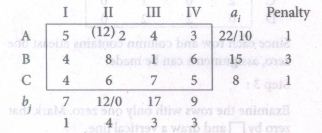
[∵ the max penalty is 4. In II, least cost is 2 & min (12,22) = 12]
II-allocation:
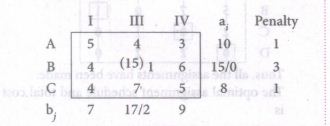
[∵ the max penalty is 3. In B, least cost is 1 & min (17,15) = 15]
III-allocation:
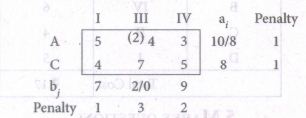
[∵ the max penalty is 3. In III, least cost is 4 & min (2, 10) = 2]
IV-allocation:
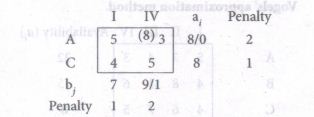
[∵ the max penalty is 2. In A, least cost is 3 & min (9, 8) = 8]
V-allocation:
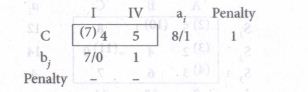
[∵ the max penalty is 1. In C, least cost is 4 & min (7, 8) = 7]
VI-allocation:
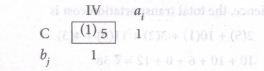
[∵ min (1,1) = 1]
Thus, the allocations are
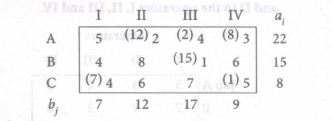
∴ The transportation schedule is
A → II, A → III, A → IV, B → III, C → I and C → IV
Hence, the total transportation cost is
= 12(2) + 2(4) + 8(3) + 15(1) + 7(4) + 1(5)
= 24 + 8 + 24 + 15 + 28 + 5 = Rs.104
4.
Let I = \(\int { \frac { 1 }{ { 3x }^{ 2 }+13x-10 } } dx\)
= \(\frac { 1 }{ 3 } \int { \frac { dx }{ { x }^{ 2 }+\frac { 13 }{ 3 } x-\frac { 10 }{ 3 } } } \)
= \(\frac { 1 }{ 3 } \int { \frac { dx }{ { x }^{ 2 }+\frac { 13 }{ 3 } x+\frac { 169 }{ 36 } -\frac { 169 }{ 36 } -\frac { 10 }{ 3 } } } \)
= \(\frac { 1 }{ 3 } \int { \frac { dx }{ { \left( x+\frac { 13 }{ 6 } \right) }^{ 2 }-\frac { 289 }{ 36 } } } \)
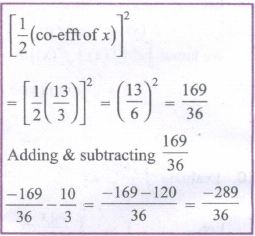
= \(\frac { 1 }{ 3 } \int { \frac { dx }{ { \left( x+\frac { 13 }{ 6 } \right) }^{ 2 }-{ \left( \frac { 17 }{ 16 } \right) }^{ 2 } } } \)
= \(\left[ \because \int { \frac { dx }{ { x }^{ 2 }-{ a }^{ 2 } } =\frac { 1 }{ 2a } log\left| \frac { x-a }{ x+a } \right| } +c \right] \)
= \(\frac { 1 }{ 3 } \times \frac { 1 }{ 2\times \frac { 17 }{ 6 } } log\left| \frac { x+\frac { 13 }{ 6 } -\frac { 17 }{ 6 } }{ x+\frac { 13 }{ 6 } +\frac { 17 }{ 6 } } \right| +c\)
= \(\frac { 1 }{ 17 } log\left| \frac { x-\frac { 2 }{ 5 } }{ x+5 } \right| +c\)
= \(\frac { 1 }{ 17 } log\left| \frac { 3x-2 }{ 3(x+5) } \right| +c\)
5.
Given \(\frac { dc }{ dq } =\frac { { c }^{ 2 }+2cq }{ { q }^{ 2 } } \)
This is a homogeneous equation in e and q of order 2
∴ Put c = vq and \(\frac { dc }{ dq } =v+q\frac { dv }{ dq } \)
∴ v + q\(\frac { dv }{ dq } \) = v2a2 + 2vq0q =\(\frac { { q }^{ 2 }({ v }^{ 2 }+2v) }{ { q }^{ 2 } } \)v2+2vv
q\(\frac { dv }{ dq } \) = v2+2v-v = v2+v
Separating the variables we get,
\(\frac { dv }{ v+v } =\frac { dq }{ q } \)
Integrating \(\int { \frac { dv }{ v(v+1) } } =\int { \frac { dq }{ q } } \)
[ \(\frac { 1 }{ v(v+1) } =\frac { A }{ v } +\frac { B }{ v+1 } \)
⇒ 1 = A(v+1)+B
put v = -1
1 = -B ⇒ B = -1
put v = 0
⇒ 1 = A ]
\(\int { \left( \frac { 1 }{ v } -\frac { 1 }{ v+1 } \right) dv } =\int { \frac { dq }{ q } } \)
⇒ log v -log (v + 1) = log q + log k
⇒ log\(\frac { v }{ v+1 } \) = logq.k
⇒ \(\frac { v }{ v+1 } \) = q.k
Replacing v by \(\frac { c }{ q } \), we get
\(\frac { c/q }{ c/q+1 } \) = q.k
⇒ \(\frac { c }{ c+q } \) = kq
⇒ c = kq(c+q) .....(1)
Given when c = 1 and q = 1
⇒ 1 = k(1) (1+1) ⇒ 1 = 2 k ⇒ k = \(\frac { 1 }{ 2 } \)
∴ (1) ⇒ c = \(\frac{q}{2}\)(c+q)
∴ ⇒ 2c = q(c+q)
6.
| x | 1941 | 1951 | 1961 | 1971 | 1981 | 1991 |
| y | 20 | 24 | 29 | 36 | 46 | 51 |
Here we find the population for year 1946. (i.e) the value of y at x = 1946. Since the value of y is required near the beginning of the table, we use the Newton’s forward interpolation formula.
\({ y }_{ \left( x={ x }_{ 0 }+nh \right) }={ y }_{ 0 }+\frac { n }{ n! } \Delta { y }_{ 0 }+\frac { n(n-1) }{ 2! } { \Delta }^{ 2 }{ y }_{ 0 }+\frac { n(n-)(n-2) }{ 3! } { \Delta }^{ 3 }{ y }_{ 0 }+..\)
To find y at x = 1946
\(\therefore\) x0 + nh = 1946, x0 = 1941, h = 10
1941 + n(10) = 1946 \(\Rightarrow\) n = 0.5
| x | y | \(\Delta y\) | \(\Delta ^{ 2 }y\) | \(\Delta ^{ 3 }y\) | \(\Delta ^{ 4 }y\) | \(\Delta ^{ 5 }y\) |
| 1941 | 20 | |||||
| 4 | ||||||
| 1951 | 24 | 1 | ||||
| 5 | 1 | |||||
| 1961 | 29 | 2 | 0 | |||
| 7 | 1 | -9 | ||||
| 1971 | 36 | 3 | -9 | |||
| 10 | -8 | |||||
| 1981 | 46 | -5 | ||||
| 5 | ||||||
| 1991 | 51 |
Here we find the population for year 1946. (i.e) the value of y at x = 1946. Since the value of y is required near the beginning of the table, we use the Newton’s forward interpolation formula.
\({ y }_{ \left( x=1946 \right) }=20+\frac { 0.5 }{ 1! } (4)+\frac { 0.5(0.5-1) }{ 2! } (1)+\frac { 0.5(0.5-1)(0.5-2) }{ 3! } (1)+\frac { 0.5(0.5-1)(0.5-2)(0.5-3) }{ 4! } (0)+\frac { 0.5(0.5-1)(0.5-2)(0.5-3)(0.5-4) }{ 5! } (-9)\)
= 20+2-0.125+0.0625-0.24609
= 21.69 lakhs
7.
Since the number of columns is less than the number of rows, given assignment problem is unbalanced one.
To balance it, introduce dummy columns with all the entries zero.
∴ The revised assignment problem is
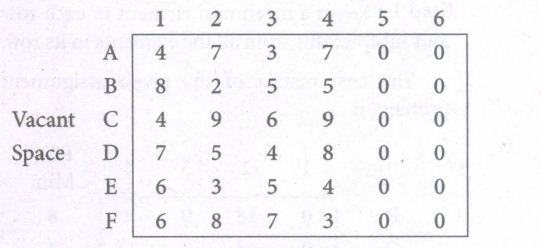
Step 1 : Select the smallest element in each row and subtract this from all the elements in its row.
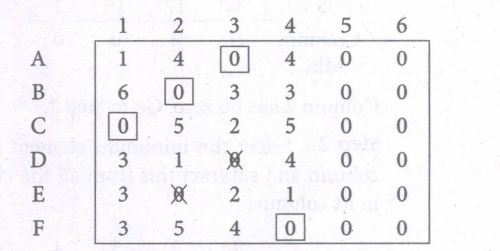
Since each row and column has atleast one zero, assignments can be made.
Step 2 : Examine the rows with atleast one row.
Row A & B have exactly one row. Mark them by and mark X by other zeros in its column.
Row C & F also has only one zero.
Here only 4 vacant space can be assigned to 4 trucks.
∴ The optimal assignments schedule and total cost is
| Vacant space | Truck | Cost |
|---|---|---|
| A | 3 | 3 |
| B | 2 | 2 |
| C | 1 | 4 |
| F | 4 | 3 |
| Total Cost | Rs. 12 | |
∴ The optimal assignment (minimum) cost = Rs. 12
8.
| Commodity | 1995 | 2005 | ||
| Price(p0) | (q0) | Price | Quantity | |
| A | 5 | 60 | 15 | 70 |
| B | 4 | 20 | 8 | 35 |
| C | 3 | 15 | 6 | 20 |
| p0q0 | p0q1 | p1q0 | p1q1 |
| 300 | 350 | 900 | 1050 |
| 80 | 140 | 160 | 280 |
| 45 | 60 | 90 | 120 |
| 425 | 550 | 1150 | 1450 |
Laspeyre's price index number
\(P^{L}_{01}\) = \({\frac {\sum p_{1}q_{0}}{\sum p_{0}q_{0}}} \times 100\)
= \(\frac {1150}{425} \times {100}\) = 270.58
Paasche's index number
\(P^{L}_{01}\) = \({\frac {\sum p_{1}q_{0}}{\sum p_{0}q_{1}}} \times 100\)
= \(\frac {1450}{550} \times {100}\) = 263.63
9.
| Sample | 1 | 2 | 3 | 4 | 5 | 6 | 7 | 8 | 9 | 10 | Total |
| Mean | 383 | 508 | 505 | 582 | 557 | 337 | 514 | 614 | 707 | 753 | 5460 |
| Range | 95 | 128 | 100 | 91 | 68 | 65 | 148 | 28 | 37 | 80 | 840 |
\(\overset { = }{ X } =\frac { \sum { \bar { X } } }{ 10 } =\frac { 5460 }{ 10 } =546\)
The control limits for \(\overset{-}{X}\) chart is
\(UCL=\overset { = }{ X } +{ A }_{ 2 }\bar { R } =546+0.483(84)=586.57\)
\(CL=\overset { = }{ X } =546\)
\(LCL=\overset { = }{ X } -{ A }_{ 2 }\bar { R } =546-0.483(84)=505.43\)
\(\bar { R } =\frac { \sum { R } }{ n } =\frac { 840 }{ 10 } =84\)
The control limits for Range chart is
\(UCL={ D }_{ 4 }\bar { R } =2.004(84)=168.336\)
\(CL=\bar { R } =84\)
\(LCL={ D }_{ 3 }\bar { R } =0(84)=0\)
10.
Sample size n = 50,
Sample mean \(\bar { X } \) = 1850
Population mean μ = 1800
Population standard deviation σ = 100
Null Hypotheses H0:
μ = 1800 (i.e., To claim that the breaking strength of the cables have increased)
Alternative Hypotheses H1:
μ≠1800(To claim that the breaking strength of the cables have not increased)
The level of significance ∝ = 1% =.001
Applying the test statistic,
\(Z=\frac { \bar { X } -\mu }{ \frac { \sigma }{ \sqrt { n } } } \)
\(\Rightarrow Z=\frac { 1850-1800 }{ \frac { 100 }{ \sqrt { 50 } } } =\frac { 50 }{ \frac { 100 }{ 7.07 } } =\frac { 50 }{ 14.144 } =3.535\)
\(\Rightarrow \therefore Z=3.535\)
The Significant value \({ Z }_{ \frac { \alpha }{ 2 } }=2.58\)
Here \(Z<{ Z }_{ \frac { \alpha }{ 2 } }i.e.,3.535<2.58\)
Inference: Since \(Z<{ Z }_{ \frac { \alpha }{ 2 } }\) at 1% level of significance, the null hypothesis Ho is rejected.
Hence, we conclude that μ≠ 1800 and we cannot support the claim that the breaking strength of the cables have increased.
11.
Let I = \(\int _{ 0 }^{ 1 }{ \frac { x }{ { \left( 1-x \right) }^{ \frac { 3 }{ 4 } } } } dx\)
\(=-\int _{ 0 }^{ 1 }{ \frac { -x }{ { \left( 1-x \right) }^{ \frac { 3 }{ 4 } } } } dx\)
[Multiply and divide by -1]
\(=-\int _{ 0 }^{ 1 }{ \frac { 1-x-1 }{ { \left( 1-x \right) }^{ \frac { 3 }{ 4 } } } } dx\)
[Adding and subtracting 1 in the numberator]
\(=\int _{ 1 }^{ 0 }{ \frac { 1-x-1 }{ { \left( 1-x \right) }^{ \frac { 3 }{ 4 } } } } dx\)
\(\left[ \because \int _{ a }^{ b }{ f\left( x \right) } dx=-\int _{ b }^{ a }{ f\left( x \right) dx } \right] \)
\(=\int _{ 1 }^{ 0 }{ \left( \frac { 1-x }{ { \left( 1-x \right) }^{ \frac { 3 }{ 4 } } } -\frac { 1 }{ { \left( 1-x \right) }^{ \frac { 3 }{ 4 } } } \right) } dx\)
\(=\int _{ 1 }^{ 0 }{ \left( { \left( 1-x \right) }^{ 1-\frac { 3 }{ 4 } }-{ \left( 1-x \right) }^{ -\frac { 3 }{ 4 } } \right) } dx\)
\(=\int _{ 1 }^{ 0 }{ { \left( 1-x \right) }^{ \frac { 1 }{ 4 } }dx-\int _{ 1 }^{ 0 }{ { \left( 1-x \right) }^{ -\frac { 3 }{ 4 } } } } dx\)
\(={ \left[ \frac { { \left( 1-x \right) }^{ \frac { 1 }{ 4 } +1 } }{ -1\left( \frac { 1 }{ 4 } +1 \right) } -\frac { { \left( 1-x \right) }^{ -\frac { 3 }{ 4 } +1 } }{ -1\left( -\frac { 3 }{ 4 } +1 \right) } \right] }_{ 1 }^{ 0 }\)
\(={ \left[ -\frac { { { \left( 1-x \right) }^{ \frac { 5 }{ 4 } } } }{ \frac { 5 }{ 4 } } +\frac { { \left( 1-x \right) }^{ \frac { 1 }{ 4 } } }{ \frac { 1 }{ 4 } } \right] }_{ 1 }^{ 0 }\)
\(={ \left[ -\frac { 4 }{ 5 } { \left( 1-x \right) }^{ \frac { 5 }{ 4 } }+4{ \left( 1-x \right) }^{ \frac { 1 }{ 4 } } \right] }_{ 1 }^{ 0 }\)
\(=-\frac { 4 }{ 5 } \left( { 1 }^{ \frac { 5 }{ 4 } } \right) +4\left( { 1 }^{ \frac { 1 }{ 4 } } \right) -0\)
\(=-\frac { 4 }{ 5 } (1)+4(1)=-\frac { 4 }{ 5 } +4\)
\(=\frac { -4+20 }{ 5 } =\frac { 16 }{ 5 } \)
12.
Let p be the probability of having a laptop
Given p = \(\frac { 40 }{ 100 } \) = 0.4 ⇒ q = 1-p = 1-0.4 = 0.6
n = 15
(i) P(X = 3)
=15C3 (0.4)3 (0.6)12 ∵ p(x) =nCx pxqn-x, n = 15, x = 3
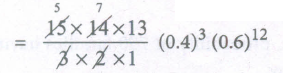
= 455 (0.064) (0.002176) = 0.0634
(ii) P (12 travellers not having laptop)
= P (3 travellers having laptop)
[∵ n = 15 and 15 - 12 = 3]
= P(X = 3)
= 0.0634.
(iii) P (atleast 3 travellers have laptop)
= P (X ≥ 3) = 1 - P(X < 3)
= 1 - [P(X = 0) + P(X = 1) + P(X = 2)]
=1-[15C0 (0.4)0 (0.6)15 + 15C1 (0.4)2 (0.6)13 (0.6)14]
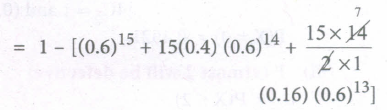
= 1 - (0.6)13 [(0.6)2 + 6(0.6)1 + 105(0.16)]
= 1 - (0.6)13 [0.36 + 3.6 + 16.8]
= 1 - (0.0013) (20.76) = 1 - 0.0270
= 0.9730.
13.
Given MC = \(\frac{dC}{dx}\alpha x\)
\(\Rightarrow \frac { dC }{ dx } ={ k }_{ 1 }x\)
\(\Rightarrow dC={ k }_{ 1 }xdx\)
\(\Rightarrow \int { dC={ k }_{ 1 }\int { x } dx } \)
\(\Rightarrow C={ k }_{ 1 }\frac { { x }^{ 2 } }{ 2 } +{ k }_{ 2 }...(1)\)
Given fixed cost is Rs. 5000
∴ When x = 0, C = 5000
⇒ 5000 = k1(0) + k2 = 5000
∴ (1)becomes C=k1\(\frac{x^2}{2}+5000\) ...(2)
Also it is given that when x = 50, C = Rs. 5625
\(\therefore (2)5625={ k }_{ 1 }\frac { { x }^{ 2 } }{ 2 } +5000\)
\(\Rightarrow 5625-5000={ k }_{ 1 }\times \frac { { (50) }^{ 2 } }{ 2 } \)
\(\Rightarrow 625={ k }_{ 1 }\times \frac { (50)\times (50) }{ 2 } \)
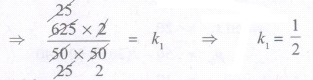
\(C=\frac { 1 }{ 2 } \left( \frac { { x }^{ 2 } }{ 2 } \right) +5000\)
⇒C = \(\frac{x^2}{4}\) + 5000
14.
From the values of p(x) given in the probability distribution, we obtain
F(1) = P(x\(\le\)1) = P(1) = 0.10
F(2) = P(x\(\le\)2) = P(1) + P(2)
= 0.10+0.12 = 0.22
F(3) = P(x\(\le\)3) = P(1)+P(2)+P(3)
= F(2)+P(3)
= 0.22+0.20
= 0.42
F(4) = F(3)+P(4)
= 0.42+0.30
= 0.72
F(5) = F(4)+P(5)
= 0.72+0.15
= 0.87
F(6) = F(5)+P(6)
= 0.87+0.08
= 0.95
F(7) = F(6)+P(7)
= 0.95+0.05
= 1.00
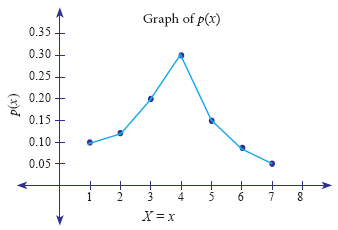
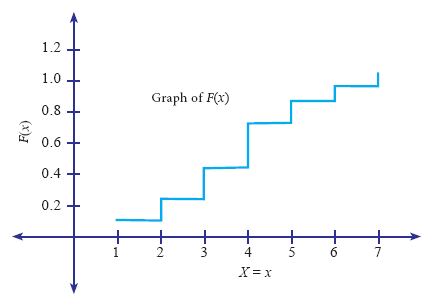
\(F(x) \text { is } F_{x}(x)= \begin{cases}0, & \text { if } x<1 \\ 0.10, & \text { if } x \leq 1 \\ 0.22, & \text { if } x \leq 2 \\ 0.42, & \text { if } x \leq 3 \\ 0.72, & \text { if } x \leq 4 \\ 0.87, & \text { if } x \leq 5 \\ 0.95, & \text { if } x \leq 6 \\ 1, & \text { if } x \leq 7\end{cases}\)
15.
Given non-homogeneous equations are
5x+ 3y + 7z = 4
3x + 26y + 2z = 9
7x + 2y + 10z = 5
The matrix equation corresponding to the given system is
\(\left( \begin{matrix} 5 & 3 & 7 \\ 3 & 26 & 2 \\ 7 & 2 & 10 \end{matrix} \right) \left( \begin{matrix} x \\ y \\ z \end{matrix} \right) =\left( \begin{matrix} 4 \\ 9 \\ 5 \end{matrix} \right) \)
| Augmented matrix [A, B] | Elementary Transformation |
|---|---|
| \(\left( \begin{matrix} 5 & 3 & 7 \\ 3 & 26 & 2 \\ 7 & 2 & 10 \end{matrix}\begin{matrix} 4 \\ 9 \\ 5 \end{matrix} \right) \) | |
| \(\sim \left( \begin{matrix} 3 & 26 & 2 \\ 5 & 3 & 7 \\ 7 & 2 & 10 \end{matrix}\begin{matrix} 9 \\ 4 \\ 5 \end{matrix} \right) \) | \({ R }_{ 1 }\leftrightarrow { R }_{ 2 }\) |
| \(\left( \begin{matrix} 1 & \frac { 26 }{ 3 } & \frac { 2 }{ 3 } \\ 5 & 3 & 7 \\ 7 & 2 & 10 \end{matrix}\begin{matrix} 3 \\ 4 \\ 5 \end{matrix} \right) \) | \({ R }_{ 1 }\rightarrow { R }_{ 1 }\div 3\) |
| \(\left( \begin{matrix} 1 & \frac { 26 }{ 3 } & \frac { 2 }{ 3 } \\ 0 & \frac { -121 }{ 3 } & \frac { 11 }{ 3 } \\ 7 & 2 & 5 \end{matrix}\begin{matrix} 3 \\ -11 \\ 5 \end{matrix} \right) \) | \({ R }_{ 2 }\rightarrow { R }_{ 2 }-5{ R }_{ 1 }\) |
| \(\left( \begin{matrix} 1 & \frac { 26 }{ 3 } & \frac { 2 }{ 3 } \\ 0 & \frac { -121 }{ 3 } & \frac { 11 }{ 3 } \\ 0 & \frac { -176 }{ 3 } & \frac { 16 }{ 3 } \end{matrix}\begin{matrix} 3 \\ -11 \\ -16 \end{matrix} \right) \) | \({ R }_{ 3 }\rightarrow { R }_{ 3 }-7{ R }_{ 1 }\) |
| \(\sim \left( \begin{matrix} 1 & \frac { 26 }{ 3 } & \frac { 2 }{ 3 } \\ 0 & \frac { -11 }{ 3 } & \frac { 1 }{ 3 } \\ 0 & \frac { -11 }{ 3 } & \frac { 1 }{ 3 } \end{matrix}\begin{matrix} 3 \\ -1 \\ -1 \end{matrix} \right) \) | \({ R }_{ 2 }\rightarrow { R }_{ 2 }\div 11\) \({ R }_{ 3 }\rightarrow { R }_{ 3 }\div 16\) |
| \(\left( \begin{matrix} 1 & \frac { 26 }{ 3 } & \frac { 2 }{ 3 } \\ 0 & \frac { -11 }{ 3 } & \frac { 1 }{ 3 } \\ 0 & 0 & 0 \end{matrix}\begin{matrix} 3 \\ -1 \\ 0 \end{matrix} \right) \) | \({ R }_{ 3 }\rightarrow { R }_{ 3 }-{ R }_{ 2 }\) |
\(\therefore\) The system is consistent with infinitely many solutions let us rewrite the above echelon form into matrix form
\(\left( \begin{matrix} 1 & \frac { 26 }{ 3 } & \frac { 2 }{ 3 } \\ 0 & \frac { -11 }{ 3 } & \frac { 1 }{ 3 } \\ 0 & 0 & 0 \end{matrix} \right) \left( \begin{matrix} x \\ y \\ z \end{matrix} \right) =\left( \begin{matrix} 3 \\ -1 \\ 0 \end{matrix} \right) \)
\(x+\cfrac { 26 }{ 3 } y+\cfrac { 2 }{ 3 } z=3\)
\(x+\cfrac { 26 }{ 3 } y+\cfrac { 2 }{ 3 } z=3\)
let z = k where k\(\in\) R
\((2)\Rightarrow \cfrac { -11 }{ 3 } y+\cfrac { k }{ 3 } =-1\)
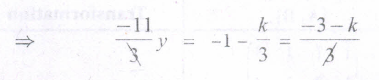
\(\Rightarrow \ -11y=-3-k\)
11y = 3 + k
\(\Rightarrow \quad y=\cfrac { 1 }{ 11 } \left( 3+k \right) \)
Substituting \(y=\cfrac { 1 }{ 11 } \left( 3+k \right) \) and z = k in (1) we get,
\(x+\cfrac { 26 }{ 3 } \left( \cfrac { 3+k }{ 11 } \right) +\cfrac { 2 }{ 3 } k=3\)
\(=\cfrac { 26 }{ 3 } \left( \cfrac { 3+k }{ 11 } \right) -\cfrac { 2k }{ 3 } +3\)
\(\cfrac { 78-26k }{ 33 } -\cfrac { 2k }{ 3 } +3\)
\(\cfrac { 78-26k-22k+99 }{ 33 } \)
\(\cfrac { 78-26k-22k+99 }{ 33 } \)
\(\cfrac { 21-48k }{ 33 } =\cfrac { 3(7-16k) }{ 33 } \)
= \(\cfrac { 1 }{ 11 } (7-6k)\)
\(\therefore\) Solution set is \(\left\{ \cfrac { 1 }{ 11 } \left( 7-16k \right), \cfrac { 1 }{ 11 } (3+k),k \right\} \)K \(\in\) R
Hence, for different values of k, we get infinitely many solutions.
16.
Sample size n = 500
Proportion of bad apples in the sample
= \(\frac { 45 }{ 500 } \) = 0.09
p = 0.09
∴ q = 1 - p = 1-0.09 = 0.91
Standard error = \(\sqrt { \frac { pq }{ n } } =\sqrt { \frac { (.09)(.91) }{ 500 } } \)
= 0.0128
As the significance level is α = 0.001, \(Z_{ \frac { \alpha }{ 2 } }\) = 2.58
∴ The confidence limits for the population proportion of bad apples are given by
p-zα (S.E.) ≤ p ≤ p + zα (S.E.)
⇒ 0.09 - 2.58 (0.0128) ≤ p ≤ .09 + 2.58 (0.0128)
⇒ 0.09 - 0.033 ≤ p ≤ .09 + 0.033
⇒ 0.057 ≤ p ≤ 0.123
Thus, the bad apples in the consignment lie between (0.057, 0.123).
17.
Since the random variable X is the probability distribution function, Σpi = 1
∴ a + 2a + 3a + 4a + 5a + 6a = 1
21a = 1 ⇒ a = \(\frac{1}{21}\)
Now, F(4) = P(X ≤ 4)
= P(X = 0) + P(X = 1) + P(X = 2)P(X = 3) + P(X = 4)
= a + 2a + 3a + 4a + 5a = 15a
= 15\((\frac{1}{21})=\frac{5}{7}\)
∴ F(4) = \(\frac{5}{7}\)
18.
Here total supply = 300 + 400 + 500 = 1200
Total demand = 250 + 350 + 400 + 200 =1200
∴ Total supply = total demand
The given problem is a balanced transportation problem.
Hence, there exists a feasible solution to the given problem
I-allocation:
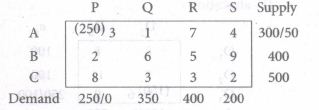
[∵ Min (250, 300) = 250]
II-allocation:
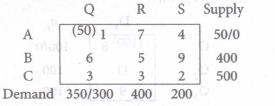
[∵ Min (50,350) = 50]
III-allocation:
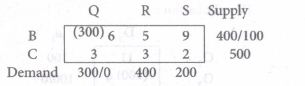
[∵ Min (300,400) = 300]
IV-allocation:
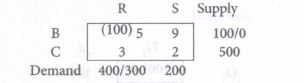
[∵ Min (400,100) = 100]
V-allocation:
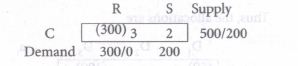
[∵ Min (300, 500) = 300]
VI-allocation:
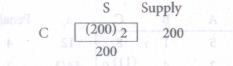
[∵ Min (200, 200) = 200]
Thus, the allocations are
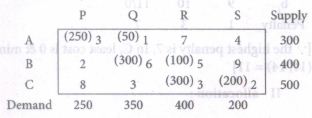
∴ The transportation schedule is
A → P, A → Q, B → Q, B → R, C → R, C → S
Hence, the total transportation cost is
= 250 (3) + 50 (1) + 300 (6) + 100 (5) + 300 (3) + 200 (2)
= 750 + 50 + 1800 + 500 + 900 + 400
= Rs. 4400
19.
\(\int { \frac { { \left( { x }^{ 2 }+1 \right) }^{ 2 }-{ x }^{ 2 } }{ { x }^{ 2 }-x+1 } } dx=\int { \frac { { \left( { x }^{ 2 }+1 \right) }^{ 2 }-{ x }^{ 2 } }{ { x }^{ 2 }-x+1 } } \)
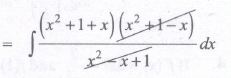
[∵ a2 - b2 = (a+b) (a-b)]
= ∫ (x2 + 1 + x)dx
= \(\frac { { x }^{ 3 } }{ 3 } +x+\frac { { x }^{ 2 } }{ 2 } +c\)
20.
Given cos2x dy + y.etanx dx=0
⇒ cos2x dy = -y etanx dx [∵ t = tanx, dt = sec2x dx, ∴ \(\int { { e }^{ t } } dt\) = etanx]
⇒ \(\frac { dy }{ y } =-\frac { { e }^{ tanx } }{ cos^{ 2 }x } \)dx
⇒ \(\frac { dy }{ y } \) = -sec2x.etanx dx
Integrating, \(\int { \frac { dy }{ y } } =-\int { sec^{ 2 }x } .e^{ tanx }dx\)
log y = -etanx + C
⇒ log y + etanx = C
21.
Given values are
| x | 1 | 2 | 3 | 4 |
| y | -1 | -1 | 1 | 5 |
The difference table is
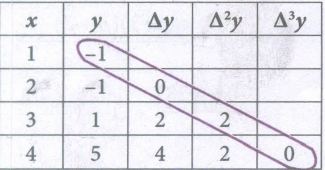
x0 + nh = x ⇒ 1 + n = x ⇒ n = x - 1
∴ By Newton's forward interpolation formula,
y= y0\(\frac { n }{ 1! } { \triangle y }_{ 0 }+\frac { n(n+1) }{ 2! } { \triangle }^{ 2 }{ y }_{ 0 }+\frac { n(n+1)(n+2) }{ 3! } { \triangle }^{ 3 }{ y }_{ 0 }\)
JPG.JPG)
[∵ Δ3y0 = 0]
⇒ y = -1 + 0 + x2 - 3x + 2
⇒ y = x2 - 3x + 1
Hence, the required second degree polynomial is y = x2 - 3x + 1
22.
Here p = q = 1/2
(a) probability of A beating B in exactly 3 games out of 4
\(\left( \begin{matrix} 4 \\ 3 \end{matrix} \right) { (\frac { 1 }{ 2 } ) }^{ 3 }\left( \frac { 1 }{ 2 } \right) ^{ 4-3 }\)
= 1/4 = 25%
(b) probability of A beating B in exactly 5 games out of 8
\(\left( \begin{matrix} 8 \\ 5 \end{matrix} \right) { (\frac { 1 }{ 2 } ) }^{ 5 }\left( \frac { 1 }{ 2 } \right) ^{ 8-5 }\)
\(=\frac { 7 }{ 32 } \) = 21.875%
Clearly, the first event is more probable.
23.
\(MC=125+10x-\frac { { x }^{ 2 } }{ 9 } \)
\(C=\int { MC } dx+k\)
\(=\int { \left( 125+10x-\frac { x^{ 2 } }{ 9 } \right) } dx+k\)
= 125 + 5x2- \(\frac { { x }^{ 3 } }{ 27 } \) + k
Fixed cost k = 250
C = 125x + 5x2- \(\frac { { x }^{ 3 } }{ 27 } \) + 250
When x = 15
C = 125(15) + 5(15)2- \(\frac { { (15) }^{ 3 } }{ 27 } \) + 250
= 1875 +1125 −125 + 250
C = Rs. 3,125
24.
Let the amount invested in the two accounts be Rs. x and Rs. y respectively
By the given data, x + y = 8600 ..(1)
\(4\cfrac { 3 }{ 4 } \times \cfrac { x }{ 100 } +6\cfrac { 1 }{ 2 } \times \cfrac { y }{ 100 } =431.25\) \(\left[ \therefore interest=\cfrac { PNR }{ 100 } \right] \)
\(\Rightarrow \cfrac { 19x }{ 400 } +\cfrac { 13y }{ 3200 } =431.25\)
\(\Rightarrow \cfrac { 19x+26y }{ 400 } =431.25\)
19x + 26y = 172500 ...(2)
\(\Delta =\left| \begin{matrix} 1 & 1 \\ 19 & 26 \end{matrix} \right| =1(26)-1(19)\)
= 26-19 =7
\({ \Delta }x=\left| \begin{matrix} 8600 & 1 \\ 172500 & 26 \end{matrix} \right| =8600(26)-1(172500)\)
= 223600 - 172500 = 51100
\(\Delta y=\left| \begin{matrix} 1 & 8600 \\ 19 & 172500 \end{matrix} \right| =1(172500)-19(8600)\)
= 172500 - 163400 = 9100
\(x=\cfrac { \Delta x }{ \Delta } -\cfrac { 51100 }{ 7 } =7300\)
\(y=\cfrac { \Delta y }{ \Delta } =\cfrac { 9100 }{ 7 } =1300\)
\(\therefore\) Investment in the interest of \(4\frac { 3 }{ 4 } \) % account is Rs. 7300 and investment in the rate of \(6\frac { 1 }{ 2 } \) account is Rs.1300.
25.
(a)
Statistical methods
26.
(a)
Type I error
27.
(c)
\(\frac{3}{8}\)
28.
(c)
P(X>a)
29.
(c)
maximum cost
30.
(b)
cos x
31.
(d)
none of these
32.
(b)
singular
33.
(c)
60
34.
(c)
5
35.
(c)
f (a) − f(a − h)
36.
(d)
All of the above
37.
(d)
\(\frac { 1+v }{ 2{ v }^{ 2 } } dv=-\frac { dx }{ x } \)
38.
(c)
CL, LCL, UCL
39.
(a)
a sample
40.
(b)
2
41.
(a)
0.5443
42.
(b)
discrete
43.
(c)
\(\frac{32}{3}\) sq.units
44.
(b)
\({ R }_{ i }\rightarrow { 2R }_{ i }+{ 2C }_{ j }\)
45.
\(\frac { { d }^{ 2 }y }{ { dx }^{ 3 } } -3{ \left( \frac { dy }{ dx } \right) }^{ 6 }+2y={ x }^{ 2 }\)
∴ order = 3,
∴ Degree = 1
46.
\(\bar{\bar{X}}\) = \(\frac{11.2 + 11.8 + 10.8 + 11.6 + 11.0+ 9.6 + 10.4 + 9.6 + 10.6 + 10.0}{10}\)
\(=\frac{106.6}{10}=10.66\)
\(\bar{R}=\frac{7+4+8+5+7+4+8+4+7+9}{10}\)
\(=\frac{63}{10}=6.3\)
Control limits for mean chart
UCL = \(\bar{\bar{X}}\) + A2\(\bar{R}\)
= 10.66 + .577(6.3) = 14.295
CL = \(\bar{\bar{X}}\) = 10.66
Control limits for R-chart
UCL = D2\(\bar{R}\) = 2.115 \(\times\) 6.3
= 13.324
CL = \(\bar{R}\) = 6.3
LCL = D3\(\bar{R}\) = 0
47.
Given n = 9 and mean = 6 ⇒ np = 6
9p = 6 ⇒ \(\frac { 6 }{ 9 } =\frac { 2 }{ 3 } \)
∴ q=1-p = \(1-\frac { 2 }{ 3 } =\frac { 1 }{ 3 } \)
Variance = npq = \(9\times \frac { 2 }{ 3 } \times \frac { 1 }{ 3 } \) = 2
48.
Since three values of f(x) are given, we assume that the polynomial is of degree two.
⇒ Δ3(f(x0)) = 0
⇒ ∆3(yo) = 0
⇒ (E - 1)3 yo= 0
⇒ (E3 - 3E2 + 3E - 1) yo= 0
⇒ y3- 3y2+ 3y1 - yo= 0
⇒ 157 - 3 (126) + 3y1 - 100 = 0
⇒ y1 = 107
∴ The missing term is 107.
49.
Given MR = 9 - 6x2 + 2x
⇒ഽMR=ഽ(9 - 6x2 + 2x)sx
\(\Rightarrow R=9x-\frac { { 6x }^{ 3 } }{ 3 } +\frac { { 2x }^{ 2 } }{ 2 } +k\)
⇒ R = 9x - 2x3 + x2 + k
When x = 0, R = 0 ⇒ k = 0
∴ R = 9x - 2x3 + x2
50.
Let A = \(\left( \begin{matrix} 2 & -4 \\ -1 & 2 \end{matrix} \right) \)
The order of A is 2 \(\times\) 2
\(\rho (A)\le min(2,2)\)
\(\Rightarrow \rho (A)\le 2\)
\(\left| \begin{matrix} 2 & -4 \\ -1 & 2 \end{matrix} \right| =4-4=0\)
Since the second order minor vanishes \(\rho (A)\neq 2\)
We have to try for atleast one non-zero first order minor.
ie. atleast one non-zero element of A.
This is possible because A has non-zero element
\(\therefore \rho (A)-1\)
51.
If the total supply = total demand, then the given problem is a balanced transportation problem.
52.
A region corresponding to a test statistic in the sample space which tends to rejection of Ho is called critical region.
53.
Gamma integral \(\Gamma \) (n+1) = n! where n is a positive integer.
∴ \(\Gamma \) (4) = (4-1)!
= 3! = 3\(\times\)2 = 6
54.
Given E(X) = 0
then Var (X) = E(X2) - [E(X)]2
= E(X2)-02 [∵ E(X)]2 [∵E(X) = 0]
var (X) = E(X2)
Thus, Var(X) = E(X2) hence proved.

12th Standard Syllabus & Materials
12th Standard
TN 12th Computer Applications வலையமைப்பு வடமிடல் Sample Question Papers Study Material - QB365 Set A
NEW12th Standard
TN 12th Computer Applications களப்பெயர் முறைமை (DNS) Sample Question Papers Study Material - QB365 Set A
NEW12th Standard
TN 12th Computer Applications வலையமைப்பு எடுத்துக்காட்டுகள் மற்றும் நெறிமுறைகள் Sample Question Papers Study Material - QB365 Set A
NEW12th Standard
TN 12th Computer Applications கணினி வலையமைப்பு ஓர் அறிமுகம் Sample Question Papers Study Material - QB365 Set A



Tamilnadu Stateboard 12th Standard Subjects

Maths

Chemistry

Physics

Biology

Computer Science
Business Maths and Statistics

Economics

Commerce

Accountancy

History

Computer Applications
Biology
Computer Technology
Computer Applications
Computer Science
Business Maths and Statistics
Commerce
Economics
Maths
Chemistry
Physics
Computer Technology
History
Accountancy

Tamil

English

French
Tamilnadu Stateboard Standards
