
 100% FREE ACCESS
12th Standard Syllabus & Materials
12th Standard
TN 12th Computer Applications மின்னணு தரவு பரிமாற்றம் Sample Question Papers Study Material - QB365 Set A
NEW12th Standard
TN 12th Computer Applications மின் - வணிக பாதுகாப்பு அமைப்புகள் Sample Question Papers Study Material - QB365 Set A
NEW12th Standard
TN 12th Computer Applications மின்னணு செலுத்தல் முறைகள் Sample Question Papers Study Material - QB365 Set A
NEW12th Standard
TN 12th Computer Applications மின் - வணிகம் Sample Question Papers Study Material - QB365 Set A
NEW12th Standard
TN 12th Computer Applications திறந்த மூல கருத்துருக்கள் Sample Question Papers Study Material - QB365 Set A
NEW12th Standard
TN 12th Computer Applications வலையமைப்பு வடமிடல் Sample Question Papers Study Material - QB365 Set A

Published on: 01/03/2021
12th Standard English Medium Business Maths Reduced Syllabus Annual Exam Model Question Paper with Answer Key - 2021
Download Tamil Nadu 12th Standard Business Maths and Statistics question papers, model tests, one-mark questions, important questions, and public exam papers in PDF format. Free study materials and answer keys for TN State Board students.
Questions + Answers key
Take MCQ Business Maths and Statistics Test
1.
A random sample of 500 apples was taken from large consignment and 45 of them were found to be bad. Find the limits at which the bad apples lie at 99% confidence level.
2.
The probability distribution of a discrete random variable. X is given by
| X | -2 | 2 | 5 |
| P(X=x) | \(\frac{1}{4}\) | \(\frac{1}{4}\) | \(\frac{1}{2}\) |
then find 4E(X2)- Var (2X)
3.
For the given pay-off matrix, choose the best alternative for the given states of nature under
(i) Maximin (ii) Minimax princple
| Alternative | States of Nature | ||
| Good | Fair | Bad | |
| A | 100 | 60 | +50 |
| B | 80 | 50 | +10 |
| C | 40 | 20 | +5 |
4.
Evaluate \(\int { \frac { { { x }^{ 4 }+{ x }^{ 4 }+1 } }{ { x }^{ 2 }-x+1 } } \)
5.
Form the differential equation for \(\frac { { x }^{ 2 } }{ { a }^{ 2 } } +\frac { { y }^{ 2 } }{ { b }^{ 2 } } \)=1 where a & b are arbitrary constants.
6.
Find the rank of each of the following matrices.
\(\left( \begin{matrix} -1 & 2 & -2 \\ 4 & -3 & 4 \\ -2 & 4 & -4 \end{matrix} \right) \)
7.
A second degree polynomial passes though the point (1,-1) (2,-1) (3,1) (4,5). Find the polynomial.
8.
Evaluate \(\int _{ 1 }^{ 4 }{ f(x) } dx\), where f(x) = \(\begin{cases} 7x+3,if \ 1\le x\le 3 \\ 8x,if \ 3\le x\le 4 \end{cases}\)
9.
A pair of dice is thrown 4 times. If getting a doublet is considered a success, find the probability of 2 successes.
10.
11.
The subscription department of a magazine sends out a letter to a large mailing list inviting subscriptions for the magazine. Some of the people receiving this letter already subscribe to the magazine while others do not. From this mailing list, 45% of those who already subscribe will subscribe again while 30% of those who do not now subscribe will subscribe. On the last letter, it was found that 40% of those receiving it ordered a subscription. What percent of those receiving the current letter can be expected to order a subscription?
12.
Chance variation does not affect _____ of the product
price
value
quantity
quality
13.
An _______ is a specific observed value of a statistic
Estimation
Estimator
Estimate
Testing of hypothesis
14.
The area under the standard normal curve between Z=-∞ and z=∞ is
0
0.5
1
0.75
15.
If X is a discrete random variable then which of the following is correct?
0 ≤ F(x) ≤ 1
F(-∞) = 0,F(∞) ≤ 1
P(X = Xn) = F(Xn)-F(Xn-1)
F(x) is a constant function
16.
_____determines the lowest out comes for each alternative.
Least cost
Minimax criteria
Maximin criteria
Payoff matrix
17.
Solution of \(\frac { dx }{ dy } \)+mx = 0 where m<0 is _______
x = cemy
x = ce-my
x = my + c
x = c
18.
The value of \(\int _{ 0 }^{ \frac { \pi }{ 2 } }{ cosx } { e }^{ sinx }dx=\)
1
e-1
0
-1
19.
The rank of an n x n matrix each of whose elements is 2 is __________
1
2
n
n2
20.
∇f(x+ 3h) ______________
f{x + 2h)
f(x + 3h) - f(x + 2h)
f(x + 3h)
f(x + 2h) - f(x - 3h)
21.
The area of the region bounded by the line 2y = -x + 8, X - axis and the lines x = 2 and x = 4 is ________ sq.units.
\(\frac{1}{5}\)
\(\frac{2}{5}\)
5
\(\frac{5}{2}\)
22.
If h = 1, then Δ(x2) = _______.
2x
2x −1
2x +1
1
23.
The Penalty in VAM represents difference between the first ________.
Two largest costs
Largest and Smallest costs
Smallest two costs
None of these
24.
Which of the following is the homogeneous differential equation?
(3x−5)dx = (4y−1)dy
xy dx−(x3+y3)dy = 0
y2dx+(x2 − xy − y2)dy = 0
(x2+y)dx = (y2+x)dy
25.
The additive model of the time series with the components T, S, C and I is ________.
y = T + S + C × I
y = T + S × C × I
y = T + S + C + I
y = T + S × C + I
26.
In simple random sampling from a population of N units, the probability of drawing any unit at the first draw is ______.
\(\frac{n}{N}\)
\(\frac{1}{N}\)
\(\frac{N}{n}\)
1
27.
The value of \(\int _{ -\frac{\pi}{2}}^{ \frac{\pi}{2}}\) cos x dx is _______.
0
2
1
4
28.
An experiment succeeds twice as often as it fails. The chance that in the next six trials, there shall be at least four successes is ________.
240/729
489/729
496/729
251/729
29.
An expected value of a random variable is equal to it’s ________.
variance
standard deviation
mean
covariance
30.
Area bounded by the curve y = \(\frac{1}{x}\) between the limits 1 and 2 is ________.
log 2 sq.units
log 5 sq.units
log 3 sq.units
log 4 sq.units
31.
In a transition probability matrix, all the entries are greater than or equal to _______.
2
1
0
3
32.
Measurements of the weights of a random sample of 200 ball bearings made by certain machine during one week showed a mean of 0.824 newtons and a S.D. of 0.042 newton's. Find
a) 95% and
b) 99% confidence limits for the mean weight of all the ball bearings.
33.
If the height of 300 students are normally distributed with mean 64.5 inches and standard deviation 3.3 inches find the height below which 99% of the student lie?
34.
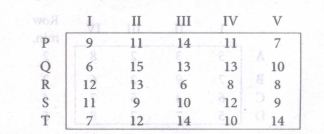
Consider the problem of assigning five jobs to five persons. The assignment costs are given as follows. Determine the optimum assignment.
35.
Prove that \(\int _{ a }^{ b }{ \frac { f\left( x \right) }{ f\left( x \right) +f(a+b-x) } } dx=\frac { b-a }{ 2 } \)
36.
Solve: x2\(\frac { dy }{ dx } \) = y2+2xy given that y = 1, when x = 1
37.
Using Newton’s formula for interpolation estimate the population for the year 1905 from the table:
| Year | 1891 | 1901 | 1911 | 1921 | 1931 |
| Population | 98.752 | 1,32,285 | 1,68,076 | 1,95,690 | 2,46,050 |
38.
The following data gives readings of 10 samples of size 6 each in the production of a certain product. Draw control chart for mean and range with its control limits.
| Sample | 1 | 2 | 3 | 4 | 5 | 6 | 7 | 8 | 9 | 10 |
| Mean | 383 | 508 | 505 | 582 | 557 | 337 | 514 | 614 | 707 | 753 |
| Range | 95 | 128 | 100 | 91 | 68 | 65 | 148 | 28 | 37 | 80 |
39.
40.
A manufacturer of ball pens claims that a certain pen he manufactures has a mean writing life of 400 pages with a standard deviation of 20 pages. A purchasing agent selects a sample of 100 pens and puts them for test. The mean writing life for the sample was 390 pages. Should the purchasing agent reject the manufactures claim at 1% level?
41.
An insurance company has discovered that only about 0.1 per cent of the population is involved in a certain type of accident each year. If its 10,000 policy holders were randomly selected from the population, what is the probability that not more than 5 of its clients are involved in such an accident next year? (e−10=.000045)
42.
The marginal cost and marginal revenue with respect to commodity of a firm are given by C'(x) = 8 + 6x and R'(x)= 24. Find the total Profit given that the total cost at zero output is zero.
43.
A continuous random variable X has p.d.f
f(x) = 5x4, 0\(\le\)x\(\le\)1
Find a1 and a2 such that
i) P[X\(\le\)a1] = P[X>a1]
ii) P[X>a2] = 0.05
44.
Calculate the cost of living index by aggregate expenditure method
| Commodity | Quantity | Price(Rs.) | |
| 2000 | 2000 | 2003 | |
| A | 100 | 8 | 12 |
| B | 25 | 6 | 7.50 |
| C | 10 | 5 | 5.25 |
| D | 20 | 48 | 52 |
| E | 65 | 15 | 16.50 |
| F | 30 | 19 | 27.00 |
45.
If 10 coins are tossed, find the probability that exactly 5 heads appears.
46.
If f(0) = 5, f(1) = 6, f(3) = 50, find f(2) by using Lagrange's formula.
47.
If the marginal revenue for a commodity is MR = 9 - 6x2 + 2x, find the total revenue function.
48.
If A and B are non-singular matrices, prove that AB is non-singular.
49.
Find the differential equation of the following
x2 + y2 = a2
50.
What do you mean by balanced transportation problem?
51.
State any two demerits of systematic random sampling.
52.
Integrate the following with respect to x
\(\frac { 1 }{ { 9-16x }^{ 2 } } \)
53.
The time to failure in thousands of hours of an important piece of electronic equipment used in a manufactured DVD player has the density function
\(f(x)= \begin{cases}2 e^{-2 x}, & x>0 \\ 0,& \text { otherwise }\end{cases}\)
Find the expected life of this piece of equipment.
1.
Sample size n = 500
Proportion of bad apples in the sample
= \(\frac { 45 }{ 500 } \) = 0.09
p = 0.09
∴ q = 1 - p = 1-0.09 = 0.91
Standard error = \(\sqrt { \frac { pq }{ n } } =\sqrt { \frac { (.09)(.91) }{ 500 } } \)
= 0.0128
As the significance level is α = 0.001, \(Z_{ \frac { \alpha }{ 2 } }\) = 2.58
∴ The confidence limits for the population proportion of bad apples are given by
p-zα (S.E.) ≤ p ≤ p + zα (S.E.)
⇒ 0.09 - 2.58 (0.0128) ≤ p ≤ .09 + 2.58 (0.0128)
⇒ 0.09 - 0.033 ≤ p ≤ .09 + 0.033
⇒ 0.057 ≤ p ≤ 0.123
Thus, the bad apples in the consignment lie between (0.057, 0.123).
2.
\(E(X)=\sum { xp(x)=-2(\frac { 1 }{ 4 } ) } +2(\frac { 1 }{ 4 } )+5(\frac { 1 }{ 2 } )\)
\(=\frac { -2 }{ 4 } +\frac { 2 }{ 4 } +\frac { 5 }{ 2 } =\frac { 5 }{ 2 } \)
∴ 4E(X2)-V(2X)=4E(X2)-4.V(X)
=4E(X2)-4[E(X2)-E(X)2]
=4E(X2)-4E(X2)+4[E(X)]2
\(=4{ \left( \frac { 5 }{ 2 } \right) }^{ 2 }[\because E(X)=\frac { 5 }{ 2 } ]\)
\(=4\left( \frac { 25 }{ 4 } \right) =25\)
3.
| Alternative | States of Nature | Minimum | Maximum | ||
| Good | Fair | Bad | |||
| A | 100 | 60 | +50 | +50 | 100 |
| B | 80 | 50 | +10 | 10 | 80 |
| C | 40 | 20 | +5 | 5 | 40 |
(i) Max (50, 10, 5) = 50
∴ A is the best alternative under maximin principle
(ii) Min (100, 80,40) = 40
∴ C is the best alternative under minimax principle
4.
\(\int { \frac { { \left( { x }^{ 2 }+1 \right) }^{ 2 }-{ x }^{ 2 } }{ { x }^{ 2 }-x+1 } } dx=\int { \frac { { \left( { x }^{ 2 }+1 \right) }^{ 2 }-{ x }^{ 2 } }{ { x }^{ 2 }-x+1 } } \)
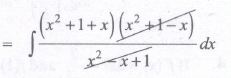
[∵ a2 - b2 = (a+b) (a-b)]
= ∫ (x2 + 1 + x)dx
= \(\frac { { x }^{ 3 } }{ 3 } +x+\frac { { x }^{ 2 } }{ 2 } +c\)
5.
Given \(\frac { { x }^{ 2 } }{ { a }^{ 2 } } +\frac { { y }^{ 2 } }{ { b }^{ 2 } } \)= 1
⇒ \(\frac { { b }^{ 2 }x^{ 2 }+{ a }^{ 2 }{ y }^{ 2 } }{ { a }^{ 2 }{ y }^{ 2 } } \)= 1
⇒ b2x2+a2y2 = a2b2
Differentiating again w.r.t 'x' we get,
2b2x + 2a2y\(\frac { dy }{ dx } \)=0 ⇒ b2x+a2yy1 = 0 ....(2)
Differentiating w.r.t 'x' we get,
b2 + a2[yy2 + y1y1] = 0
⇒ b2 + a2[yy2 + y12] = 0 ...(3)
Eliminating a2 and b2 from (1) and (3) we get
\(\left| \begin{matrix} x & y{ y }_{ 1 } \\ 1 & { y }_{ 1 }^{ 2 }+y{ y }_{ 2 } \end{matrix} \right| \) = 0
⇒ x(y12+yy2) - yy1 = 0
⇒ x\(\left( \left( \frac { dy }{ dx } \right) ^{ 2 }+y.\frac { d^{ 2 }y }{ { dx }^{ 2 } } \right) -y\left( \frac { dy }{ dx } \right) \)= 0 which is the required differential equation.
6.
Let A = \(\left( \begin{matrix} -1 & 2 & -2 \\ 4 & -3 & 4 \\ -2 & 4 & -4 \end{matrix} \right) \)
The order of A is 3 x 3
\(\therefore \rho (A)\le 3\) [Since minimum of (3,3) is 3]
Let us transform the matrix to an echelon form
| Matrix A | Elementary Transformation |
|---|---|
| \(A=\left( \begin{matrix} -1 & 2 & -2 \\ 4 & -3 & 4 \\ -2 & 4 & -4 \end{matrix} \right) \) | |
| \(\sim \left( \begin{matrix} 1 & -2 & 2 \\ 4 & -3 & 4 \\ -4 & 4 & -4 \end{matrix} \right) \) | \(R_{ 1 }\rightarrow { R }_{ 1 }\left( -1 \right) \) |
| \(\sim \left( \begin{matrix} 1 & -2 & 2 \\ 0 & 5 & -4 \\ -2 & 4 & -4 \end{matrix} \right) \) | \({ R }_{ 2 }\rightarrow { R }_{ 2 }-4{ R }_{ 1 }\) |
| \(\sim \left( \begin{matrix} 1 & -2 & 2 \\ 0 & 5 & -4 \\ 0 & 0 & 0 \end{matrix} \right) \) | \({ R }_{ 3 }\rightarrow { R }_{ 32 }+2R_{ 1 }\) |
The matrix is in echelon form and the number of non-zero rows is 2.
\(\therefore \rho (A)=2\)
7.
Given values are
| x | 1 | 2 | 3 | 4 |
| y | -1 | -1 | 1 | 5 |
The difference table is
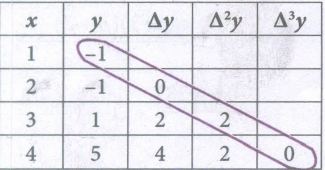
x0 + nh = x ⇒ 1 + n = x ⇒ n = x - 1
∴ By Newton's forward interpolation formula,
y= y0\(\frac { n }{ 1! } { \triangle y }_{ 0 }+\frac { n(n+1) }{ 2! } { \triangle }^{ 2 }{ y }_{ 0 }+\frac { n(n+1)(n+2) }{ 3! } { \triangle }^{ 3 }{ y }_{ 0 }\)
JPG.JPG)
[∵ Δ3y0 = 0]
⇒ y = -1 + 0 + x2 - 3x + 2
⇒ y = x2 - 3x + 1
Hence, the required second degree polynomial is y = x2 - 3x + 1
8.
\(\int _{ 1 }^{ 4 }{ f(x) } dx=\int _{ 1 }^{ 3 }{ f(x) } dx+\int _{ 3 }^{ 4 }{ f(x) } dx\)
= \(\int _{ 1 }^{ 3 }{ (7x+3) } dx+\int _{ 3 }^{ 4 }{ 8x } dx\)
= \({ \left[ \frac { { 7x }^{ 2 } }{ 2 } +3x \right] }_{ 1 }^{ 3 }{ +\left[ \frac { { 8x }^{ 2 } }{ 2 } \right] }_{ 3 }^{ 4 }\)
= \(\frac { 63 }{ 2 } +9-\frac { 13 }{ 2 } +64-36\)
= 62
9.
In a throw of a pair of dice the doublets are (1, 1) (2, 2) (3, 3) (4, 4) (5, 5) (6, 6)
Probability of getting a doublet p = 6/36 = 1/6
⇒ q = 1 – p = 5/6 and also n = 4 is given
The probability of successes
\(=\left( \begin{matrix} 4 \\ x \end{matrix} \right) { (\frac { 1 }{ 6 } ) }^{ x }\left( \frac { 5 }{ 6 } \right) ^{ 4-x }\)
Therefore the probability of 2 successes are
\(P(X=2)\left( \begin{matrix} 4 \\ 2 \end{matrix} \right) { (\frac { 1 }{ 6 } ) }^{ 2 }\left( \frac { 5 }{ 6 } \right) ^{ 4-2 }\)
\(=6\times \frac { 1 }{ 36 } \times \frac { 25 }{ 36 } \)
\(=\frac { 25 }{ 216 } \)
10.
11.
Transition probability matrix
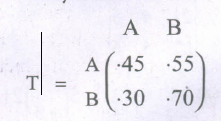
Where A represents the percentage of subscribers and B represents the percentage of non - subscribers.
A 40% = ·40
By the given data, 40% received the order of subscription = 60% are non-subscribers.
A 40% = ·40
and B 60% = ·60
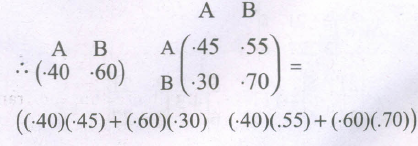
((-40)(-45) + (·60)(-30) (-40)(.55) + (-60)(.70))
(-18+·18 ·22+42)
(·36 ·64)
\(\Rightarrow\) 36% of those receiving the current letter can be expected to order a subscription
12.
(d)
quality
13.
(c)
Estimate
14.
(c)
1
15.
(c)
P(X = Xn) = F(Xn)-F(Xn-1)
16.
(c)
Maximin criteria
17.
(b)
x = ce-my
18.
(b)
e-1
19.
(a)
1
20.
(b)
f(x + 3h) - f(x + 2h)
21.
(c)
5
22.
(c)
2x +1
23.
(c)
Smallest two costs
24.
(c)
y2dx+(x2 − xy − y2)dy = 0
25.
(c)
y = T + S + C + I
26.
(b)
\(\frac{1}{N}\)
27.
(b)
2
28.
(c)
496/729
29.
(c)
mean
30.
(a)
log 2 sq.units
31.
(c)
0
32.
Given sample size n = 200
Sample mean \(\bar { x } \) = 0.824
Sample S.D. s = 0.042
Standard error = \(\frac { s }{ \sqrt { n } } =\frac { 0.042 }{ \sqrt { 200 } } \)
= \(\frac { 0.042 }{ 14.14 } \) = 0.00270
(a) As the level of significance is α = 0.05, \(Z_{ \frac { \alpha }{ 2 } }\) = 1.96
∴ 95% confidence limits for μ are given by \(\bar { x } -Z_{ \frac { \alpha }{ 2 } }(S.E)\le \mu \le \bar { x } +Z_{ \frac { \alpha }{ 2 } }(S.E)\)
⇒ 0.824 - (1.96) (0.00270) ≤ μ ≤ 0.824 + (1.96) (0.00270)
⇒ 0.824 - 0.00582 ≤ μ ≤ 0.824 + 0.00582
⇒ 0.818 ≤ μ ≤ 0.832
Hence, the 95% confidence limits for μ is (0.818,0.832)
(b) As the level of significance is α =0.001, \(Z_{ \frac { \alpha }{ 2 } }\) = 2.58
∴ 99% confidence limits for μ are given by \(\bar { x } -Z_{ \frac { \alpha }{ 2 } }(S.E)\le \mu \le \bar { x } +Z_{ \frac { \alpha }{ 2 } }(S.E)\)
⇒ 0.824 - (2.58) (0.00270) ≤ μ ≤ 0.824 + (2.58) (0.00270)
⇒ 0.824 - 0.00582 ≤ μ ≤ 0.824 + 0.005825
⇒ 0.816 ≤ μ ≤ 0.832
Hence, the 99% confidence limits for μ is (0.816, 0.832)
33.
Let X denote the height of the student
Given μ = 64.5 inches and σ = 3.3 inches
Given that P(-∞ < Z < C) = 0.99
⇒ P( -∞ < Z < 0) + P (0 < Z < C) = 0.99
⇒ 0.5 + P (0 < Z < C) = 0.99
⇒ P(0 < Z < C) = 0.99 - 0.5 = 0.49...(1)
From the standard normal distribution table
P(0 < Z < 2.33) = 0.49...(2)
From (1) & (2), C = 2.33
we know that Z = \(\frac { X-\mu }{ \sigma } \)
⇒ 2.33 = \(\frac { X-64.5 }{ 3.3 } \)
⇒ X = (2.33) (3.3) + 64.5
⇒ X = 72.19 inches
Hence, the height below which 99% of the student lie is 72.19 inches.
34.
Here the number of rows and columns are equal.
∴ The given assignment problem is balanced.
Step 1 :
Select a smallest element in each row and subtract this from all the elements in its row.
∴ The cost matrix of the given assignment problem is
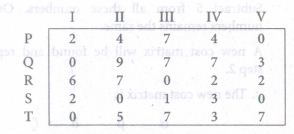
Here column IV has no zero. Go to step 2.
Step 2:
Select the smallest element in each column and subtract this from all the elements in its column.
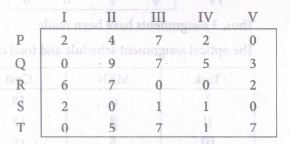
Since each row and column contains atleast one zero, assignments can be made.
Step 3:
Examine the row with exactly one zero. Mark the zero by \(\Box \) and draw a vertical line. After examining all the rows examine the column with one zero. mark the zero by \(\Box\) and draw a horizontal line.
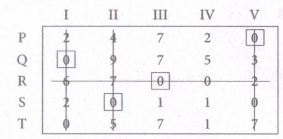
Here only 4 assignments have been made.
The numbers not lying on the line are
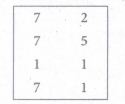
and min. of these numbers is 1.
Now subtract 1 from all these numbers and add 1 to the numbers on the intersecting line (ie. 6, 7, 2). Other numbers remains the same.
∴ The new cost matrix is
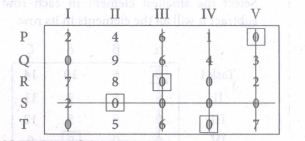
Now, repeat Step 3.
Thus, all the 5 assignments have been made.
The optimal assignment schedule and total cost is
| Person | Job | Cost |
| P | V | 7 |
| Q | I | 6 |
| R | III | 6 |
| S | II | 9 |
| T | IV | 10 |
| Total Cost | Rs. 38 | |
35.
Let I = \(\int _{ a }^{ b }{ \frac { f\left( x \right) }{ f\left( x \right) +f(a+b-x) } } dx=\frac { b-a }{ 2 } --(1)\)
By the property, \(\int _{ a }^{ b }{ f\left( x \right) } dx=\int _{ a }^{ b }{ f(a+b-x) } dx\)
\(I=\int _{ a }^{ b }{ \frac { f(a+b-x) }{ f(a+b-x)+f(a+b-(a+b-x)) } } dx\)
= \(\int _{ a }^{ b }{ \frac { f(a+b-x) }{ (a+b-x)+f(a+b-a-b+x) } } dx\)
= \(\int _{ a }^{ b }{ \frac { f(a+b-x) }{ f(a+b-x)+f(x) } } ---(2)\)
Adding (1) and (2) we get, 2I= \(\int _{ a }^{ b }{ \left( \frac { f(x) }{ f(x)+f(a+b-x) } +\frac { f(a+b-x) }{ f(a+b-x)+f(x) } \right) } \)
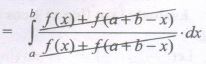
= \(\int _{ a }^{ b }{ dx } ={ \left[ x \right] }_{ a }^{ b }=b-a\)
2I = b - a
\(\Rightarrow I=\frac { b-a }{ 2 } \) Hence proved
36.
Given x2\(\frac { dy }{ dx } \)= y2+2xy
⇒ \(\frac { dy }{ dx } =\frac { { y }^{ 2 }+2xy }{ x^{ 2 } } \)
The numerator and denominator are homogeneous function of degree
∴ put y = vx and \(\frac { dy }{ dx } =v+x\frac { dv }{ dx } \)
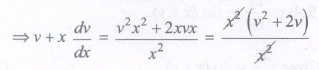
= v2+2v
⇒ v + x\(\frac { dv }{ dx } \) = v2+ 2v
⇒ x\(\frac { dv }{ dx } \) = v2+ 2v-v = v2+ v
Separating the variables,
\(\frac { dv }{ { v }^{ 2 }+v } =\frac { dx }{ x } \Rightarrow \frac { dv }{ v(v+1) } =\frac { dx }{ x } \)
[\(\frac { 1 }{ v(v+1) } =\frac { A }{ v } +\frac { B }{ v+1 } \)
1 = A(v+1)+Bv
put v = -1
1 = -B
put v = 0
1 = A
∴ \(\left( \frac { 1 }{ v } +\frac { 1 }{ v+v } \right) dv=\frac { dx }{ x } \)
Integrating
\(\int { \frac { dv }{ v } } -\int { \frac { dv }{ v+1 } } =\int { \frac { dx }{ x } } \)
⇒ log v - log (v + 1) - log x + log c
⇒ log\(\left( \frac { v }{ v+1 } \right) \)= log(xc)
⇒ \(\frac { v }{ v+1 } \)
Replacing v by \(\frac { y }{ x } \) we get,
\(\frac { \frac { y }{ x } }{ \frac { y }{ x } +1 } =xc\Rightarrow \frac { \frac { y }{ x } }{ \frac { x+y }{ x } } \) = xc
⇒ \(\frac { y }{ x+y } \) = xc
⇒ y = cx(x+y) ....(1)
Given, when x = -1, y = 1
∴ 1 = c(1) (1+1) ⇒ = 2c ⇒ c = \(\frac { 1 }{ 2 } \)
∴ (1) becomes, y = \(\frac { x }{ 2 } \)(x+y)
⇒ 2y = x(x+y)
37.
To find the population for the year 1905 (i.e) the value of y at x = 1905
Since the value of y is required near the beginning of the table, we use the Newton’s forward interpolation formula.
\({ y }_{ \left( x={ x }_{ 0 }+nh \right) }={ y }_{ 0 }+\cfrac { n }{ n! } \Delta { y }_{ 0 }+\cfrac { n(n-1) }{ 2! } { \Delta }^{ 2 }{ y }_{ 0 }+\cfrac { n(n-)(n-2) }{ 3! } { \Delta }^{ 3 }{ y }_{ 0 } + ...\)
To find y at x = 1905
\(\therefore\) x0+nh = 1905 , x0 = 1891, h = 10
1891+n(10) = 1905 \(\Rightarrow\) n = 1.4
| x | y | \(\Delta y\) | \(\Delta ^{ 2 }y\) | \(\Delta ^{ 3 }y\) | \(\Delta ^{ 4 }y\) |
|---|---|---|---|---|---|
| 1891 | 98,752 | ||||
| 33,533 | |||||
| 1901 | 1,32,285 | 2,258 | |||
| 35,791 | –10,435 | ||||
| 1911 | 1,68,076 | -8,177 | 41,376 | ||
| 27,614 | |||||
| 1921 | 1,95,690 | 30,941 | |||
| 22,764 | |||||
| 50,360 | |||||
| 1931 | 2,46,050 |
y(x=1905) = \(98,752+(1.4)(33533)+\frac { (1.4)(0.4) }{ 2 } (2258)+\frac { (1.4)(0.4)(-0.6) }{ 6 } (-10435)+\frac { (1.4)(0.6)(-0.6)(-1.6) }{ 24 } (41358)\)
= 98,752 + 46946.2 + 632.4 + 584.36 + 1389.63
= 1,48,304.43
= 1,48,304
38.
| Sample | 1 | 2 | 3 | 4 | 5 | 6 | 7 | 8 | 9 | 10 | Total |
| Mean | 383 | 508 | 505 | 582 | 557 | 337 | 514 | 614 | 707 | 753 | 5460 |
| Range | 95 | 128 | 100 | 91 | 68 | 65 | 148 | 28 | 37 | 80 | 840 |
\(\overset { = }{ X } =\frac { \sum { \bar { X } } }{ 10 } =\frac { 5460 }{ 10 } =546\)
The control limits for \(\overset{-}{X}\) chart is
\(UCL=\overset { = }{ X } +{ A }_{ 2 }\bar { R } =546+0.483(84)=586.57\)
\(CL=\overset { = }{ X } =546\)
\(LCL=\overset { = }{ X } -{ A }_{ 2 }\bar { R } =546-0.483(84)=505.43\)
\(\bar { R } =\frac { \sum { R } }{ n } =\frac { 840 }{ 10 } =84\)
The control limits for Range chart is
\(UCL={ D }_{ 4 }\bar { R } =2.004(84)=168.336\)
\(CL=\bar { R } =84\)
\(LCL={ D }_{ 3 }\bar { R } =0(84)=0\)
39.
40.
Sample size n =100, Sample mean \(\bar x\) = 390 pages, Population mean \(\mu\) = 400 pages
Population SD \(\sigma\) = 20 pages
The sample is a large sample and so we apply Z -test
Null Hypothesis:
There is no significant difference between the sample mean and the population mean of writing life of pen he manufactures, i.e., H0 : \(\mu\) = 400
Alternative Hypothesis:
There is significant difference between the sample mean and the population mean of writing life of pen he manufactures, i.e., H1:\(\mu\neq\) 400 (two tailed test)
The level of significance \(\alpha\) = 1% = 0.01
Applying the test statistic
\(Z=\frac{\bar{x}-\mu}{\frac{\sigma}{\sqrt{n}}} \sim N(0,1) ; \)
\(Z=\frac{390-400}{\frac{20}{\sqrt{100}}}=\frac{-10}{2}=-5, \therefore|Z|=5\)
Thus the calculated value |Z| = 5 and the significant value or table value \({ Z }_{ \frac { \sigma }{ 2 } }=2.58\)
Comparing the calculated and table values, we found Z > \({ Z }_{ \frac { \sigma }{ 2 } }\) i.e., 5 > 2.58
Inference: Since the calculated value is greater than table value i.e., \(Z>{ Z }_{ \frac { \sigma }{ 2 } }\) at 1% level of significance, the null hypothesis is rejected and Therefore we concluded that \(\mu \neq400\) and the manufacturer’s claim is rejected at 1% level of significance.
41.
p = probability that a person will involve in an accident in a year
= 0.1/100 = 1/1000
given n = 10,000
so, \(\lambda\) = np = 10000\((\frac{1}{10000})\) = 10
Probability that not more than 5 will involve in such an accident in a year
P(X \(\le\) 5) = P(X = 0)+P(X = 1)+P(X = 2)+P(X = 3)+P(X = 4)+P(X = 5)
\(={ e }^{ -10 }[1+\frac { 10 }{ 1! } +\frac { { 10 }^{ 2 } }{ 2! } +\frac { { 10 }^{ 3 } }{ 3! } +\frac { { 10 }^{ 4 } }{ 4! } +\frac { { 10 }^{ 5 } }{ 5! } ]\)
= 0.06651
42.
Given MC = 8 + 6x
\(C(x)=\int { (8+6x)dx } \) + k1
= 8x + 3x2 + k1 ...(1)
But given when x = 0, C = 0 ⇒ k1 = 0
ஃ C(x) = 8x + 3x2 ....(2)
Given that MR = 24
R(x) = \(\int { MR } \) dx + k2
= \(\int { 24 } \) dx + k2
= \(\int { 24 } \) + k2
Revenue = 0, when x = 0 ⇒ k2 = 0
R(x) = 24x ...(3)
Total Profit functions P(x) = R(x) – C(x)
P(x) = 24x − 8x − 3x2
= 16x − 3x2
43.
i) Since P[X\(\le\)a1] = P[X>a1]
\(P[X\le { a }_{ 1 }]=\frac { 1 }{ 2 } \)
\(i.e., \int _{ 0 }^{ { a }_{ 1 } }{ f(x)dx } =\frac { 1 }{ 2 } \)
\(i.e., \int _{ 0 }^{ { a }_{ 1 } }{ { 5x }^{ 4 } } dx=\frac { 1 }{ 2 } \)
\(5{ { \left[ \frac { { x }^{ 5 } }{ 5 } \right] } }_{ { 0 }_{ } }^{ a1 }=1/2\)
\({ a }_{ 1 }={ (0.5) }^{ \frac { 1 }{ 5 } }\)
ii) \(P[X>{ a }_{ 2 }]=0.05\)
\(\int _{ { a }_{ 2 } }^{ 1 }{ { f(x })dx=0.05 } \)
\(\int _{ { a }_{ 2 } }^{ 1 }{ { 5x }^{ 4 }dx=0.05 } \)
\(5{ { \left[ \frac { { x }^{ 5 } }{ 5 } \right] } }_{ { a }_{ 2 } }^{ 1 }=0.05\)
\({ a }_{ 2 }={ [0.95] }^{ \frac { 1 }{ 5 } }\)
44.
| Commodity | Quantity | Price(Rs.) | p1q0 | p0q0 | |
| 2000(q0) | 2000 (p0) | 2003 (p1) | |||
| A | 100 | 8 | 12 | 1200 | 800 |
| B | 25 | 6 | 7.50 | 187.50 | 150 |
| C | 10 | 5 | 5.25 | 52.50 | 50 |
| D | 20 | 48 | 52 | 1040.00 | 960 |
| E | 65 | 15 | 16.50 | 1072.50 | 975 |
| F | 30 | 19 | 27.00 | 810 | 570 |
C.L.I = \(\frac{\Sigma p_1q_0}{\Sigma p_0q_0}\times100\)
C.L.I = \(\frac{4362.50}{3505}\times100\) = 124.46
45.
Given n = 10, P(H) = \(\frac { 1 }{ 2 } \) ⇒ p =\(\frac { 1 }{ 2 } \)
q=1-p = \(1-\frac { 1 }{ 2 } =\frac { 1 }{ 2 } \)
P(X = x) = nCx pxqn-x
∴ P(X = 5) = 10C5 p5q5
= \(\frac { 10\times 9\times 8\times 7\times 6 }{ 5\times 4\times 3\times 2\times 1 } \left( \frac { 1 }{ 2 } \right) ^{ 5 }\left( \frac { 1 }{ 2 } \right) ^{ 10 }\)
= \(\frac { 6\times 7\times 6 }{ 2^{ 10 } } \)
= \(\frac { 2\times 3\times 7\times 2\times 3 }{ 2^{ 10 } } =\frac { 63 }{ { 2 }^{ 8 } } \)
= \(\frac { 63 }{ 256 } \).
46.
By data we have,
x0 = 0, x1 = 1, x2 = 3
y0 = 5, y1 = 6, y2 = 50 and x = 2
Using Lagrange's formula, we get
\(y=\frac { (x-{ x }_{ 1 })(x-{ x }_{ 2 }) }{ ({ x }_{ 0 }-{ x }_{ 1 })({ x }_{ 0 }-{ x }_{ 2 }) } { y }_{ 0 }+\frac { (x-{ x }_{ 1 })(x-{ x }_{ 2 }) }{ ({ x }_{ 0 }-{ x }_{ 1 })({ x }_{ 0 }-{ x }_{ 2 }) } { y }_{ 1 }+\frac { (x-{ x }_{ 0 })(x-{ x }_{ 1 }) }{ ({ x }_{ 2 }-{ x }_{ 0 })({ x }_{ 0 }-{ x }_{ 1 }) } { y }_{ 2 }\)
= \(5\times \frac { (2-0)(2-3) }{ (0-1)(0-3) } +6\times \frac { (2-0)(2-3) }{ (1-0)(1-3) } +50\times \frac { (2-0)(2-1) }{ (3-0)(3-1) } \)
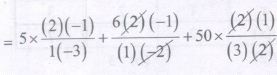
= \(\frac { 10 }{ 3 } -6+\frac { 50 }{ 3 } =\frac { 60 }{ 3 } -6=20-6=14\)
∴ f(2) = 14
47.
Given MR = 9 - 6x2 + 2x
⇒ഽMR=ഽ(9 - 6x2 + 2x)sx
\(\Rightarrow R=9x-\frac { { 6x }^{ 3 } }{ 3 } +\frac { { 2x }^{ 2 } }{ 2 } +k\)
⇒ R = 9x - 2x3 + x2 + k
When x = 0, R = 0 ⇒ k = 0
∴ R = 9x - 2x3 + x2
48.
Since A and B are non-singular,
|A| \(\neq \) 0, |B|\(\neq \) 0
Consider |AB| |A|·|B|
\(\neq \) 0 since |A|\(\neq \) 0 and |B|\(\neq \) 0.=? |AB| \(\neq \) 0
\(\therefore\) AB is non-singular.
49.
Differentiating w.r.t 'x' we get, 2x + 2y\(\frac { dy }{ dx } \)= 0
Dividing by 2, we get,
x+y\(\frac { dy }{ dx } \) = 0
50.
If the total supply = total demand, then the given problem is a balanced transportation problem.
51.
1. Systematic samples are not random samples.
2. If N is not a multiple of n, then the sampling interval (k) cannot be an integer, thus sample selection becomes difficult.
52.
\(\int { \frac { 1 }{ 9-{ 16x }^{ 2 } } } dx\)
\(=\frac { 1 }{ 16 } \int { \frac { 1 }{ \frac { 9 }{ 16 } -{ x }^{ 2 } } } dx\)
\(=\frac { 1 }{ 16 } \int { \frac { 1 }{ { \left( \frac { 3 }{ 2 } \right) }^{ 2 }-{ x }^{ -2 } } } \)
\(=\frac { 1 }{ 16 } \left[ \frac { 1 }{ 2\left( \frac { 3 }{ 4 } \right) } \log\left| \frac { \frac { 3 }{ 4 } +x }{ \frac { 3 }{ 4 } -x } \right| \right] +c\)
\(\left[ \because \int { \frac { dx }{ { x }^{ 2 }-{ a }^{ 2 } } } =\frac { 1 }{ 2a } \log\left| \frac { x-a }{ x+a } \right| \right] +c\)
\(=\frac { 1 }{ 16 } \times \frac { 2 }{ 3 } \log { \left| \frac { \frac { \left( 3+4x \right) }{ 4 } }{ \frac { \left( 3-4x \right) }{ 4 } } \right| } +c\)
\(=\frac { 1 }{ 24 } \log { \left| \frac { 3+4x }{ 3-4x } \right| } +c\)
53.
Given p.d.f. is f(x) = \(\begin{cases} { 2e }^{ -2x },>0 \\ 0,\quad otherwise \end{cases}\)
Expected life of this piece of equipment is
\(E(X)=\int _{ -\infty }^{ \infty }{ x.f(x)dx=\int _{ 0 }^{ \infty }{ x.{ 2e }^{ -2x } } } \)
\(=2\int _{ 0 }^{ \infty }{ { xe }^{ -2x }dx=2\left[ \frac { 1! }{ { 2 }^{ 2 } } \right] } \)
[\(\because \int _{ 0 }^{ \infty }{ { x }^{ n }{ e }^{ -ax }dx=\frac { n! }{ { a }^{ n+1 } } } \) gamma integral here n = 1, a = 2]
\(E(X)=\frac { 2 }{ 4 } =\frac { 1 }{ 2 } \)

12th Standard Syllabus & Materials
12th Standard
TN 12th Computer Applications களப்பெயர் முறைமை (DNS) Sample Question Papers Study Material - QB365 Set A
NEW12th Standard
TN 12th Computer Applications வலையமைப்பு எடுத்துக்காட்டுகள் மற்றும் நெறிமுறைகள் Sample Question Papers Study Material - QB365 Set A
NEW12th Standard
TN 12th Computer Applications கணினி வலையமைப்பு ஓர் அறிமுகம் Sample Question Papers Study Material - QB365 Set A
NEW12th Standard
TN 12th Computer Applications PHP-உடன் MySQL-ஐ இணைத்தல் Sample Question Papers Study Material - QB365 Set A



Tamilnadu Stateboard 12th Standard Subjects

Maths

Chemistry

Physics

Biology

Computer Science
Business Maths and Statistics

Economics

Commerce

Accountancy

History

Computer Applications
Biology
Computer Technology
Computer Applications
Computer Science
Business Maths and Statistics
Commerce
Economics
Maths
Chemistry
Physics
Computer Technology
History
Accountancy

Tamil

English

French
Tamilnadu Stateboard Standards
