
 100% FREE ACCESS
12th Standard Syllabus & Materials
12th Standard
TN 12th Computer Applications மின்னணு தரவு பரிமாற்றம் Sample Question Papers Study Material - QB365 Set A
NEW12th Standard
TN 12th Computer Applications மின் - வணிக பாதுகாப்பு அமைப்புகள் Sample Question Papers Study Material - QB365 Set A
NEW12th Standard
TN 12th Computer Applications மின்னணு செலுத்தல் முறைகள் Sample Question Papers Study Material - QB365 Set A
NEW12th Standard
TN 12th Computer Applications மின் - வணிகம் Sample Question Papers Study Material - QB365 Set A
NEW12th Standard
TN 12th Computer Applications திறந்த மூல கருத்துருக்கள் Sample Question Papers Study Material - QB365 Set A
NEW12th Standard
TN 12th Computer Applications வலையமைப்பு வடமிடல் Sample Question Papers Study Material - QB365 Set A

Published on: 01/03/2021
12th Standard English Medium Business Maths Reduced Syllabus Creative Five Mark Question with Answerkey - 2021(Public Exam )
Download Tamil Nadu 12th Standard Business Maths and Statistics question papers, model tests, one-mark questions, important questions, and public exam papers in PDF format. Free study materials and answer keys for TN State Board students.
Questions + Answers key
Take MCQ Business Maths and Statistics Test
1.
Compute
(i) Laspeyre's
(ii) Paasche's
(iii) Fisher's price index number for 2000 from the following data.
| Commodity | Price | Quantity | ||
| 1990 | 2000 | 1990 | 2000 | |
| A | 2 | 4 | 8 | 6 |
| B | 5 | 6 | 10 | 5 |
| C | 4 | 5 | 14 | 10 |
| D | 2 | 2 | 19 | 13 |
2.
Measurements of the weights of a random sample of 200 ball bearings made by certain machine during one week showed a mean of 0.824 newtons and a S.D. of 0.042 newton's. Find
a) 95% and
b) 99% confidence limits for the mean weight of all the ball bearings.
3.
The probability distribution of the discrete random variables X and Y are given below
| X | 0 | 1 | 2 | 3 |
| P(X) | \(\frac{1}{5}\) | \(\frac{2}{5}\) | \(\frac{1}{5}\) | \(\frac{1}{5}\) |
| Y | 0 | 1 | 2 | 3 |
| P(Y) | \(\frac{1}{5}\) | \(\frac{3}{10}\) | \(\frac{2}{5}\) | \(\frac{1}{10}\) |
Prove that E(Y2) = 2E(X).
4.
If f'(x) = a sin x + b cos x and f'(0) = 4, f(0) = 3, f\(\left( \frac { \pi }{ 2 } \right) \) = 5, find f(x).
5.
The net profit p and quantity x satisfy the differential equation \(\frac { dp }{ dx } =\frac { 2{ p }^{ 3 }-{ x }^{ 3 } }{ 3x{ p }^{ 2 } } \). Find the relationship between the net profit and demand given that p = 20, when x = 10.
6.
The Marginal revenue for a commodity is MR=\(\frac { { e }^{ x } }{ 100 } +x+{ x }^{ 2 }\), find the revenue function.
7.
Using interpolation estimate the output of a factory in 1986 from the following data
| Year | 1974 | 1978 | 1982 | 1990 |
| Output in 1000 tones | 25 | 60 | 80 | 170 |
8.
Find a polynomial of degree two which takes the values
| x | 0 | 1 | 2 | 3 | 4 | 5 | 6 | 7 |
| y | 1 | 2 | 4 | 7 | 11 | 16 | 22 | 29 |
9.
Solve the following differential equations (D2+D−6)y=e3x + e−3x
10.
Solve cos2 x \(\frac{dy}{dx}\) + y = tan x
11.
Integrate the following with respect to x.
ex (1+ x) log(xex)
12.
Determine the mean and variance of the random variable X having the following probability distribution.
| X=x | 1 | 2 | 3 | 4 | 5 | 6 | 7 | 8 | 9 | 10 |
| P(x) | 0.15 | 0.10 | 0.10 | 0.01 | 0.08 | 0.01 | 0.05 | 0.02 | 0.28 | 0.20 |
13.
The length of time (in minutes) that a certain person speaks on the telephone is found to be random phenomenon, with a probability function specified by the probability density function f(x) as \( f(x)\begin{cases} { Ae }^{ -x/5 },\quad \text{for}\quad x\ge 0 \\ 0 \quad ,\quad \text{otherwise }\end{cases}\)
(a) Find the value of A that makes fix) a p.d.f,
(b) What is the probability that the number of minutes that person will talk over the phone is
(i) more than 10 minutes
(ii) less than 5 minutes and
(iii) between 5 and 10 minutes.
14.
A continuous random variable X has the following distribution function:
\(f(x)=\left\{\begin{array}{l} 0 , \text{if} \ x \leq1 \\ k(x-1)^4, \text{if} \ 1< x \leq 3 \\ 1, \text{if} \ x > 3 \end{array}\right.\)
Find (i) k and (ii) the probability density function.
15.
A firm’s marginal revenue function is MR = 20e-x/10 \(\left( 1-\frac { x }{ 10 } \right) \). Find the corresponding demand function.
16.
The amount of bread (in hundreds of pounds) x that a certain bakery is able to sell in a day is found to be a numerical valued random phenomenon, with a probability function specified by the probability density function f(x) is given by
\(f(x)=\left\{\begin{array}{l} Ax,for \ 0≤x10 \\ A(20−x),for \ 10 ≤x< 20 \\ 0,\quad \quad \quad otherwise \end{array}\right.\)
(a) Find the value of A.
(b) What is the probability that the number of pounds of bread that will be sold tomorrow is
(i) More than 10 pounds,
(ii) Less than 10 pounds, and
(iii) Between 5 and 15 pounds?
17.
Find the area bounded by the curve y = x2 and the line y = 4
18.
Sketch the graph \(y=\left| x+3 \right| \) and evaluate \(\int _{ -6 }^{ 0 }{ \left| x+3 \right| } \) dx.
19.
Evaluate \(\int { { \left( \log x \right) }^{ 2 } } dx\)
20.
Find k if the equations 2x + 3y − z = 5, 3x − y + 4z = 2, x + 7y − 6z = k are consistent.
21.
Two types of soaps A and B are in the market. Their present market shares are 15% for A and 85% for B. Of those who bought A the previous year, 65% continue to buy it again while 35% switch over to B. Of those who bought B the previous year, 55% buy it again and 45% switch over to A. Find their market shares after one year and when is the equilibrium reached?
22.
An amount of Rs. 5,000/- is to be deposited in three different bonds bearing 6%, 7% and 8% per year respectively. Total annual income is Rs. 358/-. If the income from first two investments is Rs. 70/- more than the income from the third, then find the amount of investment in each bond by rank method.
23.
Investigate for what values of ‘a’ and ‘b’ the following system of equations x + y + z = 6,x + 2y + 3z = 10, x + 2y + az = b have
(i) no solution
(ii) a unique solution
(iii) an infinite number of solutions.
24.
Show that the equations are inconsistent x − 4y + 7z = 14, 3x + 8y − 2z = 13, 7x − 8y + 26z = 5
25.
Show that the following system of equations have unique solution:
x + y + z = 3, x + 2y + 3z = 4, x + 4y + 9z = 6 by rank method.
1.
| Commodity | Price | Quantity | ||
| Base year p0 | Current year p1 | Base year q0 | Current year q1 | |
| A | 2 | 4 | 8 | 6 |
| B | 5 | 6 | 10 | 5 |
| C | 4 | 5 | 14 | 10 |
| D | 2 | 2 | 19 | 13 |
| p0q0 | p1q0 | p0q1 | p1q1 |
| 16 | 32 | 12 | 24 |
| 50 | 60 | 25 | 30 |
| 56 | 70 | 40 | 50 |
| 38 | 38 | 26 | 26 |
| 160 | 200 | 103 | 130 |
(i) Laspeyre's index number
\(P_{01}^{L} = \frac{\Sigma p_1q_0}{\Sigma p_0q_0}\times100\)
\(=\frac{200}{160}\times100=125\)
(ii) Paasche's Price index number
\(P_{01}^{P} = \frac{\Sigma p_1q_1}{\Sigma p_0q_1}\times100\)
\(=\frac{130}{103}\times100=126.21\)
(iii) Fisher's price index number
\(P_{01}^{F} =\sqrt {{P_{01}^{L}}\times{P_{01}^{P}}}=125.6\)
2.
Given sample size n = 200
Sample mean \(\bar { x } \) = 0.824
Sample S.D. s = 0.042
Standard error = \(\frac { s }{ \sqrt { n } } =\frac { 0.042 }{ \sqrt { 200 } } \)
= \(\frac { 0.042 }{ 14.14 } \) = 0.00270
(a) As the level of significance is α = 0.05, \(Z_{ \frac { \alpha }{ 2 } }\) = 1.96
∴ 95% confidence limits for μ are given by \(\bar { x } -Z_{ \frac { \alpha }{ 2 } }(S.E)\le \mu \le \bar { x } +Z_{ \frac { \alpha }{ 2 } }(S.E)\)
⇒ 0.824 - (1.96) (0.00270) ≤ μ ≤ 0.824 + (1.96) (0.00270)
⇒ 0.824 - 0.00582 ≤ μ ≤ 0.824 + 0.00582
⇒ 0.818 ≤ μ ≤ 0.832
Hence, the 95% confidence limits for μ is (0.818,0.832)
(b) As the level of significance is α =0.001, \(Z_{ \frac { \alpha }{ 2 } }\) = 2.58
∴ 99% confidence limits for μ are given by \(\bar { x } -Z_{ \frac { \alpha }{ 2 } }(S.E)\le \mu \le \bar { x } +Z_{ \frac { \alpha }{ 2 } }(S.E)\)
⇒ 0.824 - (2.58) (0.00270) ≤ μ ≤ 0.824 + (2.58) (0.00270)
⇒ 0.824 - 0.00582 ≤ μ ≤ 0.824 + 0.005825
⇒ 0.816 ≤ μ ≤ 0.832
Hence, the 99% confidence limits for μ is (0.816, 0.832)
3.
\(E(X)=0\times \frac { 1 }{ 5 } +1(\frac { 2 }{ 5 } )+2\left( \frac { 1 }{ 5 } \right) +3\times \frac { 1 }{ 5 } \)
\(=\frac { 2 }{ 5 } +\frac { 2 }{ 5 } +\frac { 3 }{ 25 } =\frac { 7 }{ 5 } \)
\(\\ \therefore 2E(X)=\frac { 14 }{ 5 } ...(1)\)
\(E({ Y }^{ 2 })=0\times \frac { 1 }{ 5 } +{ 1 }^{ 2 }(\frac { 3 }{ 10 } )+{ 2 }^{ 2 }(\frac { 2 }{ 5 } )+{ 3 }^{ 2 }(\frac { 1 }{ 10 } )\)
\(=\frac { 3 }{ 10 } +\frac { 8 }{ 5 } +\frac { 9 }{ 10 } =\frac { 3+16+9 }{ 10 } \)
\(=\frac { 28 }{ 10 } =\frac { 14 }{ 5 } ..(2)\)
From (1) and (2), E(Y2) = 2 E(X).
4.
Given f'(x) = a sin x + b cos x ------(1)
ഽ f'(x) dx = a ഽ sin x dx + b ഽ cos x dx [∵ f'(x) dx = f(x)]
⇒ f(x) = -a cos x + b sin x + c -------(2)
Given f'(0) = 4
∴ (1) 4 = a sin 0 + b cos 0
⇒ 4 = a (0) + b (1)
[∵ sin 0 = 0 and cos 0 = 1]
⇒ 4 = b
Also, f(0) = 3
∴ (2) 3 = -a cos 0 + b sin 0 +c
⇒ 3 = -a (1) + b (0) +c
⇒ 3 = -a +c --------(3)
And f\(\left( \frac { \pi }{ 2 } \right) \) = 5
∴ (2) 5 = -a cos \( \frac { \pi }{ 2 } \)+ b sin \( \frac { \pi }{ 2 } \)+ c
⇒ 5 = -a (0) + b (1) +c
[∵ sin \( \frac { \pi }{ 2 } \)=1 and cos \( \frac { \pi }{ 2 } \)= 0]
⇒ 5 = b + c
⇒ 5 = 4 + c [∵ b = 4]
⇒ 5 - 4 = c
c = 1
Substituting c = 1 in (3) we get,
3 = -a + 1
⇒ a = 1 - 3
⇒ a = -2
∴ From (2), f(x) = -(-2) cos x + 4 sin x + 1
⇒ f(x) = 2 cos x + 4 sin x +1
5.
Given \(\frac { dp }{ dx } =\frac { 2{ p }^{ 3 }-{ x }^{ 3 } }{ 3x{ p }^{ 2 } } \)
The numerator and denominator are homogeneous functions of 3,
∴ Put p=vx and \(\frac { dp }{ dx } =v+x\frac { dv }{ dx } \)
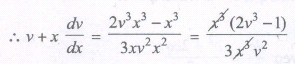
= \(\frac { 2{ v }^{ 3 }-1 }{ 3{ v }^{ 2 } } \)
⇒ \(\frac { dv }{ dx } =\frac { 2{ v }^{ 3 }-1 }{ 3{ v }^{ 2 } } -v=\frac { 2{ v }^{ 3 }-1-3{ v }^{ 3 } }{ 3{ v }^{ 2 } } \)
= \(\frac { -1-{ v }^{ 3 } }{ 3{ v }^{ 2 } } \)
⇒ \(\left( \frac { 3{ v }^{ 2 } }{ 1+{ v }^{ 3 } } \right) dv=-\frac { dx }{ x } \)
Integrating, \(\int { \frac { 3{ v }^{ 2 } }{ 1+{ v }^{ 3 } } } dv=-\int { \frac { dx }{ x } } \)
⇒ log(1+v3) = -log x + log c
⇒ 1+v3 = \(\frac { c }{ x } \)
Replacing v by \(\frac { p }{ x } \) we get
\(1+\frac { { p }^{ 3 } }{ { x }^{ 3 } } =\frac { c }{ x } \Rightarrow \frac { { x }^{ 3 }+{ p }^{ 3 } }{ { x }^{ 3 } } =\frac { c }{ x } \)
⇒ \(\frac { { x }^{ 3 }+{ p }^{ 3 } }{ { x }^{ 2 } } \)= c ⇒ x3+p3 = cx2...(1)
When x = 10, p = 20
⇒ 103 + 203 = c(10)2 ⇒ 1000 + 8000 = 100 c
⇒ 9000 = 100 c
⇒ c = 90
∴ (1) becomes,
x3+p3 = 90x2
⇒ p3 = 90x2-x3
⇒ p3 = x2(90-x) which is the required relationship.
6.
Given that MR \(=\frac { { e }^{ x } }{ 100 } +x+{ x }^{ 2 }\)
\(\int { MR } =\int { \left( \frac { { e }^{ x } }{ 100 } +x+{ x }^{ 2 } \right) } dx\)
\(R=\frac { { e }^{ x } }{ 100 } +\frac { { x }^{ 2 } }{ 2 } +\frac { { x }^{ 3 } }{ 3 } +k\)
When x=0, R=0
\(\Rightarrow 0=\frac { { e }^{ 0 } }{ 100 } +0+0+k\)
\(k=-\frac { 1 }{ 100 } [\because { e }^{ 0 }=1]\)
∴ Revenue \(R=\frac { { e }^{ x } }{ 100 } +\frac { { x }^{ 2 } }{ 2 } +\frac { { x }^{ 3 } }{ 3 } +\frac { 1 }{ 100 } \)
7.
Given
| Year | 1974 | 1978 | 1982 | 1990 |
| Output in 1000 tones | 25 | 60 | 80 | 170 |
Here the intervals are unequal.
∴ By Lagranges interpolation formula, we have
x0 = 1974, x1 = 1978, x2 = 1982, x3 = 1990
y0 = 25, y1 = 60, y2 = 80, y3 = 170 and x = 1986.
∴ y = f(x) = \(\frac { (x-{ x }_{ 1 })(x-{ x }_{ 2 })(x-{ x }_{ 3 }) }{ ({ x }_{ 0 }-{ x }_{ 1 })({ x }_{ 0 }-{ x }_{ 2 })({ x }_{ 0 }-{ x }_{ 3 }) } \times { y }_{ 0 }+\frac { (x-{ x }_{ 0 })(x-{ x }_{ 2 })(x-{ x }_{ 3 }) }{ ({ x }_{ 1 }-{ x }_{ 0 })({ x }_{ 1 }-{ x }_{ 2 })(x_{ 1 }-{ x }_{ 3 }) } \times { y }_{ 1 }+\frac { (x-{ x }_{ 0 })(x-{ x }_{ 1 })(x-{ x }_{ 3 }) }{ ({ x }_{ 2 }-{ x }_{ 0 })({ x }_{ 2 }-{ x }_{ 1 })({ x }_{ 2 }-{ x }_{ 3 }) } \times { y }_{ 2 }+\frac { (x-{ x }_{ 0 })(x-{ x }_{ 1 })(x-{ x }_{ 2 }) }{ ({ x }_{ 3 }-{ x }_{ 0 })({ x }_{ 3 }-{ x }_{ 1 })({ x }_{ 3 }-{ x }_{ 2 }) } \times { y }_{ 3 }\)
\(\frac { (x-{ x }_{ 0 })(x-{ x }_{ 2 })(x-{ x }_{ 3 }) }{ ({ x }_{ 0 }-{ x }_{ 1 })({ x }_{ 0 }-{ x }_{ 2 })({ x }_{ 0 }-{ x }_{ 3 }) } \times25+\frac { (x-{ x }_{ 0 })(x-{ x }_{ 2 })(x-{ x }_{ 3 }) }{ ({ x }_{ 1 }-{ x }_{ 0 })({ x }_{ 1 }-{ x }_{ 2 })(x_{ 1 }-{ x }_{ 3 }) } \times60+\frac { (x-{ x }_{ 0 })(x-{ x }_{ 1 })(x-{ x }_{ 3 }) }{ ({ x }_{ 2 }-{ x }_{ 0 })({ x }_{ 2 }-{ x }_{ 1 })({ x }_{ 2 }-{ x }_{ 3 }) } \times80+\frac { (x-{ x }_{ 0 })(x-{ x }_{ 1 })(x-{ x }_{ 2 }) }{ ({ x }_{ 3 }-{ x }_{ 0 })({ x }_{ 3 }-{ x }_{ 1 })({ x }_{ 3 }-{ x }_{ 2 }) } \times 70+\frac { (1986-1974)(1986-1982)(1986-1990) }{ (1990-1974)(1990-1978)(1990-1982) } \times 170\)
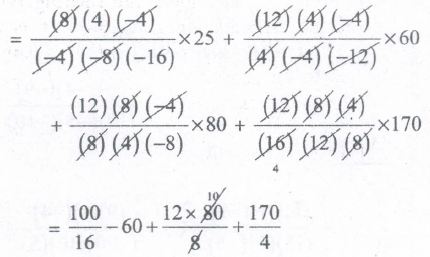
= 6.25 - 60 + 120 + 42.5
y = 108.75
8.
We will use Newton’s backward interpolation formula to find the polynomial.
\({ y }_{ \left( x={ x }_{ 0 }+nh \right) }={ y }_{ 0 }+\frac { n }{ n! } \Delta { y }_{ 0 }+\frac { n(n-1) }{ 2! } { \Delta }^{ 2 }{ y }_{ 0 }+\frac { n(n-)(n-2) }{ 3! } { \Delta }^{ 3 }{ y }_{ 0 }+..\)
| x | y | \(\Delta y\) | \(\Delta ^{ 2 }y\) | \(\Delta ^{ 3 }y\) |
| 0 | 1 | |||
| 1 | ||||
| 1 | 2 | 1 | ||
| 2 | 0 | |||
| 2 | 4 | 1 | ||
| 3 | 0 | |||
| 3 | 7 | 1 | ||
| 4 | 0 | |||
| 4 | 11 | 1 | ||
| 5 | 0 | |||
| 5 | 16 | 1 | ||
| 6 | 0 | |||
| 6 | 22 | 1 | ||
| 7 | ||||
| 7 | 29 |
To find y in terms of x
\(\therefore\) xn + nh = x, xn = 7, h = 1 \(\Rightarrow\) n = x − 7
\({ y }_{ (x) }=29+(x-7)(7)+\frac { (x-7)(x-6) }{ 2 } (1)\)
= \(29+7x-49+\frac { 1 }{ 2 } \left( { x }^{ 2 }-13x+42 \right) \)
= \(\frac { 1 }{ 2 } \left[ { x }^{ 2 }+x+2 \right] \)
9.
The auxiliary equation is m2 + m - 6 = 0
⇒ (m + 3) (m - 2) = 0
⇒ m = -3, 2
The roots are real and different.
∴ The complementary function CF is Ae-3x + Bex
Particular Integral
PI1=\(\frac { 1 }{ \phi (D) } \)f1(x)
=\(\frac { 1 }{ ({ D }^{ 2 }+D-6) } \)e3x
PI1=\(\frac { { e }^{ 3x } }{ (D+3)(D-2) } =\frac { { e }^{ 3x } }{ (3+3)(3-2) } \)
= \(\frac { { e }^{ 3x } }{ 6(1) } =\frac { e^{ 3x } }{ 6 } \)
PI2 = \(\frac { 1 }{ \phi (D0 } { f }_{ 2 }(x)=\frac { e^{ -3x } }{ (D+3)(D-2) } \)
= x\(\frac { { e }^{ -3x } }{ (-3-2) } \) [∵ when D = - 3, D + 3 = 0]
PI2 = \(-\frac { x }{ 5 } \)e-3x
∴ y = CF+PI1+PI2
∴ The general solution is
y = Ae-3x+Be2x+\(\frac { { e }^{ 3x } }{ 6 } -\frac { x }{ 5 } \)e-3x
10.
The given equation can be written as \(\frac { dy }{ dx } +\frac { 1 }{ { cos }^{ 2 }x } y=\frac { tanx }{ { cos }^{ 2 }x } \)
\(\frac { dy }{ dx } \) + y sec2x = tan x sec2x
It is of the form \(\frac{dy}{dx}\) + Py + Q
Here P = sec2x,Q = tanx sec2x
ഽPdx = ഽsec2 x dx = tanx
I.F = eഽpdx = etan x
The required solution is y(I.F) = ഽQ(I.F)dx + c
yetan x = ഽtan x sec2xetan xdx + c
Put tan x = t
Then sec2 xdx = dt
∴ yetan x = ഽtet dt + c
= ഽtd(et) + c
= tet − et + c
= tanx etan x−etan x+ c
yetan x = etan x(tan x − 1) + c
11.
Let I = ∫ ex(1+x) log(xex)dx
Put t = x ex
⇒ dt = (x.ex + ex(1))dx
= ex(x+1)dx
∴ I = ∫ log t.dt
Let u = log t; dv = dt
\(du=\frac { 1 }{ t } dt;v=t\)
∴Using integration by parts we get,
I = ∫udv = vu - ∫vdu
= t log t - ∫dt = t logt - t + c
= t log t - t + c
= xex log(xex) - (xex) + c [∵ t = xex]
= xex (log(xex)-1)+c
12.
Mean of the random variableX = E(X) = \({ \sum_x { x{ P }_{ x }(x) } } \)
= (1 × 0.15) + (2 × 0.10) + (3 × 0.10) + (4 × 0.01) + (5 × 0.08) + (6 × 0.01) +(7 × 0.05) + (8 × 0.02) + (9 × 0.28) + (10 × 0.20)
E(X) = 6.18
E(X2) = \(\sum _{ x }^{ }{ { x }^{ 2 } } { P }_{ X }(x)\)
= (12 × 0.15) + (22 × 0.10) + (32 × 0.10) + (42 × 0.01) + (52 × 0.08) + (62 × 0.01) + (72 × 0.05) + (82 × 0.02) + (92 × 0.28) + (102 × 0.20).
= 50.38
Variance of the Random Variagble X = V(X) = E(X2)-[E(X)]2
=50.38-(6.56)2
= 12.19
Therefore, the mean and variance of the given discrete distribution are 6.18 and 12.19 respectively.
13.
Given \( f(x)\begin{cases} { Ae }^{ -x/5 },\quad \text{for}\quad x\ge 0 \\ 0 \quad ,\quad \text{otherwise }\end{cases}\)
a) since f(x) is a p.d.f.,
\(\int _{ 0 }^{ \infty }{ { Ae }^{ \frac { -x }{ 5 } }dx=1\Rightarrow A.\frac { { \left[ { e }^{ \frac { -x }{ 5 } } \right] }_{ 0 }^{ \infty } }{ \frac { - }{ 5 } } =1 } \)
\(\Rightarrow -5A[{ e }^{ -\infty }-{ e }^{ 0 }]=1\)
\(\Rightarrow -5A[0-1]=1\quad [\because { e }^{ -\infty }=0\quad and\quad { e }^{ 0 }=1]\)
\(\Rightarrow 5A=1\Rightarrow A=\frac { 1 }{ 5 } \)
\(\therefore A=\frac { 1 }{ 5 } \)
b) i) Probability that the person will talk over the phone more than 10 minutes is P(X >10)
∴ P(X>10) =\(\\ \int _{ 10 }^{ \infty }{ \frac { 1 }{ 5 } { e }^{ \frac { -x }{ 5 } }dx } [\because A=\frac { 1 }{ 5 } ]\)
\(={ \frac { 1 }{ 5 } \left[ \frac { { e }^{ \frac { -x }{ 5 } } }{ \frac { -1 }{ 5 } } \right] }_{ 10 }^{ \infty }\)
\(=-\left[ { e }^{ -\infty }-{ e }^{ \frac { -10 }{ 5 } } \right] =-\left[ 0-{ e }^{ -2 } \right] \)
\(={ e }^{ -2 }=\frac { 1 }{ { e }^{ 2 } } \left[ \because { e }^{ -\infty }=0 \right] \)
ii) Probability that the person will take over the phone less that 5 minutes is P(X < 5)
\(\therefore P(X<5)=\int _{ 0 }^{ 5 }{ { e }^{ \frac { -x }{ 5 } }dx } [\because A=\frac { 1 }{ 5 } ]\)
\(=\frac { 1 }{ 5 } { \left[ \frac { { e }^{ \frac { -x }{ 4 } } }{ \frac { -1 }{ 5 } } \right] }_{ 0 }^{ 5 }=-{ e }^{ \frac { -5 }{ 5 } }{ -e }^{ 0 }\)
\(=-\left( { e }^{ -1 }-1 \right) \left[ \because { e }^{ 0 }=1 \right] \)
\(=1-{ e }^{ -1 }-\frac { 1 }{ e } =\frac { e-1 }{ e } \)
\(\therefore P(X<5)=\frac { e-1 }{ e } \)
iii) The probability that the person will take over the phone between 5 and 10 minutes is P(5 < X < 10)
\(=-\left[ { e }^{ \frac { -10 }{ 5 } }-{ e }^{ \frac { -5 }{ 5 } } \right] \)
\(=-\left[ { e }^{ -2 }-{ e }^{ -1 } \right] \)
\(={ e }^{ -1 }-{ e }^{ -2 }=\frac { 1 }{ e } -\frac { 1 }{ { e }^{ 2 } } \)
14.
We have F(x) = f(x) ≥ 0, where F(x) is the distribution function and f(x) is the probability density function.
Here F(x) = 0 for x ≤ 1 f(x) = 0 for x ≤ 1
Again F(x) = 1 for x > 3
f(x) = d/dx (1) = 0 for x > 3
In 1 < x ≤ 3, F(x) = k(x – 1)4
f(x) = d/dx (k(x – 1)4) = 4k(x – 1)3
\(\therefore f(x)=4k{ (x-1) }^{ 3 }for\quad 1\le x\le 3\)
i) Since f(x) is a probability density function,
\(\int _{ 1 }^{ 3 }{ f(x)dx=1 } \)
\(\Rightarrow \int _{ 1 }^{ 3 }{ { 4k(x-1) }^{ 3 }dx=1 } \)
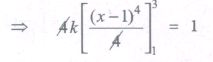
\(\Rightarrow k[{ (3-1) }^{ 4 }-{ (0) }^{ 4 }]=1\)
\(\Rightarrow k({ 2 }^{ 4 })=1\Rightarrow k(16)=1\)
\(\Rightarrow k=\frac { 1 }{ 16 } \)
ii) \(\therefore\)p.d.f
\(f(x)=\frac { 4\times 1 }{ 16 } { (x-1) }^{ 3 }for\quad 1\le x\le 3\)
\(f(x)=\frac { 1 }{ 4 } { (x-1) }^{ 3 }for\quad 1\le x\le 3\)
15.
Given marginal revenue function.
\(MR=\frac { DR }{ dx } =20{ e }^{ \frac { -x }{ 10 } }\left( 1-\frac { x }{ 10 } \right) \)
\(dR={ 20e }^{ \frac { -x }{ 10 } }\left( 1-\frac { x }{ 10 } \right) dx\)
\(R=\int { { 20e }^{ \frac { -x }{ 10 } } } \left( 1-\frac { x }{ 10 } \right) dx\)
We know that \(\int { { e }^{ ax }[af(x)+f'(x)]dx={ e }^{ ax }f(x) } +c\)
Here \(\\ a=\frac { -1 }{ 10 } ,f(x)=x,\quad f'(x)=1\)
\(R=20\int { { e }^{ \frac { -x }{ 10 } } } \left[ -\frac { 1 }{ 10 } x+1 \right] dx=20{ e }^{ \frac { -x }{ 10 } }x+k\)
\(\Rightarrow R=20{ e }^{ \frac { -x }{ 10 } }x+k\quad ...(1)\)
When x = 0, R = 0
0 = 0 + k ⇒ k = 0
(1) becomes
\(R=20x{ e }^{ \frac { -x }{ 10 } }\)
Demand function P
\(=\frac { R }{ x } =\frac { 20x{ e }^{ \frac { -x }{ 10 } } }{ x } \)
\(\Rightarrow P=20{ e }^{ \frac { -x }{ 10 } }\)
16.
(a) We know that
\(\int _{ -\infty }^{ \infty }{ f(x) } dx=1\)
\(\int _{ 0 }^{ 10 }{ Axdx } +\int _{ 10 }^{ 20 }{ A(20-x)dx=1 } \)
\(A\left\{ { \left[ \frac { { x }^{ 2 } }{ 2 } \right] }_{ 0 }^{ 10 }+{ \left[ 20x-\frac { { x }^{ 2 } }{ 2 } \right] }_{ 10 }^{ 20 } \right\} =1\)
A[(50-0)+(400-200)-(200-50)] = 1
\(A=\frac{1}{100}\)
(b) (i) The probability that the number of pounds of bread that will be sold tomorrow is more than 10 pounds is given by
\(P(10\le X\le 20)=\int _{ 10 }^{ 20 }{ \frac { 1 }{ 100 } (20-x) } dx\)
\(=\frac { 1 }{ 100 } { \left[ 20x-\frac { { x }^{ 2 } }{ 2 } \right] }_{ 10 }^{ 20 }\)
\(=\frac { 1 }{ 100 } [(400-200)-(200-50)]\)
= 0.5
(ii) The probability that the number of pounds of bread that will be sold tomorrow is less than 10 pounds, is given by
\(P(0\le X\le 20)=\int _{ 0 }^{ 10 }{ \frac { 1 }{ 100 } } xdx\)
\(=\frac { 1 }{ 100 } { \left[ \frac { { x }^{ 2 } }{ 2 } \right] }_{ 0 }^{ 10 }\)
\(=\frac { 1 }{ 100 } (50-0)\)
= 0.5
(ii) The probability that the number of pounds of bread that will be sold tomorrow is between 5 and 15 pounds is
\(P(5\le X \le15)=\int _{ 5 }^{ 10 }{ \frac { 1 }{ 100 } xdx } +\int _{ 10 }^{ 15 }{ \frac { 1 }{ 100 } (20-x)dx } \)
\(=\frac { 1 }{ 100 } { \left[ \frac { { x }^{ 2 } }{ 2 } \right] }_{ 5 }^{ 10 }+\frac { 1 }{ 100 } { \left[ 20x-\frac { { x }^{ 2 } }{ 2 } \right] }_{ 10 }^{ 15 }\)
= 0.75
17.
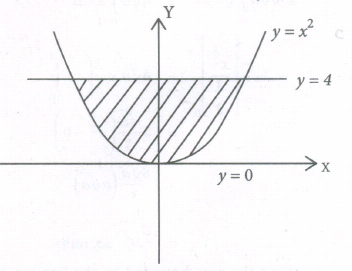
Since y = x2 is symmetric
about Y-axis, the required
Area = \(2\int _{ 0 }^{ 4 }{ x\quad dy } \)
When \(y={ x }^{ 2 }\Rightarrow x=\sqrt { y } \)
∴ Area \(=2\int _{ 0 }^{ 4 }{ \sqrt { y } dy } \)
\(=2\int _{ 0 }^{ 4 }{ { y }^{ \frac { 1 }{ 2 } }dy } \)
\(=2\times \frac { 2 }{ 2 } { \left[ { y }^{ \frac { 3 }{ 2 } } \right] }_{ 0 }^{ 4 }\)
\(=\frac { 4 }{ 3 } \left[ { 4 }^{ \frac { 3 }{ 2 } }-{ 0 }^{ \frac { 3 }{ 2 } } \right] \)
\(=\frac { 4 }{ 3 } \left[ { 4 }^{ \frac { 3 }{ 2 } } \right] \)
\(=\frac { 4 }{ 3 } \times { ({ 2 }^{ 2 }) }^{ \frac { 3 }{ 2 } }=\frac { 4 }{ 3 } \times { 2 }^{ 3 }\)
\(A=\frac { 4 }{ 3 } \times 8=\frac { 32 }{ 3 } \) sq.units
18.
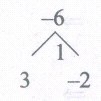
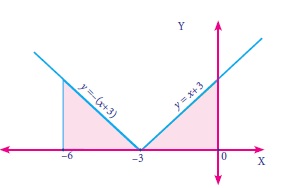
\(y=\left| x+3 \right| =\begin{cases} x+3\quad if\quad x\ge -3\quad \\ -(x+3)\quad if\quad x<-3 \end{cases}\)
Required area = \(\int _{ b }^{ a }{ y } dx=\int _{ -6 }^{ 0 }{ y } dx\)
= \(\int _{ -6 }^{ -3 }{y}\ dx+\int _{ -3 }^{ 0 }{ y} dx\)
= \(\int _{ -6 }^{ -3 }{ -(x+3) } dx+\int _{ -3 }^{ 0 }{ (x+3) } dx\)
= \(-{ \left[ \frac { { (x+3) }^{ 2 } }{ 2 } \right] }_{ -6 }^{ -3 }{ +\left[ \frac { { (x+3) }^{ 2 } }{ 2 } \right] }_{ -3 }^{ 0 }\)
\(=-\left[ 0-\frac { 9 }{ 2 } \right] +\left[ \frac { 9 }{ 2 } -0 \right] \)
= 9 sq. units
19.
\(\int { { \left( \log x \right) }^{ 2 } } dx= \int { udv } \)
= uv − \(\int { } \)vdu
= x (log x)2 − 2\(\int { } \) logxdx...(*)
\(=x(\log x)^{ 2 }-2\int { udv } \)
\(=x(\log x)^{ 2 }-2[uv-\int { udv } ]\)
\(=x(\log x)^{ 2 }-2[x \log x-\int { dx] } \)
\(=x(\log x)^{ 2 }-2x \log x+x+c\)
\(=x[(\log{ ) }^{ 2 }-\log{ x }^{ 2 }+2]+c\)
| For \(\int { } \)log x dx in (*) | |
| Take u = (log x) Differentiate \(du=\frac { 1 }{ x } dx\) | and dv = dx Integrate v = x |
20.
Given non-homogeneous equations are
2x + 3y - z = 5, 3x - y + 4z = 2, x + 7y - 6z = k
| Augmented matrix | Elementary Transformation |
|---|---|
| \(\left( \begin{matrix} 2 & 3 & -1 \\ 3 & -1 & 4 \\ 1 & 7 & -6 \end{matrix}\begin{matrix} 5 \\ 2 \\ k \end{matrix} \right) \) | |
| \(\left( \begin{matrix} 1 & 7 & -6 \\ 3 & -1 & 4 \\ 2 & 3 & -1 \end{matrix}\begin{matrix} k \\ 2 \\ 5 \end{matrix} \right) \) | \({ R }_{ 1 }\leftrightarrow { R }_{ 3 }\) |
| \(\left( \begin{matrix} 1 & 7 & -6 \\ 0 & -22 & 22 \\ 0 & -11 & 11 \end{matrix}\begin{matrix} k \\ 2-3k \\ 5-2k \end{matrix} \right) \) | \({ R }_{ 2 }\rightarrow { R }_{ 2 }-3{ R }_{ 1 }\) |
| \(\left( \begin{matrix} 1 & 7 & -6 \\ 0 & -22 & 22 \\ 0 & 0 & 0 \end{matrix}\begin{matrix} k \\ 2-3k \\ 2(5-2k)-(2-3k) \end{matrix} \right) \) | \({ R }_{ 2 }\rightarrow { R }_{ 2 }-3{ R }_{ 1 }\) \({ R }_{ 3 }\rightarrow { R }_{ 3 }-2{ R }_{ 1 }\) |
| \(\left( \begin{matrix} 1 & 7 & -6 \\ 0 & -22 & 22 \\ 0 & 0 & 0 \end{matrix}\begin{matrix} k \\ 2-3k \\ 10-4k-2+3k \end{matrix} \right) \) | \({ R }_{ 3 }\rightarrow 2{ R }_{ 3 }-{ R }_{ 2 }\) |
| \(\left( \begin{matrix} -1 & 7 & -6 \\ 0 & -22 & 22 \\ 0 & 0 & 0 \end{matrix}\begin{matrix} k \\ 2-3k \\ 8-k \end{matrix} \right) \) |
Here \(\rho (A)=2\)
Since the given system is consistent, \(\rho \)(A, B) must be equal to 2.
This can happen only when
8 - k = 0 \(\Rightarrow\) k = 8
21.
Transition probability matrix
(A B) T = (A B)
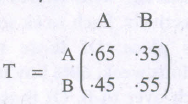
Where A represents the percent of people those who bought soap A and B represents the percent of people those who bought soap B.
By the given data
A = 15% = ·15
and B = 85% = ·85
Percentage after one year is
\(\left( \cdot 15\quad \cdot 85 \right) \left( \begin{matrix} \cdot 65 & \cdot 35 \\ \cdot 45 & \cdot 55 \end{matrix} \right) \)
= ((.15)(·65) + (·85)(-45) ·15(-35)+ ·85(-55))
= (-0975 + ·3825 ·0525 + -4675)
= (-48 ·52)
Hence, market share after one year is 48% and 52% At equilibrium,
\(\left( A\quad B \right) \left( \begin{matrix} \cdot 65 & \cdot 35 \\ \cdot 45 & \cdot 55 \end{matrix} \right) =(A\quad B)\)
(-65A + A5B ·35A +·55B) = (A B)
Equating the corresponding entries on both sides we get
\(\Rightarrow \cdot 65A+\cdot 45B=A\)
\(\Rightarrow \cdot 65A+\cdot 45(1-A)=A\)
[Since A+B = 1 B = 1-A]
\(\Rightarrow \cdot 65A+\cdot 45-\cdot 45A=A\)
\(\Rightarrow \cdot 45=A-\cdot 65A+\cdot 45A\)
\(\Rightarrow \cdot 45=A\left( \cdot 35+45 \right) \)
\(\Rightarrow \cdot 45=A(\cdot 35+45)\)
\(\Rightarrow \cdot 45=A(-8)\)
\(\Rightarrow A=\cfrac { \cdot 45 }{ \cdot 8 } =\cdot 5625=56.25\)
\(\therefore B=1-A=1-\cdot 5625=\cdot 4375\)
= 43.75%
\(\therefore\) Equilibrium is reached when A = 56.25% and B = 43.75%
22.
Let the amount of investment in each bond be
Rs. x, Rs. y, Rs. z respectively.
Given x + y + z = 5000 ..(1)
Also \(\cfrac { 6x }{ 100 } +\cfrac { 7y }{ 100 } +\cfrac { 8z }{ 100 } =358\)
∴ Interes \(= \cfrac { PNR }{ 100 } =\cfrac { x\times 1\times 6 }{ 100 } =\cfrac { 6x }{ 100 } \)
\(\Rightarrow \cfrac { 6x+7y+8z }{ 100 } =358\)
\(\Rightarrow 6x+7y++8z=35800\)
Given that \(\cfrac { 6x }{ 100 } +\cfrac { 7y }{ 100 } =70+\cfrac { 8z }{ 100 } \)
\(\Rightarrow 6x+7y=7008z\)
\(\Rightarrow 6x+7y-8z=7000\)
The matrix equation corresponding to the given system is
\(\left( \begin{matrix} 1 & 1 & 1 \\ 6 & 7 & 8 \\ 6 & 7 & -8 \end{matrix} \right) \left( \begin{matrix} x \\ y \\ z \end{matrix} \right) =\left( \begin{matrix} 5000 \\ 35800 \\ 7000 \end{matrix} \right) \)
| Augmented matrix [A,B] | Elementary Transformation |
|---|---|
| \(\left( \begin{matrix} 1 & 1 & 1 \\ 6 & 7 & 8 \\ 6 & 7 & -8 \end{matrix}\begin{matrix} 5000 \\ 35800 \\ 7000 \end{matrix} \right) \) | |
| \(\left( \begin{matrix} 1 & 1 & 1 \\ 0 & 1 & 2 \\ 0 & 1 & -14 \end{matrix}\begin{matrix} 5000 \\ 5800 \\ -2300 \end{matrix} \right) \) | \(\ { R }_{ 2 }\rightarrow { R }_{ 2 }-6{ R }_{ 1 }\) \({ { R }_{ 3 }\rightarrow { R }_{ 3 }-{ 6R }_{ 1 } }\) |
| \(\left( \begin{matrix} 1 & 1 & 1 \\ 0 & 1 & 2 \\ 0 & 0 & -16 \end{matrix}\begin{matrix} 5000 \\ 5800 \\ -28800 \end{matrix} \right) \) | \({ R }_{ 3 }\rightarrow { R }_{ 3 }-{ R }_{ 2 }\) |
The last equivalent matrix is in echelon form and ρ(A) = ρ([A,B]) = 3 = Number of unknowns
Thus, the given system is consistent with unique solution. To find the solution, let us rewrite the above echelon form into the matrix form
\(\left( \begin{matrix} 1 & 1 & 1 \\ 0 & 1 & 2 \\ 0 & 0 & -16 \end{matrix} \right) \left( \begin{matrix} x \\ y \\ z \end{matrix} \right) =\left( \begin{matrix} 5000 \\ 5800 \\ -28800 \end{matrix} \right) \)
\(\Rightarrow x+y+z=5000\) ...(1)
\(\Rightarrow y+2z=5800\) ..(2)
\(\Rightarrow -16z=-28800\) ...(3)
\((3)\Rightarrow -16z=-28800\)
\(\Rightarrow z=\cfrac { 28800 }{ -16 } =1800\)
Substituting z = 1800 in (2) we get,
y + 2(1800) = 5800
\(\Rightarrow\) y + 3600 = 5800
\(\Rightarrow\) y=5800-3600
\(\Rightarrow\) y = 2200
Substituting y = 2200 and z = 1800 in (1) we get
\(\Rightarrow\) x + 2200 + 1800 = 5000
\(\Rightarrow\)x + 4000 = 5000
\(\Rightarrow\)x = 5000 - 4000
\(\Rightarrow\)x = 1000
Hence, the amount of investment in each bond is Rs. 1000, Rs. 2200 and Rs. 1800 respectively
23.
The matrix equation corresponding to the given system is
\(\left( \begin{matrix} 1 & 1 & 1 \\ 1 & 2 & 3 \\ 1 & 2 & a \end{matrix} \right) \left( \begin{matrix} X \\ Y \\ Z \end{matrix} \right) =\left( \begin{matrix} 6 \\ 10 \\ b \end{matrix} \right) \)
AX = B
| Augmented matrix [A,B] | Elementary Transformation |
| \(\left( \begin{matrix} 1 & 1 & 1 \\ 1 & 2 & 3 \\ 1 & 2 & a \end{matrix}\begin{matrix} 6 \\ 10 \\ b \end{matrix} \right) \) \(\sim \left( \begin{matrix} 1 & 1 & 1 \\ 0 & 1 & 2 \\ 0 & 1 & a-1 \end{matrix}\begin{matrix} 6 \\ 4 \\ b-6 \end{matrix} \right) \) \(\sim \left( \begin{matrix} 1 & 1 & 1 \\ 0 & 1 & 2 \\ 0 & 0 & a-3 \end{matrix}\begin{matrix} 6 \\ 4 \\ b-10 \end{matrix} \right) \) |
\({ R }_{ 2 }\rightarrow { R }_{ 2 }-{ R }_{ 1 }\) \({ R }_{ 3 }\rightarrow { R }_{ 3 }-{ R }_{ 1 }\) |
Case (i) For no solution:
The system possesses no solution only when \(\rho (A)\neq ([A,B])\) which is possible only when a−3 = 0 and b −10 \(\neq \) 0.
Hence for a = 3, b \(\neq \) 10, the system possesses no solution.
Case (ii) For a unique solution:
The system possesses a unique solution only when \(\rho (A)= ([A,B])\)=number of unknowns.
i.e when \(\rho (A)=\rho ([A,B])\) = 3
Which is possible only when a−3 \(\neq \) 0 and b may be any real number as we can observe .
Hence for a \(\neq \) and b \(\in \) R, the system possesses a unique solution.
Case (iii) For an infinite number of solutions:
The system possesses an infinite number of solutions only when
\(\rho (A)=\rho ([A,B])\)
Hence for a = 3, b = 10, the system possesses infinite number of solutions.
24.
The matrix equation corresponding to the given system is
\(\left( \begin{matrix} 1 & -4 & 7 \\ 3 & 8 & -2 \\ 7 & -8 & 26 \end{matrix} \right) \left( \begin{matrix} X \\ Y \\ Z \end{matrix} \right) =\left( \begin{matrix} 14 \\ 13 \\ 5 \end{matrix} \right) \)
AX = B
| Augmented matrix [A,B] | Elementary Transformation |
| \(\left( \begin{matrix} 1 & -4 & 7 \\ 3 & 8 & -2 \\ 7 & -8 & 26 \end{matrix}\begin{matrix} 14 \\ 13 \\ 5 \end{matrix} \right) \) \(\sim \left( \begin{matrix} 1 & -4 & 7 \\ 0 & 20 & -23 \\ 0 & 20 & -23 \end{matrix}\begin{matrix} 14 \\ -29 \\ -93 \end{matrix} \right) \) \(\sim \left( \begin{matrix} 1 & -4 & 7 \\ 0 & 20 & -23 \\ 0 & 0 & 0 \end{matrix}\begin{matrix} 14 \\ -29 \\ 64 \end{matrix} \right) \) |
|
| \(\rho (A)=2,\rho ([A,B])=3\) |
The last equivalent matrix is in the echelon form. [A, B] has 3 non-zero rows and [A] has 2 non-zero rows.
\(\therefore \rho ([A,B])=3\),\(\rho (A)=2,\)
\(\rho (A)\neq ([A,B])\)
The system is inconsistent and has no solution.
25.
Given non-homogeneous equations are
x + y + z = 3
x + 2y + 3z = 4
x + 4y + 9z = 6
The matrix equation corresponding to the given system is
\(\left( \begin{matrix} 1 & 1 & 1 \\ 1 & 2 & 3 \\ 11 & 4 & 9 \end{matrix} \right) \left( \begin{matrix} x \\ y \\ z \end{matrix} \right) =\left( \begin{matrix} 3 \\ 4 \\ 6 \end{matrix} \right) \)
AX = B
| Augmented matrix | Elementary Transformation |
|---|---|
| \(\left( \begin{matrix} 1 & 1 & 1 \\ 1 & 2 & 3 \\ 1 & 4 & 9 \end{matrix}\begin{matrix} 3 \\ 4 \\ 6 \end{matrix} \right) \) | |
| \(\left( \begin{matrix} 1 & 1 & 1 \\ 0 & 1 & 2 \\ 0 & 3 & 8 \end{matrix}\begin{matrix} 3 \\ 1 \\ R \end{matrix} \right) \) | \({ R }_{ 2 }\rightarrow { R }_{ 2 }-{ R }_{ 1 }\) \({ R }_{ 3 }\rightarrow { R }_{ 3 }-{ R_{ 1 } }\) |
| \(\left( \begin{matrix} 1 & 1 & 1 \\ 0 & 1 & 2 \\ 0 & 0 & 2 \end{matrix}\begin{matrix} 3 \\ 1 \\ 0 \end{matrix} \right) \) | \({ R }_{ 3 }\rightarrow { R }_{ 3 }-{ R }_{ 2 }\) |
Clearly the last equivalent matrix is in echelon form and it has three non-zero rows
\(\therefore \rho (A)=3\quad \rho \left( \left[ A,B \right] \right) =3\)
\(\rho (A)=\rho \left( \left[ A,B \right] \right) =3\)
\(\therefore\) The given system is consistent and has unique solution.
To find the solution, let us rewrite the above echelon form into the matrix form
\(\left( \begin{matrix} 1 & 1 & 1 \\ 0 & 1 & 2 \\ 0 & 0 & 2 \end{matrix} \right) \left( \begin{matrix} x \\ y \\ z \end{matrix} \right) =\left( \begin{matrix} 3 \\ 1 \\ 0 \end{matrix} \right) \)
\(\Rightarrow\) x + y + z = 3
y + 2z = 1
\((3)\Rightarrow 2x=0\Rightarrow z=\cfrac { 0 }{ 2 } =0\)
\((2)\Rightarrow y+2(0)=1\Rightarrow y+0=1\Rightarrow y=1-0=1\)
\(\left( 1 \right) \Rightarrow x+1+0=3\)
\(\Rightarrow x+1=3\)
\(\Rightarrow x=3-1\)
\(\Rightarrow x=2\)
\(\therefore\) Solution set [2, 1, 0]

12th Standard Syllabus & Materials
12th Standard
TN 12th Computer Applications களப்பெயர் முறைமை (DNS) Sample Question Papers Study Material - QB365 Set A
NEW12th Standard
TN 12th Computer Applications வலையமைப்பு எடுத்துக்காட்டுகள் மற்றும் நெறிமுறைகள் Sample Question Papers Study Material - QB365 Set A
NEW12th Standard
TN 12th Computer Applications கணினி வலையமைப்பு ஓர் அறிமுகம் Sample Question Papers Study Material - QB365 Set A
NEW12th Standard
TN 12th Computer Applications PHP-உடன் MySQL-ஐ இணைத்தல் Sample Question Papers Study Material - QB365 Set A



Tamilnadu Stateboard 12th Standard Subjects

Maths

Chemistry

Physics

Biology

Computer Science
Business Maths and Statistics

Economics

Commerce

Accountancy

History

Computer Applications
Biology
Computer Technology
Computer Applications
Computer Science
Business Maths and Statistics
Commerce
Economics
Maths
Chemistry
Physics
Computer Technology
History
Accountancy

Tamil

English

French
Tamilnadu Stateboard Standards
