
 100% FREE ACCESS
12th Standard Syllabus & Materials
12th Standard
TN 12th Computer Applications மின்னணு தரவு பரிமாற்றம் Sample Question Papers Study Material - QB365 Set A
NEW12th Standard
TN 12th Computer Applications மின் - வணிக பாதுகாப்பு அமைப்புகள் Sample Question Papers Study Material - QB365 Set A
NEW12th Standard
TN 12th Computer Applications மின்னணு செலுத்தல் முறைகள் Sample Question Papers Study Material - QB365 Set A
NEW12th Standard
TN 12th Computer Applications மின் - வணிகம் Sample Question Papers Study Material - QB365 Set A
NEW12th Standard
TN 12th Computer Applications திறந்த மூல கருத்துருக்கள் Sample Question Papers Study Material - QB365 Set A
NEW12th Standard
TN 12th Computer Applications வலையமைப்பு வடமிடல் Sample Question Papers Study Material - QB365 Set A

Published on: 01/03/2021
12th Standard English Medium Business Maths Reduced Syllabus Creative Three Mark Question with Answerkey - 2021(Public Exam )
Download Tamil Nadu 12th Standard Business Maths and Statistics question papers, model tests, one-mark questions, important questions, and public exam papers in PDF format. Free study materials and answer keys for TN State Board students.
Questions + Answers key
Take MCQ Business Maths and Statistics Test
1.
From the data given below, construct a cost of living index number by family budget method for 1986 with 1976 as the base year.
| Commodity | P | Q | R | S | T | U |
| Quantity in 1976 | 50 | 25 | 10 | 20 | 30 | 40 |
| Price in 1976 (Rs) | 10 | 5 | 8 | 7 | 9 | 6 |
| Price in 1986 (Rs) | 6 | 4 | 3 | 8 | 10 | 12 |
2.
Fit a straight line trend for the following data using the method of least squares.
| x | 0 | 1 | 2 | 3 | 4 |
| y | 1 | 1 | 3 | 4 | 6 |
3.
The mean life time of 50 electric bulbs produced by a manufacturing company is estimated to be 825 hours with the S.D. of 110 hours. If II is the mean life time of all the bulbs produced by the company, test the hypothesis that μ = 900 hours at 5% level of significance.
4.
A random sample of 500 apples was taken from large consignment and 45 of them were found to be bad. Find the limits at which the bad apples lie at 99% confidence level.
5.
Alpha particles are emitted by a radio active source at an average rate of 5 in a 20 minutes interval. Using Poisson distribution find the probability that there will be atleast 2 emission in a particular 20 minutes interval (e-5 = 0.0067).
6.
Obtain K, μ and σ2 of of the normal distribution whose probability distribution function is f(x) = \(K{ e }^{ -2x^{ 2 }+4x-2 }\), -∞
7.
The standard deviation of a binomial distribution (q +p)16 is 2. Find its mean.
8.
An urn contains 4 white and 6 red balls. Four balls are drawn at random from the urn. Find the probability distribution of the number of white balls.
9.
Two cards are drawn from a pack of 52 playing cards. Find the probability distribution of the number of aces.
10.
If the probability density function of a random variable. X is given by f(x) = \(\frac{2x}{9}\),0
11.
A player tosses two unbiased coins. He wins Rs. 5 if two heads appear, Rs. 2 if one head appear and Rs.1 if no head appear. Find the expected amount to win.
12.
The probability distribution of a discrete random variable. X is given by
| X | -2 | 2 | 5 |
| P(X=x) | \(\frac{1}{4}\) | \(\frac{1}{4}\) | \(\frac{1}{2}\) |
then find 4E(X2)- Var (2X)
13.
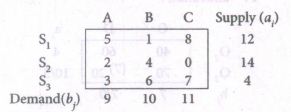
Find the initial basic feasible solution for the following transportation problem by Vogel's approximation method.
14.
A man plans to invest some amount in a small saving scheme with a guaranteed compound in crest compounded continuously at the ratio of 12 percent for 5 years. How much should he invest if he wants an amount of Rs. 25000 at the end of 5 year period? (e-0.6 = 0.5488)
15.
If f' (x) = 3x2 - \(\frac { 2 }{ { x }^{ 3 } } \) and f(1) = 0, find f(x)
16.
Show that the equation of the curve whose slope at any point is equal to y + 2x and which passes through the origin is y = 2(ex-x-1).
17.
Solve: cos2x dy + y.etanx dx = 0
18.
Form the differential equation for \(\frac { { x }^{ 2 } }{ { a }^{ 2 } } +\frac { { y }^{ 2 } }{ { b }^{ 2 } } \)=1 where a & b are arbitrary constants.
19.
If y75 = 2459, y50 = 2018, y85 = 1180, and y90 =402, find y82
| x | 75 | 80 | 85 | 90 |
| y | 2459 | 2018 | 1180 | 402 |
20.
Using graphic method, find the value of y when x=27.
| x | 10 | 15 | 20 | 25 | 30 |
| y | 35 | 32 | 29 | 26 | 23 |
21.
Find the area of the region bounded by the line x - y =1, x-axis and the lines x = -2 and x = 0.
x - y = 1
| x | 0 | 1 |
| y | -1 | 0 |
22.
Find the area under the demand curve xy = 1 bounded by the ordinates x = 3, x = 9 and x-axis
23.
Two products A and B currently share the market with shares 60% and 40% each respectively. Each week some brand switching latees place. Of those who bought A the previous week 70% buy it again whereas 30% switch over to B. Of those who bought B the previous week, 80% buy it again whereas 20% switch over to A. Find their shares after one week and after two weeks.
24.
Solve: 2x - 3y - 1 = 0, 5x + 2y - 12 = 0 by Cramer's rule.
25.
Show that the equations 2x - y + z = 7, 3x + y - 5z = 13, x + y + z = 5 are consistent and have a unique solution.
1.
| Commodity | Price | Quantity V | P = \(\frac {p_{1}}{p_{0}} \times 100\) | PV | |
| P0 | P1 | ||||
| P | 10 | 6 | 50 | 60 | 3000 |
| Q | 5 | 4 | 25 | 80 | 2000 |
| R | 8 | 3 | 10 | 37.5 | 375 |
| S | 7 | 8 | 20 | 114.29 | 2285.8 |
| T | 9 | 10 | 30 | 111.11 | 3333.3 |
| U | 6 | 12 | 40 | 200 | 8000 |
| 175 | 18994.1 | ||||
Cost ofliving index = \(\frac{\sum PV}{\sum V}\) = \(\frac {18994.1}{175}\) = 108.54
2.
| x | y | x2 | xy |
| 0 | 1 | 0 | 0 |
| 1 | 1 | 1 | 1 |
| 2 | 3 | 4 | 6 |
| 3 | 4 | 9 | 12 |
| 4 | 6 | 16 | 24 |
| 10 | 15 | 30 | 43 |
Let y= ax + b be the best line of fit.
The normal equations are
a\(\sum\)x + nb = \(\sum\)y
a\(\sum\)x2 + b\(\sum\)x = \(\sum\)xy
10a+ 5b = 15
⇒ 2a+b = 3 ...(1)
30a + 10b = 43
⇒ 3a+b = 4.3 ....(2)
(1)-(2) ⇒ - a = -1.3
⇒ a = 1.3
Substituting a = 1.3 in (1) we get,
2(1.3) + b = 3
⇒ 2.6 + b = 3
⇒ b = 3 - 2.6 = 0.4
∴ The line of best fit isy = 1.3x + 0.4
3.
Given sample size n = 50
Sample mean \(\bar { x }\) = 825
Population mean μ = 900
Population S.D. σ = 110
Null hypotheses: H0: μ = 900
Alternative hypotheses: H1: μ ≠ 900
The test statistic, z = \(\frac { \bar { x } -\mu }{ \frac { \sigma }{ \sqrt { n } } } \)
=\(\frac { 825-900 }{ \frac { 110 }{ \sqrt { 50 } } } \) = -4.82
∴ |z| = -4.82
As the significance level is α = 0.05, \(Z_{ \frac { \alpha }{ 2 } }\) = 1.96
Here |z| > \(Z_{ \frac { \alpha }{ 2 } }\) as 4.82 > 1.96
Inference: As |z| > \(Z_{ \frac { \alpha }{ 2 } }\), H0 is rejected. Hence, we can conclude that mean life time of the population of electric bulbs cannot be taken as 900 hours.
4.
Sample size n = 500
Proportion of bad apples in the sample
= \(\frac { 45 }{ 500 } \) = 0.09
p = 0.09
∴ q = 1 - p = 1-0.09 = 0.91
Standard error = \(\sqrt { \frac { pq }{ n } } =\sqrt { \frac { (.09)(.91) }{ 500 } } \)
= 0.0128
As the significance level is α = 0.001, \(Z_{ \frac { \alpha }{ 2 } }\) = 2.58
∴ The confidence limits for the population proportion of bad apples are given by
p-zα (S.E.) ≤ p ≤ p + zα (S.E.)
⇒ 0.09 - 2.58 (0.0128) ≤ p ≤ .09 + 2.58 (0.0128)
⇒ 0.09 - 0.033 ≤ p ≤ .09 + 0.033
⇒ 0.057 ≤ p ≤ 0.123
Thus, the bad apples in the consignment lie between (0.057, 0.123).
5.
Average rate of particles emitted in
20 minutes = 5
∴ λ = 5
Let X be the number of particles emitted in 20 minutes
∴ P(X = x) = \(\frac { { e }^{ -\lambda }.{ \lambda }^{ 0 } }{ x! } \), x = 0,1,2,....n
∴ P(X≥2) = 1-P(X<2)
= 1-[P(X = 0) + P(X = 1)]
= 1-\(\left[ \frac { e^{ -5 }.5^{ 0 } }{ 0! } +\frac { e^{ -5 }.5^{ 1 } }{ 1! } \right] \)
= 1-e-5 (1+5)
= 1-e-5(6)
= 1-(0.0067)(6)
= 1-0.0402
P(X ≥ 2) = 0.9598
6.
Consider -2x2 + 4x - 2 = -2(x2-2x+1)
= -2(x-1)2
∴ \({ e }^{ -2x^{ 2 }+4x-2 }=e^{ -2(x-1)^{ 2 } }\)
\({ e }^{ -\frac { 1 }{ 2 } \frac { (x-1)^{ 2 } }{ \frac { 1 }{ 4 } } }=e^{ -\frac { 1 }{ 2 } \left( \frac { x-1 }{ \frac { 1 }{ 2 } } \right) ^{ 2 } }\)
i.e \(K{ e }^{ -2x^{ 2 }+4x-2 }=\frac { 1 }{ \sigma \sqrt { 2\pi } } .e^{ -\frac { 1 }{ 2 } \left( \frac { x-\mu }{ \sigma } \right) }\)
⇒ \(Ke^{ -\frac { 1 }{ 2 } \left( \frac { x-1 }{ \frac { 1 }{ 2 } } \right) ^{ 2 } }=\frac { 1 }{ \sigma \sqrt { 2\pi } } .e^{ -\frac { 1 }{ 2 } \left( \frac { x-\mu }{ \sigma } \right) }\)
⇒ σ = \(\frac{1}{2}\), μ = 1 and K = \(\frac { 1 }{ \sigma \sqrt { 2\pi } } \)
⇒ K = \(\frac { 1 }{ \frac { 1 }{ 2 } .\sqrt { 2\pi } } \Rightarrow K=\sqrt { \frac { 2 }{ \pi } } \).
7.
Given n = 16, S.D = 2 ⇒ \(\sqrt { npq } \) =2
⇒ npq = 4
∴ 16(pq) = 4 ⇒ pq =\(\frac { 4 }{ 16 } =\frac { 1 }{ 4 } \)
⇒ q = \(\frac { 1 }{ 4p } \)...(1)
Since p + q = 1 ⇒ p+\(\frac { 1 }{ 4p } \)=1
⇒ \(\frac { 4{ p }^{ 2 }+1 }{ 4p } \) = 1
⇒ 4p2+1 = 4p ⇒ 4p2 -4p+1 = 0
⇒ (2p-1)2 = 0 ⇒ 2p-1 = 0
⇒ 2p = 1 ⇒ p = \(\frac { 1 }{ 2 } \)
∴ q = 1-p = \(1-\frac { 1 }{ 2 } =\frac { 1 }{ 2 } \)
Mean = np = 16 x \(\frac { 1 }{ 2 } \) = 8
8.
Let X denote the number of white balls drawn from the urn.
Since there are 4 white balls, X can take values 0,1,2,3,4.
P(X = 0)=p(gettmg no white balls)\(=\frac { { 6C }_{ 4 } }{ 10{ C }_{ 4 } } \)
\(\frac{1}{14}\)
P(X = 1) = P(getting one white ball and 3 red balls) \(\frac { { 4C }_{ 4 }\times { 6C }_{ 3 } }{ { 10 }C_{ 4 } } =\frac { 8 }{ 21 } \)
P(X = 2) = P(getting two white balls and 2 red balls) \(\frac { { 4C }_{ 2 }\times { 6C }_{ 2 } }{ { 10 }C_{ 4 } } =\frac { 8 }{ 21 } \)
P(X = 3) = P(getting 3 white balls and 1 red ball) \(\frac { { 4C }_{ 3 }\times { 6C }l }{ { 10 }C_{ 4 } } =\frac { 4 }{ 35 } \)
P(X = 4) = P(getting 4 white balls) =\(\frac { 4{ C }_{ 4 } }{ 10{ C }_{ 4 } } \)
=\(\frac{1}{210}\)
Thus the probability distribution of X is
| X | 0 | 1 | 2 | 3 | 4 |
| P(X) | \(\frac{1}{14}\) | \(\frac{8}{21}\) | \(\frac{6}{14}\) | \(\frac{4}{35}\) | \(\frac{1}{210}\) |
9.
Let X denote the number of aces in a pack of 52 playing cards.
Since there are 4 aces in a pack, and we are drawing 3 ace cards, X can take values 0, 1, 2, 3.
P(X = 0) = P(getting no ace card) \(\frac { 48{ C }_{ 3 } }{ 52{ C }_{ 3 } } \)
\(=\frac { 4324 }{ 5525 } \)
P(X=1) = P(getting one ace card and 2 other cards)
\(\\ =\frac { 4{ C }_{ 1 }\times 48{ C }_{ 2 } }{ 52{ C }_{ 3 } } =\frac { 1128 }{ 5525 } \)
P(X=2) = P(getting 2ace card and one other card)
\(=\frac { { 4C }_{ 2 }\times { 48C }_{ 1 } }{ 52{ C }_{ 3 } } =\frac { 72 }{ 5525 }\)
P(X=3) = P(getting 3 ace card) = \(\frac { { 4C }_{ 3 } }{ { 52C }_{ 3 } } \)
\(=\frac { 1 }{ 5525 } \)
Hence, the probability distribution function is
| X | 0 | 1 | 2 | 3 |
| P(X) | \(\frac{4324}{5525}\) | \(\frac{1128}{5525}\) | \(\frac{72}{5525}\) | \(\frac{1}{5525}\) |
10.
\(E(X)=\int _{ 0 }^{ 3 }{ x.f(x)dx=\int _{ 0 }^{ 3 }{ x\left( \frac { dx }{ 9 } \right) dx } } \)
\(=\frac { 2 }{ 9 } \int _{ 0 }^{ 3 }{ { x }^{ 2 }dx=\frac { 2 }{ 9 } .{ \left[ \frac { { x }^{ 3 } }{ 3 } \right] }_{ 0 }^{ 3 } } \)
\(=\frac { 2 }{ 27 } ({ 3 }^{ 3 }-0)=\frac { 2 }{ 27 } (27)=2\)
\(\therefore E(3X+8)=3.E(X)+8\quad [\because E(8)=8]\)
= 3(2) + 8 = 6 + 8
E(3X + 8) = 14
11.
When 2 coins are tossed, sample space S={HH, HT, TH, TT} ⇒ n(s) = 4
∴P(X = 5) = p(getting 2 heads) =\(\frac{1}{4}\)
P(X = 2) = p(getting 1 head) = \(\frac{2}{4}=\frac{1}{2}\)
P(X = 1) = p(getting no head) = \(\frac{1}{4}\)
Hence the probability distribution function is
| X | 1 | 2 | 5 |
| P(X=x) | \(\frac{1}{4}\) | \(\frac{1}{2}\) | \(\frac{1}{4}\) |
\(\therefore E(x)=\sum { { x }_{ i }{ p }_{ i }=1(\frac { 1 }{ 4 } ) } +2(\frac { 1 }{ 2 } )+5(\frac { 1 }{ 4 } )\)
\(=\frac { 1 }{ 4 } +1+\frac { 5 }{ 4 } =\frac { 1+4+5 }{ 4 } \)
\(=\frac { 10 }{ 4 } =2.50\)
Hence the expected money to win is Rs. 2.50
12.
\(E(X)=\sum { xp(x)=-2(\frac { 1 }{ 4 } ) } +2(\frac { 1 }{ 4 } )+5(\frac { 1 }{ 2 } )\)
\(=\frac { -2 }{ 4 } +\frac { 2 }{ 4 } +\frac { 5 }{ 2 } =\frac { 5 }{ 2 } \)
∴ 4E(X2)-V(2X)=4E(X2)-4.V(X)
=4E(X2)-4[E(X2)-E(X)2]
=4E(X2)-4E(X2)+4[E(X)]2
\(=4{ \left( \frac { 5 }{ 2 } \right) }^{ 2 }[\because E(X)=\frac { 5 }{ 2 } ]\)
\(=4\left( \frac { 25 }{ 4 } \right) =25\)
13.
Σai = 12 + 14 + 4 = 30
Σbj = 9 + 10 + 11 = 30
Σai = Σbj
∴ The given problem is a balanced transportation problem.
Hence, there exists a feasible solution to the given problem.
I - allocation :
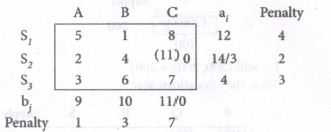
[∵ the highest penalty is 7, In C, least cost is 0 & min (11, 14) = 11]
II - allocation :
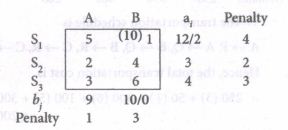
[∵ the highest penalty is 4, In S1'least cost is 1& min (10, 12) = 10]
III - allocation :
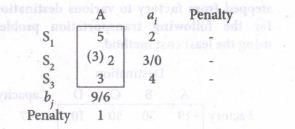
[∵ In A, least cost is 2 & min (9, 3) = 3]
IV - allocation :
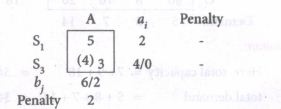
[∵ In A, least cost is 3 & min (6,4) = 4]
V - allocation :
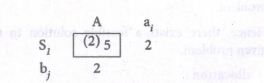
[∵ min (2, 2) = 2]
Thus, the allocations are
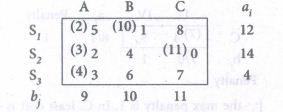
∴ The transportation schedule is
S1 → A, S1 → B, S2 → A, S2 → C S3 → A
Hence, the total transportation cost is
= 2(5) + 10(1) + 3(2) + 11(0) + 4(3)
= 10 + 10 + 6 + 0 + 12 = Rs. 38
14.
Let p(t) denotes the amount of money in the account at time t. Then the differential equation governing the growth of money is
\(\frac { dp }{ dt } =\frac { 12 }{ 100 } p\Rightarrow \frac { dp }{ dt } =0.12p\)
Separating the variables,
\(\frac { dp }{ dt } =0.12\)
Integrating, \(\int { \frac { dp }{ P } } =\int { 0.12 } \)dt+c
⇒ log p = 0.12t + C
⇒ P = e0.12t+c ⇒ P = e0.12t . ec
⇒ P = e0.12t.C1 .....(1)
When t = 0, p = 0 ⇒ p = e0 (c1) ⇒ c1 = p
When t = 5, and p = 25000
25000 = e12(5).p [∵ c1 = p]
⇒ 25000 = e0.6p
⇒ \(\frac { 2500 }{ { e }^{ 0.6 } } \) = p
⇒ 25000 (e-0.6) = p
⇒ 25000 (0.5488) = p
⇒ Rs. 13720
Hence, to get an amount of Rs. 25000 at the end of 5 years, Rs. 13720 must be invested.
15.
Given
f' (x) = 3x2 - \(\frac { 2 }{ { x }^{ 3 } } \)
We know f(x) = ∫ f'(x) dx
= \(\int { \left( { 3x }^{ 2 }-\frac { 2 }{ { x }^{ 3 } } \right) } \)
\(f\left( x \right) =3\left( \frac { { x }^{ 3 } }{ 3 } \right) -2\left( \frac { { -x }^{ -2 } }{ -2 } \right) +c\)
\(f\left( x \right) ={ x }^{ 3 }+\frac { 1 }{ { x }^{ 2 } } +c....(1)\)
Also, f(1) = 0
\(0={ 1 }^{ 3 }+\frac { 1 }{ { 1 }^{ 2 } } +c\)
= 1 + 1 + c
c = -2
\(\therefore f\left( x \right) ={ x }^{ 3 }+\frac { 1 }{ { x }^{ 2 } } -2\)
16.
Given slope = y + 2x
⇒ \(\frac { dy }{ dx } \) = y+2x
⇒ \(\frac { dy }{ dx } \)- y = 2x
This is of the form \(\frac { dy }{ dx } \)+ Py = Q where P = -1, Q = 2x
\(\\ \int { P } dx=\int { -1 } dx\) = -x
∴ I.F. = \(e^{ \int { P } dx }\) = e-x
∴ The solution is y.\(e^{ \int { P } dx }=\int { Q } .e^{ \int { P } dx }\)dx+C
⇒ y.e-x = \(\int { 2x } \).e-xdx+C
Let u = x; dv = e-x
u2 = 1; v = -e-x
v1 = e-x
⇒ ye-x = 2[-xe-x-1(e-x)]+C
[Bernoulli's formula]
⇒ ye-x = -2x e-x -2e-x+ C...(1)
Since the Curve passes through (0, 0), we get
⇒ 0 = 0-2e0 + C ⇒ C = 2
(1) becomes,
∴ ye-x = -2xe-x - 2e-x + 2
ye-x = -2xe-x - 2e-x + 2ex.e-x
= e-x(2 ex-2x-2)
ye-x = 2e-x(ex-x-1)
17.
Given cos2x dy + y.etanx dx=0
⇒ cos2x dy = -y etanx dx [∵ t = tanx, dt = sec2x dx, ∴ \(\int { { e }^{ t } } dt\) = etanx]
⇒ \(\frac { dy }{ y } =-\frac { { e }^{ tanx } }{ cos^{ 2 }x } \)dx
⇒ \(\frac { dy }{ y } \) = -sec2x.etanx dx
Integrating, \(\int { \frac { dy }{ y } } =-\int { sec^{ 2 }x } .e^{ tanx }dx\)
log y = -etanx + C
⇒ log y + etanx = C
18.
Given \(\frac { { x }^{ 2 } }{ { a }^{ 2 } } +\frac { { y }^{ 2 } }{ { b }^{ 2 } } \)= 1
⇒ \(\frac { { b }^{ 2 }x^{ 2 }+{ a }^{ 2 }{ y }^{ 2 } }{ { a }^{ 2 }{ y }^{ 2 } } \)= 1
⇒ b2x2+a2y2 = a2b2
Differentiating again w.r.t 'x' we get,
2b2x + 2a2y\(\frac { dy }{ dx } \)=0 ⇒ b2x+a2yy1 = 0 ....(2)
Differentiating w.r.t 'x' we get,
b2 + a2[yy2 + y1y1] = 0
⇒ b2 + a2[yy2 + y12] = 0 ...(3)
Eliminating a2 and b2 from (1) and (3) we get
\(\left| \begin{matrix} x & y{ y }_{ 1 } \\ 1 & { y }_{ 1 }^{ 2 }+y{ y }_{ 2 } \end{matrix} \right| \) = 0
⇒ x(y12+yy2) - yy1 = 0
⇒ x\(\left( \left( \frac { dy }{ dx } \right) ^{ 2 }+y.\frac { d^{ 2 }y }{ { dx }^{ 2 } } \right) -y\left( \frac { dy }{ dx } \right) \)= 0 which is the required differential equation.
19.
Since 82 lies at the beginning of the table, we can use Newton's forward interpolation formula
\(\Rightarrow { y }_{ o }+\frac { n }{ n! } \triangle { y }_{ o }+\frac { n(n+1) }{ 2! } { \triangle }^{ 2 }{ y }_{ o }+\frac { n(n+1)(n-2) }{ 3! } { \triangle }^{ 3 }{ (y }_{ o })\)
Also x0 + nh = 82 ⇒ 75 + n(5) = 82 ⇒ 5n = 82 - 75 = 7
⇒ n = \(\frac75\) = 1.4
The difference table is
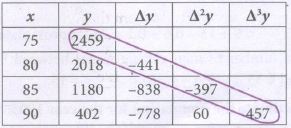
\(y=2459+\frac { 1.4 }{ 1! } (-441)+\frac { (1.4)(1.4-1) }{ 2! } (-397)+\frac { (1.4)(1.4-1)(1.4-2) }{ 3! } (457)\)
= 2459 - 617.4 - 111.6 - 25.592
y = 1704. 408 when x = 82.
20.
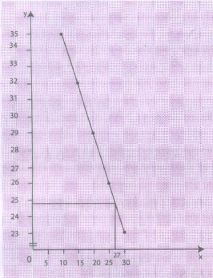
From the graph, it is clear that when x = 27, the value of y is 24.8
21.
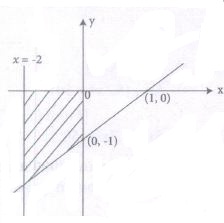
Here, the area lies below the x-axis
\(\therefore \ A=\int _{ -2 }^{ 0 }{ (-y)dx } =\int _{ 0 }^{ -2 }{ ydx } \)
\(\left[ \because \int _{ a }^{ b }{ f()dx } =-\int _{ b }^{ a }{ f(x)dx } \right] \)
\(={ \int _{ 0 }^{ -2 }{ (x-1)dx=\left[ \frac { { x }^{ 2 } }{ 2 } -x \right] } }_{ 0 }^{ -2 }\)
\(\left( \frac { { (-2) }^{ 2 } }{ 2 } -(2) \right) -0\)
\(=\frac { 4 }{ 2 } +2=2+2\)
A = 4 sq.units
22.
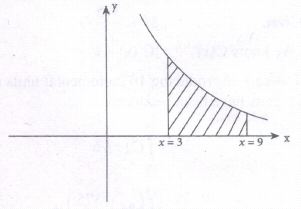
Area \(=\int _{ a }^{ b }{ ydx } \)
\(=\int _{ 3 }^{ 9 }{ \frac { 1 }{ x } dx } \)
\(={ [log\quad x] }_{ 3 }^{ 9 }\)
= log9-log3
\(=log\left( \frac { 9 }{ 3 } \right) \)
A = log 3 sq.units.
23.
Transition probability matrix
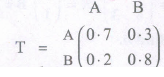
Shares after one week
\(\left( \cdot 6\cdot 4 \right) \left( \begin{matrix} \cdot 7 & \cdot 3 \\ \cdot 6 & \cdot 8 \end{matrix} \right) \)
= (-6\(\times\)·7+-4x·2 ·6\(\times\)·3+·4\(\times\)·8)
= z:(-42+·08 ·18+·32)= (·50 ·50)
\(\Rightarrow\) A = 50% and B = 50%
Shares after two weeks \(\left( \cdot 5\cdot 5 \right) \left( \begin{matrix} \cdot 7 & \cdot 3 \\ \cdot 2 & \cdot 8 \end{matrix} \right) \)
= (-5\(\times\)·7+·5\(\times\).2 ·5\(\times\)·3 +·5\(\times\)·8)
= (-35+·10 ·15 + 40) = (-45 ·55)
A = 45% and B = 55%
24.
The non-homogeneous equations are
2x - 3y - 1 = 0, 5x + 2y - 12 = 0
\(\Delta =\left| \begin{matrix} 2 & -3 \\ 5 & 2 \end{matrix} \right| =4+15=19\neq 0\)
Since \(\Delta \neq 0\) Cramer's rule can be applied and the system is consistent with unique solution.
\(\Delta x=\left| \begin{matrix} 1 & -3 \\ 12 & 2 \end{matrix} \right| =2+36=38\)
\(\Delta y=\left| \begin{matrix} 2 & 1 \\ 5 & 12 \end{matrix} \right| =24-5=19\)
\(x=\cfrac { \Delta x }{ \Delta } =\cfrac { 38 }{ 19 } =1\)
\(y=\cfrac { \Delta y }{ \Delta } =\cfrac { 19 }{ 19 } =1\)
\(\therefore \) Solution set is {2, 1}
25.
The non-homogeneous equation are
2x - y + z = 7, 3x + y - 5z = 13, x + y + z = 5
| Augmented matrix [A,B] |
Elementary Transformation |
|---|---|
| \(\left( \begin{matrix} 2 & -1 & 1 \\ 3 & 1 & -5 \\ 1 & 1 & 1 \end{matrix}\begin{matrix} 7 \\ 13 \\ 5 \end{matrix} \right) \) | |
| \(-\left( \begin{matrix} 1 & 1 & 1 \\ 3 & 1 & -5 \\ 2 & -1 & 1 \end{matrix}\begin{matrix} 5 \\ 13 \\ 7 \end{matrix} \right) \) | \({ R }_{ 1 }\leftrightarrow { R }_{ 3 }\) |
| \(\sim \left( \begin{matrix} 1 & 1 & 1 \\ 0 & -2 & -8 \\ 0 & -3 & -1 \end{matrix}\begin{matrix} 5 \\ -2 \\ -3 \end{matrix} \right) \) | \({ R }_{ 2 }\rightarrow { R }_{ 2 }-3{ R }_{ 1 }\) \({ R }_{ 3 }\rightarrow { R }_{ 3 }-2{ R }_{ 1 }\) |
| \(\sim \left( \begin{matrix} 1 & 1 & 1 \\ 0 & -2 & -8 \\ 0 & 0 & 11 \end{matrix}\begin{matrix} 5 \\ -2 \\ 0 \end{matrix} \right) \) | \({ R }_{ 3 }\rightarrow { R }_{ 3 }-\cfrac { 3 }{ 2 } { R }_{ 2 }\) |
Clearly \(\rho (A)=3\) and \(\rho (A,B)\) = 3 = Number of unknowns
\(\therefore\) The given system is consistent and has unique solution.

12th Standard Syllabus & Materials
12th Standard
TN 12th Computer Applications களப்பெயர் முறைமை (DNS) Sample Question Papers Study Material - QB365 Set A
NEW12th Standard
TN 12th Computer Applications வலையமைப்பு எடுத்துக்காட்டுகள் மற்றும் நெறிமுறைகள் Sample Question Papers Study Material - QB365 Set A
NEW12th Standard
TN 12th Computer Applications கணினி வலையமைப்பு ஓர் அறிமுகம் Sample Question Papers Study Material - QB365 Set A
NEW12th Standard
TN 12th Computer Applications PHP-உடன் MySQL-ஐ இணைத்தல் Sample Question Papers Study Material - QB365 Set A



Tamilnadu Stateboard 12th Standard Subjects

Maths

Chemistry

Physics

Biology

Computer Science
Business Maths and Statistics

Economics

Commerce

Accountancy

History

Computer Applications
Biology
Computer Technology
Computer Applications
Computer Science
Business Maths and Statistics
Commerce
Economics
Maths
Chemistry
Physics
Computer Technology
History
Accountancy

Tamil

English

French
Tamilnadu Stateboard Standards
