
 100% FREE ACCESS
12th Standard Syllabus & Materials
12th Standard
TN 12th Maths Applications of Matrices and Determinants Sample Question Papers Study Material - QB365 Set A
NEW12th Standard
TN 12th Computer Applications மின்னணு தரவு பரிமாற்றம் Sample Question Papers Study Material - QB365 Set A
NEW12th Standard
TN 12th Computer Applications மின் - வணிக பாதுகாப்பு அமைப்புகள் Sample Question Papers Study Material - QB365 Set A
NEW12th Standard
TN 12th Computer Applications மின்னணு செலுத்தல் முறைகள் Sample Question Papers Study Material - QB365 Set A
NEW12th Standard
TN 12th Computer Applications மின் - வணிகம் Sample Question Papers Study Material - QB365 Set A
NEW12th Standard
TN 12th Computer Applications திறந்த மூல கருத்துருக்கள் Sample Question Papers Study Material - QB365 Set A

Published on: 01/03/2021
12th Standard English Medium Business Maths Reduced Syllabus Creative Two Mark Question with Answerkey - 2021(Public Exam )
Download Tamil Nadu 12th Standard Business Maths and Statistics question papers, model tests, one-mark questions, important questions, and public exam papers in PDF format. Free study materials and answer keys for TN State Board students.
Questions + Answers key
Take MCQ Business Maths and Statistics Test
1.
The following data shows the value of sample mean (\(\bar{X}\)) and the range R for 10 samples of size 5 each. Calculate the control limits for : mean chart and range chart.
| Sample No. | 1 | 2 | 3 | 4 | 5 | 6 | 7 | 8 | 9 | 10 |
| Mean \(\bar{X}\) | 11.2 | 11.8 | 10.8 | 11.6 | 11.0 | 9.6 | 10.4 | 9.6 | 10.6 | 10.0 |
| Range | 7 | 4 | 8 | 5 | 7 | 4 | 8 | 4 | 7 | 9 |
(Given for n = 5, A2 = .577, D3 = 0, D4 = 2.115)
2.
Construct the cost of living index for 2003 on the basis of 2000 from the following data using family budget method.
| Item | Price(Rs.) | Weights | |
| Food | 2000 | 2003 | 30 |
| Rent | 200 | 280 | 30 |
| Clothing | 150 | 120 | 20 |
| Fuel & lighting | 50 | 100 | 10 |
| Miscellaneous | 100 | 200 | 20 |
3.
Calculate the seasonal indices by the method of simple average for the following data.
| Year | I quarter | II quarter | III quarter | IV quarter |
| 1985 | 68 | 62 | 61 | 63 |
| 1986 | 65 | 58 | 66 | 61 |
| 1987 | 68 | 63 | 63 | 67 |
4.
Using the method ofleast squares, fit a straight line trend for Σx = 10, Σy = 16.9, Σx2 = 30, Σxy = 47.4 and n = 7.
5.
The income distribution of the population of a village has a mean of Rs. 6000 and a variance of Rs. 32,400. Could a sample of 64 persons with a mean income of Rs. 5950 belong to this population. (Test at 1% level of significance).
6.
Out of 1500 school students, a sample of 150 selected to test the accuracy of solving a problem in B.M. and of them 10 did a mistake. Calculate the standard error of sample proportion.
7.
Out of 1000 T.V. viewers, 320 watched a particular programme. Calculate the standard error.
8.
The probability of the happening of an event X is 0.002 in an experiment. If an experiment is reported 1000 times, find the probability that the event X happens exactly twice? (e-2 = 0.1353)
9.
The random variable X has the normal distribution f(x) = \(C{ e }^{ -\left( \frac { x-100 }{ 50 } \right) ^{ 2 } }\), then find the value of C.
10.
In a packet of 50 pens, 10 are defective, 10 pens are selected at random. What is the probability that atleast one is defective.
11.
If 10 coins are tossed, find the probability that exactly 5 heads appears.
12.
Suppose X is a binomial variate X ~ B (5, p) and P(X = 2) = P(X = 3), then find p.
13.
If the mean of the binomial distribution is 20 and standard deviation is 4, then find the number of events.
14.
If the mean of the binomial distribution with 9 trial is 6, then find the variance.
15.
Find the mean for the probability density function \(f(x)=\begin{cases} \frac { 1 }{ 24 } ,-12\le x\le 12 \\ 0,\quad otherwise \end{cases}\)
16.
In a gambling game a man wins Rs. 10 if he gets all heads or all tails and loses Rs. 5 if he gets 1 or 2 heads when 3 coins are tossed once. Find his expectation of gain.
17.
In an entrance examination a student has to answer all the 120 questions. Each question has four options and only one option is correct. A student gets 1 mark for a correct answer and loses \(\frac{1}{2}\) mark for a wrong answer. What is the expectation of the mark scored by a student if he chooses the answer to each question at random?
18.
A continuous random variable. X has the p.d.f. defined by \(f(x)=\left\{\begin{array}{l} C e^{-a x}, \quad 0<x<\infty \\ 0, \quad \text { elsewhere } \end{array}\right.\) Find the value of C if a> 0
19.
Verify whether \(f(x)=\begin{cases} \frac { 2x }{ 9 } ,\quad 0\le x\le \\ 0,\quad elsewhere \end{cases}\) is a probability density function
20.
Two eggs are drawn at random without replacement from a bag containing two bad eggs and eight good eggs. Find the probability of getting two bad eggs?
21.
An unbiased die is rolled. If the random variable X is defined as
X(w) = {1, the outcome w is an even number
{0, if the outcome w is an odd number
Find the probability distribution of X.
22.
Determine whether the following is a probability distribution of a random variable X.
| X | 0 | 1 | 2 |
| P(X) | 0.6 | 0.1 | 0.2 |
23.
The following is the pay-off matrix (in rupees) for three strategies and three states of nature. Select a strategy using maximin principle.
24.
For the given pay-off matrix, find the optimal decision under the minimax principle.
25.
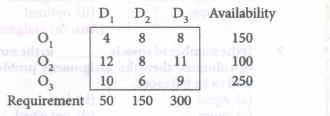
Determine an initial basic feasible solution to the following transportation problem using feast cost method.
26.
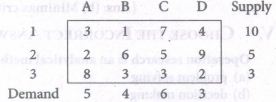
Obtain the initial solution for the following problem using north-west corner rule.
27.
If \(\int _{ 0 }^{ a }{ { 3x }^{ 2 } } dx=8\) find the value of a
28.
Evaluate \(\int { \frac { 2+3cosx }{ { sin }^{ 2 }x } } dx\)
29.
Evaluate ∫ tan2x dx
30.
Evaluate \(\int { { a }^{ 3{ log }_{ a }x } } dx\)
31.
Solve: (D2-6D+25)y = 0
32.
Solve: 3\(\frac { { d }^{ 2 }y }{ dx^{ 2 } } -5\frac { dy }{ dx } \)+ 2y = 0
33.
The change in the cost of ordering and holding C as quantity q is given by \(\frac { dC }{ dq } =a-\frac { c }{ q } \) where a is a Constanst. Find C as a function of q.
34.
Solve: \(\frac { dy }{ dx } \)+ ay = ex (where a ≠ -1)
35.
Solve: x dy +y dx = 0
36.
Form the differential equation of family of rectangular hyperbolas whose asymptotes are the Co-ordinate axes.
37.
Find the differential equation for y = mx + \(\frac { a }{ m } \) where m is arbitrary constant.
38.
Find the second order backward differences of f(x).
39.
Find the missing term from the following data
| x | 1 | 2 | 3 | 4 |
| f(x) | 100 | - | 126 | 157 |
40.
Find the producer's surplus for the supply function p = x2 + x + 3 when xo = 4
41.
Find the consumer's surplus for the demand function p = 25 - x -x2 when Po = 19
42.
The marginal cost function is MC = \(\frac{100}{x}\). Find the cost function C(x) if C(16) = 100.
43.
The marginal cost at a production level of x units is given by C '(x) = 85 +\(\frac{375}{x^2}\). Find the cost of producing 10 in elemental units after 15 units have been produced?
44.
If the marginal revenue for a commodity is MR = 9 - 6x2 + 2x, find the total revenue function.
45.
The marginal cost function of manufacturing x units of a commodity is 3x2 - 2x + 8. If there is no fixed cost, find the total cost function?
46.
Find the area under the curve y = 4x - x2 included between x = 0, x = 3 and the X-axis.
47.
Find the area of the region bounded by the parabola x2 = 4y, y = 2, y = 4 and the y-axis.
48.
For what value of x, the matrix
\(A=\left| \begin{matrix} 1 & -2 & 3 \\ 1 & 2 & 1 \\ x & 2 & -3 \end{matrix} \right| \) is singular?
49.
Solve: x + 2y = 3 and 2x + 4y = 6 using rank method.
50.
Find the rank of the matrix \(\left[ \begin{matrix} 7 & -1 \\ 2 & 1 \end{matrix} \right] \)
1.
\(\bar{\bar{X}}\) = \(\frac{11.2 + 11.8 + 10.8 + 11.6 + 11.0+ 9.6 + 10.4 + 9.6 + 10.6 + 10.0}{10}\)
\(=\frac{106.6}{10}=10.66\)
\(\bar{R}=\frac{7+4+8+5+7+4+8+4+7+9}{10}\)
\(=\frac{63}{10}=6.3\)
Control limits for mean chart
UCL = \(\bar{\bar{X}}\) + A2\(\bar{R}\)
= 10.66 + .577(6.3) = 14.295
CL = \(\bar{\bar{X}}\) = 10.66
Control limits for R-chart
UCL = D2\(\bar{R}\) = 2.115 \(\times\) 6.3
= 13.324
CL = \(\bar{R}\) = 6.3
LCL = D3\(\bar{R}\) = 0
2.
| Items | p0 | p1 | Weights V | \(P=\frac{p_1}{p_0}\times100\) | PV |
| Food | 200 | 280 | 30 | 140 | 4200 |
| Rent | 100 | 200 | 20 | 200 | 4000 |
| Clothing | 150 | 120 | 20 | 80 | 1600 |
| Fuel & Lighting | 50 | 100 | 10 | 200 | 2000 |
| Miscellaneous | 100 | 200 | 20 | 200 | 4000 |
| 100 | 15800 |
Cost of living index (C.L.I) = \(\frac{\Sigma PV}{\Sigma V}\)
= \(\frac{15800}{100}\) = 158
Hence, there is 58% increase in cost of living in 2003 compared to 2000.
3.
| Year | I quarter | II quarter | III quarter | IV quarter |
| 1985 | 68 | 62 | 61 | 63 |
| 1986 | 65 | 58 | 66 | 61 |
| 1987 | 68 | 63 | 63 | 67 |
| Total | 201 | 183 | 190 | 191 |
| Average | 67 | 61 | 63.33 | 63.67 |
Grand average = \(\frac{67 + 61 + 63.33 + 63.37}{4}\)
= \(\frac{255}{4}=63.75\)
Seasonal index (S.I) = \(\frac{Quarterly average}{Grand average}\times100\)
Hence, S.I for I quarter = \(\frac{67}{63.75}\times100\) = 105.01
S.I for II quarter = \(\frac{61}{63.75}\times100\) = 95.68
S.I for III quarter = \(\frac{63.33}{63.75}\times100\) = 99.35
S.I for IV quarter = \(\frac{63.67}{63.75}\times100\) = 99.87
4.
Let the straight line of best fit be y = ax + b.
The normal equations are
Σy = a Σx + nb
Σxy = a Σx2 + bΣx
⇒ 10a + 7b = 16.9 ....(1)
30a + 10b = 47.4.... (2)
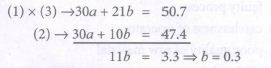
Substituting b = 0.3 in (2) we get
30a + 3 = 47.4 ⇒ 30a = 44.4
\(a=\frac{44.4}{30}=1.48\)
∴ The straight line trend is y = 1.48x + 0.3
5.
Given sample size n = 64
Sample mean \(\bar { x } \) = 5950
Population mean μ = 6000
Population variance σ2 = 32400
Population Standard deviation σ =\(\sqrt { 32400 } \) =180
Null hypothesis: H0: population mean μ = 6000 Alternative hypothese : H1: μ ≠ 6000
The test statistic, Z = \(\frac { \bar { x } -\mu }{ \frac { \sigma }{ \sqrt { n } } } \)
=\(\frac { 5950-6000 }{ \frac { 180 }{ \sqrt { 64 } } } =\frac { -50 }{ \frac { 180 }{ 8 } } \)
= -50\(\left( \frac { 8 }{ 180 } \right) \) = -2.2
|z| = 2.2
As the level of significance is α =0.001, \(Z_{ \frac { \alpha }{ 2 } }\) = 2.58 Here |z| < zα
Inference: Null hypotheses H0 is accepted.
Hence, we can conclude that the sample of 64 persons with a mean income of Rs.5950 belong to the population.
6.
Given population size N = 1500
Sample size n = 150
Sample proportion p =\(\frac { 10 }{ 150 } \)=0.07
∴ q = 1 - P = 1 - 0.07 = 0.93
Standard error of sample proportion =\(\sqrt { \frac { pq }{ n } } \)
=\(\sqrt { \frac { (0.07)(0.93) }{ 150 } } \)
S.E(p) = 0.02
7.
Sample size n = 1000
Sample proportion of T.V. viewers
p=\(\frac { 320 }{ 1000 } \)=0.32
∴ q = 1 - P = 1 - 0.32 =0.68
Standard error = \(\sqrt { \frac { pq }{ n } } =\sqrt { \frac { (.32)(.68) }{ 1000 } } \)
S.E = 0.0147
8.
Let p be the probability of happening of an event.
Given p = 0.002 = \(\frac { 2 }{ 1000 } \)
Also n = 1000
∴ Mean = np = \(1000\times \frac { 2 }{ 1000 } \) = 2
Hence, X follows Poisson distribution with
P(x,λ) = \(\frac { e^{ -\lambda }.{ \lambda }^{ 0 } }{ x! } \)
∴ P( event happens exactly twice)
= P(X = 2)
= \(\frac { e^{ -\lambda }.{ \lambda }^{ 2 } }{ 2! } =\frac { e^{ -2 }.{ (2 }^{ 2 }) }{ 2 } \)
= e-2(2) = 2(0.1353) = 0.2706
∴ P(X = 2) = 0.2706
9.
The probability function for the normal distribution is
f(x) = \(\frac { 1 }{ \sigma \sqrt { 2\pi } } e^{ -\frac { 1 }{ 2 } \left( \frac { x-\mu }{ \sigma } \right) ^{ 2 } }\), -∞
= \(C{ e }^{ -\frac { 1 }{ 2 } \left( \frac { x-100 }{ 25 } \right) ^{ 2 } }\)
= \(C{ e }^{ -\frac { 1 }{ 2 } \left( \frac { x-100 }{ 5 } \right) ^{ 2 } }\) ...(2)
Comparing (1) and (2), μ =100, σ = 5 and
C = \(\frac { 1 }{ \sigma \sqrt { 2\pi } } =\frac { 1 }{ 5\sqrt { 2\pi } } \)
∴ C = \(\frac { 1 }{ 5\sqrt { 2\pi } } \).
10.
Given n = 10
Probability of selecting a defective pen = p
= \(\frac { 10 }{ 50 } =\frac { 1 }{ 5 } \)
q = 1-p = \(1-\frac { 1 }{ 5 } =\frac { 4 }{ 5 } \)
∴ P(X = x) = nCx pxqn-x
P (at least one pen is defective)
= P(X≥1) = 1-P(X<1)
= 1-P(X = 0)
= 1-10C0 \(\left( \frac { 1 }{ 5 } \right) ^{ 0 }\left( \frac { 4 }{ 5 } \right) ^{ 10 }\)
= 1-\(\frac { { 4 }^{ 10 } }{ { 5 }^{ 10 } } \)
11.
Given n = 10, P(H) = \(\frac { 1 }{ 2 } \) ⇒ p =\(\frac { 1 }{ 2 } \)
q=1-p = \(1-\frac { 1 }{ 2 } =\frac { 1 }{ 2 } \)
P(X = x) = nCx pxqn-x
∴ P(X = 5) = 10C5 p5q5
= \(\frac { 10\times 9\times 8\times 7\times 6 }{ 5\times 4\times 3\times 2\times 1 } \left( \frac { 1 }{ 2 } \right) ^{ 5 }\left( \frac { 1 }{ 2 } \right) ^{ 10 }\)
= \(\frac { 6\times 7\times 6 }{ 2^{ 10 } } \)
= \(\frac { 2\times 3\times 7\times 2\times 3 }{ 2^{ 10 } } =\frac { 63 }{ { 2 }^{ 8 } } \)
= \(\frac { 63 }{ 256 } \).
12.
Since X is a binomial variate X ~ B (5, p)
n = 5 and P(X = x) = nCx px qn-x
Given P[X = 2] = P[X = 3]
⇒ 5C2 p2q3 = 5C3 p3q2
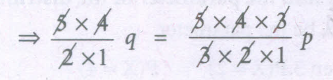
⇒ q=p
we know p+q = 1 ⇒ p+p =1
⇒ 2p = 1⇒ p =\(\frac { 1 }{ 2 } =\frac { 1 }{ 2 } \).
13.
Given mean 20 ⇒ np = 20
S.D = 4 ⇒ \(\sqrt { npq } \) = 4
∴ \(\frac { npq }{ np } =\frac { 16 }{ 20 } \Rightarrow q=\frac { 4 }{ 5 } \)
P = 1-q =\(1-\frac { 4 }{ 5 } =\frac { 1 }{ 5 } \)
Substitutingp and q in npq = 16, we get
\(n\times \frac { 1 }{ 5 } \times \frac { 4 }{ 5 } \) =16
n = \(\frac { 16\times 5\times 5 }{ 4 } \) = 100
∴ Number of events = 100
14.
Given n = 9 and mean = 6 ⇒ np = 6
9p = 6 ⇒ \(\frac { 6 }{ 9 } =\frac { 2 }{ 3 } \)
∴ q=1-p = \(1-\frac { 2 }{ 3 } =\frac { 1 }{ 3 } \)
Variance = npq = \(9\times \frac { 2 }{ 3 } \times \frac { 1 }{ 3 } \) = 2
15.
Mean = E(X)=\(\int _{ -\infty }^{ \infty }{ x.f(x)dx=\int _{ -12 }^{ 12 }{ x.\left( \frac { 1 }{ 24 } \right) } dx } \)
\(=\frac { 1 }{ 24 } \int _{ -12 }^{ 12 }{ x.dx } \)
\(=0[\because \int _{ -a }^{ a }{ f(x)dx=0 } when\ f(x)\ is\ an\ odd\ function]\)
\(\therefore E(X)=0\)
16.
Let X denote the amount
∴ X is a random variable. taking the values 10 and -5 when 3 coins are tossed, sample space S = {HHH, HHT, HTH, THH, HTT, THT, TTH,TTT}
∴ P(X = 10) = P (getting 3 heads or 3 tails)
\(=\frac { 2 }{ 8 } =\frac { 1 }{ 4 } \)
P(X = -5) = p(getting 1head or 2heads)
\(=\frac { 6 }{ 8 } =\frac { 3 }{ 4 } \)
∴ Probability distribution function is
| X | 10 | -5 |
| P(X = x) | \(\frac{1}{4}\) | \(\frac{3}{4}\) |
∴ Expected gain E(X) = Σxipi = 10(\(\frac{1}{4}\))-5(\(\frac{3}{4}\))
\(=\frac { 10 }{ 4 } -\frac { 15 }{ 4 } =-\frac { 5 }{ 4 } =-1.25\)
∴E(X) = -1.25 [A loss of Rs. 1.25]
17.
Let X be a random variable. That denote the mark obtained by a student for answering a question.
∴ X can take values 1 and -\(\frac{1}{2}\)
∴ P(X = 1) = P (answering a question correctly)
= \(\frac{1}{4}\)
P(X = -\(\frac{1}{2}\)) = P(answering a question wrongly)
=\(1-\frac{1}{4}=\frac{3}{4}\)
∴ Probability distribution function is
| X | 1 | -\(\frac{1}{2}\) |
| P(X) | \(\frac{1}{4}\) | \(\frac{3}{4}\) |
\(\therefore E(x)=\sum { xp(x)=1(\frac { 1 }{ 4 } )-\frac { 1 }{ 2 } \left( \frac { 3 }{ 4 } \right) =\frac { 1 }{ 4 } -\frac { 3 }{ 8 } } \)
\(=\frac { 2-3 }{ 8 } =-\frac { 1 }{ 8 } \)
∴ Expectation of mark for answering a single question is -\(\frac{1}{8}\)
∴ Expectation of mark for answering 120 questions = 120(-\(\frac{1}{8}\)) = -15.
18.
Since f(x) is a probability density function,
\(\int _{ -\infty }^{ \infty }{ f(x)dx=1 } \)
\(\Rightarrow \int _{ 0 }^{ \infty }{ { ce }^{ -ax }dx=1 } \Rightarrow C\int _{ 0 }^{ \infty }{ { e }^{ -ax }dx=1 } \)
\(\Rightarrow c{ \left[ \frac { { e }^{ -ax } }{ -a } \right] }_{ 0 }^{ \infty }=1\Rightarrow \frac { -c }{ a } [{ e }^{ -\infty }-{ e }^{ 0 }]\)
\(\Rightarrow \frac { -c }{ a } [0-1]=1\quad [\because { e }^{ -\infty }=0,{ e }^{ 0 }=1]\)
\(\Rightarrow \frac { c }{ a } =1\Rightarrow C=a\quad \therefore C=a\)
19.
Clearly f(x) ≥0 for all real values of x
\(\therefore \int _{ -\infty }^{ \infty }{ f(x)dx } =\int _{ 0 }^{ 3 }{ \frac { 2x }{ 9 } dx=\frac { 2 }{ 9 } \int _{ 0 }^{ 3 }{ xdx } } \)
\(=\frac { 2 }{ 9 } { \left[ \frac { { x }^{ 2 } }{ 2 } \right] }_{ 0 }^{ 3 }=\frac { 2 }{ 9 } \left[ \frac { 9 }{ 2 } -0 \right] =\frac { 2 }{ 9 } \times \frac { 9 }{ 2 } =1\)
∴ f(x) is a probability density function.
20.
A bag contains 2 bad eggs and 8 good eggs
∴ Total number of eggs = 10
We are going to select 3 eggs, out of that 2 must be bad eggs.
∴ Required probability \(=\frac { { 2C }_{ 2 }\times { 8C }_{ 1 } }{ 10{ C }_{ 3 } } =\frac { 1\times 8 }{ \frac { 10\times 9\times 8 }{ 3\times 2\times 1 } } \)
\(=\frac { 1\times 8\times 3\times 2\times 1 }{ 10\times 9\times 8 } =\frac { 1 }{ 15 } \)
∴ Probability of getting two bad eggs = \(\frac{1}{15}.\)
21.
When a die is rolled, sample space
S = {1, 2, 3, 4, 5, 6} ⇒ n(S) = 6
∴P(X = 0) = Probability of getting an odd number = \(\frac{3}{6}\)[∵ Their are 3 favourable events]
= \(\frac{1}{2}\)
Thus, the probability distribution of the random variable X is given by
| X | 0 | 1 |
| P(X) | \(\frac{1}{2}\) | \(\frac{1}{2}\) |
22.
P(X = 0) + P(X = 1) + P(X = 2)
= 0.6 + 0.1 + 0.2 = 0.9 ≠ 1
Hence the given distribution of probabilities is not a probability distribution.
23.
| Strategy | States of Nature | Minimum | ||
| S1 | S2 | S3 | ||
| d1 | 12 | 9 | 13 | 9 |
| d2 | 15 | 11 | 8 | 8 |
| d3 | 5 | 8 | 10 | 5 |
Max (9, 8, 5) = 9
∴ d1 is the best strategy using maximin principle.
24.
| Alternative | Economy | Maximum | ||
| Growing | Stable | Declining | ||
| Bonds | 40 | 45 | 5 | 45 |
| Stocks | 70 | 30 | -13 | 70 |
| Mutual Funds | 53 | 45 | -5 | 53 |
Min (45, 70, 53) = 45
∴ Choosing Bonds is the best decision under minimax principle.
25.
Here total availability = 150 + 100 + 250 = 500
total requirement = 50 + 150 + 300 = 500
∴ Total availability = total requirement
∴ The given problem is a balanced transportation problem
Hence, there exists a feasible solution to the given problem
I - allocation:
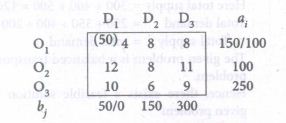
[∵ least cost is 4 & min (50,150) = 50]
II - allocation:
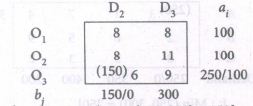
[∵ least cost is 6 & min (150, 250) = 150]
III - allocation:
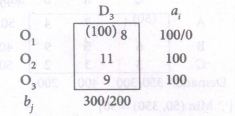
[∵ least cost is 8 & min (300, 100) = 100]
IV - allocation:
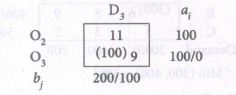
[∵ least cost is 9 & min (200,100) = 100]
V - allocation:
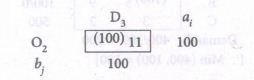
[∵ min (100, 100) = 100]
Thus, the allocations are
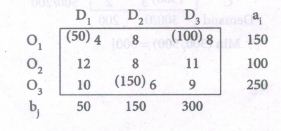
∴ The transportation schedule is
O1 → D1, O1 → D3, O2 → D3, O3 → D2, O3 → D3
Hence, the total transportation cost is
= 50(4) + 100(8) + 100(11) + 150(6) + 100(9)
= 200 + 800 + 1100 + 900 + 900
= Rs. 3900
26.
Here, total supply = 10 + 5 + 3 = 18
total demand = 5 + 4 + 6 + 3 = 18
∴ Total supply = total demand
∴ The given problem is a balanced transportation problem.
∴ We can find an initial basic feasible solution to the given problem.
I - allocation:
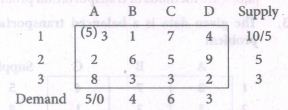
[∵ min (5, 10) = 5]
II - allocation:
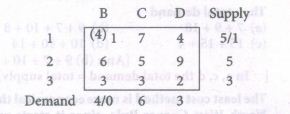
[∵ min (4, 5) = 4]
III - allocation:
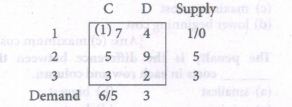
[∵ min (1, 6) = 1]
IV - allocation:
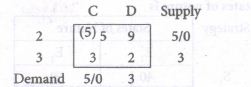
[∵ min (5, 5) = 5]
V - allocation:
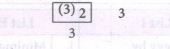
[∵ min (3, 3) = 3]
Thus, the allocations are
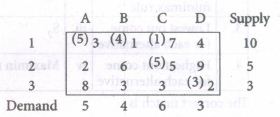
∴ The transportation schedule is
1 → A, 1 → B, 1 → C, 2 → C, 3 → D
Hence, the total transportation cost
= 5(3) + 4(1) + 1(7) + 5(5) + 3(2)
= 15 + 4 + 7 + 25 + 6 = Rs. 57
27.
Given \(\int _{ 0 }^{ a }{ { 3x }^{ 2 } } dx=8\)
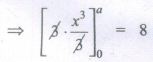
⇒ \({ \left[ { x }^{ 3 } \right] }_{ 0 }^{ a }=8\)
⇒ a3 - 0 = 8
⇒ a3 = 8
⇒ a3 = 23
⇒ a = 2
∴ a = 2
28.
\(\int { \frac { 2+3cosx }{ { sin }^{ 2 }x } } dx\) = \(\int { \frac { 2 }{ { sin }^{ 2 }x } } dx\) + \(\int { \frac { 3cosx }{ { sin }^{ 2 }x } } dx\)
= 2 \(\int { \frac { 1 }{ { sin }^{ 2 }x } } dx\) + 3 \(\int { \frac { cosx }{ { sin }x } .\frac { 1 }{ sinx } } dx\)
= 2 ∫ cosec2 x dx + 3 ∫ cot x cosec x dx
= -2 cot x - 3 cosec x + c
29.
∫ tan2x dx = ∫ (sec2 x-1) dx
[∵ 1 + tan2 x = sec2 x]
= ∫ sec2x dx - ∫ 1 dx
= tan x - x +c.
30.
We know that logax = x
∴ ∫ a3logax dx = ∫ alogax3 dx = ∫ x3 dx
= \(\frac { { x }^{ 4 } }{ 4 } +c\)
31.
The auxiliary equation is m2 - 6m + 25 = 0
Here a = 1, b = -6, c = 25
∴ m = \(\frac { -b\pm \sqrt { { b }^{ 2 }-4ac } }{ 2a } =\frac { 6\pm \sqrt { 36-4(1)(25) } }{ 2 } \)
= \(\frac { 6\pm \sqrt { 36-100 } }{ 2 } =\frac { 6\pm \sqrt { -64 } }{ 2 } =\frac { 6\pm 8i }{ 2 }\)

= 3 ± 4i
∴ α = 3, β = 4
Complementary function CF is eax
[A cosβx + B sinβx]
⇒ CF = e3x[A cos4x + B sn4x]
∴ The general solution is e3x
[A cos4x + B sin4x]
32.
The auxiliary equation is 3m2 - 5m + 2 = 0
⇒ (m - 1)(3m - 2) = 0
⇒ m = 1, \(\frac { 2 }{ 3 } \)
The roots are real and different
∴ Complementary function CF is Aex + \({ Be }^{ \frac { 2 }{ 3 } x }\)
∴ The general solution is y = Aex + \({ Be }^{ \frac { 2 }{ 3 } x }\).
33.
Given \(\frac { dC }{ dq } =a-\frac { c }{ q } \)
⇒ \(\frac { dC }{ dq } +\frac { C }{ q } \) = a
The given differential equation is of the form
\(\frac { dC }{ dq } \)+PC = Q where
P = \(\frac { 1 }{ q } \) and Q = a
\(\int { p } dq=\int { \frac { 1 }{ q } } \)
Integrating factor I.F = elog q =q
∴ The solution is C y\(e^{ \int { P } dq }=\int { Q } e^{ \int { P } dq }\)+C
⇒ C(q) = \(\int { a } .qdq+C\)
⇒ C.q = a\(\left( \frac { { q }^{ 2 } }{ 2 } \right) \)+C
⇒ 2Cq = aq2 + K where K = 2C.
34.
The given equation is of the form \(\frac { dy }{ dx } \)+ py = Q
where P = a and Q = ex
\(\int { P } dx=\int { a } dx\) = ax
Integrating factor (L.F.) = \(e^{ \int { P } dx }\) = eax
∴ The solution is y \(e^{ \int { P } dx }=\int { Q } e^{ \int { P } dx }dx\)+C
⇒ y.eax =\(\int { { e }^{ x }.{ e }^{ ax } } dx+C\)
⇒ y.eax = \(\int { e^{ (a+1)x }dx+C } \)
⇒ y.eax = \(\frac { { e }^{ (a+1)x } }{ a+1 } \)+C
35.
x dy = -y dx
Separating the variables we get
\(\frac { dy }{ y } =-\frac { dx }{ x } \)
Integrating, \(\int { \frac { dy }{ y } } =-\int { \frac { dx }{ x } } \)
⇒ log y = -log x + log C
⇒ log y = log\(\left( \frac { C }{ x } \right) \Rightarrow y=\frac { C }{ x } \) ⇒ xy = C.
36.
Equation of family of rectangular hyperbolas whose asymptotes are the Co-ordinate axis is
xy - c2
Differentiating w.r.t. 'x' we get,
x.\(\frac { dy }{ dx } \)+y(1) = 0
⇒ x\(\left( \frac { dy }{ dx } \right) \)+y(1) = 0 which is the required differential equation.
37.
Given y = mx + \(\frac { a }{ m } \) ...(1)
Differentiating w.r.t. 'x' we get,
\(\frac { dy }{ dx } \) = m(1)+0 ⇒ m = \(\frac { dy }{ dx } \) ...(2)
Substituting (2) in (1) we get,
y = \(\left( \frac { dy }{ dx } \right) x+\frac { a }{ \frac { dy }{ dx } } \Rightarrow y=\frac { \left( \frac { dy }{ dx } \right) ^{ 2 }x+a }{ \left( \frac { dy }{ dx } \right) } \)
⇒ y\(\left( \frac { dy }{ dx } \right) =x\left( \frac { dy }{ dx } \right) ^{ 2 }\)+ a which is the required differential equation.
38.
We know f(x), ∇f(x + h), ∇f(x + 2h),... are the first order differences of f(x).
= f(x) - 2f(x - h) + f(x - 2h)
Consider ∇2f(x) = ∇[∇f(x))]
= ∇[f(x) - f(x - h)]
= ∇ f(X) - ∇ f(x - h)
= [f(x) - f(x - h)] - [f(x - h) - f(x - 2h)]
= f(x) - f(x - h) - f(x - h) - f(x - 2h)
∴ ∇2 f(x), ∇2 f(x + h), ∇2 f(x + 2h) ... are the second order differences of f(x).
39.
Since three values of f(x) are given, we assume that the polynomial is of degree two.
⇒ Δ3(f(x0)) = 0
⇒ ∆3(yo) = 0
⇒ (E - 1)3 yo= 0
⇒ (E3 - 3E2 + 3E - 1) yo= 0
⇒ y3- 3y2+ 3y1 - yo= 0
⇒ 157 - 3 (126) + 3y1 - 100 = 0
⇒ y1 = 107
∴ The missing term is 107.
40.
Given supply function is P = x + x + 3 and Xo = 4
∴ Po = 42 + 4 + 3
= 16+ 4 + 3 = 23
∴ p0x0 = 23(4) = 92
Producer's surplus
\(PS={ p }_{ 0 }{ x }_{ 0 }-\int _{ 0 }^{ x0 }{ g(x)dx } \)
\(=92-\int _{ 0 }^{ 4 }{ \left( { x }^{ 2 }+x+3 \right) dx } \)
\(=92-{ \left( \frac { { x }^{ 3 } }{ 3 } +\frac { { x }^{ 2 } }{ 2 } +3x \right) }_{ 0 }^{ 4 }\)
\(=92-\left( \frac { { 4 }^{ 3 } }{ 3 } +\frac { { 4 }^{ 2 } }{ 2 } +3(4) \right) \)
\(=92-\left( \frac { 64 }{ 3 } +8+12 \right) \)
\(=92-\frac { 64 }{ 3 } -20=72-\frac { 64 }{ 3 } \)
\(=\frac { 216-64 }{ 3 } \)
\(PS=\frac { 152 }{ 3 } \) units
41.
Given demand function is p = 25 - x - X2
and p0 = 19
⇒ 19 = 25-x-x2
⇒ x2 + x - 6 = 0
⇒ (x + 3) (x - 2) = 0
⇒ x = -3 or x = 2
Since x cannot be negative xo = 2
po xo = 19(2) = 38
\(CS=\int _{ 0 }^{ 2 }{ f(x)dx-{ p }_{ 0 }{ x }_{ 0 } } \)
\(=\int _{ 0 }^{ 2 }{ \left( 25-x-{ x }^{ 2 } \right) dx-38 } \)
\(={ \left( 25x-\frac { { x }^{ 2 } }{ 2 } -\frac { { x }^{ 3 } }{ 3 } \right) }_{ 0 }^{ 2 }-38\)
\(=25(2)-\frac { 4 }{ 2 } -\frac { 8 }{ 3 } -38\)
\(=50-2-\frac { 8 }{ 3 } -38\)
\(=10-\frac { 8 }{ 3 } =\frac { 30-8 }{ 3 } \)
\(CS=\frac { 22 }{ 3 } \) units
42.
Given \(MC=\frac { 100 }{ x } \)
\(\\ \int { MC } =\int { \frac { 100 }{ x } } \)
⇒ C = 100 log x + k
Given C(16) =100 ⇒ When x = 16,
C = 100
∴ 100 = 100 log 16 + k
⇒ k = 100-100 log 16
C = 100 log x + 100 - 100 log 16
= 100 (log x - log16 + 1)
\(C=100(log\left( \frac { x }{ 16 } \right) +1)\)
43.
Given C'(x) = 85 + \(\frac{375}{x^2}\).
We know C(x) ഽC'(x) + k
The cost of producing 10 incremental units after 15 units have been produced
\(C'(x)=85+\frac { 375 }{ { x }^{ 2 } } \)
\(C(x)=\int { C'(x) } dx\)
\(\int _{ 15 }^{ 25 }{ C'(x) } dx\)
\(\int _{ 15 }^{ 25 }{ \left( 85+\frac { 375 }{ { x }^{ 2 } } \right) } dx\)
\({ \left[ 85+\frac { 375 }{ { x } } \right] }_{ 15 }^{ 25 }\)
\(\left( 85(25)-\frac { 375 }{ 25 } \right) -\left( 85(15)-\frac { 375 }{ 15 } \right) \)
= (2125 - 15) - (1275 - 25)
= 2110 - 1250 = Rs. 860
44.
Given MR = 9 - 6x2 + 2x
⇒ഽMR=ഽ(9 - 6x2 + 2x)sx
\(\Rightarrow R=9x-\frac { { 6x }^{ 3 } }{ 3 } +\frac { { 2x }^{ 2 } }{ 2 } +k\)
⇒ R = 9x - 2x3 + x2 + k
When x = 0, R = 0 ⇒ k = 0
∴ R = 9x - 2x3 + x2
45.
Given MC = 3x2 - 2x + 8
⇒ ഽMC = ഽ(3x2 - 2x + 8)dx
\(\Rightarrow C=\frac { { 3x }^{ 3 } }{ 3 } -\frac { { 2x }^{ 2 } }{ 2 } +8x+k\)
⇒ C = x3 - x2 + 8x + k
Since there is no fixed cost,
when x = 0, C = 0 ⇒ k = 0
∴ C = x3 - x2 + 8x
46.
Given curve is y = 4x - X2
The limits are from x = 0 to x = 3
∴ Area \(\int _{ 0 }^{ 3 }{ y } dx=\int _{ 0 }^{ 3 }{ (4x-{ x }^{ 2 }) } dx\)
\({ \left[ \frac { 4{ x }^{ 2 } }{ 2 } -\frac { { x }^{ 3 } }{ 3 } \right] }_{ 0 }^{ 3 }=2(9)-\frac { 27 }{ 3 } \)
=18 - 9
Area = 9 sq.units
47.
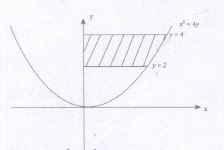
Area under the curve is
\(A=\int _{ c }^{ d }{ xdy } =\int _{ 2 }^{ 4 }{ \sqrt { 4y } dy } \)
\(=2\int _{ 2 }^{ 4 }{ { y }^{ \frac { 1 }{ 2 } }dy } =2{ \left( \frac { { y }^{ \frac { 3 }{ 2 } } }{ \frac { 3 }{ 2 } } \right) }_{ 2 }^{ 4 }\)
\(=\frac { 4 }{ 3 } \left( { y }^{ \frac { 3 }{ 2 } } \right) \)
\(=\frac { 4 }{ 3 } \left( { 4 }^{ \frac { 3 }{ 2 } }-{ 2 }^{ \frac { 3 }{ 2 } } \right) \)
\(=\frac { 4 }{ 3 } \left( 4\sqrt { 4 } -2\sqrt { 2 } \right) \)
\(=\frac { 4 }{ 3 } (8-2\sqrt { 2 } )\)sq.units
48.
The matrix A is singular, if
\(\left| \begin{matrix} 1 & -2 & 3 \\ 1 & 2 & 1 \\ x & 2 & -3 \end{matrix} \right| =0\)
\(1\left| \begin{matrix} 2 & 1 \\ 2 & -3 \end{matrix} \right| +2\left| \begin{matrix} 1 & 1 \\ x & -3 \end{matrix} \right| +3\left| \begin{matrix} 1 & 2 \\ x & 2 \end{matrix} \right| =0\)
\(\Rightarrow\) (-8) -6 - 2x + 6 - 6x = 0
\(\Rightarrow\) -8-2x-6x = 0
\(\Rightarrow\) -8-8x = 0
\(\Rightarrow\) -8 = 8x
\(\Rightarrow\) \(x=\cfrac { -8 }{ 8 } =-1\)
49.
The non-homogeneous equations are
x + 2y = 3, 2x + 4y = 6
| Augmented matrix [A, b] | Elementary Transformation |
| \(\left( \begin{matrix} 1 & 2 & 3 \\ 2 & 4 & 6 \end{matrix} \right) \) | |
| \(-\left( \begin{matrix} 1 & 2 & 3 \\ 0 & 0 & 0 \end{matrix} \right) \) | \({ R }_{ 2 }\rightarrow { R }_{ 2 }-2{ R }_{ 1 }\) |
Here \(\rho (A)=1\) and \(\rho \left( \left[ A,B \right] \right) =1\)
Since \(\rho (A)=\rho \left[ \left( A,B \right) \right] =1<\) Number of unknowns, the given system is consistent with infinitely many solutions.
To find the solution, let us rewrite the above echelon form into the matrix form, we get
\(\left( \begin{matrix} 1 & 2 \\ 0 & 0 \end{matrix} \right) \left( \begin{matrix} x \\ y \end{matrix} \right) =\left( \begin{matrix} 3 \\ 0 \end{matrix} \right) \)
\(\Rightarrow x+2y=3\)
let \(y=k,k\varepsilon R\)
\((1)\Rightarrow x+2k=3\Rightarrow x=3-2k\)
\(\therefore\) Solution set is \(\left\{ 3-2k,k \right\} ,k\epsilon R\)
For different values of k; we get infinite number of solutions
50.
Let \(A=\left[ \begin{matrix} 7 & -1 \\ 2 & 1 \end{matrix} \right] \)
The order of A is 2 x 2
\(\rho (A)\le min(2,2)\)
\(\left[ \begin{matrix} 7 & -1 \\ 2 & 1 \end{matrix} \right] =7-(-2)=7+29\neq 0\)
The highest order of non-vanishing minor of A is 2
\(\therefore \rho (A)=2\)

12th Standard Syllabus & Materials
12th Standard
TN 12th Computer Applications வலையமைப்பு வடமிடல் Sample Question Papers Study Material - QB365 Set A
NEW12th Standard
TN 12th Computer Applications களப்பெயர் முறைமை (DNS) Sample Question Papers Study Material - QB365 Set A
NEW12th Standard
TN 12th Computer Applications வலையமைப்பு எடுத்துக்காட்டுகள் மற்றும் நெறிமுறைகள் Sample Question Papers Study Material - QB365 Set A
NEW12th Standard
TN 12th Computer Applications கணினி வலையமைப்பு ஓர் அறிமுகம் Sample Question Papers Study Material - QB365 Set A



Tamilnadu Stateboard 12th Standard Subjects

Maths

Chemistry

Physics

Biology

Computer Science
Business Maths and Statistics

Economics

Commerce

Accountancy

History

Computer Applications
Biology
Computer Technology
Computer Applications
Computer Science
Business Maths and Statistics
Commerce
Economics
Maths
Chemistry
Physics
Computer Technology
History
Accountancy

Tamil

English

French
Tamilnadu Stateboard Standards
