
 100% FREE ACCESS
12th Standard Syllabus & Materials
12th Standard
TN 12th Maths Applications of Matrices and Determinants Sample Question Papers Study Material - QB365 Set A
NEW12th Standard
TN 12th Computer Applications மின்னணு தரவு பரிமாற்றம் Sample Question Papers Study Material - QB365 Set A
NEW12th Standard
TN 12th Computer Applications மின் - வணிக பாதுகாப்பு அமைப்புகள் Sample Question Papers Study Material - QB365 Set A
NEW12th Standard
TN 12th Computer Applications மின்னணு செலுத்தல் முறைகள் Sample Question Papers Study Material - QB365 Set A
NEW12th Standard
TN 12th Computer Applications மின் - வணிகம் Sample Question Papers Study Material - QB365 Set A
NEW12th Standard
TN 12th Computer Applications திறந்த மூல கருத்துருக்கள் Sample Question Papers Study Material - QB365 Set A

Published on: 01/03/2021
12th Standard English Medium Business Maths Reduced Syllabus Public Exam Model Question Paper - 2021
Download Tamil Nadu 12th Standard Business Maths and Statistics question papers, model tests, one-mark questions, important questions, and public exam papers in PDF format. Free study materials and answer keys for TN State Board students.
Questions + Answers key
Take MCQ Business Maths and Statistics Test
1.
A random sample of 500 apples was taken from large consignment and 45 of them were found to be bad. Find the limits at which the bad apples lie at 99% confidence level.
2.
A random variable X can take all nonnegative integral values and the probabilities that X takes the value r is proportional to aT (0 < ∝ < 1). Find P(X = 0)
3.
For the given pay-off matrix, choose the best alternative for the given states of nature under
(i) Maximin (ii) Minimax princple
| Alternative | States of Nature | ||
| Good | Fair | Bad | |
| A | 100 | 60 | +50 |
| B | 80 | 50 | +10 |
| C | 40 | 20 | +5 |
4.
Evaluate \(\int _{ 1 }^{ 2 }{ \frac { log\quad x }{ { x }^{ 2 } } } dx\)
5.
Solve: (x2-yx2)dy + (y2+xy2)dx = 0
6.
If h = 1 then prove that (E−1Δ)x3 = 3x2 − 3x + 1.
7.
Write a brief note on seasonal variations
8.
If \(\int _{ a }^{ b }{ dx } =1\) and \(\int _{ a }^{ b }{ xdx } =1\), then find a and b
9.
Weights of fish caught by a traveler are approximately normally distributed with a mean weight of 2.25 kg and a standard deviation of 0.25 kg. What percentage of fish weigh less than 2 kg?
10.
Show that the equations 3x − 2y = 6, 6x − 4y = 10 are inconsistent
11.
Choose the odd one out
Price index number
Quantity index number
cost of living index number
Ideal index number
12.
A sample of 100 students are drawn from 1550 student of a school. The mean weight and variance of the sample are 67.45 kg and 9 kg. Then the standard error is _________
.3
.9
.6745
6.745
13.
The area under the standard normal curve between Z=-∞ and z=∞ is
0
0.5
1
0.75
14.
Which of the following are correct?
(i) E(aX+b) = a E(X) + b
(ii) μ2= μ21 - (μ11)2
(iii) μ2= variance
(iv) V (a X + b) = a2 V(x)
all
i, ii and iii
ii and iii
i and iv
15.
If the number of rows is____tothenumber of columns, then the assignment problem is said to be balanced.
equal
less
more
not equal
16.
The differential equation of all circles with centre at the origin is _____________
xdy +ydx = 0
xdy - ydx = 0
xdx + ydy = 0
xdx - ydy = 0
17.
The anti-derivative of f(x) = \(\sqrt { x } +\frac { 1 }{ \sqrt { x } } \) is ___________ +c
\(\frac { { 2 } }{ 3 } { x }^{ \frac { 3 }{ 2 } }+\frac { 2 }{ { x }^{ \frac { 1 }{ 2 } } } \)
\(\frac { { 3 } }{ 2 } { x }^{ \frac { 3 }{ 2 } }+2{ x }^{ \frac { 1 }{ 2 } }\)
\(\frac { { 2 } }{ 3 } { x }^{ \frac { 3 }{ 2 } }+2{ x }^{ \frac { 1 }{ 2 } }\)
none
18.
If A is a singular matrix, then Adj A is ___________
non-singular
singular
symmetric
not defined
19.
Newton's forward interpolation formula is used when the value of y is required near the ______ of the table
end
beginning
left
right
20.
The area unded by the curves y = 2x, x = 0 and x = 2 is________sq.units.
loge2
3loge2
\(\frac{3}{log_e2}\)
2loge3
21.
If ‘n’ is a positive integer Δn[ Δ-n f(x)] _______.
f(2x)
f(x+ h)
f (x)
Δf(x)
22.
The Penalty in VAM represents difference between the first ________.
Two largest costs
Largest and Smallest costs
Smallest two costs
None of these
23.
Solution of \(\frac { dy }{ dx } \) + Px = 0 ______.
x = cepy
x = ce−py
x = py + c
x = cy
24.
Another name of consumer’s price index number is: ________.
Whole-sale price index number
Cost of living index
Sensitive
Composite
25.
26.
ഽ\(\frac { sin2x }{ 2sinx } dx\) is _______.
sin x + c
\(\frac12\)sin x + c
cos x + c
\(\frac12\)cos x + c
27.
If P(Z > z) = 0.8508 what is the value of z (z has a standard normal distribution)?
–0.48
0.48
-1.04
1.04
28.
E[X-E(X)]2 is ________.
E(X)
E(X2)
V(X)
S.D(X)
29.
Area bounded by the curve y = e−2x between the limits 0 ≤ x ≤ ∞ is ________.
1 sq.units
\(\frac{1}{2}\) sq.unit
5 sq.units
2 sq.units
30.
If \(\rho(A) \neq \rho(A, B)\), then the system is _______.
Consistent and has infinitely many solutions
Consistent and has a unique solution
inconsistent
consistent
31.
Calculate the seasonal indices by the method of simple average for the following data.
| Year | I quarter | II quarter | III quarter | IV quarter |
| 1985 | 68 | 62 | 61 | 63 |
| 1986 | 65 | 58 | 66 | 61 |
| 1987 | 68 | 63 | 63 | 67 |
32.
In a Poisson distribution 3 P(X = 2) = P(X = 4), then find the parameter of the distribution.
33.
When h = 1, find Δ (x3).
34.
Find the area under the curve y = 4x - x2 included between x = 0, x = 3 and the X-axis.
35.
Solve: x + 2y = 3 and 2x + 4y = 6 using rank method.
36.
Find the order and degree of the following differential equations.
(2 - y'')2 = y''2 + 2y'
37.
What is the difference between Assignment Problem and Transportation Problem?
38.
Mention two branches of statistical inference?
39.
Find the expected value for the random variable of an unbiased die
40.
Evaluate \(\int \sqrt{2 x+1} \ d x\)
41.
A sample poll of 100 voters chosen at random from all voters in a given district indicated that 55% of them were in favour of a particular candidate. Find
(a) 95% confidence limits
(b) 99% confidence limits for the proportion to all voters in favour of this candidate.
42.
If the height of 300 students are normally distributed with mean 64.5 inches and standard deviation 3.3 inches find the height below which 99% of the student lie?
43.
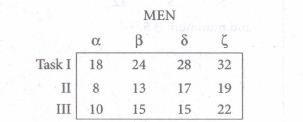
Solve the following assignment problem.
44.
Evaluate ഽ x3 sin (x4) dx
45.
Solve: (y-x)\(\frac { dy }{ dx } \) = a2
46.
Solve the following equation by using Cramer’s rule
2x + y −z = 3, x + y + z =1, x− 2y− 3z = 4
47.
From the following table obtain a polynomial of degree y in x
| x | 1 | 2 | 3 | 4 | 5 |
| y | 1 | -1 | 1 | -1 | 1 |
48.
A car hire company has one car at each of five depots a,b,c,d and e. A customer in each of the fine towers A,B,C,D and E requires a car. The distance (in miles) between the depots (origins) and the towers(destinations) where the customers are given in the following distance matrix.
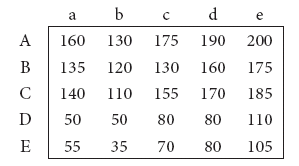
How should the cars be assigned to the customers so as to minimize the distance travelled?
49.
A quality control inspector has taken ten samples of size four packets each from a potato chips company. The contents of the sample are given below, Calculate the control limits for mean and range chart.
| Sample Number | Observations | |||
| 1 | 2 | 3 | 4 | |
| 1 | 12.5 | 12.3 | 12.6 | 12.7 |
| 2 | 12.8 | 12.4 | 12.4 | 12.8 |
| 3 | 12.1 | 12.6 | 12.5 | 12.4 |
| 4 | 12.2 | 12.6 | 12.5 | 12.3 |
| 5 | 12.4 | 12.5 | 12.5 | 12.5 |
| 6 | 12.3 | 12.4 | 12.6 | 12.6 |
| 7 | 12.6 | 12.7 | 12.5 | 12.8 |
| 8 | 12.4 | 12.3 | 12.6 | 12.5 |
| 9 | 12.6 | 12.5 | 12.3 | 12.6 |
| 10 | 12.1 | 12.7 | 12.5 | 12.8 |
(Given for n = 5, A2 = 0.58, D3 = 0 and D4 = 2.115)
50.
Explain in detail about the test of significance for single mean.
51.
A car hiring firm has two cars. The demand for cars on each day is distributed as a Poisson variate, with mean 1.5. Calculate the proportion of days on which
(i) Neither car is used
(ii) Some demand is refused
52.
The price elasticity of demand for a commodity is \(\frac { p }{ { x }^{ 3 } } \). Find the demand function if the quantity of demand is 3, when the price is Rs. 2
53.
The marginal cost of production of a firm is given by C'(x) = 5 + 0.13x, the marginal revenue is given by R'(x) = 18 and the fixed cost is Rs. 120. Find the profit function.
54.
A continuous random variable X has p.d.f
f(x) = 5x4, 0\(\le\)x\(\le\)1
Find a1 and a2 such that
i) P[X\(\le\)a1] = P[X>a1]
ii) P[X>a2] = 0.05
1.
Sample size n = 500
Proportion of bad apples in the sample
= \(\frac { 45 }{ 500 } \) = 0.09
p = 0.09
∴ q = 1 - p = 1-0.09 = 0.91
Standard error = \(\sqrt { \frac { pq }{ n } } =\sqrt { \frac { (.09)(.91) }{ 500 } } \)
= 0.0128
As the significance level is α = 0.001, \(Z_{ \frac { \alpha }{ 2 } }\) = 2.58
∴ The confidence limits for the population proportion of bad apples are given by
p-zα (S.E.) ≤ p ≤ p + zα (S.E.)
⇒ 0.09 - 2.58 (0.0128) ≤ p ≤ .09 + 2.58 (0.0128)
⇒ 0.09 - 0.033 ≤ p ≤ .09 + 0.033
⇒ 0.057 ≤ p ≤ 0.123
Thus, the bad apples in the consignment lie between (0.057, 0.123).
2.
We have P(X=r)∝αr
⇒P(X = r) = λαr,r = 0,1,2,....
Since sum of all the probabilities in a probability distribution is 1.
P(X = 0)+P(X = 1)+P(P(X = 2)+... = 1
⇒ λα0+λα1+λα2+...= 1
⇒λ(1+α+α2+.....) = 1
⇒\(\lambda(\frac{1}{1-\alpha})\) = 1
⇒ λ = 1 - α
∴ P(X = r) = (1-α)αr, r = 0,1,2,...
Hence P(X=0) = (1-α)α0 = (1-α)(1) = 1-α.
3.
| Alternative | States of Nature | Minimum | Maximum | ||
| Good | Fair | Bad | |||
| A | 100 | 60 | +50 | +50 | 100 |
| B | 80 | 50 | +10 | 10 | 80 |
| C | 40 | 20 | +5 | 5 | 40 |
(i) Max (50, 10, 5) = 50
∴ A is the best alternative under maximin principle
(ii) Min (100, 80,40) = 40
∴ C is the best alternative under minimax principle
4.
Let I = \(\int _{ 1 }^{ 2 }{ \frac { log\quad x }{ { x }^{ 2 } } } dx\)
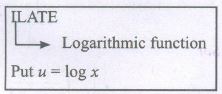
u = log x and dv = \(\frac { 1 }{ { x }^{ 2 } } dx\quad ={ x }^{ -2 }dx\)
\(du=\frac { 1 }{ x } ;v=\frac { { x }^{ -2+1 } }{ { -2+1 } } =\frac { { x }^{ -1 } }{ -1 } =\frac { -1 }{ x } \)
Using integration by parts we get,
ഽu dv = uv - ഽv du
\(\therefore I=\int _{ 1 }^{ 2 }{ \frac { log\quad x }{ { x }^{ 2 } } } dx\)
= \({ \left[ -\frac { 1 }{ x } logx-\int { -\frac { 1 }{ x } .\frac { 1 }{ x } } dx \right] }_{ 1 }^{ 2 }\)
= \({ \left[ -\frac { 1 }{ x } logx+\int { \frac { 1 }{ { x }^{ 2 } } } dx \right] }_{ 1 }^{ 2 }\)
= \({ \left[ -\frac { 1 }{ x } logx-\frac { 1 }{ x } \right] }_{ 1 }^{ 2 }\)
= \(-{ \left[ \frac { 1 }{ x } logx+\frac { 1 }{ x } \right] }_{ 1 }^{ 2 }\)
= \(-\left[ \left( \frac { 1 }{ 2 } log2+\frac { 1 }{ 2 } \right) -\left( 1log1+\frac { 1 }{ { 1 }^{ 1 } } \right) \right] \)
= \(-\left[ \frac { 1 }{ 2 } log2+\frac { 1 }{ 2 } -0-1 \right] \)
\(\left[ \because log1=0 \right] \)
= \(-\left[ \frac { 1 }{ 2 } log2-\frac { 1 }{ 2 } \right] \)
= \(\frac { 1 }{ 2 } -\frac { 1 }{ 2 } log2\)
= \(\frac { 1 }{ 2 } (1-log2)\)
5.
Given (x2-yx2)dy + (y2+xy2)dx = 0
⇒ x2(1-y)dy+y2(1+x)dx = 0
⇒ x2(1-y)dy = -y2(1+x)dx
Separating the variables we get,
\(\frac { (1-y) }{ y^{ 2 } } dy=-\frac { (1+x) }{ x^{ 2 } } \)dx
⇒ \(\frac { 1 }{ { y }^{ 2 } } dy-\frac { 1 }{ y } dy=-\frac { 1 }{ x^{ 2 } } dx-\frac { 1 }{ x } dx\)
Integrating, \(\int { { y }^{ -2 } } dy-\int { \frac { 1 }{ y } } dy=-\int { \frac { 1 }{ x^{ 2 } } } dx-\int { \frac { 1 }{ x } } \)
\(-\frac { 1 }{ y } -logy=\frac { 1 }{ x } \) -log x + C
⇒ log x - log y = \(\frac { 1 }{ x } +\frac { 1 }{ y } \)+C
⇒ log \(log\left( \frac { x }{ y } \right) =\frac { x+y }{ xy } \)+C
⇒ \(\frac { x }{ y } =e^{ \frac { x+y }{ xy } +C }\)
⇒ \(\frac { x }{ y } =K.e^{ \frac { x+y }{ xy } }\) [where eC = K]
6.
Given h = 1
LHS = (E−1Δ) x3
= Δ(E-1(x3))
= Δ(x - h)3 [∵ E-1f(x) = f(x - nh)]
= Δ(1 - h)3 [∵ h = 1]
= (x - 1+ 1)3 - (x - 1)3 [∵ Δf(x) =f(x + h) - f(x)]
= x3 - (x - 1)3
= x3 - (x3 - 3x2 + 3x - 1)
[∵ (a - b)3 = a3 - 3a2b + 3ab2 - b3]
= x3 - x3 + 3x2 - 3x + 1
= 3x2 - 3x + 1
= RHS
Hence proved
7.
Tendency movements are due to nature, which repeat themselves periodically in every seasons. These variations repeat themselves in less than one year time. It is measured in an interval of time.
Seasonal variations may be influenced by natural force, social customs and traditions.
8.
Given that \(\int _{ a }^{ b }{ dx } =1\)
\({ \left[ x \right] }_{ a }^{ b }\) = 1
b − a = 1 … (1)
Now, \(\int _{ a }^{ b }{ xdx } =1\)
\({ \left[ \frac { { x }^{ 2 } }{ a } \right] }_{ a }^{ b }\) = 1
b2 − a2 = 2
(b + a)(b − a) = 2
b + a = 2 … (2) [∵ b -a =1]
(1) + (2) ⇒ 2b = 3
ஃ \(b=\frac { 3 }{ 2 } \)
Now, \(\frac { 3 }{ 2 } \) - a = 1 [∵ from (1)]
ஃ a = \(\frac { 1 }{ 2 } \)
9.
We are given mean μ = 2.25 and standard deviation σ = 0.25.
Probability that weight of fish is less than 2 kg is P(X < 2.0)
When x = 20 \(Z=\frac { X-\mu }{ \sigma } =\frac { 2.0-2.25 }{ 0.25 } =P(Z<-1.0)=P(Z>1.0)\)
= 0.5 – 0.3413 = 0.1587
Therefore 15.87% of fishes weigh less than 2 kg.
10.
The matrix equation corresponding to the given system is
\(\left( \begin{matrix} 3 & -2 \\ 6 & -4 \end{matrix} \right) \left( \begin{matrix} x \\ y \end{matrix} \right) =\left( \begin{matrix} 6 \\ 10 \end{matrix} \right) \)
AX = B
| Matrix A | Augmented matrix [A,B] | Elementary Transformation |
| \(\left( \begin{matrix} 3 & -2 \\ 6 & -4 \end{matrix} \right) \) \(\sim \left( \begin{matrix} 3 & -2 \\ 0 & 0 \end{matrix} \right) \) |
\(\left( \begin{matrix} 3 & -2 & 6 \\ 6 & -4 & 10 \end{matrix} \right) \) \(\sim \left( \begin{matrix} 3 & -2 & 6 \\ 0 & 0 & -2 \end{matrix} \right) \) |
\({ R }_{ 2 }\rightarrow { R }_{ 2 }-{ 2R }_{ 1 }\) |
| \(\rho (A)=1\) | \(\rho ([A,B])=2\) |
\(\therefore \)\(\rho ([A,B])=2\), \(\rho (A)=1\)
\(\rho (A)\neq \rho \left( [A,B] \right) \)
\(\therefore \) The given system is inconsistent and has no solution.
11.
(d)
Ideal index number
12.
(a)
.3
13.
(c)
1
14.
(a)
all
15.
(a)
equal
16.
(c)
xdx + ydy = 0
17.
(c)
\(\frac { { 2 } }{ 3 } { x }^{ \frac { 3 }{ 2 } }+2{ x }^{ \frac { 1 }{ 2 } }\)
18.
(b)
singular
19.
(b)
beginning
20.
(c)
\(\frac{3}{log_e2}\)
21.
(c)
f (x)
22.
(c)
Smallest two costs
23.
(b)
x = ce−py
24.
(b)
Cost of living index
25.
(b)
26.
(a)
sin x + c
27.
(c)
-1.04
28.
(c)
V(X)
29.
(b)
\(\frac{1}{2}\) sq.unit
30.
(c)
inconsistent
31.
| Year | I quarter | II quarter | III quarter | IV quarter |
| 1985 | 68 | 62 | 61 | 63 |
| 1986 | 65 | 58 | 66 | 61 |
| 1987 | 68 | 63 | 63 | 67 |
| Total | 201 | 183 | 190 | 191 |
| Average | 67 | 61 | 63.33 | 63.67 |
Grand average = \(\frac{67 + 61 + 63.33 + 63.37}{4}\)
= \(\frac{255}{4}=63.75\)
Seasonal index (S.I) = \(\frac{Quarterly average}{Grand average}\times100\)
Hence, S.I for I quarter = \(\frac{67}{63.75}\times100\) = 105.01
S.I for II quarter = \(\frac{61}{63.75}\times100\) = 95.68
S.I for III quarter = \(\frac{63.33}{63.75}\times100\) = 99.35
S.I for IV quarter = \(\frac{63.67}{63.75}\times100\) = 99.87
32.
Let λ be the parameter
Given 3. P(X = 2) = P(X = 4)
⇒ 3. \(\frac { { e }^{ -\lambda }.{ \lambda }^{ 2 } }{ 2! } =\frac { e^{ -\lambda }.{ \lambda }^{ 4 } }{ 4! } \)
\(\frac { 3{ \lambda }^{ 2 } }{ 2 } =\frac { { \lambda }^{ 4 } }{ 4\times 3\times 2 } \)
⇒ 36λ2 = λ4
λ4-36λ2 = 0
⇒ λ2(λ2-36) = 0
⇒ λ2 = 0 or λ2 = 36
⇒ λ = 6 since λ > 0
33.
We know Δ (f(x)) = f(x + h) -f(x)
Since h = 1, ∆ (f)) = f(x + 1) - f(x)
[∵ (x + 1)3 = x3 + 3x2 + 3x + 1]
⇒ Δ (x3) = (x + 1)3 - x3

⇒ Δ (x3) = 3x2 + 3x + 1
34.
Given curve is y = 4x - X2
The limits are from x = 0 to x = 3
∴ Area \(\int _{ 0 }^{ 3 }{ y } dx=\int _{ 0 }^{ 3 }{ (4x-{ x }^{ 2 }) } dx\)
\({ \left[ \frac { 4{ x }^{ 2 } }{ 2 } -\frac { { x }^{ 3 } }{ 3 } \right] }_{ 0 }^{ 3 }=2(9)-\frac { 27 }{ 3 } \)
=18 - 9
Area = 9 sq.units
35.
The non-homogeneous equations are
x + 2y = 3, 2x + 4y = 6
| Augmented matrix [A, b] | Elementary Transformation |
| \(\left( \begin{matrix} 1 & 2 & 3 \\ 2 & 4 & 6 \end{matrix} \right) \) | |
| \(-\left( \begin{matrix} 1 & 2 & 3 \\ 0 & 0 & 0 \end{matrix} \right) \) | \({ R }_{ 2 }\rightarrow { R }_{ 2 }-2{ R }_{ 1 }\) |
Here \(\rho (A)=1\) and \(\rho \left( \left[ A,B \right] \right) =1\)
Since \(\rho (A)=\rho \left[ \left( A,B \right) \right] =1<\) Number of unknowns, the given system is consistent with infinitely many solutions.
To find the solution, let us rewrite the above echelon form into the matrix form, we get
\(\left( \begin{matrix} 1 & 2 \\ 0 & 0 \end{matrix} \right) \left( \begin{matrix} x \\ y \end{matrix} \right) =\left( \begin{matrix} 3 \\ 0 \end{matrix} \right) \)
\(\Rightarrow x+2y=3\)
let \(y=k,k\varepsilon R\)
\((1)\Rightarrow x+2k=3\Rightarrow x=3-2k\)
\(\therefore\) Solution set is \(\left\{ 3-2k,k \right\} ,k\epsilon R\)
For different values of k; we get infinite number of solutions
36.
(2 - y'')2 = y''2 + 2y'

⇒ 4-y'' = 2y
The highest derivative is of second order and its poweris 1.
∴ Order is 2 and degree is 1.
37.
The assignment problem is a special case of transportation problem where the number of sources and destinations are equal. Here, jobs represent sources and machines represent destinations.
38.
The two branches of statistical inference are
(i) Estimation and
(ii) Testing of hypotheses.
39.
S = {1, 2, 3, 4, 5, 6}⇒ n(s) = 6
∴ X takes the values 1, 2, 3, 4, 5, 6
P(X = 1) = \(\frac{1}{6}\)
P(X = 2) = \(\frac{1}{6}\)
P(X = 3) = \(\frac{1}{6}\)
P(X = 4) = \(\frac{1}{6}\)
P(X = 5) = \(\frac{1}{6}\)
P(X = 6) = \(\frac{1}{6}\)
[Since in all the cases, only one favourable event and total no of events is 6]
∴ The probability mass function is
| X = x | 1 | 2 | 3 | 4 | 5 | 6 |
| P(X = x) | \(\frac{1}{6}\) | \(\frac{1}{6}\) | \(\frac{1}{6}\) | \(\frac{1}{6}\) | \(\frac{1}{6}\) | \(\frac{1}{6}\) |
∴ Expected value for the random value of an unbiased die
\(E(X)=\sum _{ i=1 }^{ 6 }{ xp(x) } \)
\(=1(\frac { 1 }{ 6 } )+2(\frac { 1 }{ 6 } )+3(\frac { 1 }{ 6 } )+4(\frac { 1 }{ 6 } )+5(\frac { 1 }{ 6 } )+6(\frac { 1 }{ 6 } )\)
\(=\frac { 1+2+3+4+5+6 }{ 6 } =\frac { 21 }{ 6 } =\frac { 7 }{ 2 } \)
\(\\ \therefore E(X)=3.5\)
40.
\( \int \sqrt{2 x+1} \ d x=\int(2 x+1)^{\frac{1}{2}} d x\)
\(=\frac { { \left( 2x+1 \right) }^{ \frac { 3 }{ 2 } } }{ 3 } +c\)
41.
Given p = \(\frac { 55 }{ 100 } \)
∴ q = \(\frac { 45 }{ 100 } \) and n = 100
Standard error = \(\sqrt { \frac { pq }{ n } } =\sqrt { \frac { \frac { 55 }{ 100 } \times \frac { 45 }{ 100 } }{ 100 } } \)
= 0.0497
(a) As the level of significance α = 0.05 \(Z_{ \frac { \alpha }{ 2 } }\) = 1.96
∴ 95% confidence limits for proportion is given by \(p-Z_{ \frac { \alpha }{ 2 } }(S.E)\le p\ge p+Z_{ \frac { \alpha }{ 2 } }(S.E)\)
⇒ 0.55 - (1.96) (0.0497) ≤ p ≤ 0.55 + (1.96) (0.0497)
⇒ 0.453 ≤ p ≤ 0.647
∴ 95% confidence interval for proportion is (0.45, 0.65)
(b) As the level of significance is α = 0.01, \(Z_{ \frac { \alpha }{ 2 } }\) = 2.58
∴ 99% confidence limits for proportion is given by \(p-Z_{ \frac { \alpha }{ 2 } }(S.E)\le p\ge p+Z_{ \frac { \alpha }{ 2 } }(S.E)\)
⇒ 0.55 - (2.58) (0.0497) ≤ p ≤ 0.55 + (2.58) (0.0497)
⇒ 0.422 ≤ p ≤ 0.678
Hence, 99% confidence interval for proportion is (0.42, 0.68).
42.
Let X denote the height of the student
Given μ = 64.5 inches and σ = 3.3 inches
Given that P(-∞ < Z < C) = 0.99
⇒ P( -∞ < Z < 0) + P (0 < Z < C) = 0.99
⇒ 0.5 + P (0 < Z < C) = 0.99
⇒ P(0 < Z < C) = 0.99 - 0.5 = 0.49...(1)
From the standard normal distribution table
P(0 < Z < 2.33) = 0.49...(2)
From (1) & (2), C = 2.33
we know that Z = \(\frac { X-\mu }{ \sigma } \)
⇒ 2.33 = \(\frac { X-64.5 }{ 3.3 } \)
⇒ X = (2.33) (3.3) + 64.5
⇒ X = 72.19 inches
Hence, the height below which 99% of the student lie is 72.19 inches.
43.
Since the number of rows is less then the number of columns, given assignment problem is unbalanced one.
To balance it, introduce a dummy row with all the entries zero.
The revised assignment problem is
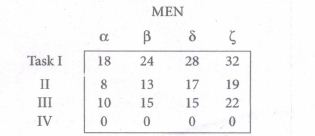
Here only 3 tasks can be assigned to 3 men.
Step 1 :
Select the smallest element in each row and subtract it will all the elements in its row.
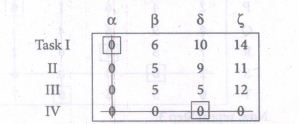
Here each row and column has atleast one zero.
Step 2:
Examine the row with only one zero, mark that zero by \(\Box\) and draw a vertical line.
After examining all the rows, examine the column with single zero, mark that zero by \(\Box\) and draw a horizontal line.
Step 3:
Only two assignment have been made.
The elements not lying on the line are
\(\begin{matrix} 6 & 10 & 14 \\ 5 & 9 & 11 \\ 5 & 5 & 12 \end{matrix}\)
and minimum is 5.
Subtract 5 from all these numbers. Other numbers remains the same.
A new cost matrix will be found .and repeat step 2.
∴ The new cost matrix is
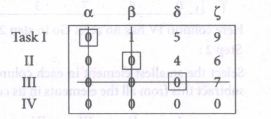
Thus, 3 assignments have been made.
The optical assignment schedule and total cost is
| Task | MEN | Cost |
| I | α | 18 |
| II | β | 13 |
| III | δ | 15 |
| Total Cost | Rs. 46 | |
44.
Let I = ഽ x3 sin (x4) dx
Put t = x4
⇒ dt = 4x3 dfx
\(\Rightarrow \frac { dt }{ 4 } ={ x }^{ 3 }dx\)
\(\therefore I=\int { sin } t.\frac { dt }{ 4 } =\frac { 1 }{ 4 } sint\quad dt\)
= \(-\frac { 1 }{ 4 } cos\quad t+c\)
= \(-\frac { 1 }{ 4 } cos\left( { x }^{ 4 } \right) +c\) \(\left[ \because t={ x }^{ 4 } \right] \)
45.
(y-x)\(\frac { dy }{ dx } \) = a2
⇒ \(\frac { dy }{ dx } =\frac { { a }^{ 2 } }{ y-x } \Rightarrow \frac { dx }{ dy } =\frac { y-x }{ { a }^{ 2 } } \)
⇒ \(\frac { dx }{ dy } =\frac { y }{ { a }^{ 2 } } -\frac { x }{ a^{ 2 } } \)
⇒ \(\frac { dx }{ dy } +\frac { x }{ { a }^{ 2 } } =\frac { 1 }{ { a }^{ 2 } } \)
This is of the form \(\frac { dx }{ dy } \)+Px = Q
where P = \(\frac { 1 }{ { a }^{ 2 } } \) and Q = \(\frac { 1 }{ { a }^{ 2 } } \)y
∴ \(\int { P } dy=\int { \frac { 1 }{ { a }^{ 2 } } dy } =\frac { 1 }{ { a }^{ 2 } } \)
I.F = \(e^{ \int { pdy } }=e^{ y/{ a }^{ 2 } }\)
∴ The solution is \(\int { x. } e^{ \int { pdy } }=\int { Q.e^{ \int { pdy } } } dy\)
⇒ x.ey/a2 =\(\int { \frac { 1 }{ { a }^{ 2 } } y } \) ey/a2dy+C....(1)
Put \(\frac { 1 }{ { a }^{ 2 } } \)y = t ⇒ dy = a2dt
[∵ u = t; d = et]
u1= 1; v = et
v1 = et
\(\int { u } dv\) = uv-u1v1]
∴ (1) ⇒ x.ey/a2 = a2\(\int { te^{ t } } \)dt
= a2[tet-et]+C
\(xe^{ \frac { y }{ { a }^{ 2 } } }\) = a2.et(t-1)+C
\(xe^{ \frac { y }{ { a }^{ 2 } } }=a^{ 2 }.e^{ \frac { y }{ { a }^{ 2 } } }\left( \frac { y }{ { a }^{ 3 } } -1 \right) \) [∵ t = \(\frac { y }{ { a }^{ 2 } } \)]
46.
\(\Delta =\left| \begin{matrix} 2 & 1 & -1 \\ 1 & 1 & 1 \\ 1 & -2 & 3 \end{matrix} \right| =2\)
\(\left| \begin{matrix} 1 & 1 \\ -2 & -3 \end{matrix} \right| -1\left| \begin{matrix} 1 & 1 \\ 1 & -3 \end{matrix} \right| -1\left| \begin{matrix} 1 & 1 \\ 1 & -2 \end{matrix} \right| \)
= 2 (-3+2) - 1 (-3 -1) -1 (-2-1)
= 2(-1) -1 (-4) -1 (-3)
= -2 + 4 + 3 = 5.
Since\(\Delta \neq 0\),
we can apply Cramer's rule and the system is consistent with unique solution.
\(x=\left| \begin{matrix} 3 & 1 & -1 \\ 1 & 1 & 1 \\ 4 & -2 & 3 \end{matrix} \right| =3\left| \begin{matrix} 1 & 1 \\ -2 & -3 \end{matrix} \right| -1\left| \begin{matrix} 1 & 1 \\ 4 & -3 \end{matrix} \right| -1\left| \begin{matrix} 1 & 1 \\ 4 & -2 \end{matrix} \right| \)
= 3(-3 + 2) -1(-3 -4) -1(-2 -4)
= 3 (-1) -1 (-7) -1 (-6)
= -3 + 7 + 6 = 10.
\(\Delta y=\left| \begin{matrix} 2 & 3 & -1 \\ 1 & 1 & 1 \\ 1 & 4 & -3 \end{matrix} \right| =2\left| \begin{matrix} 1 & 1 \\ 4 & -3 \end{matrix} \right| -3\left| \begin{matrix} 1 & 1 \\ 1 & -3 \end{matrix} \right| -1\left| \begin{matrix} 1 & 1 \\ 1 & 4 \end{matrix} \right| \)
= 2(-3 -4) -3 (-3 -1) -1 (4-1)
= 2 (-7) -3 (-4) -1(3)
= 14 + 12 - 3 = -5
\(\Delta z=\left| \begin{matrix} 2 & 1 & 3 \\ 1 & 1 & 1 \\ 1 & -2 & 4 \end{matrix} \right| \)
= \(2\left| \begin{matrix} 1 & 1 \\ -2 & 4 \end{matrix} \right| -1\left| \begin{matrix} 1 & 1 \\ 1 & 4 \end{matrix} \right| +3\left| \begin{matrix} 1 & 1 \\ 1 & -2 \end{matrix} \right| \)
= 2(4 + 2) -1(4 -1) + 3(-2 -1)
= 2(6) -1(3) + 3(-3)
= 12 - 3 - 9
= 0
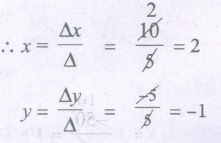
\(z=\cfrac { \Delta z }{ \Delta } =\cfrac { 0 }{ 5 } =0\)
\(\therefore\)Solution set is (2, -1, 0)
47.
Given
The difference table is
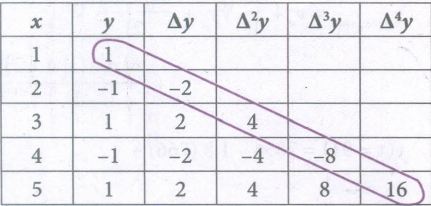
To findy when x = x ⇒ x0+ nh = x ⇒ 1 + n (1) = x ⇒ n = x-1
Newton's forward interpolation formula is
y(x=x) = \(\frac { n }{ 1! } { \triangle y }_{ 0 }+\frac { n(n+1) }{ 2! } { \triangle }^{ 2 }{ y }_{ 0 }+\frac { n(n+1)(n+2) }{ 3! } { \triangle }^{ 3 }{ y }_{ 0 }\)+ .....
y(x=x) = 1 + (x-1)(-2) + \(\frac { (x-1)(x-2) }{ 2 } (4)+\frac { (x-1)(x-2)(x-3) }{ 6 } (-8)+\frac { (x-1)(x-2)(x-3)(x-4) }{ 24 } (16)\)
⇒ y = 1 - 2x + 2(x2 - 3x + 2) - \(\frac{4}{3}\) (x - 1) (x - 2) (x - 3) + \(\frac{2}{3}\) (x - 1) (x - 2) (x - 3) (x -4)
⇒ y = 3 - 2x + 2x2 - 6x + 4 - \(\frac{4}{3}\) [(x2 - 3x + 2) (x- 3)] + \(\frac{2}{3}\) [(x2 - 3x + 2)(x2 - 7x + 12)]
⇒ y = 2x2 - 8x+ 7- \(\frac{4}{3}\) [x3- 3x2+ 2x- 3x2 + 9x- 6] + \(\frac{2}{3}\) [x4 - 3x3 + 2x2 - 7x3 + 21x2 - 14x + 12x2 - 36x + 24]
⇒ y = 2x2-8x+7- \(\frac{4}{3}\) x3 + 4x2 - \(\frac{8}{3}\) x + 4x2 - 12x + 8 + \(\frac { { 12x }^{ 4 } }{ 3 } -\frac { 20 }{ 3 } { x }^{ 3 }+\frac { 70 }{ 3 } { x }^{ 2 }-\frac { 100x }{ 3 } +\frac { 48 }{ 3 } \)
⇒ y = \(\frac{2}{3}\) x4 + x3 \(\left( \frac { -4 }{ 3 } \frac { -20 }{ 3 } \right) \) + x2\(\left( 2+4+4+\frac { 70 }{ 3 } \right) \) + x \(\left( -8-\frac { 8 }{ 3 } -12-\frac { 100 }{ 3 } \right) \) + 31
⇒ y = \(\frac{2}{3}\) x4 - 8x3 + \(\frac{100}{3}\) x2 - 56x + 31 which is the required polynomial.
48.
Here the number of rows and columns are equal.
∴ The given assignment problem is balanced.
Step 1: Select a minimum element in each row and subtract this from all the elements in its row.
∴ The cost matrix of the given assignment problem is
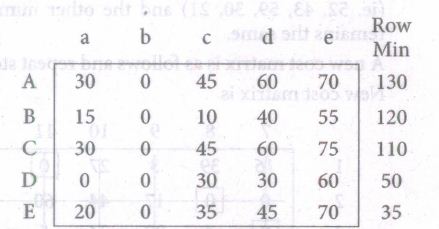
Here column c, d and e have no zeros. Go to step 2.
Step 2 : Select the minimum element in each column and subtract this from all the elements in its column.
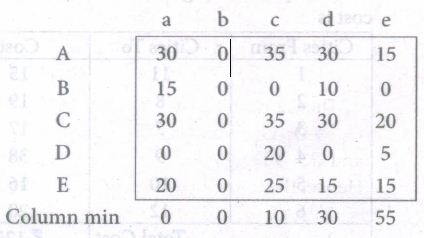
Since each row and column contains exactly atleast one zero, assignments can be made.
Step 3: (Assignment)
Examine the rows with exactly one zero. Mark that zero by and draw a vertical line.
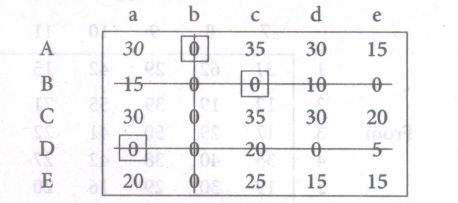
Also examine the columns with exactly one zero. Mark that zero by and draw a horizontal line.
Here, numbers not lying on the line are and minimum of these number is 15.
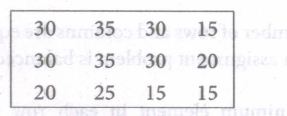
Now, subtract 15 from all these numbers and numbers lying on the line remains the same.
Hence, the new cost matrix is as follows.
Again repeat step 3 (Assignment)
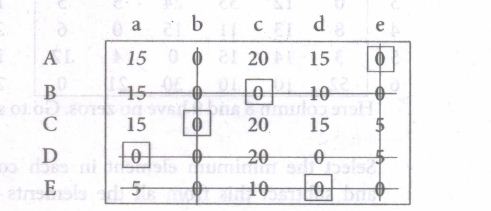
Thus, all the 5 assignments have been made.
The optimal assignment schedule and total cost is
| Towers | Depot | Cost |
|---|---|---|
| A | e | 200 |
| B | c | 130 |
| C | b | 110 |
| D | a | 50 |
| E | d | 80 |
| Total Cost | Rs. 570 | |
49.
| Sample No | Observations | Total | \(\overline {X}\) | R = x max - xmin | |||
| 1 | 2 | 3 | 4 | ||||
| 1 | 12.5 | 12.3 | 12.6 | 12.7 | 50.1 | \(\frac {50.1}{4} = 12.5\) | 12.7-12.3 = 0.4 |
| 2 | 12.8 | 12.4 | 12.4 | 12.8 | 50.4 | \(\frac {50.4}{4} = 12.6\) | 12.8-12.4 = 0.4 |
| 3 | 12.1 | 12.6 | 12.5 | 12.4 | 49.6 | \(\frac {49.6}{4} = 12.4\) | 12.6-12.1 = 0.5 |
| 4 | 12.2 | 12.6 | 12.5 | 12.3 | 49.6 | \(\frac {49.6}{4} = 12.4\) | 12.6-12.2 = 0.4 |
| 5 | 12.4 | 12.5 | 12.5 | 12.5 | 49.9 | \(\frac {49.9}{4} = 12.5\) | 12.6-12.4 = 0.1 |
| 6 | 12.3 | 12.4 | 12.6 | 12.6 | 49.9 | \(\frac {49.9}{4} = 12.5\) | 12.6-12.3 = 0.3 |
| 7 | 12.6 | 12.7 | 12.5 | 12.8 | 50.6 | \(\frac {50.6}{4} = 12.7\) | 12.6-12.5 = 0.3 |
| 8 | 12.4 | 12.3 | 12.6 | 12.5 | 49.8 | \(\frac {49.8}{4} = 12.5\) | 12.6-12.3 =.3 |
| 9 | 12.6 | 12.5 | 12.3 | 12.6 | 50 | \(\frac {50}{4} = 12.5\) | 12.6-12.3 =.3 |
| 10 | 12.1 | 12.7 | 12.5 | 12.8 | 50.1 | \(\frac {50.1}{4} = 12.5\) |
12.8-12.1 =.7 |
| 125.1 | 3.7 | ||||||
\(\overline {\overline{X}} = \frac {125.1}{10}\) = 12.51
\(\overline{R} = \frac {3.7}{10}\) = 0.37
Control limits for \(\overline {X}\) - chart
UCL = \(\overline {\overline{X}} + A_{2} \overline {R}\)
= [when n = 4, A2 = .729]
= 12.51 + .729 (0.37)
= 12.51 + 0.27 = 12.78
CL = \(\overline {\overline{X}}\) = 12.51
LCL = \(\overline {\overline{X}} - A_{2} \overline {R}\)
= 12.51 - 0.27 = 12.24
Control limits for R-chart
UCL = D4 \(\overline{R}\)
= 2.282(0.37) = 0.84
[when n = 4, D4 = 2.282]
CL = \(\overline{R}\) = 0.37
LCL = D3 \(\overline{R}\) = 0
[When n = 4, D3 = 0]
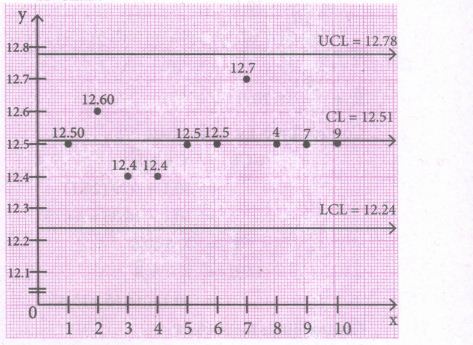
\(\overline {X}\) - chart
\(\overline {R}\) - chart
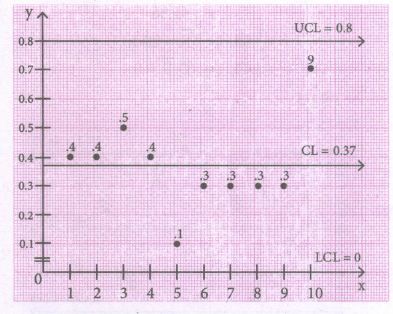
Conclusion: The above diagram shows all the control lines with the data points plotted.
Since all the points lie within the control limits, we can say that the process is in control.
50.
Let xi, (i = 1,2,3....n) is a ran dom sample of size n from a normal population with mean μ and variance σ2, then the sample mean is distributed
normally with mean μ and variance \(\frac { { \sigma }^{ 2 } }{ n } \)
Thus for large samples, the standard normal variate corresponding to \(\bar { X } \) is:
\(Z=\frac { \bar { X } -\mu }{ \frac { \sigma }{ \sqrt { n } } } \sim N(0,1)\)
Under the null hypothesis, that the sample has been drawn from a population with mean μ and variance σ2, the test statistic is \(Z=\frac { \bar { X } -\mu }{ \frac { \sigma }{ \sqrt { n } } } \)
51.
Given mean = λ = 1.5
X follows poisson distribution with
p(x,λ) = \(\frac { e^{ -\lambda }.{ \lambda }^{ x } }{ x! } \)
(i) ∴ P(neither car is used)
= P(X = 0) = \(\frac { e^{ -1.5 }.(1.5)^{ 0 } }{ 0! } \) =e-1.5
= 0.2231 [∵ e-1.5 =0.2231]
(ii) P (Some demand is refused)
The demand may be either 0 car, 1 car or 2 cars
∴ P (Some demand is refused) = 1 - P(X ≤ 2)
= 1 - [P(X = 0) + P (X = 1) + P(X = 2)]
= 1-\(\left[ \frac { e^{ -\lambda }.{ \lambda }^{ 0 } }{ 0! } +\frac { e^{ -\lambda }.{ \lambda }^{ 1 } }{ 1! } +\frac { e^{ -\lambda }.{ \lambda }^{ 2 } }{ 2! } \right] \)
= 1-e-λ (1+λ+\(\frac { { \lambda }^{ 2 } }{ 2 } \))
= 1-e-1.5 (1+1.5+\(\frac { (1.5)^{ 2 } }{ 2 } \))
= 1 - 0.2231 (3.625) = 1 - 0.8087 = 0.1912
∴ Probability of some demand is refused = 0.1912.
52.
Given elasticity of demand = \(\frac{p}{x^3}\)
\(\Rightarrow \frac { -p }{ x } .\frac { dx }{ dp } =\frac { p }{ { x }^{ 3 } } \)
\(\Rightarrow \frac { { -x }^{ 3 }dx }{ x } =p.\frac { dp }{ p } \)
\(\Rightarrow -{ x }^{ 2 }dx=dp\)
\(\Rightarrow -\int { { x }^{ 2 }dx } =\int { dp } \)
\(\Rightarrow -\frac { { x }^{ 3 } }{ 3 } +k=p\)
When p = 2, x = 3
\(\Rightarrow -\frac { { 3 }^{ 3 } }{ 3 } +k=2\)
k = 2 + 9 ⇒ k = 11
∴ (1) becomes
\(P=-\frac { { x }^{ 3 } }{ 3 } +11\)
= 11−\(\frac { { x }^{ 3 } }{ 3 } \)
53.
Given C'(x) = 5 + 0.13x
R'(x) = 18
Fixed cost is Rs. 120
C'(x) = 5 + 0.13x
⇒ ∫C'(x) = ∫(5+0.13x)dx
⇒ C(x) = 5x \(+\frac { 0.13{ x }^{ 2 } }{ 2 } +{ k }_{ 1 }\)
Since fixed cost is Rs.120 ⇒ k1 = 120
\(\therefore C(x)=5x+\frac { 0.13{ x }^{ 2 } }{ 2 } +120\) ...(1)
Also R'(x) = 18
⇒ ∫R'(x) = ∫18dx
⇒ R(x) = 18x+k2
When x = 0, R = 0 ⇒ k2= 0
∴ R(x) = 18x ...(2)
Profit function ⇒ P(x) = R(x) - C(x)
\(=18x-5x-\frac { 0.13{ x }^{ 2 } }{ 2 } -120\)
[from (1) & (2)]
P(x) = 13x-0.065x2-120
54.
i) Since P[X\(\le\)a1] = P[X>a1]
\(P[X\le { a }_{ 1 }]=\frac { 1 }{ 2 } \)
\(i.e., \int _{ 0 }^{ { a }_{ 1 } }{ f(x)dx } =\frac { 1 }{ 2 } \)
\(i.e., \int _{ 0 }^{ { a }_{ 1 } }{ { 5x }^{ 4 } } dx=\frac { 1 }{ 2 } \)
\(5{ { \left[ \frac { { x }^{ 5 } }{ 5 } \right] } }_{ { 0 }_{ } }^{ a1 }=1/2\)
\({ a }_{ 1 }={ (0.5) }^{ \frac { 1 }{ 5 } }\)
ii) \(P[X>{ a }_{ 2 }]=0.05\)
\(\int _{ { a }_{ 2 } }^{ 1 }{ { f(x })dx=0.05 } \)
\(\int _{ { a }_{ 2 } }^{ 1 }{ { 5x }^{ 4 }dx=0.05 } \)
\(5{ { \left[ \frac { { x }^{ 5 } }{ 5 } \right] } }_{ { a }_{ 2 } }^{ 1 }=0.05\)
\({ a }_{ 2 }={ [0.95] }^{ \frac { 1 }{ 5 } }\)

12th Standard Syllabus & Materials
12th Standard
TN 12th Computer Applications வலையமைப்பு வடமிடல் Sample Question Papers Study Material - QB365 Set A
NEW12th Standard
TN 12th Computer Applications களப்பெயர் முறைமை (DNS) Sample Question Papers Study Material - QB365 Set A
NEW12th Standard
TN 12th Computer Applications வலையமைப்பு எடுத்துக்காட்டுகள் மற்றும் நெறிமுறைகள் Sample Question Papers Study Material - QB365 Set A
NEW12th Standard
TN 12th Computer Applications கணினி வலையமைப்பு ஓர் அறிமுகம் Sample Question Papers Study Material - QB365 Set A



Tamilnadu Stateboard 12th Standard Subjects

Maths

Chemistry

Physics

Biology

Computer Science
Business Maths and Statistics

Economics

Commerce

Accountancy

History

Computer Applications
Biology
Computer Technology
Computer Applications
Computer Science
Business Maths and Statistics
Commerce
Economics
Maths
Chemistry
Physics
Computer Technology
History
Accountancy

Tamil

English

French
Tamilnadu Stateboard Standards
