
 100% FREE ACCESS
12th Standard Syllabus & Materials
12th Standard
TN 12th Maths Applications of Matrices and Determinants Sample Question Papers Study Material - QB365 Set A
NEW12th Standard
TN 12th Computer Applications மின்னணு தரவு பரிமாற்றம் Sample Question Papers Study Material - QB365 Set A
NEW12th Standard
TN 12th Computer Applications மின் - வணிக பாதுகாப்பு அமைப்புகள் Sample Question Papers Study Material - QB365 Set A
NEW12th Standard
TN 12th Computer Applications மின்னணு செலுத்தல் முறைகள் Sample Question Papers Study Material - QB365 Set A
NEW12th Standard
TN 12th Computer Applications மின் - வணிகம் Sample Question Papers Study Material - QB365 Set A
NEW12th Standard
TN 12th Computer Applications திறந்த மூல கருத்துருக்கள் Sample Question Papers Study Material - QB365 Set A

Published on: 01/03/2021
12th Standard English Medium Business Maths Reduced Syllabus Three Mark Important Questions - 2021(Public Exam )
Download Tamil Nadu 12th Standard Business Maths and Statistics question papers, model tests, one-mark questions, important questions, and public exam papers in PDF format. Free study materials and answer keys for TN State Board students.
Questions + Answers key
Take MCQ Business Maths and Statistics Test
1.
Find the rank of each of the following matrices.
\(\left( \begin{matrix} 1 & 2 & -1 \\ 2 & 4 & 1 \\ 3 & 6 & 3 \end{matrix}\begin{matrix} 3 \\ -2 \\ -7 \end{matrix} \right) \)
2.
3.
Construct a forward difference table for the following data
| x | 0 | 10 | 20 | 30 |
| y | 0 | 0.174 | 0.347 | 0.518 |
4.
Determine how much quantity should be stepped from factory to various destinations for the following transportation problem using the least cost method
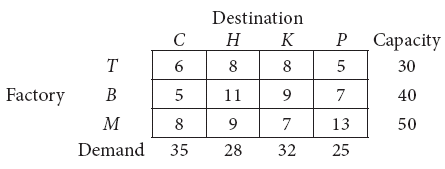
Cost are expressed in terms of rupees per unit shipped.
5.
Solve the following:
\(\frac { dy }{ dx } +ycosx=sinx\ cosx\).
6.
7.
Form the differential equation that represents all parabolas each of which has a latus rectum 4a and whose axes are parallel to the x axis.
8.
A sample of 100 items, draw from a universe with mean value 4 and S.D 3, has a mean value 63.5. Is the difference in the mean significant at 0.05 level of significance?
9.
Explain in detail about non-sampling error.
10.
Using second fundamental theorem, evaluate the following:
\(\int _{ -1 }^{ 1 }{ \frac { 2x+3 }{ { x }^{ 2 }+3x+7 } dx } \)
11.
Assume that a drug causes a serious side effect at a rate of three patients per one hundred. What is the probability that atleast one person will have side effects in a random sample of ten patients taking the drug?
12.
The average daily procurement of milk by village society in 800 litres with a standard deviation of 100 litres. Find out proportion of societies procuring milk between 800 litres to 1000 litres per day.
13.
The probability that a student get the degree is 0.4 Determine the probability that out of 5 students
(i) one will be graduate
(ii) atleast one will be graduate
14.
Integrate the following with respect to x.
\(\frac { { x }^{ e-1 }+{ e }^{ x-1 } }{ { x }^{ e }+{ e }^{ x } } \)
15.
A manufacture’s marginal revenue function is given by MR = 275 − x − 0.3x2. Find the increase in the manufactures total revenue if the production is increased from 10 to 20 units.
16.
Consider a random variable X with probability density function \(f(x)= \begin{cases}4x^3 & \text { if } 0< x < 1 \\ 0, & \text { otherwise }\end{cases}\)
Find E(X) and V(X).
17.
The demand function p = 85 − 5x and supply function p = 3x − 35. Calculate the equilibrium price and quantity demanded. Also calculate consumer’s surplus.
18.
Let X be a discrete random variable with the following p.m.f
\(p(x) = \begin{cases}0.3 & \text { for } x =3 \\ 0.2, & \text { for } x = 5 \\ 0.3, & \text { for } x = 8 \\ 0.2, & \text { for} x = 10 \\ 0, & \text { otherwise } \\ \end{cases}\)
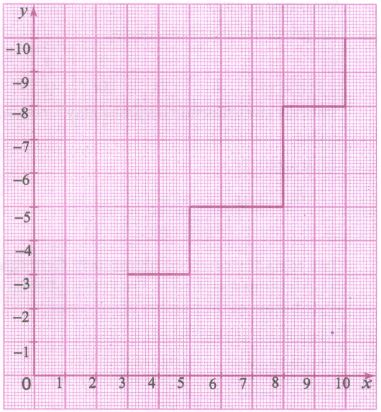
Find and plot the c.d.f. of X.
19.
The marginal cost function of manufacturing x shoes is 6 +10x − 6x2. The cost producing a pair of shoes is Rs. 12. Find the total and average cost function.
20.
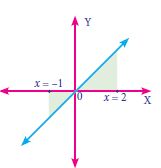
Find the area bounded by y = x between the lines x = −1 and x = 2 with x -axis.
21.
Integrate the following with respect to x.
x3e3x
22.
Integrate the following with respect to x.
\(\frac { 1 }{ x{ \left( \log x \right) }^{ 2 } } \)
23.
A total of Rs. 8,600 was invested in two accounts. One account earned \(4\frac { 3 }{ 4 } %\)% annual interest and the other earned \(6\frac { 1 }{ 2 } %\)% annual interest. If the total interest for one year was Rs. 431.25, how much was invested in each account? (Use determinant method).
24.
Solve the equations 2x + 3y = 7, 3x + 5y = 9 by Cramer’s rule.
25.
Find the rank of the matrix A = \(\left( \begin{matrix} 1 & 1 & 1 \\ 3 & 4 & 5 \\ 2 & 3 & 4 \end{matrix}\begin{matrix} 1 \\ 2 \\ 0 \end{matrix} \right) \)
1.
Let A =\(\left( \begin{matrix} 1 & 2 & -1 \\ 2 & 4 & 1 \\ 3 & 6 & 3 \end{matrix}\begin{matrix} 3 \\ -2 \\ -7 \end{matrix} \right) \)
The order of A is 3 x 4
\(\therefore \rho \left( A \right) \le 3\) [Since minimum of (3, 3) is 3]
Let us transform the matrix to an echelon form.
| Matrix A | Elementary Transformation |
|---|---|
| \(A=\left( \begin{matrix} 1 & 2 & -1 \\ 2 & 4 & 1 \\ 3 & 6 & 3 \end{matrix}\begin{matrix} 3 \\ -2 \\ -7 \end{matrix} \right) \) | |
| \(\sim \left( \begin{matrix} 1 & 2 & -1 \\ 0 & 0 & 3 \\ 3 & 6 & 3 \end{matrix}\begin{matrix} 3 \\ -8 \\ -7 \end{matrix} \right) \) | \({ R }_{ 2 }\rightarrow { { R }_{ 2 }-2{ R }_{ 1 } }\) |
| \(\sim \left( \begin{matrix} 1 & 2 & -1 \\ 0 & 0 & 3 \\ 0 & 0 & 6 \end{matrix}\begin{matrix} 3 \\ -8 \\ -16 \end{matrix} \right) \) | \({ R }_{ 3 }\rightarrow { R }_{ 2 }-3{ R }_{ 1 }\) |
| \(\left( \begin{matrix} 1 & 2 & -1 \\ 0 & 0 & 3 \\ 0 & 0 & 0 \end{matrix}\begin{matrix} 3 \\ -18 \\ 0 \end{matrix} \right) \) | \({ R }_{ 3 }\rightarrow { R }_{ 3 }-2{ R }_{ 2 }\) |
The matrix is in echelon form and the number of non- zero rows is 2.
\(\therefore \rho (A)=2\)
2.
3.
The Forward difference table is given below
| x | y | Δy | Δ2y | Δ3y |
| 0 | 0 | |||
| 0.174 | ||||
| 10 | 0.174 | -0.001 | ||
| 0.173 | -0.001 | |||
| 20 | 0.347 | -0.002 | ||
| 0.171 | ||||
| 30 | 0.518 |
4.
Total Capacity = Total Demand
\(\therefore\) The given problem is balanced transportation problem.
Hence there exists a feasible solution to the given problem.
Given Transportation Problem is
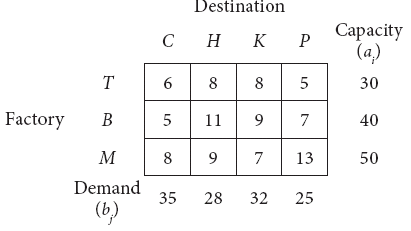
First Allocation:
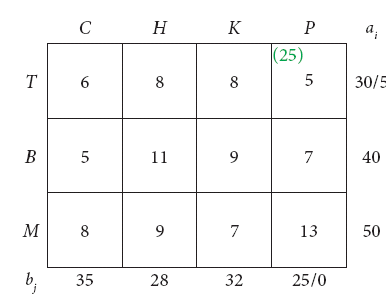
Second Allocation:
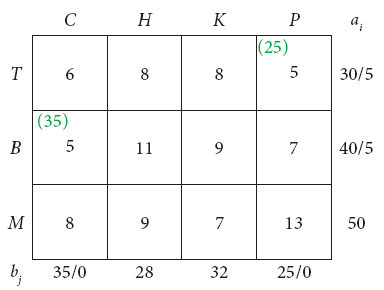
Third Allocation:
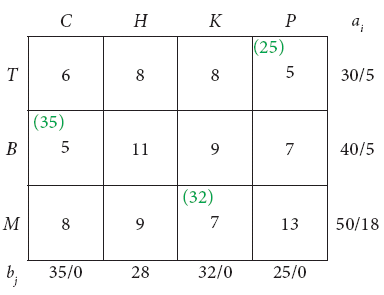
Fourth Allocation:
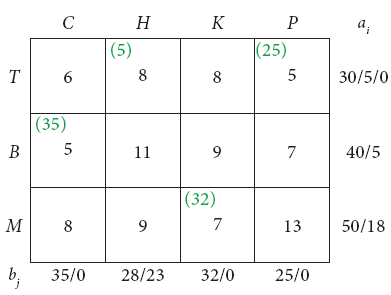
Fifth Allocation:
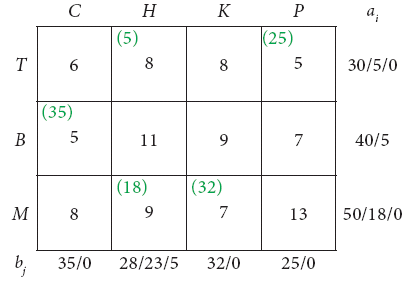
Sixth Allocation:
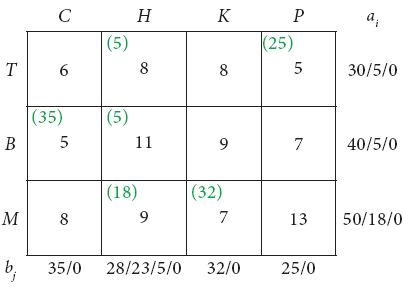
Transportation schedule :
T⟶H,T⟶P,B⟶C,B⟶H,M⟶H,M⟶K
The total Transportation cost = ( 5×8) + (25×5)+ (35×5) + (5×11)+ (18×9) + (32×7)
= 40+125+175+55+162+224
= Rs.781
5.
The given differential equation is of the follows
\(\frac { dy }{ dx } \)+ Py =Q where
P = cos x, Q = sinx cosx
∴ \(\int { P } dx=\int { cosx } dx\)
∴ Integrating factor (I.F) =\(e^{ \int { p.dx } }=e^{ sinx }\)
Hence, the solution is
\(ye^{ \int { p.dx } }=\int { Qe^{ \int { p.dx } } } dx+c\)
⇒ \(y.e^{ sinx }=\int { sinx } cosx.e^{ sinx }dx+c\)
put t = sin x ⇒ dt =cos x dx
⇒ \(ye^{ sinx }=\int { t{ e }^{ t } } dt\) ....(1)
put u = t; dv = et dt
du = dt; v = et
Using integration by parts
\(\int { u } dv=uv-\int { v } du\)
⇒ \(\int { t } e^{ t }dt=te^{ t }-\int { e^{ t }dt } \) = tet-et....(2)
Substituting (2) in (1) we get,
yesinx = t et-et + c
⇒ y esinx = et(t-1)+c
⇒ y esinx = esinx (sin x-1)+c [∵ t = sinx]
6.
7.
Equation of the family of paraboles with latus rectum 4a and whose axes are parallel to the x-axis is (y- k)2 = 4a(x- h)
[Where (h, k) is the centre of the parabola]
Differentiating w.r.t. 'x' we get,
2(y-k)\(\left( \frac { dy }{ dx } \right) \) = 4a(1)
⇒ 2(y-k)\(\left( \frac { dy }{ dx } \right) \) = 4a (1)
Differentiating again w.r.t x we get,
2(y-k)\(\left( \frac { { d }^{ 2 }y }{ dx^{ 2 } } \right) +\left( \frac { dy }{ dx } \right) (2)\frac { dy }{ dx } \) = 0 (Product rule)
(y-k)\(\left( \frac { d^{ 2 }y }{ dx^{ 2 } } \right) +\left( \frac { dy }{ dx } \right) ^{ 2 }\) = 0 [Divided by 2]
y-k= \(\frac { -\left( \frac { dy }{ dx } \right) ^{ 2 } }{ \frac { { d }^{ 2 }y }{ dx^{ 2 } } } \) (2)
Substituting (2) in (1) we get,
2\(\frac { -\left( \frac { dy }{ dx } \right) ^{ 2 } }{ \frac { { d }^{ 2 }y }{ dx^{ 2 } } } \left( \frac { dy }{ dx } \right) \)= 4a
⇒ \(-2\left( \frac { dy }{ dx } \right) ^{ 3 }=4a\left( \frac { d^{ 2 }y }{ dx^{ 2 } } \right) \)
⇒ \(4a\left( \frac { d^{ 2 }y }{ dx^{ 2 } } \right) +\left( \frac { dy }{ dx } \right) ^{ 3 }\)= 0
\(2a\frac { { d }^{ 2 }y }{ { dx }^{ 2 } } +{ \left( \frac { dy }{ dx } \right) }^{ 3 }=0\).
8.
Sample size n = 100,
Sample mean \(\\ \bar { X } =3.5\)
Population mean μ = 4
Population standard deviation σ = 3
Null Hypotheses: There is no significant difference in the mean. i.e., Ho : μ = 4
Alternative Hypotheses : There is Significant difference in the mean.
i.e., H1 : μ ≠ H
The level of significance ∝ = 5% = 0.05
Applying the test statistic,\(Z=\frac { \bar { X } -\mu }{ \frac { \sigma }{ \sqrt { n } } } \)
\(\Rightarrow Z=\frac { 3.5-4 }{ \frac { 3 }{ \sqrt { 100 } } } =\frac { -.5 }{ .3 } =-1.667\)
\(\Rightarrow |Z|=1.667\)
\({ Z }_{ \frac { \alpha }{ 2 } }=1.96\)
Here Z < \({ Z }_{ \frac { \alpha }{ 2 } }\)i.e., 1.667<1.96
Inference: Since Z<\({ Z }_{ \frac { \alpha }{ 2 } }\)at 5% level of significance, the null hypothesis H0 is accepted. Hence there is no Significant difference in the mean.
9.
The errors that arise due to human factors which always vary from one investigator to another in selecting, estimating or using measuring instruments are called Non-Sampling errors.
It may arise in the following ways:
a) Due to negligence and carelessness of the part of either investigator or respondents.
b) Due to lack of trained and qualified investigators.
c) Due to framing of a wrong questionnaire.
d) Due to applying wrong statistical measure.
e) Due to incomplete investigation and sample survey.
10.
Let t = x2 + 3x + 7
⇒ dt = (2x + 3)
When x = -1, t = (-1)2 +3(-1)+7 = 1-3 + 7= 5
When x = 1, t = 12 +3(1)+7 = 11
∴ I = \(\int _{ 5 }^{ 11 }{ \frac { dt }{ t } } ={ \left( \log { t } \right) }_{ 5 }^{ 11 }\)
\(=\log { 11 } -\log { 5 } \)
\(=\log { \left( \frac { 11 }{ 5 } \right) } \)
11.
Let p be the probability of drug's side effect
∴ p = \(\frac { 3 }{ 100 } \) =.03
⇒ q = 1-p = 1-0.03 = 0.97 and n = 10
P (atleast one person will have side effect)
= P(X ≥ 1)
= 1 - P(X < 1)
= 1 - [P(X =0)] ∵ p(x) =nCx pxqn-x, n=10, x=0
= 1-[10C0 (0.03)0 (0.97)10 ]
= 1-(0.97)10 [∵ 10C0 = 1 and (0.03)0 = 1]
= 1-0.7374
P(X≥1) = 0.2626
12.
We are given mean μ = 800 and standard deviation σ = 100
Probability that the procurement of milk between 800 litres to 1000 litres per day is
P(800 < X < 1000)
\(P(\frac { 800-800 }{ 100 })\)
P(0 < Z < 2) = 0.4772 (table value)
Therefore 47.75 percent of societies procure milk between 800 litres to 1000 litres per day.
13.
Probability of getting a degree p = 0.4
∴ q = 1– p
= 1 - 0.4
= 0.6
(i) P (one will be a graduate) = P(X = 1) = 5C1 (0.4)(0.6)4
= 0.2592
(ii) P ( atleast one will be a graduate) = 1–P (none will be a graduate)
= 1-5C0(P0)(Q)5-0
= 1-5C0(0.4)0(0.6)5
= 1-0.0777
= 0.9222
14.
\(Let\ I=\int { \frac { { x }^{ e-1 }+{ e }^{ x-1 } }{ { x }^{ e }+{ e }^{ x } } } dx\)
\(put\ t={ x }^{ e }+{ e }^{ x }\)
\(\Rightarrow dt=\left( e{ x }^{ e-1 }+{ e }^{ x } \right) dx\)
\(dt=e\left( { x }^{ e-1 }+{ e }^{ x-1 } \right) dx\)
\(\Rightarrow \frac { dt }{ e } =\left( { x }^{ e-1 }+{ e }^{ x-1 } \right) dx\)
\(\therefore I=\int { \frac { dt }{ e(t) } } =\frac { 1 }{ e } \int { \frac { dt }{ t } } \)
\(=\frac { 1 }{ e } \log { \left| t \right| } +c\)
\(=\frac { 1 }{ e } \log { \left| { x }^{ e }+{ e }^{ x } \right| } +c\quad \left[ \because t={ x }^{ e }+{ e }^{ x } \right] \)
15.
Given MR = 275 - x - 0.3x2
ഽMR = f(275 - x - 0.3x2)dx
To find the total revenue, when it is increased from 10 to 20 units
\(R=\int _{ 10 }^{ 20 }{ (275-x-0.3{ x }^{ 2 })dx } \)
\(={ \left( 275x-\frac { { x }^{ 2 } }{ 2 } -0.3\frac { { x }^{ 3 } }{ 3 } \right) }_{ 10 }^{ 20 }\)
\(={ \left( 275x-\frac { { x }^{ 2 } }{ 2 } -0.1{ x }^{ 3 } \right) }_{ 10 }^{ 20 }\)
\(=\left[ 275(20)-\frac { { 10 }^{ 2 } }{ 2 } -0.1({ 10 }^{ 3 }) \right] \)
= [5500 - 200 - 800] - [2750 - 50 - 100]
= [5500 - 1000] - [2750 - 150]
= 4500-2600 = 1,900
R = Rs. 1,900
16.
We know that,
\(E(X)=\int _{ -\infty }^{ \infty }{ xf(x)dx } \)
\(=\int _{ 0 }^{ 1 }{ x{ 4x }^{ 3 } } dx\)
\(=4{ \left[ \frac { { x }^{ 5 } }{ 5 } \right] }_{ 0 }^{ 1 }\)
\(E(X)=\frac { 4 }{ 5 } \)
\(E\left( { X }^{ 2 } \right) =\int _{ -\infty }^{ \infty }{ { x }^{ 2 } } f(x)dx\)
\(=\int _{ 0 }^{ 1 }{ { x }^{ 2 }{ 4x }^{ 3 } } dx\)
\(=4{ \left[ \frac { { x }^{ 6 } }{ 6 } \right] }_{ 0 }^{ 1 }\)
\(=\frac { 4 }{ 6 } =\frac { 2 }{ 3 } \)
\(V(X)=\left( { x }^{ 2 } \right) -{ [E(X)] }^{ 2 }\)
\(=\frac { 4 }{ 6 } -{ \left[ \frac { 4 }{ 5 } \right] }^{ 2 }\)
\(=\frac { 2 }{ 75 } \)
17.
Given demand function Pd = 85 - 5x and
Supply function p5 = 3x - 35
At equilibrium prices,Pd = Ps
⇒ 85 - 5x = 3x - 35
⇒ 85 + 35 = 3x + 5x
⇒ 120 = 8x
⇒ x = \(\frac{120}{8}\) = 15
When x0 = 15, p0 = 85-5(15)
= 85 - 75 = 10
p0 = 10
∴ p0x0 = 15\(\times\)10 = 150
Consumer's Surplus
\(Cs=\int _{ 0 }^{ x }{ f(x) } dx-{ p }_{ 0 }{ x }_{ 0 }\)
\(=\int _{ 0 }^{ 15 }{ (85-5x)dx-150 } \)
\(={ \left[ 85x-\frac { 5{ x }^{ 2 } }{ 2 } \right] }_{ 0 }^{ 15 }-150\)
\(=85(15)-5\frac { { (15) }^{ 2 } }{ 2 } -150\)
\(=1275-\frac { 1125 }{ 2 } -150\)
= 1275 - 562.5 - 150
= 1275 - 712.5
Cs = 562.5
18.
Given probability mass function is
| X=x | 3 | 5 | 8 | 10 |
| P(X=x) | 0.3 | 0.2 | 0.3 | 0.2 |
∴ The cumulative distribution function Fx(x) is
Fx(0) = 0 if x < 3
Fx(3) = P(X = 3) = 0.3, for 3 ≤x<5
Fx(5) = P(X = 3)+P(X = 5) = 0.3+0.2 = 0.5, for 5≤X<8
Fx(8) = P(X = 3)+P(X+5)+P(X = 8)
= 0.3+0.2+0.3
= 0.8,8≤x<10
Fx(10) = P(X = 3)+P(X = 5)+P(X = 8)+P(X = 10)
= 0.3+0.2+0.3+0.2
= 1 for x ≥10
\(F_{x}(x)= \begin{cases}0, & \text { if } x<3 \\ 0.3, & \text { if } 3 \leq x < 1 \\ 0.5, & \text { if } 5 \leq x < 8 \\ 0.8, & \text { if } 8 \leq x < 10 \\ 1, & \text { if } x ≥ 10 \\ \end{cases}\)
19.
Given,
Marginal cost MC = 6 +10x − 6x2
C = \(\int { MC } dx+k\)
= \(\int { (6+10x-{ 6x }^{ 2 })dx+k } \)
= 6x + 5x2 − 2x3 + k (1)
when x = 2, C = 12 (given)
12 = 12 + 20 −16 + k
k = -4
C = 6x + 5x2 − 2x3 − 4
Average cost = \(\frac { C }{ x } =\frac { 6x+{ 5x }^{ 2 }-2{ x }^{ 3 }+{ 4 } }{ x } \)
= 6 + 5x − 2x2 − \(\frac { 4 }{ x } \)
20.
Required area = \(\int _{ -1 }^{ 0 }{ -xdx } +\int _{ 0 }^{ 2 }{ xdx } \)
\(=-{ \left[ \frac { { x }^{ 2 } }{ 2 } \right] }_{ -1 }^{ 0 }{ +\left[ \frac { { x }^{ 2 } }{ 2 } \right] }_{ 0 }^{ 2 }=-\left[ 0-\frac { 1 }{ 2 } \right] +\left[ \frac { 4 }{ 2 } -0 \right] \)
\(=\frac { 5 }{ 2 } \) sq.units
21.
\(Let\ I=\int { { x }^{ 3 }{ e }^{ 3x } } dx\)
\(Let\ u={ x }^{ 3 };dv= { e }^{ 3x }dx\)
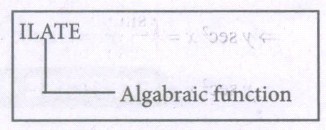
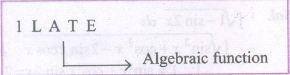
Using Bernoulli's formula
= uv − u'v1 + u''v2 − u'''v3 + ...
\(\therefore \int { { x }^{ 3 }{ e }^{ 3x }dx } \)
\(={ x }^{ 3 }\frac { { e }^{ 3x } }{ 3 } -{ 3x }^{ 2 }\left( \frac { { e }^{ 3x } }{ 9 } \right) +6x\left( \frac { { e }^{ 3x } }{ 27 } \right) -6\left( \frac { { e }^{ 3x } }{ 81 } \right) +c\)
\(=\frac { { x }^{ 3 }{ e }^{ 3x } }{ 3 } -\frac { { x }^{ 2 }{ e }^{ 3x } }{ 3 } +\frac { { 2xe }^{ 3x } }{ 9 } -\frac { { 2e }^{ 3x } }{ 27 } +c\)
\(={ e }^{ 3x }\left[ \frac { { x }^{ 3 } }{ 3 } -\frac { { x }^{ 2 } }{ 3 } +\frac { 2x }{ 9 } -\frac { 2 }{ 27 } \right] +c\)
| Successive derivatives | Repeated Integrals |
| u = x3 | dv = e3xdx |
| u' = 3x3 | \(v=\frac { { e }^{ 3x } }{ 3 } \) |
| u'' = 6x | \({ v }_{ 1 }=\frac { { e }^{ 3x } }{ 9 } \) |
| u''' = 6 | \({ v }_{ 2 }=\frac { { e }^{ 3x } }{ 27 } \) |
| \({ v }_{ 3 }=\frac { { e }^{ 3x } }{ 81 } \) |
22.
Let I \(=\int { \frac { 1 }{ x{ \left( \log x \right) }^{ 2 } } } dx\)
put log x = t on differentiating we get,
\(\frac { 1 }{ x } dx=dt\)
\(\therefore I=\int { \frac { 1 }{ { t }^{ 2 } } } dt\) [∵ t = log x]
\(I=\int { { t }^{ -2 } } dt\)
\(=\frac { { t }^{ -2+1 } }{ -2+1 } +c\)
\(=\frac { { t }^{ -1 } }{ -1 } +c\Rightarrow \frac { -1 }{ t } +c\)
\(=\frac { -1 }{ \log { \left| x \right| } } +c\) [∵ t = log |x|]
23.
Let the amount invested in the two accounts be Rs. x and Rs. y respectively
By the given data, x + y = 8600 ..(1)
\(4\cfrac { 3 }{ 4 } \times \cfrac { x }{ 100 } +6\cfrac { 1 }{ 2 } \times \cfrac { y }{ 100 } =431.25\) \(\left[ \therefore interest=\cfrac { PNR }{ 100 } \right] \)
\(\Rightarrow \cfrac { 19x }{ 400 } +\cfrac { 13y }{ 3200 } =431.25\)
\(\Rightarrow \cfrac { 19x+26y }{ 400 } =431.25\)
19x + 26y = 172500 ...(2)
\(\Delta =\left| \begin{matrix} 1 & 1 \\ 19 & 26 \end{matrix} \right| =1(26)-1(19)\)
= 26-19 =7
\({ \Delta }x=\left| \begin{matrix} 8600 & 1 \\ 172500 & 26 \end{matrix} \right| =8600(26)-1(172500)\)
= 223600 - 172500 = 51100
\(\Delta y=\left| \begin{matrix} 1 & 8600 \\ 19 & 172500 \end{matrix} \right| =1(172500)-19(8600)\)
= 172500 - 163400 = 9100
\(x=\cfrac { \Delta x }{ \Delta } -\cfrac { 51100 }{ 7 } =7300\)
\(y=\cfrac { \Delta y }{ \Delta } =\cfrac { 9100 }{ 7 } =1300\)
\(\therefore\) Investment in the interest of \(4\frac { 3 }{ 4 } \) % account is Rs. 7300 and investment in the rate of \(6\frac { 1 }{ 2 } \) account is Rs.1300.
24.
The equations are
2x + 3y = 7
3x + 5y = 9
Here \(\triangle =\left| \begin{matrix} 2 & 3 \\ 3 & 5 \end{matrix} \right| =1\)
\(\neq 0\)
\(\therefore \) we can apply Cramer’s Rule
Now \({ \triangle }_{ x }=\left| \begin{matrix} 7 & 3 \\ 9 & 5 \end{matrix} \right| =8\) \({ \triangle }_{ y }=\left| \begin{matrix} 2 & 7 \\ 3 & 9 \end{matrix} \right| =-3\)
\(\therefore \) By Cramer’s rule
\(x=\frac { { \triangle }_{ X } }{ \triangle } =\frac { 8 }{ 1 } =8\) \(y=\frac { { \triangle }_{ y } }{ \triangle } =\frac { -3 }{ 1 } =-3\)
\(\therefore \) Solution is x = 8, y = −3
25.
The order of A is 3 \(\times\) 4.
\(\therefore \) \(\rho (A)\le 3.\)
Let us transform the matrix A to an echelon form
| Matrix A | Elementary Transformation |
| \(A=\left( \begin{matrix} 1 & 1 & 1 \\ 3 & 4 & 5 \\ 2 & 3 & 4 \end{matrix}\begin{matrix} 1 \\ 2 \\ 0 \end{matrix} \right) \) \(\sim \left( \begin{matrix} 1 & 1 & 1 \\ 0 & 1 & 2 \\ 0 & 1 & 2 \end{matrix}\begin{matrix} 1 \\ -1 \\ -2 \end{matrix} \right) \) \(\sim \left( \begin{matrix} 1 & 1 & 1 \\ 0 & -1 & -2 \\ 0 & 0 & 0 \end{matrix}\begin{matrix} 1 \\ 1 \\ -1 \end{matrix} \right) \) |
\({ R }_{ 2 }\rightarrow { R }_{ 2 }-{ 3R }_{ 1 }\) \({ R }_{ 3 }\rightarrow { R }_{ 3 }-{ 2R }_{ 1 }\) \({ R }_{ 3 }\rightarrow { R }_{ 3 }-{ R }_{ 2 }\) |
The number of non zero rows is 3.
\(\therefore \) \(\rho (A)=3.\)

12th Standard Syllabus & Materials
12th Standard
TN 12th Computer Applications வலையமைப்பு வடமிடல் Sample Question Papers Study Material - QB365 Set A
NEW12th Standard
TN 12th Computer Applications களப்பெயர் முறைமை (DNS) Sample Question Papers Study Material - QB365 Set A
NEW12th Standard
TN 12th Computer Applications வலையமைப்பு எடுத்துக்காட்டுகள் மற்றும் நெறிமுறைகள் Sample Question Papers Study Material - QB365 Set A
NEW12th Standard
TN 12th Computer Applications கணினி வலையமைப்பு ஓர் அறிமுகம் Sample Question Papers Study Material - QB365 Set A



Tamilnadu Stateboard 12th Standard Subjects

Maths

Chemistry

Physics

Biology

Computer Science
Business Maths and Statistics

Economics

Commerce

Accountancy

History

Computer Applications
Biology
Computer Technology
Computer Applications
Computer Science
Business Maths and Statistics
Commerce
Economics
Maths
Chemistry
Physics
Computer Technology
History
Accountancy

Tamil

English

French
Tamilnadu Stateboard Standards
