
 100% FREE ACCESS
12th Standard Syllabus & Materials
12th Standard
TN 12th Maths Applications of Matrices and Determinants Sample Question Papers Study Material - QB365 Set A
NEW12th Standard
TN 12th Computer Applications மின்னணு தரவு பரிமாற்றம் Sample Question Papers Study Material - QB365 Set A
NEW12th Standard
TN 12th Computer Applications மின் - வணிக பாதுகாப்பு அமைப்புகள் Sample Question Papers Study Material - QB365 Set A
NEW12th Standard
TN 12th Computer Applications மின்னணு செலுத்தல் முறைகள் Sample Question Papers Study Material - QB365 Set A
NEW12th Standard
TN 12th Computer Applications மின் - வணிகம் Sample Question Papers Study Material - QB365 Set A
NEW12th Standard
TN 12th Computer Applications திறந்த மூல கருத்துருக்கள் Sample Question Papers Study Material - QB365 Set A

Published on: 01/03/2021
12th Standard English Medium Business Maths Reduced Syllabus Two Mark Important Questions - 2021(Public Exam )
Download Tamil Nadu 12th Standard Business Maths and Statistics question papers, model tests, one-mark questions, important questions, and public exam papers in PDF format. Free study materials and answer keys for TN State Board students.
Questions + Answers key
Take MCQ Business Maths and Statistics Test
1.
Find the differential equation of the following
xy = c2
2.
What is the difference between Assignment Problem and Transportation Problem?
3.
What is the Assignment problem?
4.
Write mathematical form of transportation problem.
5.
Solve the following differential equations
\(\frac { { d }^{ 2 }y }{ d{ x }^{ 2 } } -6\frac { dy }{ dx } +8y=0\)
6.
Write the control limits for the R chart.
7.
Name the control charts for variables.
8.
What do you mean by process control?
9.
Define Assignable Cause.
10.
Define Statistical Quality Control.
11.
State the test of adequacy of index number.
12.
Mention the classification of Index Number.
13.
Define seasonal index.
14.
Discuss about irregular variation
15.
Explain cyclic variations.
16.
Mention the components of the time series.
17.
What is single tailed test.
18.
Define critical region.
19.
What is interval estimation?
20.
What is an estimate?
21.
State any two demerits of systematic random sampling.
22.
What is standard error?
23.
What is sample?
24.
Evaluate the following using properties of definite integrals:
\(\int _{ -\frac { \pi }{ 4 } }^{ \frac { \pi }{ 4 } }{ { x }^{ 3 }{ cos }^{ 3 }xdx } \)
25.
Using the following Tippett’s random number table,
| 2952 | 6641 | 3992 | 9792 | 7969 | 5911 | 3170 | 5624 |
| 4167 | 9524 | 1545 | 1396 | 7203 | 5356 | 1300 | 2693 |
| 2670 | 7483 | 3408 | 2762 | 3563 | 1089 | 6913 | 7991 |
| 0560 | 5246 | 1112 | 6107 | 6008 | 8125 | 4233 | 8776 |
| 2754 | 9143 | 1405 | 9025 | 7002 | 6111 | 8816 | 6446 |
Draw a sample of 15 houses from Cauvery Street which has 83 houses in total.
26.
Define Standard normal variate.
27.
If \(\int _{ 1 }^{ a }{ { 3 }x^{ 2 } } \) dx = -1, then find the value of a ( a ∈ R ).
28.
Write the conditions for which the poisson distribution is a limiting case of binomial distribution.
29.
A pair of dice is thrown 4 times. If getting a doublet is considered a success, find the probability of 2 successes.
30.
Write down the conditions for which the binomial distribution can be used.
31.
In a book of 520 pages, 390 typo-graphical errors occur. Assuming Poisson law for the number of errors per page, find the probability that a random sample of 5 pages will contain no error.
32.
Evaluate ഽ\(\sqrt { { x }^{ 2 }-16 } \)dx
33.
Verfy the following statement:
The mean of a Binomial distribution is 12 and its standard deviation is 4.
34.
State the definition of Mathematical expectation using continuous random variable.
35.
Define Mathematical expectation in terms of discrete random variable.
36.
What do you understand by Mathematical expectation?
37.
The following information is the probability distribution of successes.
| No. of Successes | 0 | 1 | 2 |
| Probability | \(\frac{6}{11}\) | \(\frac{9}{22}\) | \(\frac{1}{22}\) |
Determine the expected number of success.
38.
Explain the distribution function of a random variable.
39.
Define discrete random variable.
40.
The number of cars in a household is given below.
| No. of cars | 0 | 1 | 2 | 3 | 4 |
| No. of Household | 30 | 320 | 380 | 190 | 80 |
Estimate the probability mass function. Verify p(xi ) is a probability mass function.
41.
Find the area bounded by the lines y − 2x − 4 = 0, y = 1, y = 3 and the y-axis
42.
Using Integration, find the area of the region bounded the line 2y + x = 8, the x axis and the lines x = 2, x = 4.
43.
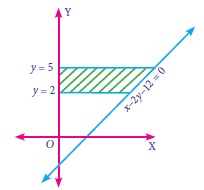
Find the area of the region bounded by the line x − 2y − 12 = 0 , the y-axis and the lines y = 2, y = 5.
44.
Evaluate \(\int { \frac { \cos2x }{ { \sin }^{ 2 }{ x \cos }^{ 2 }x } dx } \)
45.
Evaluate \(\int { \left( { x }^{ 3 }+7 \right) \left( x-4 \right) dx } \)
46.
Evaluate \(\int \sqrt{2 x+1} \ d x\)
47.
Solve: \(\frac { dy }{ dx } ={ ae }^{ y }\)
48.
Determine the binomial distribution for which the mean is 4 and variance 3. Also find P(X=15).
49.
If MR = 14 − 6x + 9x2, find the demand function.
50.
Integrate the following with respect to x.
\(\frac { 8x+13 }{ \sqrt { 4x+7 } } \)
1.
Differentiating w.r.t 'x' we get,
x.\(\frac { dy }{ dx } \) + y(1) = 0 [Product rule]
⇒ x\(\frac { dy }{ dx } \) + y = 0 which is the required differentiated equation.
2.
The assignment problem is a special case of transportation problem where the number of sources and destinations are equal. Here, jobs represent sources and machines represent destinations.
3.
To assign the different jobs to the different machines (one job per machine) to minimize the overall cost is known as assignment problem.
4.
The objective function is minimize Z = \(\overset { m }{ \underset { i=1 }{ \Sigma } } \overset { n }{ \underset { j=1 }{ \Sigma } } { { C }_{ ij } }{ x }_{ ij }\) subject to the constraints
\(\overset { n }{ \underset { j=1 }{ \Sigma } }{ x }_{ ij } = a_i, i=1,2,.....m\) (Supply constraints)
\(\overset { m }{ \underset { i=1 }{ \Sigma } }{ x }_{ ij } = b_j, j=1,2,.....n\) (demand constraints)
xij ≥, 0 for all i, j (non-negative restrictions)
5.
The auxiliary equation is m2 - 6m + 8 = 0
⇒ (m-4)(m-2) = 0
⇒ m = 2, 4
The roots are real and different
∴ Complementary function CF is Ae2x + Be4x
∴ The general solution is y = Ae2x + Be4x

6.
| Case (i) when SD are given |
Case (ii) when SD are not given |
| (i) UCL = \(\overline{R} + 3 {\sigma}_{R}\) | (i) UCL = D4 \(\overline {R }\) |
| (ii) CL = \(\overline {R }\) | (ii) CL = \(\overline {R }\) |
| (iii) LCL = \(\overline {R} - {3\sigma_{R}}\) | (iii) LCL = D3 \(\overline {R }\) |
7.
The control charts of variables are
(i) Charts for mean (\(\overline { X } \))
(ii) Charts for Range (R)
8.
The main objective in any product process is to control and maintain a satisfactory quality level of the manufactured product. This is done by Process Control. In process control the proportion of defective items in the production process is to be minimized and it is achieved through the technique of control charts.
9.
Assignable Causes is present in any production process is due to non-random causes. It may occur at any stage of the process, right from the arrival of the raw materials to the final delivery of the product. Some of the important factors of assignable causes are defective raw materials, fault in machines. unskilled manpower, worn out tools, new operation etc.
10.
Statistical Quality control is a powerful technique used to diagnose the lack of quality in any of the raw materials, processes, machines etc. It is essential that end products should possess the qualities that the consumer expects from the manufacturer.
11.
Index numbers are studied to know the relative changes in price and quantity for any two years compared. There are two tests which are used to test the adequacy for an index number. The two tests are as follows.
(i) Time reversal test
(ii) Factor reversal test
The criterion for a good index number is to satisfy the above two tests.
12.
Index number can be classified as follows
(i) Price index number
It measures the general changes in the retail or wholesale price level of a particular or group of commodities.
(ii) Quantity index number
These are indices to measure the changes in the quantity of goods manufactured in a factory.
(iii) Cost of living index number
These are intended to study the effect of change in the price level on the cost of living of diferent classes of people.
13.
Seasonal index is a measure of how a particular season compares with the average season.
14.
Irregular variations do not have particular pattern and there is no regular period of time of their occurrences. Normally they are short terms variations but its occurrence sometimes has its effect so intense that they may give rise to new cyclic or other movements of variations.
For example floods, wars, earthquakes, Tsunami, strikes, lockouts etc.
15.
Cyclic uniformly periodic in nature. They may or may not follow exactly similar patterns after equal intervals of time. Generally one cyclic period ranges from 7 to.9 years and there is no hard and fast rule in the fixation of years for a cyclic period. For example, every business cycle has a Start-Boom-Depression- Recover maintenance during booms and depressions, changes in government monetary policies, changes in interestrates.
16.
The components of time series are
(i) Secular trend
(ii) Seasonal variations
(iii) Cyclic variations
(iv) Irregular variations
17.
When the hypothesis about the population parameter is rejected only for the value of sample statistic falling into one of the tails of the sampling distribution, then it is known as one tailed test.
18.
A region corresponding to a test statistic in the sample space which tends to rejection of Ho is called critical region.
19.
Generally, there are situations where point estimation is not desirable and we are interested in finding limits within which the parameter would be expected to lie is called an interval estimation.
20.
When we observe a specific numerical value, of our estimator, we call that value is an estimate. In other words, an estimate is a specific observed value of statistic.
21.
1. Systematic samples are not random samples.
2. If N is not a multiple of n, then the sampling interval (k) cannot be an integer, thus sample selection becomes difficult.
22.
The standard deviation of the sampling distribution of a statistic is known as its Standard Error.
23.
A selection of a group of individuals from a population in such a way that it represents the population is called as sample.
24.
Let f(x) = x3 cos3x
f(-x) = (-x)3 [cos(-x)]3
= -x3 (cos x)3
[Since cos x is an even function]
= -f(x)
∴ f(-x) = -f(x) ⇒ f(x) is an odd function
By the property, \(\int _{ -a }^{ a }{ f\left( x \right) } dx=0\) if f(x) is an odd function.
\(\Rightarrow \int _{ \frac { -\pi }{ 4 } }^{ \frac { \pi }{ 4 } }{ { x }^{ 3 } } { cos }^{ 3 }x\ dx=0\)
25.
There many ways to select 15 random samples from the given Tippet’s random number table. Since the population size is 83(two-digit number). Here the door numbers are assigned from 1 to 83. Assume that at random we first choose 2nd column. So the first sample is 66 and other 14 samples are 74, 52, 39, 15, 34, 11, 14, 13, 27, 61, 79, 72, 35, and 60. If the numbers are above 83, choose the next number ranging from 1 to 83.
| 2952 | 6641 | 3992 | 9792 | 7969 | 5911 | 3170 | 5624 |
| 4167 | 9524 | 1545 | 1396 | 7203 | 5356 | 1300 | 2693 |
| 2670 | 7483 | 3408 | 2762 | 3563 | 1089 | 6913 | 7991 |
| 0560 | 5246 | 1112 | 6107 | 6008 | 8125 | 4233 | 8776 |
| 2754 | 9143 | 1405 | 9025 | 7002 | 6111 | 8816 | 6446 |
26.
A random variable Z = \(\frac { X-\mu }{ \sigma } \) follows the standard normal distribution is called the standard normal variate with mean 0 and standard deviation 1. i.e. Z~ N(0,1). Its,probability density function is given by:
\(\varphi(Z)=\frac{1}{\sqrt{2 \pi}} e^{-\frac{Z^{2}}{2}},-\infty< Z< \infty
\)
27.
Given that \(\int _{ 1 }^{ a }{ { 3 }x^{ 2 } } dx=-1\)
\({ \left[ { x }^{ 3 } \right] }_{ 1 }^{ a }=-1\)
a3 −1 = –1
a3 = 0 ⇒ a = 0
28.
Poisson distribution is a limiting case of binomial distribution under the following conditions.
(i) n, the number of trials is indefinitely large ie., n⟶∞.
(ii) p, the constant probability of success in each trial is very small ie., p ⟶0.
(iii) np = λ is finite.Thus p = λ/n and q = 1 -(λ/n) where λ is a positive real number.
29.
Let p be the probability of getting doublet in a pair of dice.
∴ p = \(\frac { 6 }{ 36 } \) [∵ favourable events are (1, 1) (2,2) (3,3) (4,4) (5,5) (6,6) and n(S) = 36]
⇒ p = \(\frac { 1 }{ 6 } \) ∴ q=1-p =\(1-\frac { 1 }{ 6 } =\frac { 5 }{ 6 } \)]
∴ P (getting 2 success) = P(X = 2)
=4C2 \(\left( \frac { 1 }{ 6 } \right) ^{ 2 }\left( \frac { 5 }{ 6 } \right) ^{ 2 }\) [∵ p(x) =nCx pxqn-x, n = 4, x = 2 ]
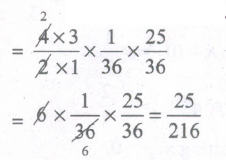
∴ P(X = 2) =\(\frac { 25 }{ 216 } \).
30.
The binomial distribution can be used under the following conditions.
(i) The number of trials en' is finite,
(ii) The trials are independent of each other.
(iii) The probability of success 'p' is constant for each trial.
(iv) In every trial there are only two possible outcomes namely success or failure.
31.
The average number of typographical errors per page in the book is given by \(\lambda\) = (390/520) = 0.75.
Hence using Poisson probability law, the probability of x errors per page is given by
\(P(X=x)=\frac { { e }^{ -\lambda }{ \lambda }^{ x } }{ x! } ={ e }^{ -0.75 }=\frac{(0.75)^x}{x!}\) x = 0,1,2,3……
The required probability that a random sample of 5 pages will contain no error is given by :
[P(X = 0)]5 = (e-0.75)5 = e-3.75
32.
ഽ\(\sqrt { { x }^{ 2 }-16 } \) dx = ഽ\(\sqrt { { x }^{ 2 }-{ 4 }^{ 2 } } \) dx
= \(\frac { x }{ 2 } \sqrt { { x }^{ 2 }-{ 4 }^{ 2 } } -\frac { { 4 }^{ 2 } }{ 2 } \log\left| x+\sqrt { { x }^{ 2 }-{ 4 }^{ 2 } } \right| +c\)
= \(\frac { x }{ 2 } \sqrt { { x }^{ 2 }-16 } -8 \log\left| x+\sqrt { { x }^{ 2 }-16 } \right| +c\)
33.
Mean: np = 12
\(SD=\sqrt { npq } =4\)
\(npq={ 4 }^{ 2 }=16,\frac { np }{ npq } =\frac { 12 }{ 16 } =\frac { 3 }{ 4 } \)
\(q=\frac { 4 }{ 3 } >1\)
Since p + q cannot be greater than unity, the Statement is wrong
34.
If X is a continuous random variable and f(x) is the value of its probability density function at x, then the expected value of X is
\(E(X)=\int _{ -\infty }^{ \infty }{ x.(x)dx } \)
35.
Let X be a discrete random variable with probability mass function p(x), then its expected value is defined by
E(X) =\(\sum _{ x }^{ }{ x.p(x) } \)
36.
Mathematical expectation E(X) is an average of the values, that the random variable takes on, where each value is weighted by the probability that the random variable is equal to that value. Values that are most probable receive more weight. Each value x is multiplied by the approximate probability that X equals the valuex.
37.
Expected number of success is
E(X)\(E(X)=\sum _{ x }^{ }{ x } { P }_{ X }(x)\)
\(=\left( 0\times \frac { 6 }{ 11 } \right) +\left( 1\times \frac { 9 }{ 22 } \right) +\left( 2\times \frac { 1 }{ 22 } \right) \)
\(=\frac { 11 }{ 22 } \)
= 0.5
Therefore, the expected number of success is 0.5. Approximately one success.
38.
The discrete cumulative distribution function or distribution function of a real valued discrete random variable X takes the countable number of points x1,x2, .... with corresponding probabilities p(x1)p(x2).... and the distribution function is defined by
Fx(x) = P(X≤x) for all x∈R
ie.Fx(x) = \(\sum _{ { x }_{ i }\le x }^{ }{ p({ x }_{ i }) } \)
For a continuous random variable with the probability density function fx(x) then the distribution function Fx(x) is defined by
Fx(x) = P(X≤x)
39.
Discrete random variable :
A variable which can assume finite number of possible values or an infinite sequence of countable real numbers is called a discrete random variable.
40.
Let X be the number of cars
| X=xi | Number of Household | P(xi) |
| 0 | 30 | 0.03 |
| 1 | 320 | 0.32 |
| 2 | 380 | 0.38 |
| 3 | 190 | 0.19 |
| 4 | 80 | 0.08 |
| Total | 1000 | 1.00 |
i) P(xi)\(\ge\)0\(\forall \) i and
ii) \(\sum _{ i=1 }^{ \infty }{ P({ x }_{ i })=p(0)+p(1)+p(3)+p(4) } \)
= 0.03+0.32+0.38+0.19+0.08 = 1
Hence p(xi) is a probability mass function.
41.
y - 2x - 4 = 0
| x | 0 | -2 |
| y | 4 | 0 |
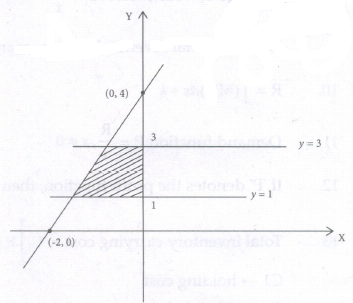
Given y - 2.x - 4 = 0
⇒ y-4 = 2x
⇒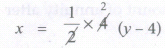
Since the area lies to the left of Y-axis, with the limits y = 1 &y = 3.
Area =\(\int _{ 1 }^{ 3 }{ -xdy } \)
\(=\int _{ 1 }^{ 3 }{ -\left( \frac { 1 }{ 2 } \right) (y-4)dy } \)
\(=\frac { 1 }{ 2 } \int _{ 1 }^{ 3 }{ (4-y)dy } =\frac { 1 }{ 2 } { \left[ 4y-\frac { { y }^{ 2 } }{ 2 } \right] }_{ 1 }^{ 3 }\)
\(=\frac { 1 }{ 2 } \left[ \left( 4(3)-\frac { { 3 }^{ 2 } }{ 2 } \right) -\left( 4(1)-\frac { { 1 }^{ 2 } }{ 2 } \right) \right] \)
\(=\frac { 1 }{ 2 } \left[ \left( 12-\frac { 9 }{ 2 } \right) -\left( 4-\frac { 1 }{ 2 } \right) \right] \)
\(=\frac { 1 }{ 2 } \left[ \left( \frac { 24-9 }{ 2 } \right) -\left( \frac { 8-1 }{ 2 } \right) \right] \)
\(=\frac { 1 }{ 2 } \left[ \frac { 15 }{ 2 } -\frac { 7 }{ 2 } \right] =\frac { 1 }{ 2 } \left[ \frac { 8 }{ 2 } \right] \)
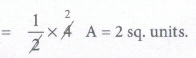
42.
2y + x = 8
| x | 0 | 8 |
| y | 4 | 0 |
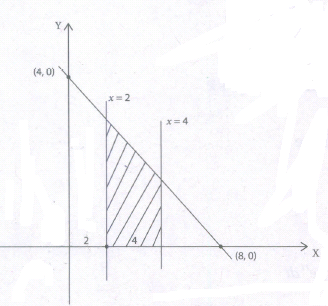
Given 2y + x = 8
2y = 8-x
y = \(\frac{1}{2}\) (8-x)
Given limits are x = 2 and x = 4
Area of the shaded region between the given limits
\(A=\int _{ a }^{ b }{ y\quad dx } =\int _{ 2 }^{ 4 }{ \frac { 1 }{ 2 } (8-x)dx } \)
\(\frac { 1 }{ 2 } \int _{ 2 }^{ 4 }{ (8-x)dx } =\frac { 1 }{ 2 } { \left[ 8x-\frac { { x }^{ 2 } }{ x } \right] }_{ 2 }^{ 4 }\)
\(=\frac { 1 }{ 2 } \left[ \left( 8(4)-\frac { { 4 }^{ 2 } }{ 2 } \right) \left( 8(2)-\frac { { 2 }^{ 2 } }{ 2 } \right) \right] \)
\(=\frac { 1 }{ 2 } [(32-8)-(16-21)]\)
\(=\frac { 1 }{ 2 } [24-14]\)
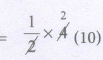
A = 5 sq. units.
43.
x - 2y - 12 = 0
x = 2y + 12
Required Area
= \(\int _{ 2 }^{ 5 }{ xdy } \)
= \(\int _{ 2 }^{ 5 }{ (2y+12)dy= } [{ { y }^{ 2 }+12y] }_{ 2 }^{ 5 }\)
= (25 + 60)−(4 + 24) = 57 sq.units
44.
\(\int { \frac { \cos2x }{ { \sin }^{ 2 }{ x \cos }^{ 2 }x } dx } =\int { \left( { cosec }^{ 2 }x-{ sec }^{ 2 }x \right) dx } \)
= −cot x − tan x + c
[ Change into simple integrands
\(\frac { \cos2x }{ { \sin }^{ 2 }{ x \cos }^{ 2 }x } =\frac { { \cos }^{ 2 }x{ -\sin }^{ 2 }x }{ { \sin }^{ 2 }x \cos^{ 2 }x } =\frac { 1 }{ { { \sin }^{ 2 }x } } -\frac { 1 }{ { \cos }^{ 2 }x } \)
\(=cosec^{ 2 }x−sec^{ 2 }x\)
45.
\(\int { \left( { x }^{ 3 }+7 \right) \left( x-4 \right) dx } \)
= \(\int { \left( { x }^{ 4 }-{ 4x }^{ 3 }+7x-28 \right) dx } \)
\(= \frac { { x }^{ 5 } }{ 5 } -{ x }^{ 4 }+\frac { { 7x }^{ 2 } }{ 2 } -28x+c\)
46.
\( \int \sqrt{2 x+1} \ d x=\int(2 x+1)^{\frac{1}{2}} d x\)
\(=\frac { { \left( 2x+1 \right) }^{ \frac { 3 }{ 2 } } }{ 3 } +c\)
47.
Given \(\frac { dy }{ dx } \) = ae7
Separating the variables we get,
\(\frac { dy }{ { e }^{ y } } \) =adx ⇒ e-y dy = adx
Integrating both sides we get,
\(\int { e^{ -y }dy } =a\int { dx } \)
-e-y= ax+c
ax + e-y+ c = 0
48.
Given mean of the binomial distribution is 4.
⇒ np =4 ...(1)
Variance=3 ⇒ npq =3..(2)
(2) \(\div \) (1) given, \(\frac { npq }{ np } =\frac { 3 }{ 4 } \Rightarrow q=\frac { 3 }{ 4 } \)
∴ p=1-q =\(1-\frac { 3 }{ 4 } =\frac { 1 }{ 4 } \)
Substituting p=\(\frac { 1 }{ 4 } \) in (1) we get,
n\(\left( \frac { 1 }{ 4 } \right) \) =4 ⇒ n=16
∴ The binomial distribution is nCx pxqn-x, x=0,1,2....n
⇒ 16Cx \(\left( \frac { 1 }{ 4 } \right) ^{ x }\left( \frac { 3 }{ 4 } \right) ^{ 16-x }\) x=0,1,2,......16.
∴ P(X=15) =16C15 \(\left( \frac { 1 }{ 4 } \right) ^{ 15 }\left( \frac { 3 }{ 4 } \right) ^{ 1 }\)
=16C1 \(\frac { 1 }{ { 4 }^{ 15 } } .\frac { 3 }{ 4 } =16.\frac { (3) }{ 4^{ 16 } } =\frac { 4^{ 2 }.(3) }{ 4^{ 16 } } \)
P(X=15) =\(\frac { 3 }{ { 4 }^{ 14 } } \).
49.
Given MR = 14 - x + 9x2
⇒ \(\frac{dR}{dx}\) = 14 - 6x + 9x2
⇒ dR = (14 - 6x + 9x2)dx
⇒ ഽdR = ഽ(14 - 6x + 9x2)dx
\(\Rightarrow \ R=14x-\frac { 6{ x }^{ 2 } }{ 2 } +\frac { { 9x }^{ 3 } }{ 3 } +k\)
When x = 0, R = 0 ⇒ k = 0
R = 14x - 3x2+ 3x3
Demand function \(P=\frac { R }{ x } =\frac { 14x-3{ x }^{ 2 }+{ 3x }^{ 3 } }{ x } \)
⇒ P = 14 − 3x + 3x2
50.
\(\int { \frac { 8x+13 }{ \sqrt { 4x+7 } } } dx\)
\(=\int { \frac { 8x+14-1 }{ \sqrt { 4x+7 } } } dx\)
\(=\int { \frac { 2\left( 4x+7 \right) -1 }{ \sqrt { 4x+7 } } } dx\)
\(=2\int { \frac { \left( 4x+7 \right) }{ \sqrt { 4x+7 } } } dx-\int { \frac { 1 }{ \sqrt { 4x+7 } } } dx\)
\(=2\int { \sqrt { 4x+7 } dx-\int { \frac { 1 }{ \sqrt { 4x+7 } } } } dx\)
\(=2\int { { \left( 4x+7 \right) }^{ \frac { 1 }{ 2 } } } dx-\int { { \left( 4x+7 \right) }^{ -\frac { 1 }{ 2 } } } dx\)
\(=2\frac { { \left( 4x+7 \right) }^{ \frac { 1 }{ 2 } +1 } }{ 4\left( \frac { 1 }{ 2 } +1 \right) } -\frac { { \left( 4x+7 \right) }^{ -\frac { 1 }{ 2 } +1 } }{ 4\left( \frac { -1 }{ 2 } +1 \right) } +c\)
\(=2\frac { { \left( 4x+7 \right) }^{ \frac { 3 }{ 2 } } }{ 4\left( \frac { 3 }{ 2 } \right) } -\frac { { \left( 4x+7 \right) }^{ \frac { 1 }{ 2 } } }{ 4\left( \frac { 1 }{ 2 } \right) } +c\)
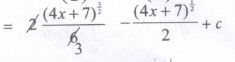
\(=\frac { { \left( 4x+7 \right) }^{ \frac { 3 }{ 2 } } }{ 3 } -\frac { { { \left( 4x+7 \right) }^{ \frac { 1 }{ 2 } } } }{ 2 } +c\)

12th Standard Syllabus & Materials
12th Standard
TN 12th Computer Applications வலையமைப்பு வடமிடல் Sample Question Papers Study Material - QB365 Set A
NEW12th Standard
TN 12th Computer Applications களப்பெயர் முறைமை (DNS) Sample Question Papers Study Material - QB365 Set A
NEW12th Standard
TN 12th Computer Applications வலையமைப்பு எடுத்துக்காட்டுகள் மற்றும் நெறிமுறைகள் Sample Question Papers Study Material - QB365 Set A
NEW12th Standard
TN 12th Computer Applications கணினி வலையமைப்பு ஓர் அறிமுகம் Sample Question Papers Study Material - QB365 Set A



Tamilnadu Stateboard 12th Standard Subjects

Maths

Chemistry

Physics

Biology

Computer Science
Business Maths and Statistics

Economics

Commerce

Accountancy

History

Computer Applications
Biology
Computer Technology
Computer Applications
Computer Science
Business Maths and Statistics
Commerce
Economics
Maths
Chemistry
Physics
Computer Technology
History
Accountancy

Tamil

English

French
Tamilnadu Stateboard Standards
