
 100% FREE ACCESS
12th Standard Syllabus & Materials
12th Standard
TN 12th Computer Applications மின்னணு தரவு பரிமாற்றம் Sample Question Papers Study Material - QB365 Set A
NEW12th Standard
TN 12th Computer Applications மின் - வணிக பாதுகாப்பு அமைப்புகள் Sample Question Papers Study Material - QB365 Set A
NEW12th Standard
TN 12th Computer Applications மின்னணு செலுத்தல் முறைகள் Sample Question Papers Study Material - QB365 Set A
NEW12th Standard
TN 12th Computer Applications மின் - வணிகம் Sample Question Papers Study Material - QB365 Set A
NEW12th Standard
TN 12th Computer Applications திறந்த மூல கருத்துருக்கள் Sample Question Papers Study Material - QB365 Set A
NEW12th Standard
TN 12th Computer Applications வலையமைப்பு வடமிடல் Sample Question Papers Study Material - QB365 Set A

Published on: 05/06/2021
QB365 provides detailed and simple solution for every Book back Questions in class 12 Business Maths Subject. It will helps to get more idea about question pattern in every book back questions with solution.
Download Tamil Nadu 12th Standard Business Maths and Statistics question papers, model tests, one-mark questions, important questions, and public exam papers in PDF format. Free study materials and answer keys for TN State Board students.
Questions + Answers key
Take MCQ Business Maths and Statistics Test
1.
A person wants to invest in one of three alternative investment plans: Stock, Bonds and Debentures. It is assumed that the person wishes to invest all of the funds in a plan. The pay-off matrix based on three potential economic conditions is given in the following table:
| Alternative | Economic conditions | ||
| High growth(Rs.) | Normal growth(Rs.) | Slow growth (Rs.)s | |
| Stocks | 10000 | 7000 | 3000 |
| Bonds | 8000 | 6000 | 1000 |
| Debentures | 6000 | 6000 | 6000 |
Determine the best investment plan using each of following criteria i) Maxmin ii) Minimax.
2.
Construct a forward difference table for y = f(x) = x3+2x+1 for x = 1,2,3,4,5
3.
Obtain an initial basic feasible solution to the following transportation problem using least cost method.
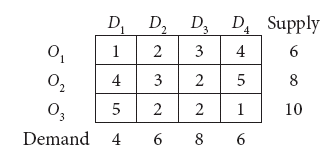
Here Oi and Dj denote ith origin and jth destination respectively.
4.
Find the sample size for the given standard deviation 10 and the standard error with respect of sample mean is 3.
5.
Suppose A and B are two equally strong table tennis players. Which of the following two events is more probable:
(a) A beats B exactly in 3 games out of 4 or
(b) A beats B exactly in 5 games out of 8 ?
6.
Let X be a discrete random variable with the following p.m.f
\(p(x) = \begin{cases}0.3 & \text { for } x =3 \\ 0.2, & \text { for } x = 5 \\ 0.3, & \text { for } x = 8 \\ 0.2, & \text { for} x = 10 \\ 0, & \text { otherwise } \\ \end{cases}\)
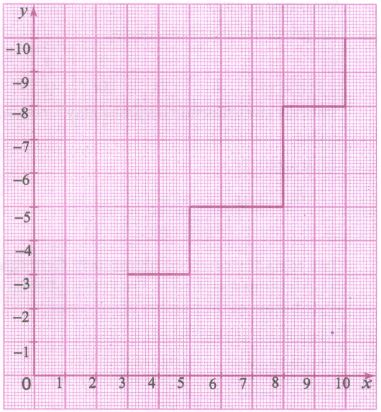
Find and plot the c.d.f. of X.
7.
Using integration, find the area of the region bounded by the line y −1 = x, the x axis and the ordinates x = –2, x = 3.
8.
Evaluate \(\int { \frac { x+2 }{ \sqrt { 2x+3 } } } dx\)
9.
Find the rank of the matrix \(\left( \begin{matrix} 1 & 2 & -1 \\ 2 & 4 & 1 \\ 3 & 6 & 3 \end{matrix}\begin{matrix} 3 \\ -2 \\ -7 \end{matrix} \right) \)
10.
Find the differential equation of the following
y = cx + c − c3
1.
| Economic Conditions | |||||
| Alternative | High growth | Normal growth | Slow growth | Minimum payoff | Maximum payoff |
| Stocks | 10000 | 7000 | 3000 | 3000 | 10000 |
| Bonds | 8000 | 6000 | 1000 | 1000 | 8000 |
| Debentures | 6000 | 6000 | 6000 | 6000 | 6000 |
(i) Max (3000, 1000, 6000) = 6000
∴ Debentures is the best using maximin principle
(ii) Max (10000, 8000, 6000) = 6000
∴ Debentures is the best using minimax principle.
2.
y = f(x) = x3+2x+1 for x = 1,2,3,4,5
| x | y | Δy | Δ2y | Δ3y | Δ4y |
|---|---|---|---|---|---|
| 1 | 4 | ||||
| 9 | |||||
| 2 | 13 | 12 | |||
| 21 | 6 | ||||
| 3 | 34 | 18 | 0 | ||
| 39 | 6 | ||||
| 4 | 73 | 24 | |||
| 63 | |||||
| 5 | 136 | ||||
3.
Total Supply = Total Demand = 24
\(\therefore\)The given problem is a balanced transportation problem.
Hence there exists a feasible solution to the given problem.
Given Transportation Problem is:
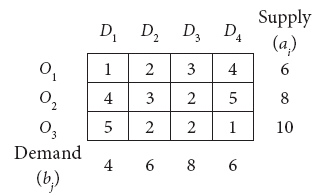
The least cost is 1 corresponds to the cells (O1, D1) and (O3, D4)
Take the Cell (O1, D1) arbitrarily.
Allocatemin (6,4) = 4 units to this cell.
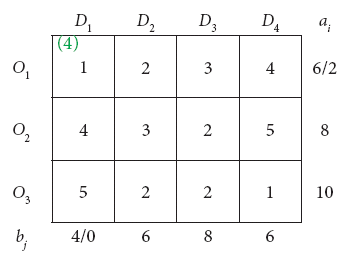
The reduced table is
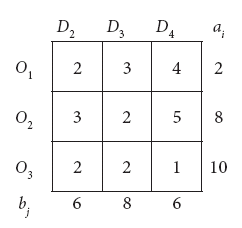
The least cost corresponds to the cell (O3, D4). Allocate min (10,6) = 6 units to this cell.
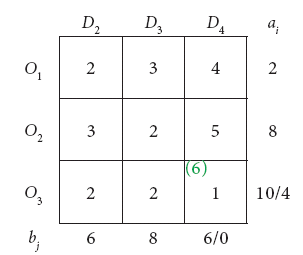
The reduced table is
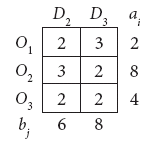
The least costis 2 corresponds to the cells (O1, D2), (O2, D3), (O3, D2), (O3, D3)
Allocate min (2,6) = 2 units to this cell.
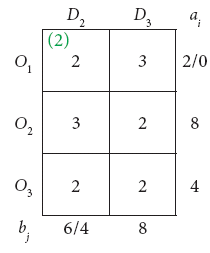
The reduced table is
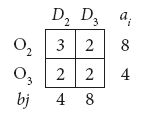
The least cost is 2 corresponds to the cells (O2, D3), (O3, D2), (O3, D3)
Allocate min ( 8,8) = 8 units to this cell.
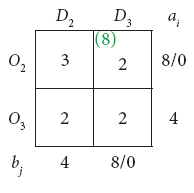
The reduced table is
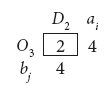
Here allocate 4 units in the cell (O3, D2)
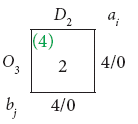
Thus we have the following allocations:
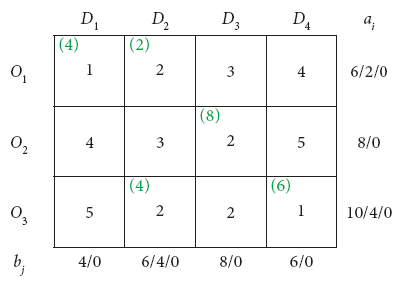
Transportation schedule :
O1⟶D1, O1⟶D2,O2⟶D3,O3⟶D2,O3⟶D4
Total transportation cost
= (4×1)+ (2×2)+(8×2)+(4×2)+(6×1)
= 4+4+16+8+6
= Rs. 38.
4.
Given \(\sigma\) = 10, S.E. \(\bar { X } \) = 3
We know that S.E = \(\frac { \sigma }{ \sqrt { n } } \)
Therefore, \(3=\frac { 10 }{ \sqrt { n } } \Rightarrow \sqrt { n } =\frac { 10 }{ 3 } \)
Taking Squaring on both sides we get
\(n=\left(\frac{10}{3}\right)^{2}=\frac{100}{9}=11.11 \cong 11\),
The required sample size is 11.
5.
Here p = q = 1/2
(a) probability of A beating B in exactly 3 games out of 4
\(\left( \begin{matrix} 4 \\ 3 \end{matrix} \right) { (\frac { 1 }{ 2 } ) }^{ 3 }\left( \frac { 1 }{ 2 } \right) ^{ 4-3 }\)
= 1/4 = 25%
(b) probability of A beating B in exactly 5 games out of 8
\(\left( \begin{matrix} 8 \\ 5 \end{matrix} \right) { (\frac { 1 }{ 2 } ) }^{ 5 }\left( \frac { 1 }{ 2 } \right) ^{ 8-5 }\)
\(=\frac { 7 }{ 32 } \) = 21.875%
Clearly, the first event is more probable.
6.
Given probability mass function is
| X=x | 3 | 5 | 8 | 10 |
| P(X=x) | 0.3 | 0.2 | 0.3 | 0.2 |
∴ The cumulative distribution function Fx(x) is
Fx(0) = 0 if x < 3
Fx(3) = P(X = 3) = 0.3, for 3 ≤x<5
Fx(5) = P(X = 3)+P(X = 5) = 0.3+0.2 = 0.5, for 5≤X<8
Fx(8) = P(X = 3)+P(X+5)+P(X = 8)
= 0.3+0.2+0.3
= 0.8,8≤x<10
Fx(10) = P(X = 3)+P(X = 5)+P(X = 8)+P(X = 10)
= 0.3+0.2+0.3+0.2
= 1 for x ≥10
\(F_{x}(x)= \begin{cases}0, & \text { if } x<3 \\ 0.3, & \text { if } 3 \leq x < 1 \\ 0.5, & \text { if } 5 \leq x < 8 \\ 0.8, & \text { if } 8 \leq x < 10 \\ 1, & \text { if } x ≥ 10 \\ \end{cases}\)
7.
y-1 = x
| x | 0 | -1 |
| y | 1 | 0 |
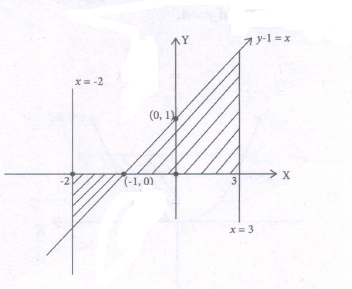
Given line is y - 1 = x ⇒ y = x + 1
Given limits are from x = - 2 to 3.
In the diagram, the area from x = - 2 to x = -1 lies below the X-axis and the area from x = -1 to x = 3 lies above the X-axis.
∴ Required Area
\(=\int _{ 2 }^{ -1 }{ -ydx+ } \int _{ -1 }^{ 3 }{ ydx } \)
\(=-\int _{ -2 }^{ -1 }{ ydx } +\int _{ -1 }^{ 3 }{ ydx } \)
\(=\int _{ -1 }^{ -2 }{ ydx } +\int _{ -1 }^{ 3 }{ ydx } \left[ \because \int _{ a }^{ b }{ f(x)dx=-\int _{ b }^{ a }{ f(x)dx } } \right] \)
\(=\int _{ -1 }^{ -2 }{ (x+1)dx+\int _{ -1 }^{ 3 }{ (x+1)dx } } \)
\(={ \left( \frac { { x }^{ 2 } }{ 2 } +x \right) }_{ -1 }^{ -2 }+{ \left( \frac { { x }^{ 2 } }{ 2 } +x \right) }_{ -1 }^{ 3 }\)
\(=\left( \frac { 4 }{ 2 } -2 \right) -\left( \frac { 1 }{ 2 } -1 \right) +\left( \frac { 9 }{ 2 } +3 \right) -\left( \frac { 1 }{ 2 } -1 \right) \)
\(=(2-2)-\left( -1\frac { 1 }{ 2 } \right) +\left( \frac { 15 }{ 2 } \right) -\left( -\frac { 1 }{ 2 } \right) \)
\(=0+\frac { 1 }{ 2 } +\frac { 15 }{ 2 } +\frac { 1 }{ 2 } =\frac { 17 }{ 2 } \) sq.units.
8.
Split into simple integrands
\({ \frac { x+2 }{ \sqrt { 2x+3 } } } = { \frac { 1/2( {2x+4) }}{ {( 2x+3 )^{1/2}} } } \)
\(=\int { \frac { 1 }{ 2 } \left\{ { \left( 2x+3 \right) }^{ \frac { 1 }{ 2 } }+{ \left( 2x+3 \right) }^{ -\frac { 1 }{ 2 } } \right\} } dx\)
\(=\frac { 1 }{ 2 } \left\{ \frac { { \left( 2x+3 \right) }^{ \frac { 1 }{ 2 } } }{ (2x+3) + 1} \right\} \)
\(\int { \frac { x+2 }{ \sqrt { 2x+3 } } } dx=\int { \frac { 1 }{ 2 } \left\{ { \left( 2x+3 \right) }^{ \frac { 1 }{ 2 } }+{ \left( 2x+3 \right) }^{ -\frac { 1 }{ 2 } } \right\} } dx\)
\(=\frac { 1 }{ 2 } \left\{ \frac { { \left( 2x+3 \right) }^{ \frac { 3 }{ 2 } } }{ 3 } +{ \left( 2x+3 \right) }^{ -\frac { 1 }{ 2 } } \right\} +c\)
9.
Let A = \(\left( \begin{matrix} 1 & 2 & -1 \\ 2 & 4 & 1 \\ 3 & 6 & 3 \end{matrix}\begin{matrix} 3 \\ -2 \\ -7 \end{matrix} \right) \)
Order of A is 3 \(\times\) 4
∴\(\rho \)(A)\(\le \)3
Consider the third order minors
\(\left| \begin{matrix} 1 & 2 & -1 \\ 2 & 4 & 1 \\ 3 & 6 & 3 \end{matrix} \right| =\) 0, \(\left| \begin{matrix} 1 & -1 & 3 \\ 2 & 1 & -2 \\ 3 & 3 & -7 \end{matrix} \right| =0\)
\(\left| \begin{matrix} 1 & 2 & 3 \\ 2 & 4 & -2 \\ 3 & 6 & -7 \end{matrix} \right| =0,\) \(\left| \begin{matrix} 2 & -1 & 3 \\ 4 & 1 & -2 \\ 6 & 3 & -7 \end{matrix} \right| =0\)
Since all third order minors vanishes, \(\rho (A)\neq 3\)
Now, let us consider the second order minors,
Consider one of the second order minors \(\\ \\ \left| \begin{matrix} 2 & -1 \\ 4 & 1 \end{matrix} \right| =6\neq 0\)
There is a minor of order 2 which is not zero.
\(\therefore \rho (A)=2\)
10.
Given equation is y = cx + c - c3 ....(1)
Differentiating w.r.t 'x' we get,
\(\frac { dy }{ dx } \) = c(1) + 0-0
⇒ \(\frac { dy }{ dx } \) = c ....(2)
Substituting (2) in (1) we get,
y=\(x\left( \frac { dy }{ dx } \right) +\left( \frac { dy }{ dx } \right) -\left( \frac { dy }{ dx } \right) ^{ 3 }\) which is the required differential equation.

12th Standard Syllabus & Materials
12th Standard
TN 12th Computer Applications களப்பெயர் முறைமை (DNS) Sample Question Papers Study Material - QB365 Set A
NEW12th Standard
TN 12th Computer Applications வலையமைப்பு எடுத்துக்காட்டுகள் மற்றும் நெறிமுறைகள் Sample Question Papers Study Material - QB365 Set A
NEW12th Standard
TN 12th Computer Applications கணினி வலையமைப்பு ஓர் அறிமுகம் Sample Question Papers Study Material - QB365 Set A
NEW12th Standard
TN 12th Computer Applications PHP-உடன் MySQL-ஐ இணைத்தல் Sample Question Papers Study Material - QB365 Set A



Tamilnadu Stateboard 12th Standard Subjects

Maths

Chemistry

Physics

Biology

Computer Science
Business Maths and Statistics

Economics

Commerce

Accountancy

History

Computer Applications
Biology
Computer Technology
Computer Applications
Computer Science
Business Maths and Statistics
Commerce
Economics
Maths
Chemistry
Physics
Computer Technology
History
Accountancy

Tamil

English

French
Tamilnadu Stateboard Standards


