
 100% FREE ACCESS
12th Standard Syllabus & Materials
12th Standard
TN 12th Computer Applications மின்னணு தரவு பரிமாற்றம் Sample Question Papers Study Material - QB365 Set A
NEW12th Standard
TN 12th Computer Applications மின் - வணிக பாதுகாப்பு அமைப்புகள் Sample Question Papers Study Material - QB365 Set A
NEW12th Standard
TN 12th Computer Applications மின்னணு செலுத்தல் முறைகள் Sample Question Papers Study Material - QB365 Set A
NEW12th Standard
TN 12th Computer Applications மின் - வணிகம் Sample Question Papers Study Material - QB365 Set A
NEW12th Standard
TN 12th Computer Applications திறந்த மூல கருத்துருக்கள் Sample Question Papers Study Material - QB365 Set A
NEW12th Standard
TN 12th Computer Applications வலையமைப்பு வடமிடல் Sample Question Papers Study Material - QB365 Set A

Published on: 05/06/2021
QB365 provides detailed and simple solution for every Book back Questions in class 12 Business Maths Subject. It will helps to get more idea about question pattern in every book back questions with solution.
Download Tamil Nadu 12th Standard Business Maths and Statistics question papers, model tests, one-mark questions, important questions, and public exam papers in PDF format. Free study materials and answer keys for TN State Board students.
Questions + Answers key
Take MCQ Business Maths and Statistics Test
1.
Using appropriate interpolation formula find the number of students whose weight is between 60 and 70 from the data given below
| Weight in lbs | 0-40 | 40-60 | 60-80 | 80-100 | 100-120 |
| No.of.students | 250 | 120 | 100 | 70 | 50 |
2.
Consider the problem of assigning five jobs to five persons. The assignment costs are given as follows. Determine the optimum assignment schedule.
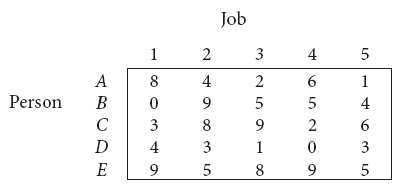
3.
The sum of Rs. 2,000 is compounded continuously, the nominal rate of interest being 5% per annum. In how many years will the amount be double the original principal? (loge2 = 0.6931)
4.
the Laspeyre’s, Paasche’s and Fisher’s price index number for the following data. Interpret on the data.
| Commodities | Price | Quandity | ||
| 2000 | 2010 | 2000 | 2010 | |
| Rice | 38 | 35 | 6 | 7 |
| Wheat | 12 | 18 | 7 | 10 |
| Rent | 10 | 15 | 10 | 15 |
| Fuel | 25 | 30 | 12 | 16 |
| Miscellaneous | 30 | 33 | 8 | 10 |
5.
A machine produces a component of a product with a standard deviation of 1.6 cm in length. A random sample of 64 componentsvwas selected from the output and this sample has a mean length of 90 cm. The customer will reject the part if it is either less than 88 cm or more than 92 cm. Does the 95% confidence interval for the true mean length of all the components produced ensure acceptance by the customer?
6.
If the probability that an individual suffers a bad reaction from injection of a given serum is 0.001, determines the probability that out of 2,000 individuals
(a) exactly 3, and
(b) more than 2 individuals will suffer a bad reaction.
7.
A continuous random variable X has p.d.f
f(x) = 5x4, 0\(\le\)x\(\le\)1
Find a1 and a2 such that
i) P[X\(\le\)a1] = P[X>a1]
ii) P[X>a2] = 0.05
8.
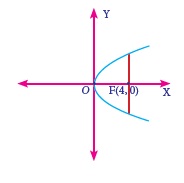
Using integration find the area of the region bounded between the line x = 4 and the parabola y2 = 16x.
9.
Integrate the following with respect to x.
\(\frac { { 3x }^{ 2 }-2x+5 }{ { \left( x-1 \right) }\left( x^{ 2 }+5 \right) } \)
10.
Find k, if the equations x + y + z = 7, x + 2y + 3z = 18, y + kz = 6 are inconsistent
1.
Let x be the weight and y be the number of students.
Difference table of cumulative frequencies are given below
| x | y | \(\Delta y\) | \(\Delta ^{ 2 }y\) | \(\Delta ^{ 3 }y\) | \(\Delta ^{ 4 }y\) |
|---|---|---|---|---|---|
| Below 40 | 250 | ||||
| 120 | |||||
| 60 | 370 | –20 | |||
| 100 | |||||
| 80 | 470 | ||||
| 70 | 10 | ||||
| 100 | 540 | –20 | |||
| 50 | |||||
| 120 | 590 |
Let us calculate the number of students whose weight is below 70. For this we use forward difference formula
\({ y }_{ \left( x={ x }_{ 0 }+nh \right) }={ y }_{ 0 }+\frac { n }{ n! } \Delta { y }_{ 0 }+\frac { n(n-1) }{ 2! } { \Delta }^{ 2 }{ y }_{ 0 }+\frac { n(n-)(n-2) }{ 3! } { \Delta }^{ 3 }{ y }_{ 0 }+....\)
To find y at x = 70
\(\therefore\) x0+nh = 70, x0 = 40, h = 20
40+n(20) = 70 \(\Rightarrow\) n = 1.5
\({ y }_{ \left( x=70 \right) }=250+1.5\left( 120 \right) +\frac { \left( 1.5 \right) \left( 0.5 \right) }{ 2! } \left( -20 \right) +\frac { \left( 1.5 \right) \left( 0.5 \right) \left( -0.5 \right) }{ 3! } \left( -10 \right) +\frac { \left( 1.5 \right) \left( 0.5 \right) \left( -0.5 \right) \left( -1.5 \right) }{ 4! } \left( 20 \right) \)
= 250 + 180 - 7.5 + 0.625 + 0.46875
= 423.59
\(\cong \) 424.
Number of students whose weight is between
60 and 70 = y(70)−y(60) = 424−370 = 54
2.
Here the number of rows and columns are equal.
\(\therefore\) The given assignment problem is balanced.
Now let us find the solution.
Step 1: Select a smallest element in each row and subtract this from all the elements in its row.
The cost matrix of the given assignment problem is
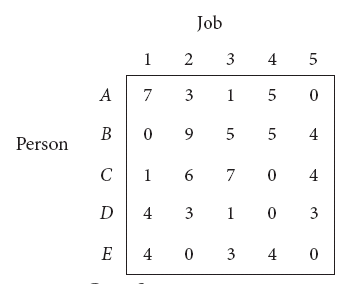
Column 3 contains no zero. Go to Step 2.
Step 2: Select the smallest element in each column and subtract this from all the elements in its column.
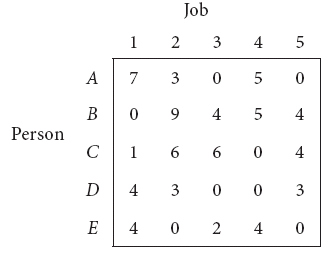
Since each row and column contains atleast one zero, assignments can be made.
Step 3: (Assignment):
Examine the rows with exactly one zero. Row B contains exactly one zero. Mark that zero by \(\square\) (i.e) Person B is assigned to Job 1. Mark other zeros in its column by ×.
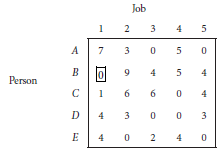
Now, Row C contains exactly one zero. Mark that zero by \(\square\). Mark other zeros in its column by × .
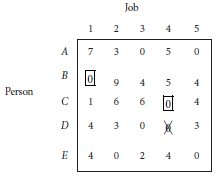
Now, Row D contains exactly one zero. Mark that zero by \(\square\) . Mark other zeros in its column by × .
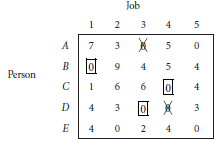
Row E contains more than one zero, now proceed column wise. In column 1, there is an assignment. Go to column 2. There is exactly one zero. Mark that zero by \(\square\) . Mark other zeros in its row by × .
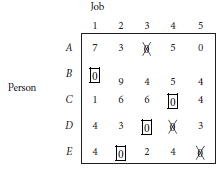
There is an assignment in Column 3 and column 4. Go to Column 5. There is exactly one zero. Mark that zero by \(\square\) . Mark other zeros in its row by × .
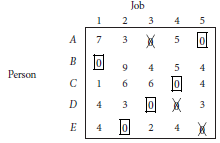
Thus all the five assignments have been made. The Optimal assignment schedule and total cost is
| Person | Job | cost |
| A | 5 | 1 |
| B | 1 | 0 |
| C | 4 | 2 |
| D | 3 | 1 |
| E | 2 | 5 |
| Total cost | 9 | |
The optimal assignment (minimum) cost = Rs. 9
3.
Let P be the principal at time ‘t’
\(\frac { dP }{ dt } =\frac { 5 }{ 100 } P=0.05P\)
⇒ ഽ\(\frac { dP }{ P } \) = ഽ0.05 dt + c
loge P = 0.05t + c
P = e0.05tec
P = c1e0.05t (1)
Given P = 2000 when t = 0
⇒ c1 = 2000
∴ (1) ⇒ P = 2000e0.05t
To find t , when P = 4000
(2) ⇒ 4000 = 2,000e0.05t
2 = e0.05t
0.05t = log2
t = \(\frac { 0.0931 }{ 0.05 } \) = 14 years (approximately)
4.
| Commodities | Price | Quandity | p0q0 | p0q1 | p1q0 | p1q1 | ||
| 2000 (p0) |
2010 q1 |
2000 (p0) |
2010 (q1) |
|||||
| Rice | 38 | 35 | 6 | 7 | 228 | 266 | 210 | 245 |
| Wheat | 12 | 18 | 7 | 10 | 84 | 120 | 126 | 180 |
| Rent | 10 | 15 | 10 | 15 | 100 | 150 | 150 | 225 |
| Fuel | 25 | 30 | 12 | 16 | 300 | 400 | 630 | 480 |
| Miscellaneous | 30 | 33 | 8 | 10 | 240 | 300 | 264 | 330 |
| Total | 952 | 1236 | 1110 | 1460 | ||||
Laspeyre’s price index number
\({ P }_{ 01 }^{ L }=\frac { \sum { { p }_{ 1 }{ q }_{ 0 } } }{ \sum { { p }_{ 0 }{ q }_{ 0 } } } \times 100=\frac { 1110 }{ 952 } \times 100=116.60\)
On an average, there is an increase of 16.60 % in the price of the commodities when the year 2000 compared with the year 2010.
Paasche’s price index number
\({ P }_{ 01 }^{ P }=\frac { \sum { { p }_{ 1 }{ q }_{ 1 } } }{ \sum { { p }_{ 0 }{ q }_{ 1 } } } \times 100=\frac { 1460 }{ 1236 } \times 100=118.12\)
On an average, there is an increase of 18.12 % in the price of the commodities when the year 2000 compared with the year 2010.
Fisher’s price index number
\({ P }_{ 01 }^{ F }=\sqrt { \frac { \sum { { p }_{ 1 }{ q }_{ 0 } } \times \sum { { p }_{ 1 }{ q }_{ 1 } } }{ \sum { { p }_{ 0 }{ q }_{ 0 } } \times \sum { { p }_{ 0 }{ q }_{ 1 } } } } \times 100=\sqrt { \frac { 1110\times 1460 }{ 952\times 1236 } } \times 100=117.36\)
On an average, there is an increase of 17.36 % in the price of the commodities when the year 2000 compared with the year 2010.
5.
Here φ is the mean length of the components in the population.
The formula for the confidence interval is
\(\bar{x}-Z_{\alpha / 2} \frac{\sigma}{\sqrt{n}}<\mu<\bar{x}+Z_{\alpha / 2} \frac{\sigma}{\sqrt{n}}\)
\({ Here } \ \sigma=1.6, Z_{\alpha / 2}=1.96, \bar{x}=90 \text { and } \mathrm{n}=64\)
Then \(S.E=\frac { \sigma }{ \sqrt { n } } =\frac { 1.6 }{ \sqrt { 64 } } =0.2\)
Therefore, 90 - (1.96 x 0.2)\(\le φ \le\) 90 + (1.96 x 0.2)
\(\text { i.e. } \ (89.61 \leq \varphi \leq 90.39)\)
This implies that the probability that the true value of the population mean length of the components will fall in this interval (89.61,90.39) at 95% . Hence we concluded that 95% confidence interval ensures acceptance of the component by the consumer.
6.
Consider a 2,000 individuals getting injection of a given serum , n = 2000
Let X be the number of individuals suffering a bad reaction.
Let p be the probability that an individual suffers a bad reaction = 0.001
and q = 1– p = 1– 0.001 = 0.999
Since n is large and p is small, Binomial Distribtuion approximated to poisson distribution
So, λ = np = 2000 × 0.001 = 2
(i) Probability out of 2000, exactly 3 will suffer a bad reaction is
\(P(X=3)=\frac { { e }^{ -\lambda }{ \lambda }^{ x } }{ x! } =\frac { { e }^{ -2 }{ 2 }^{ 3 } }{ 3! } =0.1804\)
(ii) Probability out of 2000, more than 2 individuals will suffer a bad reaction
= P(X > 2)
1-[P(X\(\le\)2)]
= 1 – [P(x = 0) + P(x = 1) + P(x = 2)]
\(=1-\left[ \frac { { e }^{ -2 }{ 2 }^{ 0 } }{ 0! } +\frac { { e }^{ -2 }{ 2 }^{ 1 } }{ 1! } +\frac { { e }^{ -2 }{ 2 }^{ 2 } }{ 2! } \right] \)
\(=1-{ e }^{ 2 }\left( \frac { { 2 }^{ 0 } }{ 0! } +\frac { { 2 }^{ 1 } }{ 1! } +\frac { { 2 }^{ 2 } }{ 2! } \right) \)
= 0.323
7.
i) Since P[X\(\le\)a1] = P[X>a1]
\(P[X\le { a }_{ 1 }]=\frac { 1 }{ 2 } \)
\(i.e., \int _{ 0 }^{ { a }_{ 1 } }{ f(x)dx } =\frac { 1 }{ 2 } \)
\(i.e., \int _{ 0 }^{ { a }_{ 1 } }{ { 5x }^{ 4 } } dx=\frac { 1 }{ 2 } \)
\(5{ { \left[ \frac { { x }^{ 5 } }{ 5 } \right] } }_{ { 0 }_{ } }^{ a1 }=1/2\)
\({ a }_{ 1 }={ (0.5) }^{ \frac { 1 }{ 5 } }\)
ii) \(P[X>{ a }_{ 2 }]=0.05\)
\(\int _{ { a }_{ 2 } }^{ 1 }{ { f(x })dx=0.05 } \)
\(\int _{ { a }_{ 2 } }^{ 1 }{ { 5x }^{ 4 }dx=0.05 } \)
\(5{ { \left[ \frac { { x }^{ 5 } }{ 5 } \right] } }_{ { a }_{ 2 } }^{ 1 }=0.05\)
\({ a }_{ 2 }={ [0.95] }^{ \frac { 1 }{ 5 } }\)
8.
The equation y2 = 16x represents a parabola (Open rightward)
Required Area = 2\(\int _{ a }^{ b }{ y } dx\)
\(=2\int _{ 0 }^{ 4 }{ \sqrt { 16x } } \ dx\)
\(=8\int _{ 0 }^{ 4 }{ { x }^{ \frac { 1 }{ 2 } } } dx=8{ \left[ { \frac { { x }^{ { \frac { 3 }{ 2 } } } }{ \frac { 3 }{ 2 } } } \right] }_{ 0 }^{ 4 }=\frac { 16 }{ 3 } \left( { \left( 4 \right) }^{ \frac { 3 }{ 2 } } \right) =\frac { 128 }{ 3 } \) sq.units
9.
\(\int { \frac { { 3x }^{ 2 }-2x56 }{ \left( x-1 \right) -\left( { x }^{ 2 }+5 \right) } } dx\)
⇒ 3x2-2x+5 = A (x2+5) + (Bx+c) (x-1)
Putting x =1,
3 - 2+5 = A (1+ 5)
⇒ 6 = A (6)
⇒ A = 1
Putting x = 0,
5 = 5 A - C
⇒ 5 = 5 - C [∵ A = 1]
⇒ C = 5 - 5 ⇒ C = 0
Putting x = -1,
3 + 2+ 5 = A (6) + (C-B) (-2)
⇒ 10 = 6A + 2B - 2C
⇒ 10 = 6 + 2B + 0
⇒ 10 - 6 = 2B ⇒ 4 = 2B
⇒ B = 2
\(=\int { \left( \frac { A }{ x-1 } +\frac { Bx+c }{ { x }^{ 2 }+5 } \right) } dx\)
\(=\int { \left( \frac { 1 }{ x-1 } +\frac { 2x+0 }{ { x }^{ 2 }+5 } \right) } dx\)
\(=\int { \frac { 1 }{ x-1 } } dx+\int { \frac { 2x }{ { x }^{ 2 }+5 } } dx\)
\(=\log { \left| x-1 \right| } +\log { \left| { x }^{ 2 }+5 \right| } +c\)
\(\left[ \because \int { \frac { { f }^{ 1 }(x) }{ f(x) } dx=\log { \left| f\left( x \right) \right| +c } } \right] \)
\(=\log { \left| \left( { x }^{ 2 }+5 \right) \left( x-1 \right) \right| } +c\)
[∵ log m + log n = log mn]
\(=\log { \left| { x }^{ 3 }-{ x }^{ 2 }+5x-5 \right| } +c\)
\(=\frac { { 3x }^{ 2 }-2x+5 }{ \left( x-1 \right) \left( { x }^{ 2 }+5 \right) } =\frac { A }{ (x-1) } +\frac { Bx+C }{ \left( { x }^{ 2 }+5 \right) } \)
10.
The matrix equation corresponding to the given system is
\(\left( \begin{matrix} 1 & 1 & 1 \\ 1 & 2 & 3 \\ 0 & 1 & k \end{matrix} \right) \left( \begin{matrix} X \\ Y \\ Z \end{matrix} \right) =\left( \begin{matrix} 7 \\ 18 \\ 6 \end{matrix} \right) \)
AX = B
| Augmented matrix [A,B] | Elementary Transformation |
|
\(\left( \begin{matrix} 1 & 1 & 1 \\ 1 & 2 & 3 \\ 0 & 1 & k \end{matrix}\begin{matrix} 7 \\ 18 \\ 6 \end{matrix} \right) \) ρ(A) = 2 or 3, ρ([A]) = 3 |
\({ R }_{ 2 }\rightarrow { R }_{ 2 }-{ R }_{ 1 }\) \({ R }_{ 3 }\rightarrow { R }_{ 3 }-{ R }_{ 2 }\) |
For the equations to be inconsistent
\(\rho ([A,B])\neq \rho (A)\)
It is possible if k − 2 = 0.
\(\therefore \) k = 2

12th Standard Syllabus & Materials
12th Standard
TN 12th Computer Applications களப்பெயர் முறைமை (DNS) Sample Question Papers Study Material - QB365 Set A
NEW12th Standard
TN 12th Computer Applications வலையமைப்பு எடுத்துக்காட்டுகள் மற்றும் நெறிமுறைகள் Sample Question Papers Study Material - QB365 Set A
NEW12th Standard
TN 12th Computer Applications கணினி வலையமைப்பு ஓர் அறிமுகம் Sample Question Papers Study Material - QB365 Set A
NEW12th Standard
TN 12th Computer Applications PHP-உடன் MySQL-ஐ இணைத்தல் Sample Question Papers Study Material - QB365 Set A



Tamilnadu Stateboard 12th Standard Subjects

Maths

Chemistry

Physics

Biology

Computer Science
Business Maths and Statistics

Economics

Commerce

Accountancy

History

Computer Applications
Biology
Computer Technology
Computer Applications
Computer Science
Business Maths and Statistics
Commerce
Economics
Maths
Chemistry
Physics
Computer Technology
History
Accountancy

Tamil

English

French
Tamilnadu Stateboard Standards


