
 100% FREE ACCESS
12th Standard Syllabus & Materials
12th Standard
TN 12th Maths Applications of Matrices and Determinants Sample Question Papers Study Material - QB365 Set A
NEW12th Standard
TN 12th Computer Applications மின்னணு தரவு பரிமாற்றம் Sample Question Papers Study Material - QB365 Set A
NEW12th Standard
TN 12th Computer Applications மின் - வணிக பாதுகாப்பு அமைப்புகள் Sample Question Papers Study Material - QB365 Set A
NEW12th Standard
TN 12th Computer Applications மின்னணு செலுத்தல் முறைகள் Sample Question Papers Study Material - QB365 Set A
NEW12th Standard
TN 12th Computer Applications மின் - வணிகம் Sample Question Papers Study Material - QB365 Set A
NEW12th Standard
TN 12th Computer Applications திறந்த மூல கருத்துருக்கள் Sample Question Papers Study Material - QB365 Set A

Published on: 13/05/2022
QB365 provides detailed and simple solution for every Book back Questions in class 12 Business Maths Subject. It will helps to get more idea about question pattern in every book back questions with solution.
latest Book back QuestionsDownload Tamil Nadu 12th Standard Business Maths and Statistics question papers, model tests, one-mark questions, important questions, and public exam papers in PDF format. Free study materials and answer keys for TN State Board students.
Questions + Answers key
Take MCQ Business Maths and Statistics Test
1.
Calculate the value of y when x = 7.5 from the table given below
| x | 1 | 2 | 3 | 4 | 5 | 6 | 7 | 8 |
| y | 1 | 8 | 27 | 64 | 125 | 216 | 343 | 512 |
2.
A computer centre has got three expert programmers. The centre needs three application programmes to be developed. The head of the computer centre, after studying carefully the programmes to be developed, estimates the computer time in minitues required by the experts to the application programme as follows.
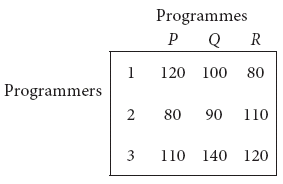
Assign the programmers to the programme in such a way that the total computer time is least.
3.
Solve: (D2 − 2D + 1)y = e2x + ex
4.
5.
The mean I.Q of a sample of 1600 children was 99. Is it likely that this was a random sample from a population with mean I.Q 100 and standard deviation 15? (Test at 5% level of significance)
6.
Evaluate the following integrals as the limit of the sum:
\(\int _{ 1 }^{ 3 }{ xdx } \)
7.
Forty percent of business travellers carry a laptop. In a sample of 15 business travelers,
(i) what is the probability that 3 will have a laptop?
(ii) what is the probability that 12 of the travelers will not have a laptop?
(iii) what is the probability that atleast three of the travelers have a laptop?
8.
Find the consumer’s surplus and producer’s surplus for the demand function pd = 25 − 3x and supply function ps = 5 + 2x.
9.
A continuous random variable X has the following probability function
| Value of X = x | 0 | 1 | 2 | 3 | 4 | 5 | 6 | 7 |
| P(x) | 0 | k | 2k | 2k | 3k | k2 | 2k2 | 7k2+k |
(i) Find k
(ii) Ealuate p(x<6), p(x\(\ge \)6) and p(0)
(iii) If P(X\(\le\)x).\(\frac{1}{2}\), then find the minimum value of x.
10.
The price of 3 Business Mathematics books, 2 Accountancy books and one Commerce book is Rs. 840. The price of 2 Business Mathematics books, one Accountancy book and one Commerce book is Rs. 570. The price of one Business Mathematics book, one Accountancy book and 2 Commerce books is Rs. 630. Find the cost of each book by using Cramer’s rule.
1.
Since the required value is at the end of the table, apply backward interpolation formula
| x | y | \(\Delta y\) | \(\Delta ^{ 2 }y\) | \(\Delta ^{ 2 }y\) | \(\Delta ^{ 4 }y\) |
| 1 | 1 | ||||
| 7 | |||||
| 2 | 8 | 12 | |||
| 19 | 6 | ||||
| 3 | 27 | 18 | 0 | ||
| 37 | 6 | ||||
| 4 | 64 | 24 | 0 | ||
| 61 | 6 | ||||
| 5 | 125 | 30 | 0 | ||
| 91 | 6 | ||||
| 6 | 216 | 36 | 0 | ||
| 127 | 6 | ||||
| 7 | 343 | 42 | |||
| 169 | |||||
| 8 | 512 |
.\({ y }_{ \left( x={ x }_{ 0 }+nh \right) }={ y }_{ 0 }+\frac { n }{ n! } \Delta { y }_{ 0 }+\frac { n(n-1) }{ 2! } { \Delta }^{ 2 }{ y }_{ 0 }+\frac { n(n-)(n-2) }{ 3! } { \Delta }^{ 3 }{ y }_{ 0 }+...\)
To find y at x = 7.5
\(\therefore\) xn + nh = 7.5, xn = 8, h = 1 \(\Rightarrow\) n = –0.5
\({ y }_{ (x=7.5) }=512+\frac { -0.5 }{ 1! } 169+\frac { 0.5(-0.5+10 }{ 2! } 42+\frac { -0.5(-0.5+1)(-0.5+2) }{ 3! } 6\)
= 421.88
2.
Here, the number of rows and columns are equal
∴ The given assignment problem is balanced.
Step I : Select a smallest element in each row and subtract this from all the elements in its row.
∴ The given assignment problem is
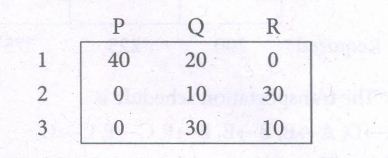
Here column 2 has no zero. Go to Step 2.
Step 2 : Select the smallest element (10) and subtract it from all the elements in its column.
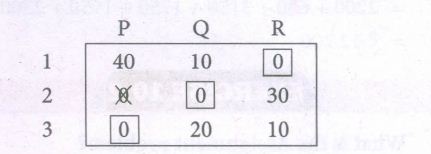
Step 3 : Examine the rows with only one zero mark that zero by Ԡ. Mark other zeros in its column by X.
Row 1 and Row 3 contains only one zero. Mark the other zeros by X
Column 2 contains exactly one zero. Mark it by Ԡ
Thus, all the 3 assignments have been made.
Hence, the optimal assignment schedule and total cost is
| Programmers | Programmes | Cost |
| 1 | R | 80 |
| 2 | Q | 90 |
| 3 | P | 110 |
Total cost = Rs. 280
Thus, the optimal assignment (minimum) cost = Rs. 280
3.
(D2 − 2D + 1)y = e2x + ex
The auxiliary equation is
m2 − 2m + 1 = 0
⇒ (m−1)(m−1) = 0
m = 1, 1
C.F = (Ax +B)ex
\(PI=\frac { 1 }{ \phi (D) } f(x)\) = \(\frac { 1 }{ { D }^{ 2 }-2D+1 } \)(e2x + ex)
P.I1 = \(\frac { 1 }{ { D }^{ 2 }-2D+1 } \)e2x
= \(\frac { 1 }{ 4-4+1 } \)e2x (replace D by 2)
= e2x
and P.I2 = \(\frac { 1 }{ { D }^{ 2 }-2D+1 } \) ex
= \(\frac { 1 }{ { (D-1) }^{ 2 } } { e }^{ x }\)
Replace D by 1. (D −1)2 = 0 when D = 1
∴ \(P.{ I }_{ 2 }={ x }_{ 2 }.\frac { 1 }{ { 2(D-1) }^{ 2 } } { e }^{ x }\)
Replace D by 1. (D −1) = 0 when D = 1
∴ P.I2 = x2\(\frac { 1 }{ 2 } { e }^{ x }\)
The general solution is
y = C.F + P.I1 + P.I2
y = (Ax +B)ex + e2x + \(\frac { { x }^{ 2 } }{ 2 } { e }^{ x }\)
4.
5.
Sample size n = 1600
Sample mean \(\bar { X } \) = 99
Population mean μ = 100
Population standard deviation σ = 15
Null Hypotheses Ho : μ = 100
Alternative Hypotheses H1 : μ ≠ 100
Level of significance α = 0.05
Applying the test statistic,
\(Z=\frac { \bar { X } -\mu }{ \frac { \sigma }{ \sqrt { n } } } \)
\(\Rightarrow Z=\frac { 99-100 }{ \frac { 15 }{ \sqrt { 1600 } } } =\frac { -1 }{ \frac { 15 }{ 40 } } =-\frac { 40 }{ 15 } =-2.667\)
∴ |Z| = 2.667
Critical value at 5% level of significance is \({ Z }_{ \frac { \alpha }{ 2 } }=1.96\)
Here |Z|>\({ Z }_{ \frac { \alpha }{ 2 } }\) as 2.667>1.96
Inference: since |Z|>\({ Z }_{ \frac { \alpha }{ 2 } }\) at 5% level of sinificance, the null hypothesis is rejected.
Hence, we can conclude that the sample has not been taken from the population with mean μ = 100.
6.
\(\int _{ a }^{ b }{ f\left( x \right) } dx=\lim _{ n\rightarrow \infty \\ h\rightarrow 0 }{ \sum _{ r=1 }^{ n }{ h.f(a+rh) } } \)
Here a = 1, b = 3
\(h=\frac { b-a }{ n } =\frac { 3-1 }{ n } =\frac { 2 }{ n } \)
and f (x) = x
Now \(f(a+rh)=f\left( 1+r\cfrac { 2 }{ n } \right) =f\left( 1+\cfrac { 2r }{ n } \right) \)
\(\therefore \int _{ 1 }^{ 3 }{ xdx } =\underset { n\rightarrow \infty }{ lim } .\cfrac { 2 }{ n } \left( 1+\cfrac { 2r }{ n } \right) \)
= \(\underset { n\rightarrow \infty }{ lim } \sum _{ r=1 }^{ n }{ \left( \cfrac { 2 }{ n } +\cfrac { 4r }{ { n }^{ 2 } } \right) } \)
= \(\underset { n\rightarrow \infty }{ lim } \left( \cfrac { 2 }{ n } .\sum _{ r=1 }^{ n }{ .1+\cfrac { 4 }{ { n }^{ 2 } } .\sum _{ r=1 }^{ n }{ .r } } \right) \)
\(\left( \because \sum _{ r=1 }^{ n }{ 1=n } \right) \)
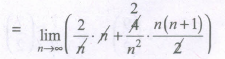
\(\left[ \sum _{ r=1 }^{ n }{ r } =\cfrac { n(n+1) }{ 2 } \right] \)
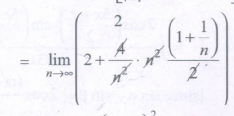
= \(2+\underset { n\rightarrow \infty }{ lim } \left( 1+\cfrac { 1 }{ n } \right) ^{ 2 }\)
= \(2+n\underset { n\rightarrow \infty }{ lim } \left( 2+\cfrac { 2 }{ n } \right) \)
= \(2+2\underset { n\rightarrow \infty }{ +lim } \left( 2+\cfrac { 2 }{ n } \right) \)
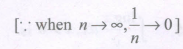
= 2 + 2 + 0
= 4
7.
Let p be the probability of having a laptop
Given p = \(\frac { 40 }{ 100 } \) = 0.4 ⇒ q = 1-p = 1-0.4 = 0.6
n = 15
(i) P(X = 3)
=15C3 (0.4)3 (0.6)12 ∵ p(x) =nCx pxqn-x, n = 15, x = 3
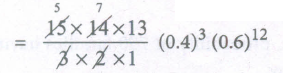
= 455 (0.064) (0.002176) = 0.0634
(ii) P (12 travellers not having laptop)
= P (3 travellers having laptop)
[∵ n = 15 and 15 - 12 = 3]
= P(X = 3)
= 0.0634.
(iii) P (atleast 3 travellers have laptop)
= P (X ≥ 3) = 1 - P(X < 3)
= 1 - [P(X = 0) + P(X = 1) + P(X = 2)]
=1-[15C0 (0.4)0 (0.6)15 + 15C1 (0.4)2 (0.6)13 (0.6)14]
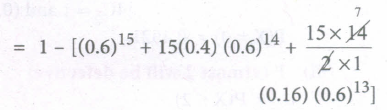
= 1 - (0.6)13 [(0.6)2 + 6(0.6)1 + 105(0.16)]
= 1 - (0.6)13 [0.36 + 3.6 + 16.8]
= 1 - (0.0013) (20.76) = 1 - 0.0270
= 0.9730.
8.
Given demand function Pd = 25 - 3x and
Supply function Ps= 5 + 2x
At market equilibrium, Pd = Ps
⇒ 25-3x = 5+2x
⇒ 25-5 = 2x+3x
⇒ 20 = 5x
⇒ x = \(\frac{20}{5}\)
⇒ x0 = 4
When x0 = 4, p0 = 25-3(4)
= 25-12 = 13
p0 = 13
∴p0x0 = 13(4) = 52
∴ Consumer's surplus
\(CS=\int _{ 0 }^{ x }{ f(x) } dx-{ p }_{ 0 }{ x }_{ 0 }\)
\(\\ =\int _{ 0 }^{ 4 }{ (25-3x)dx-52 } \)
\(={ \left[ 25x-\frac { { 3x }^{ 2 } }{ 2 } \right] }_{ 0 }^{ 4 }-52\)
\(=25(4)-\frac { 3\left( { 4 }^{ 2 } \right) }{ 2 } -52\)
=100-24-52
=100-76
C.S = 24 units
Producer's Surplus
\((PS)={ p }_{ 0 }{ x }_{ 0 }-\int _{ 0 }^{ x }{ g(x)dx } \)
\(=52-\int _{ 0 }^{ 4 }{ (5+2x)dx } \)
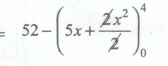
= 52 - (5(4) + 42}
= 52 - (20 + 16)
= 52 - 36
PS = 16 units
9.
Given probability function is
| Value of X = x | 0 | 1 | 2 | 3 | 4 | 5 | 6 | 7 |
| P(x) | 0 | k | 2k | 2k | 3k | k2 | 2k2 | 7k2+k |
i) Since the given function is a probability function, each ρi>0 and Σρi=1
⇒ 0+k+2k+2k+3k+k2+2k2+7k2+k = 1
⇒ 10k2+9k = 1
⇒10k2+9k-1 = 0
on factoring we get
(k+1)(10k-1) = 0
⇒k = -1 or k = \(\frac{1}{10}\)
k = -1 is not possible [each ρi>0]
we get k = \(\frac{1}{10}\)
ii) P(X<6) = P(X = 0)+P(X = 1)+P(X=2+P(X=3)+P(X=4)+P(X=5)
P(X<6) = 0 + k + 2k + 2k + 3k + k2
= 8k+k2
= \(8\left( \frac { 1 }{ 10 } \right) { \left( \frac { 1 }{ 10 } \right) }^{ 2 }\)
\(=\frac { 8 }{ 10 } +\frac { 1 }{ 100 } =\frac { 80+1 }{ 100 } =\frac { 81 }{ 100 } \)
\(\therefore P(X<6)=\frac { 81 }{ 100 } \)
Now P(X≥6) = P(X=6)+P(X=7)
= 2k2+7k2+k
= 9k2+k
\(=9{ \left( \frac { 1 }{ 10 } \right) }^{ 2 }+\frac { 1 }{ 10 } \)
\(=\frac { 9 }{ 100 } +\frac { 1 }{ 10 } =\frac { 9+10 }{ 100 } =\frac { 19 }{ 100 } \)
\(\therefore P(X\ge 6)=\frac { 19 }{ 100 } \)
And P(0X<5) = P(X = 1)+P(X = 2)+P(X = 3)+P(X = 4)
= k+2k+2k+3k
\(8k=8\left( \frac { 1 }{ 10 } \right) =\frac { 8 }{ 10 } \)
\( \therefore P(0\))
iii) Given P(X ≤ x) ≥ \(\frac{1}{2}\)
⇒P(X = 0)+P(X = 1)+P(X = 2)+P(X = 3)+P(X = 4)
= 0+k+2k+2k+3k
\(=8k=8\left( \frac { 1 }{ 10 } \right) =\frac { 8 }{ 10 } =\frac { 4 }{ 5 } >\frac { 1 }{ 2 } \)
\(\therefore P(X\le 4)\frac { 1 }{ 2 } \le x=4\)
∴ The minimum value of x is 4.
10.
Let ‘x’ be the cost of a Business Mathematics book
Let ‘y’ be the cost of a Accountancy book.
Let ‘z’ be the cost of a Commerce book.
\(\therefore \) 3x + 2y + z = 840
2x + y + z = 570
x + y + 2z = 630
Here \({ \triangle }=\left| \begin{matrix} 3 & 2 & 1 \\ 2 & 1 & 1 \\ 1 & 1 & 2 \end{matrix} \right| =-2\neq 0\)
\({ \triangle }_{ x }=\left| \begin{matrix} 840 & 2 & 1 \\ 570 & 1 & 1 \\ 630 & 1 & 2 \end{matrix}\begin{matrix} 1 \\ 1 \\ 2 \end{matrix} \right| =-240 \)
\({ \triangle }_{ y }=\left| \begin{matrix} 3 & 840 & 1 \\ 2 & 570 & 1 \\ 1 & 630 & 2 \end{matrix} \right| =-300 \)
\({ \triangle }_{ z }=\left| \begin{matrix} 3 & 2 & 840 \\ 2 & 1 & 570 \\ 1 & 1 & 630 \end{matrix} \right| =-360\)
\(\therefore \) By Cramer’s rule
\(x=\frac { { \triangle }x }{ { \triangle } } =\frac { -240 }{ -2 } =120 \)
\(y=\frac { { \triangle }y }{ { \triangle } } =\frac { 300 }{ -2 } =150 \)
\(z=\frac { { \triangle }z }{ { \triangle } } =\frac { 360 }{ -2 } =180\)
\(\therefore \) The cost of a Business Mathematics book is Rs. 120,
the cost of a Accountancy book is Rs. 150 and
the cost of a Commerce book is Rs. 180.

12th Standard Syllabus & Materials
12th Standard
TN 12th Computer Applications வலையமைப்பு வடமிடல் Sample Question Papers Study Material - QB365 Set A
NEW12th Standard
TN 12th Computer Applications களப்பெயர் முறைமை (DNS) Sample Question Papers Study Material - QB365 Set A
NEW12th Standard
TN 12th Computer Applications வலையமைப்பு எடுத்துக்காட்டுகள் மற்றும் நெறிமுறைகள் Sample Question Papers Study Material - QB365 Set A
NEW12th Standard
TN 12th Computer Applications கணினி வலையமைப்பு ஓர் அறிமுகம் Sample Question Papers Study Material - QB365 Set A



Tamilnadu Stateboard 12th Standard Subjects

Maths

Chemistry

Physics

Biology

Computer Science
Business Maths and Statistics

Economics

Commerce

Accountancy

History

Computer Applications
Biology
Computer Technology
Computer Applications
Computer Science
Business Maths and Statistics
Commerce
Economics
Maths
Chemistry
Physics
Computer Technology
History
Accountancy

Tamil

English

French
Tamilnadu Stateboard Standards


