
 100% FREE ACCESS
12th Standard Syllabus & Materials
12th Standard
TN 12th Computer Applications மின்னணு தரவு பரிமாற்றம் Sample Question Papers Study Material - QB365 Set A
NEW12th Standard
TN 12th Computer Applications மின் - வணிக பாதுகாப்பு அமைப்புகள் Sample Question Papers Study Material - QB365 Set A
NEW12th Standard
TN 12th Computer Applications மின்னணு செலுத்தல் முறைகள் Sample Question Papers Study Material - QB365 Set A
NEW12th Standard
TN 12th Computer Applications மின் - வணிகம் Sample Question Papers Study Material - QB365 Set A
NEW12th Standard
TN 12th Computer Applications திறந்த மூல கருத்துருக்கள் Sample Question Papers Study Material - QB365 Set A
NEW12th Standard
TN 12th Computer Applications வலையமைப்பு வடமிடல் Sample Question Papers Study Material - QB365 Set A

Published on: 13/05/2022
QB365 provides detailed and simple solution for every
Creative Questions in class 12 Business Maths Subject.It will helps to get more idea about question pattern in
every Creative questions with solution.
Download Tamil Nadu 12th Standard Business Maths and Statistics question papers, model tests, one-mark questions, important questions, and public exam papers in PDF format. Free study materials and answer keys for TN State Board students.
Questions + Answers key
Take MCQ Business Maths and Statistics Test
1.
The following data shows the value of sample mean (\(\bar{X}\)) and the range R for 10 samples of size 5 each. Calculate the control limits for : mean chart and range chart.
| Sample No. | 1 | 2 | 3 | 4 | 5 | 6 | 7 | 8 | 9 | 10 |
| Mean \(\bar{X}\) | 11.2 | 11.8 | 10.8 | 11.6 | 11.0 | 9.6 | 10.4 | 9.6 | 10.6 | 10.0 |
| Range | 7 | 4 | 8 | 5 | 7 | 4 | 8 | 4 | 7 | 9 |
(Given for n = 5, A2 = .577, D3 = 0, D4 = 2.115)
2.
A sample of 400 students is found to have mean height of 171.38 cms, Can it reasonable be regarded as a sample from a large population with mean height of 171.17 cms and standard deviation of 3.3 cms (Test at 5% level)
3.
If you buy a lottery ticket in 50 lotteries, in each which your chance of winning a prize is \(\frac { 1 }{ 100 } \). What is the approximate probability that you will win a prize at least once (e-0.5 = 0.6066).
4.
A continuous random variable. X has the p.d.f. defined by \(f(x)=\left\{\begin{array}{l} C e^{-a x}, \quad 0<x<\infty \\ 0, \quad \text { elsewhere } \end{array}\right.\) Find the value of C if a> 0
5.
The following is the pay-off matrix (in rupees) for three strategies and three states of nature. Select a strategy using maximin principle.
6.
Evaluate \(\int _{ 0 }^{ \pi }{ { sin }^{ 2 } } x\ dx\)
7.
Solve: \(\frac { dy }{ dx } \)+ ay = ex (where a ≠ -1)
8.
When h = 1, find Δ (x3).
9.
Find the consumer's surplus for the demand function p = 25 - x -x2 when Po = 19
10.
If A and B are non-singular matrices, prove that AB is non-singular.
1.
\(\bar{\bar{X}}\) = \(\frac{11.2 + 11.8 + 10.8 + 11.6 + 11.0+ 9.6 + 10.4 + 9.6 + 10.6 + 10.0}{10}\)
\(=\frac{106.6}{10}=10.66\)
\(\bar{R}=\frac{7+4+8+5+7+4+8+4+7+9}{10}\)
\(=\frac{63}{10}=6.3\)
Control limits for mean chart
UCL = \(\bar{\bar{X}}\) + A2\(\bar{R}\)
= 10.66 + .577(6.3) = 14.295
CL = \(\bar{\bar{X}}\) = 10.66
Control limits for R-chart
UCL = D2\(\bar{R}\) = 2.115 \(\times\) 6.3
= 13.324
CL = \(\bar{R}\) = 6.3
LCL = D3\(\bar{R}\) = 0
2.
Given sample size n = 400
Sample mean \(\bar { x } \) = 171.38
Population mean μ = 171.17
Population Standard deviation σ = 3.3
Null hypotheses: H0 : μ = 171.17
Alternative hypotheses: H1 : μ ≠ 171.17
The test statistic, z = \(\frac { \bar { x } -\mu }{ \frac { \sigma }{ \sqrt { n } } } =\frac { 171.38-171.17 }{ \frac { 3.3 }{ \sqrt { 400 } } } \)
=\(\frac { 0.21 }{ 0.165 } \) = 1.273
As the level of significance is α = 0.005, \(Z_{ \frac { \alpha }{ 2 } }\) = 1.96
Here z < \(Z_{ \frac { \alpha }{ 2 } }\) as 1.273 < 1.96
Inference: since z < \(Z_{ \frac { \alpha }{ 2 } }\), we accept the null hypotheses at 5% level of significance.
Hence, we can conclude that the sample of 400 has taken from the population with mean height of 171.17 cm.
3.
Let p be the probability of winning the prize
Given p = \(\\ \frac { 1 }{ 100 } \) and n = 50
∴ Mean = np = \(\frac { 1 }{ 100 } \times 50=\frac { 1 }{ 2 } \)
∴ λ = 0.5
Hence, X follows Poisson distribution with
P(x,λ) = \(\frac { e^{ -\lambda }.{ \lambda }^{ 0 } }{ x! } \)
∴ P(winning the prize at least once) = P(X ≥ 1)
= 1-P(X < 1)
= 1-P(X = 0)
= 1-\(\frac { e^{ -\lambda }.{ \lambda }^{ 0 } }{ x! } \) = 1-e-0.5
= 1-0.6066
∴ P(X≥1) = 0.3934
4.
Since f(x) is a probability density function,
\(\int _{ -\infty }^{ \infty }{ f(x)dx=1 } \)
\(\Rightarrow \int _{ 0 }^{ \infty }{ { ce }^{ -ax }dx=1 } \Rightarrow C\int _{ 0 }^{ \infty }{ { e }^{ -ax }dx=1 } \)
\(\Rightarrow c{ \left[ \frac { { e }^{ -ax } }{ -a } \right] }_{ 0 }^{ \infty }=1\Rightarrow \frac { -c }{ a } [{ e }^{ -\infty }-{ e }^{ 0 }]\)
\(\Rightarrow \frac { -c }{ a } [0-1]=1\quad [\because { e }^{ -\infty }=0,{ e }^{ 0 }=1]\)
\(\Rightarrow \frac { c }{ a } =1\Rightarrow C=a\quad \therefore C=a\)
5.
| Strategy | States of Nature | Minimum | ||
| S1 | S2 | S3 | ||
| d1 | 12 | 9 | 13 | 9 |
| d2 | 15 | 11 | 8 | 8 |
| d3 | 5 | 8 | 10 | 5 |
Max (9, 8, 5) = 9
∴ d1 is the best strategy using maximin principle.
6.
\(\int _{ 0 }^{ \pi }{ { sin }^{ 2 } } x\ dx\) = \(\int _{ 0 }^{ \pi }{ \frac { sinx-sin3x }{ 4 } } dx\)
[∵ sin 3x = 3sin x - 4 sin3x]
= \(\frac { 1 }{ 4 } \int _{ 0 }^{ \pi }{ \left( 3sinx-sin3x \right) } dx\)
= \(\frac { 1 }{ 4 } { \left[ -3cosx+\frac { 1 }{ 3 } cos3x \right] }_{ 0 }^{ \pi }\)
= \(\frac { 1 }{ 4 } \left[ \left( -3cos\pi +\frac { 1 }{ 3 } cos3\pi \right) -\left( -3cos0+\frac { 1 }{ 3 } cos3(0) \right) \right] \)
= \(\frac { 1 }{ 4 } \left[ \left( 3-\frac { 1 }{ 3 } \right) -\left( -3+\frac { 1 }{ 3 } \right) \right] \)
= [∵ cos π = -1, cos3 π = -1, and cos0 = 1]
= \(\frac { 1 }{ 4 } \left[ \frac { 8 }{ 3 } -\left( \frac { 8 }{ 3 } \right) \right] \)
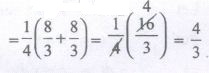
7.
The given equation is of the form \(\frac { dy }{ dx } \)+ py = Q
where P = a and Q = ex
\(\int { P } dx=\int { a } dx\) = ax
Integrating factor (L.F.) = \(e^{ \int { P } dx }\) = eax
∴ The solution is y \(e^{ \int { P } dx }=\int { Q } e^{ \int { P } dx }dx\)+C
⇒ y.eax =\(\int { { e }^{ x }.{ e }^{ ax } } dx+C\)
⇒ y.eax = \(\int { e^{ (a+1)x }dx+C } \)
⇒ y.eax = \(\frac { { e }^{ (a+1)x } }{ a+1 } \)+C
8.
We know Δ (f(x)) = f(x + h) -f(x)
Since h = 1, ∆ (f)) = f(x + 1) - f(x)
[∵ (x + 1)3 = x3 + 3x2 + 3x + 1]
⇒ Δ (x3) = (x + 1)3 - x3

⇒ Δ (x3) = 3x2 + 3x + 1
9.
Given demand function is p = 25 - x - X2
and p0 = 19
⇒ 19 = 25-x-x2
⇒ x2 + x - 6 = 0
⇒ (x + 3) (x - 2) = 0
⇒ x = -3 or x = 2
Since x cannot be negative xo = 2
po xo = 19(2) = 38
\(CS=\int _{ 0 }^{ 2 }{ f(x)dx-{ p }_{ 0 }{ x }_{ 0 } } \)
\(=\int _{ 0 }^{ 2 }{ \left( 25-x-{ x }^{ 2 } \right) dx-38 } \)
\(={ \left( 25x-\frac { { x }^{ 2 } }{ 2 } -\frac { { x }^{ 3 } }{ 3 } \right) }_{ 0 }^{ 2 }-38\)
\(=25(2)-\frac { 4 }{ 2 } -\frac { 8 }{ 3 } -38\)
\(=50-2-\frac { 8 }{ 3 } -38\)
\(=10-\frac { 8 }{ 3 } =\frac { 30-8 }{ 3 } \)
\(CS=\frac { 22 }{ 3 } \) units
10.
Since A and B are non-singular,
|A| \(\neq \) 0, |B|\(\neq \) 0
Consider |AB| |A|·|B|
\(\neq \) 0 since |A|\(\neq \) 0 and |B|\(\neq \) 0.=? |AB| \(\neq \) 0
\(\therefore\) AB is non-singular.

12th Standard Syllabus & Materials
12th Standard
TN 12th Computer Applications களப்பெயர் முறைமை (DNS) Sample Question Papers Study Material - QB365 Set A
NEW12th Standard
TN 12th Computer Applications வலையமைப்பு எடுத்துக்காட்டுகள் மற்றும் நெறிமுறைகள் Sample Question Papers Study Material - QB365 Set A
NEW12th Standard
TN 12th Computer Applications கணினி வலையமைப்பு ஓர் அறிமுகம் Sample Question Papers Study Material - QB365 Set A
NEW12th Standard
TN 12th Computer Applications PHP-உடன் MySQL-ஐ இணைத்தல் Sample Question Papers Study Material - QB365 Set A



Tamilnadu Stateboard 12th Standard Subjects

Maths

Chemistry

Physics

Biology

Computer Science
Business Maths and Statistics

Economics

Commerce

Accountancy

History

Computer Applications
Biology
Computer Technology
Computer Applications
Computer Science
Business Maths and Statistics
Commerce
Economics
Maths
Chemistry
Physics
Computer Technology
History
Accountancy

Tamil

English

French
Tamilnadu Stateboard Standards


