
 100% FREE ACCESS
12th Standard Syllabus & Materials
12th Standard
TN 12th Maths Applications of Matrices and Determinants Sample Question Papers Study Material - QB365 Set A
NEW12th Standard
TN 12th Computer Applications மின்னணு தரவு பரிமாற்றம் Sample Question Papers Study Material - QB365 Set A
NEW12th Standard
TN 12th Computer Applications மின் - வணிக பாதுகாப்பு அமைப்புகள் Sample Question Papers Study Material - QB365 Set A
NEW12th Standard
TN 12th Computer Applications மின்னணு செலுத்தல் முறைகள் Sample Question Papers Study Material - QB365 Set A
NEW12th Standard
TN 12th Computer Applications மின் - வணிகம் Sample Question Papers Study Material - QB365 Set A
NEW12th Standard
TN 12th Computer Applications திறந்த மூல கருத்துருக்கள் Sample Question Papers Study Material - QB365 Set A

Published on: 13/05/2022
QB365 provides detailed and simple solution for every
Creative Questions in class 12 Business Maths Subject.It will helps to get more idea about question pattern in
every Creative questions with solution.
Download Tamil Nadu 12th Standard Business Maths and Statistics question papers, model tests, one-mark questions, important questions, and public exam papers in PDF format. Free study materials and answer keys for TN State Board students.
Questions + Answers key
Take MCQ Business Maths and Statistics Test
1.
Fit a straight line trend to the following data using the method of least square. Estimate the trend for 2007.
| year | 2000 | 2001 | 2002 | 2003 | 2004 |
| Sales (in tonnes) | 1 | 1.8 | 3.3 | 4.5 | 6.3 |
2.
Measurements of the weights of a random sample of 200 ball bearings made by certain machine during one week showed a mean of 0.824 newtons and a S.D. of 0.042 newton's. Find
a) 95% and
b) 99% confidence limits for the mean weight of all the ball bearings.
3.
20% of the bolts produced in a factory are found to be defective. Find the probability that in a sample of 10 bolts chosen at random exactly 2 will be defective using
(i) Binomial distribution
(ii) Poisson distribution (e-2 = 0.1353)
4.
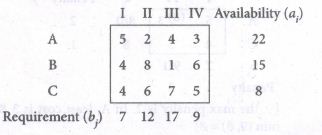
Obtain an initial basic feasible solution to the following transportation problem using Vogels' approximation method.
5.
The probability distribution of a random variation X is given below.
| X | 0 | 1 | 2 | 3 | 4 |
| P(X) | 0.1 | 0.25 | 0.3 | 0.2 | 0.15 |
Find
(i) V(X)
ii) V\((\frac{X}{2})\)
6.
Evaluate \(\int { \frac { 1 }{ { 3x }^{ 2 }+13x-10 } } dx\)
7.
Solve: (y-x)\(\frac { dy }{ dx } \) = a2
8.
From the following data, calculate the value of e1.75
| x | 1.7 | 1.8 | 1.9 | 2.0 | 2.1 |
| ex | 5.474 | 6.050 | 6.686 | 7.386 | 8.166 |
9.
The elasticity of demand with respect to price for a commodity-is a constant and is equal to 2. Find the demand function and hence the total revenue function, given that when the price is 1, the demand is 4.
10.
For what values of k, the system of equations kx+ y+z = 1, x+ ky+z= 1, x+ y+kz = 1 have
(I) Unique solution
(ii) More than one solution
(iii) no solution
1.
| Year x | Sales y | X = x-2002 | XY | X2 |
| 2000 | 1 | -2 | -2 | 4 |
| 2001 | 1.8 | -1 | -1.8 | 1 |
| 2002 | 3.3 | 0 | 0 | 0 |
| 2003 | 4.5 | 1 | 4.5 | 1 |
| 2004 | 6.3 | 2 | 12.6 | 4 |
| 16.9 | 0 | 13.3 | 10 |
Let the required equation of the straight line trend is
y = a + bX
Since Σx = 0. \(a = \frac{\Sigma y}{x} = \frac{16.9}{5}\)
\(b = \frac{\Sigma xy}{\Sigma x^2} = \frac{13.3}{10} = 1.33\)
Hence, the straight line trend is
y = 3.38 + 1.33 (x - 2002)
∴ The trend for 2007 is
yt = 3.38 + 1.33 (2007 - 2002)
⇒ yt = 3.38 + 1.33 (5)
⇒ yt = 3.38 + 6.65
⇒ yt = 10.03
2.
Given sample size n = 200
Sample mean \(\bar { x } \) = 0.824
Sample S.D. s = 0.042
Standard error = \(\frac { s }{ \sqrt { n } } =\frac { 0.042 }{ \sqrt { 200 } } \)
= \(\frac { 0.042 }{ 14.14 } \) = 0.00270
(a) As the level of significance is α = 0.05, \(Z_{ \frac { \alpha }{ 2 } }\) = 1.96
∴ 95% confidence limits for μ are given by \(\bar { x } -Z_{ \frac { \alpha }{ 2 } }(S.E)\le \mu \le \bar { x } +Z_{ \frac { \alpha }{ 2 } }(S.E)\)
⇒ 0.824 - (1.96) (0.00270) ≤ μ ≤ 0.824 + (1.96) (0.00270)
⇒ 0.824 - 0.00582 ≤ μ ≤ 0.824 + 0.00582
⇒ 0.818 ≤ μ ≤ 0.832
Hence, the 95% confidence limits for μ is (0.818,0.832)
(b) As the level of significance is α =0.001, \(Z_{ \frac { \alpha }{ 2 } }\) = 2.58
∴ 99% confidence limits for μ are given by \(\bar { x } -Z_{ \frac { \alpha }{ 2 } }(S.E)\le \mu \le \bar { x } +Z_{ \frac { \alpha }{ 2 } }(S.E)\)
⇒ 0.824 - (2.58) (0.00270) ≤ μ ≤ 0.824 + (2.58) (0.00270)
⇒ 0.824 - 0.00582 ≤ μ ≤ 0.824 + 0.005825
⇒ 0.816 ≤ μ ≤ 0.832
Hence, the 99% confidence limits for μ is (0.816, 0.832)
3.
Given n = 10, p = \(\frac { 20 }{ 100 } =\frac { 1 }{ 5 } \)
∴ q = 1-p = \(1-\frac { 1 }{ 5 } =\frac { 4 }{ 5 } \)
Let
X denote the number of defective bolts chosen
∴ X = 2
(i) Using binomial distribution
P(X = 2) = \(10{ C }_{ 2 }\left( \frac { 1 }{ 5 } \right) ^{ 2 }\left( \frac { 4 }{ 5 } \right) ^{ 8 }\)
= \(\frac { 10\times 9 }{ 2\times 1 } \left( \frac { { 4 }^{ 8 } }{ { 5 }^{ 10 } } \right) =45\left( \frac { 4^{ 8 } }{ { 5 }^{ 10 } } \right) \)
(ii) Using Poisson distribution
λ = np = 10 \(\times\) \(\frac { 1 }{ 5 } \) = 2
P(X = x) \(\times\)\(\frac { { e }^{ -\lambda }.{ \lambda }^{ 0 } }{ x! } \)
x = 0,1,2,......n
∴ P(X = 2) = \(\frac { e^{ -2 }(2^{ 2 }) }{ 2 } =e^{ -2 }\left( \frac { 4 }{ 2 } \right) \)
= 2e-2
= 2(0.1353) = 0.2706
∴ P(X = 2) = 0.2706
4.
Here Σai = 22 + 15 + 8 = 45
Σbj = 7 + 12 + 17 + 9 = 45
Σai = Σbj
∴ The given problem is balanced transportation problem.
Hence, there exists a feasible solution to the given problem.
I-allocation:
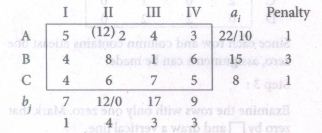
[∵ the max penalty is 4. In II, least cost is 2 & min (12,22) = 12]
II-allocation:
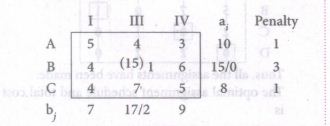
[∵ the max penalty is 3. In B, least cost is 1 & min (17,15) = 15]
III-allocation:
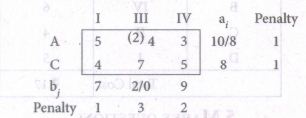
[∵ the max penalty is 3. In III, least cost is 4 & min (2, 10) = 2]
IV-allocation:
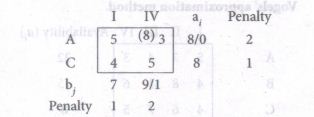
[∵ the max penalty is 2. In A, least cost is 3 & min (9, 8) = 8]
V-allocation:
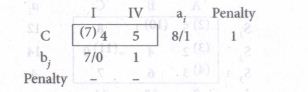
[∵ the max penalty is 1. In C, least cost is 4 & min (7, 8) = 7]
VI-allocation:
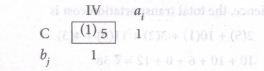
[∵ min (1,1) = 1]
Thus, the allocations are
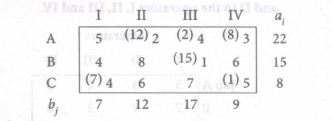
∴ The transportation schedule is
A → II, A → III, A → IV, B → III, C → I and C → IV
Hence, the total transportation cost is
= 12(2) + 2(4) + 8(3) + 15(1) + 7(4) + 1(5)
= 24 + 8 + 24 + 15 + 28 + 5 = Rs.104
5.
i) E(X) = Σxipi
= 0(0.1)+1(0.25)+2(0.3)+3(0.2)+4.(0.15)
= 2.05
E(X2) = ∑xi2pi
= 0(0.1)+1(0.25)+4(0.3)+9(0.2)+16(0.15)
= 5.65
Now, V(X) = E(X2)-[E(X)]2
= 5.65 - (2.05)2 = 1.4475
ii) \(V\left( \frac { X }{ 2 } \right) =\frac { 1 }{ 4 } v(X)\quad [\because V(aX)={ a }^{ 2 }V(X)]\)
\(=\frac { 1 }{ 4 } (1.4475)\)
\(V\left( \frac { X }{ 2 } \right) =0.361875\)
6.
Let I = \(\int { \frac { 1 }{ { 3x }^{ 2 }+13x-10 } } dx\)
= \(\frac { 1 }{ 3 } \int { \frac { dx }{ { x }^{ 2 }+\frac { 13 }{ 3 } x-\frac { 10 }{ 3 } } } \)
= \(\frac { 1 }{ 3 } \int { \frac { dx }{ { x }^{ 2 }+\frac { 13 }{ 3 } x+\frac { 169 }{ 36 } -\frac { 169 }{ 36 } -\frac { 10 }{ 3 } } } \)
= \(\frac { 1 }{ 3 } \int { \frac { dx }{ { \left( x+\frac { 13 }{ 6 } \right) }^{ 2 }-\frac { 289 }{ 36 } } } \)
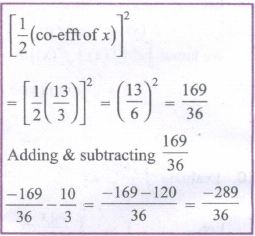
= \(\frac { 1 }{ 3 } \int { \frac { dx }{ { \left( x+\frac { 13 }{ 6 } \right) }^{ 2 }-{ \left( \frac { 17 }{ 16 } \right) }^{ 2 } } } \)
= \(\left[ \because \int { \frac { dx }{ { x }^{ 2 }-{ a }^{ 2 } } =\frac { 1 }{ 2a } log\left| \frac { x-a }{ x+a } \right| } +c \right] \)
= \(\frac { 1 }{ 3 } \times \frac { 1 }{ 2\times \frac { 17 }{ 6 } } log\left| \frac { x+\frac { 13 }{ 6 } -\frac { 17 }{ 6 } }{ x+\frac { 13 }{ 6 } +\frac { 17 }{ 6 } } \right| +c\)
= \(\frac { 1 }{ 17 } log\left| \frac { x-\frac { 2 }{ 5 } }{ x+5 } \right| +c\)
= \(\frac { 1 }{ 17 } log\left| \frac { 3x-2 }{ 3(x+5) } \right| +c\)
7.
(y-x)\(\frac { dy }{ dx } \) = a2
⇒ \(\frac { dy }{ dx } =\frac { { a }^{ 2 } }{ y-x } \Rightarrow \frac { dx }{ dy } =\frac { y-x }{ { a }^{ 2 } } \)
⇒ \(\frac { dx }{ dy } =\frac { y }{ { a }^{ 2 } } -\frac { x }{ a^{ 2 } } \)
⇒ \(\frac { dx }{ dy } +\frac { x }{ { a }^{ 2 } } =\frac { 1 }{ { a }^{ 2 } } \)
This is of the form \(\frac { dx }{ dy } \)+Px = Q
where P = \(\frac { 1 }{ { a }^{ 2 } } \) and Q = \(\frac { 1 }{ { a }^{ 2 } } \)y
∴ \(\int { P } dy=\int { \frac { 1 }{ { a }^{ 2 } } dy } =\frac { 1 }{ { a }^{ 2 } } \)
I.F = \(e^{ \int { pdy } }=e^{ y/{ a }^{ 2 } }\)
∴ The solution is \(\int { x. } e^{ \int { pdy } }=\int { Q.e^{ \int { pdy } } } dy\)
⇒ x.ey/a2 =\(\int { \frac { 1 }{ { a }^{ 2 } } y } \) ey/a2dy+C....(1)
Put \(\frac { 1 }{ { a }^{ 2 } } \)y = t ⇒ dy = a2dt
[∵ u = t; d = et]
u1= 1; v = et
v1 = et
\(\int { u } dv\) = uv-u1v1]
∴ (1) ⇒ x.ey/a2 = a2\(\int { te^{ t } } \)dt
= a2[tet-et]+C
\(xe^{ \frac { y }{ { a }^{ 2 } } }\) = a2.et(t-1)+C
\(xe^{ \frac { y }{ { a }^{ 2 } } }=a^{ 2 }.e^{ \frac { y }{ { a }^{ 2 } } }\left( \frac { y }{ { a }^{ 3 } } -1 \right) \) [∵ t = \(\frac { y }{ { a }^{ 2 } } \)]
8.
Since e1.75 lies at the beginning of the table, we can use Newton's forward interpolation formula
∴ xo + nh = x ⇒ 1.7 + n(0.1) = 1.75
⇒ n(0.1) = 1.75 - 1.7 = 0.05
⇒ n = \(\frac{0.05}{0.1}\) = 0.5
\({ y }_{ x }={ y }_{ o }+\frac { n }{ n! } \triangle { y }_{ o }+\frac { n(n+1) }{ 2! } { \triangle }^{ 2 }{ y }_{ o }+\frac { n(n+1)(n-2) }{ 3! } { \triangle }^{ 3 }{ (y }_{ o })+.......\)
The difference table is
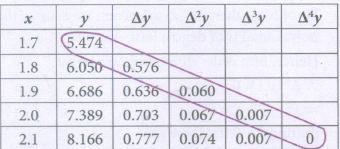
∴ \(y\left( { e }^{ 1.75 } \right) =5.74+\frac { 0.5 }{ 1! } (0.576)+\frac { (0.5)(0.5-1) }{ 2! } (0.06)+\frac { (0.5)(0.5-1)(0.5-2) }{ 3! } (0.007)\)
y(e1.75) = 5.474 + 0.288 - 0.0075 + 0.0004375
= 5.7549375
9.
Given that ηd=2
\(\Rightarrow \frac { -p }{ x } .\frac { dx }{ dp } =2\)
\(\Rightarrow \frac { dx }{ x } =-2\frac { dp }{ p } \)
Integrating both sides,
\(\int { \frac { dx }{ x } =-2\int { \frac { dp }{ p } +logk } } \)
⇒ log x+2log p=log k
log x.p2=log k[∵ a log b=log ba]
⇒ xp2=k
When x=4, p=
4(1)2=k
⇒ k=4
∴ xp2=4
⇒ xp2=\(\frac{4}{x}\)
⇒ \(p-\frac { \sqrt { 4 } }{ x } =\frac { 2 }{ \sqrt { x } } \)
Revenue \(R=px=\frac { 2 }{ \sqrt { x } } .x\)
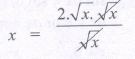
=2√x
\(R=2\sqrt { x } and\quad p=\frac { 2 }{ \sqrt { x } } \)
10.
The given non-homogeneous equations can be written as
\(\left( \begin{matrix} k & 1 & 1 \\ 1 & k & 1 \\ 1 & 1 & k \end{matrix} \right) \left( \begin{matrix} x \\ y \\ z \end{matrix} \right) =\left( \begin{matrix} 1 \\ 1 \\ 1 \end{matrix} \right) \)
| Augmented matrix [A, B] |
Elementary Transformation |
|---|---|
| \(\left( \begin{matrix} k & 1 & 1 \\ 1 & k & 1 \\ 1 & 1 & k \end{matrix}\begin{matrix} 1 \\ 1 \\ 1 \end{matrix} \right) \) | |
| \(\sim \left( \begin{matrix} 1 & 1 & k \\ 1 & k & 1 \\ k & 1 & 1 \end{matrix}\begin{matrix} 1 \\ 1 \\ 1 \end{matrix} \right) \) | \({ R }_{ 1 }\leftrightarrow { R }_{ 3 }\) |
| \(\sim \left( \begin{matrix} 1 & 1 & k \\ 0 & k-1 & 1-k \\ 0 & 1-k & 1-{ k }^{ 2 } \end{matrix}\begin{matrix} 1 \\ 0 \\ 1-k \end{matrix} \right) \) | \({ R }_{ 2 }\rightarrow { R }_{ 2 }-R_{ 1 }\) \({ R }_{ 3 }\rightarrow { R }_{ 3 }-k{ R }_{ 1 }\) |
| \(\sim \left( \begin{matrix} 1 & 1 & k \\ 0 & k-1 & 1-k \\ 0 & 0 & 2-k-{ k }^{ 2 } \end{matrix}\begin{matrix} 1 \\ 0 \\ 1-k \end{matrix} \right) \) | \({ R }_{ 3 }\rightarrow { R }_{ 3 }{ +R_{ 2 } }\) |
Case (i):
When \(k\neq 1\) and \(k\neq 2\)
\(\rho (A)=\rho (A,B)=3=\) Number of unknowns
\(\therefore \) The system has unique solution
Case (ii):
When k = 1
\(\left[ A,B \right] \sim \left( \begin{matrix} 1 & 1 & 1 \\ 0 & 0 & 0 \\ 0 & 0 & 0 \end{matrix}\begin{matrix} 1 \\ 0 \\ 0 \end{matrix} \right) \)
\(\rho (A)=\rho\) (A, B) = 1
\(\therefore \) The system is consistent and has infinitely many solutions.
Case (iii):
When k = - 2
\(\left[ A,B \right] \sim \left( \begin{matrix} 1 & 1 & -2 \\ 0 & -3 & 3 \\ 0 & 0 & 0 \end{matrix}\begin{matrix} 1 \\ 0 \\ -3 \end{matrix} \right) \)
\(\rho (A)=2\rho (A,B)\)= 3
\(\Rightarrow \rho (A)\neq 2\rho (A,B)\)
\(\therefore\) The system is inconsistent and has no solution.

12th Standard Syllabus & Materials
12th Standard
TN 12th Computer Applications வலையமைப்பு வடமிடல் Sample Question Papers Study Material - QB365 Set A
NEW12th Standard
TN 12th Computer Applications களப்பெயர் முறைமை (DNS) Sample Question Papers Study Material - QB365 Set A
NEW12th Standard
TN 12th Computer Applications வலையமைப்பு எடுத்துக்காட்டுகள் மற்றும் நெறிமுறைகள் Sample Question Papers Study Material - QB365 Set A
NEW12th Standard
TN 12th Computer Applications கணினி வலையமைப்பு ஓர் அறிமுகம் Sample Question Papers Study Material - QB365 Set A



Tamilnadu Stateboard 12th Standard Subjects

Maths

Chemistry

Physics

Biology

Computer Science
Business Maths and Statistics

Economics

Commerce

Accountancy

History

Computer Applications
Biology
Computer Technology
Computer Applications
Computer Science
Business Maths and Statistics
Commerce
Economics
Maths
Chemistry
Physics
Computer Technology
History
Accountancy

Tamil

English

French
Tamilnadu Stateboard Standards


