
 100% FREE ACCESS
12th Standard Syllabus & Materials
12th Standard
TN 12th Maths Applications of Matrices and Determinants Sample Question Papers Study Material - QB365 Set A
NEW12th Standard
TN 12th Computer Applications மின்னணு தரவு பரிமாற்றம் Sample Question Papers Study Material - QB365 Set A
NEW12th Standard
TN 12th Computer Applications மின் - வணிக பாதுகாப்பு அமைப்புகள் Sample Question Papers Study Material - QB365 Set A
NEW12th Standard
TN 12th Computer Applications மின்னணு செலுத்தல் முறைகள் Sample Question Papers Study Material - QB365 Set A
NEW12th Standard
TN 12th Computer Applications மின் - வணிகம் Sample Question Papers Study Material - QB365 Set A
NEW12th Standard
TN 12th Computer Applications திறந்த மூல கருத்துருக்கள் Sample Question Papers Study Material - QB365 Set A

Published on: 13/05/2022
QB365 provides detailed and simple solution for every Book back Questions in class 12 Business Maths Subject. It will helps to get more idea about question pattern in every book back questions with solution.
latest Book back QuestionsDownload Tamil Nadu 12th Standard Business Maths and Statistics question papers, model tests, one-mark questions, important questions, and public exam papers in PDF format. Free study materials and answer keys for TN State Board students.
Questions + Answers key
Take MCQ Business Maths and Statistics Test
1.
Solve \(\frac { dy }{ dx } \) = ex−y+ x2e− y
2.
3.
Find the differential equation of the family of parabola with foci at the origin and axis along the x-axis.
4.
Find the differential equation of all circles passing through the origin and having their centers on the y axis.
5.
Form the differential equation by eliminating α and β from (x − α)2 + (y − β)2 = r2
1.
Given \(\frac { dy }{ dx } \) = ex−y + x2e−y = e−yex + e−yx2
= e−y(ex + x2)
Separating the variables, we get eydy=(ex + x2)dx
Integrating, we get ഽeydy = ഽ(ex+x2)dx
ey = ex + \(\frac { x^{ 3 } }{ 3 } \) + c
2.
3.
Equation of family of parabolas with foci at the origin and axis along the x-axis is
y2 = 4a(x+a) ...(1)
[ ∵ the focus is at the origin its vertex will be (-a, 0) and latus rectum is 4a]
Differentiating w.r.t. 'x' we get,
2y\(\left( \frac { dy }{ dx } \right) \) = 4a(1) ....(1)
⇒ 2y\(\left( \frac { dy }{ dx } \right) \) = 4a ...(2)
Also \(\frac { 2y }{ 4 } \left( \frac { dy }{ dx } \right) \) = a
⇒ \(\frac { y }{ 2 } \left( \frac { dy }{ dx } \right) \) = a...(3)
Substituting (2) and (3) in (1) we get,
y2 = 2y\(\left( \frac { dy }{ dx } \right) \left[ x+\frac { y }{ 2 } \left( \frac { dy }{ dx } \right) \right] \)
⇒ y2 = 2xy\(\left( \frac { dy }{ dx } \right) +{ y }^{ 2 }\left( \frac { dy }{ dx } \right) ^{ 2 }\)
Dividing by Y we get,
\(y=2x\frac { dy }{ dx } { +y\left( \frac { dy }{ dx } \right) }^{ 2 }\).
4.
Equation of all circles passing through the origin and having their centres on the y-axis.
x2 + (y - k)2 = k2 ....(1)
[where (0, k) is the centre of the cirde which lies on the y-axis and radius is k].
Differentiating w.r.t. 'x
⇒ 2x + 2(y-k)\(\frac { dy }{ dx } \) = 0
⇒ (y-k) =\(\frac { -x }{ \frac { dy }{ dx } } \) ....(2)
Also, y+\(\frac { x }{ \frac { dy }{ dx } } \) = k ....(3)
Substituting (2) & (3) in (1) we get
\({ x }^{ 2 }+\left( \frac { -x }{ \frac { dy }{ dx } } \right) ^{ 2 }=\left( y+\frac { x }{ \frac { dy }{ dx } } \right) ^{ 2 }\)
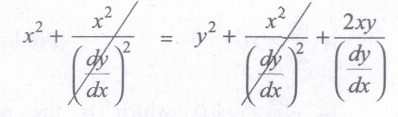
⇒ x2 = y2+\(\\ \frac { 2xy }{ \frac { dy }{ dx } } \)
⇒ \(y^{2}-x^{2}-2 x y \frac{d y}{d x}=0\)
5.
Given equation is (x - α)2 + (y - β)2 = r2
Differentiating w.r.t. 'x' we get,
2 (x - α)2 + (y - β)\(\frac { dy }{ dx } \) = r2
⇒ (x - α) + (y - β)\(\frac { dy }{ dx } \) = 0....(2)
Differentiating again w.r.t. 'x' we get
1+(y-β) \(\frac { d^{ 2 }y }{ dx^{ 2 } } +\frac { dy }{ dx } .\frac { dy }{ dx } \) = 0
⇒ 1+(y-β) \(\frac { d^{ 2 }y }{ dx^{ 2 } } +\left( \frac { dy }{ dx } \right) ^{ 2 }\)= 0
⇒ y-β = \(\frac { -1\left( 1+\left( \frac { dy }{ dx } \right) ^{ 2 } \right) }{ \frac { d^{ 2 }y }{ dx^{ 2 } } } \) .....(3)
Substituting this value in (2) we get
(x-α) = \(\left( \frac { 1+\left( \frac { dy }{ dx } \right) ^{ 2 }\frac { dy }{ dx } }{ \frac { d^{ 2 }y }{ dx^{ 2 } } } \right) \) ......(4)
Substituting (3) and (4) in (1) we get
\(\frac { \left\{ 1+\left( \frac { dy }{ dx } \right) ^{ 2 }\left( \frac { dy }{ dx } \right) ^{ 2 } \right\} }{ \left( \frac { d^{ 2 }y }{ dx^{ 2 } } \right) ^{ 2 } } +\frac { \left\{ 1+\left( \frac { dy }{ dx } \right) ^{ 2 } \right\} ^{ 2 } }{ \left( \frac { d^{ 2 }y }{ dx^{ 2 } } \right) ^{ 2 } } \)
=\(\left( \frac { d^{ 2 }y }{ dx^{ 2 } } \right) ^{ 2 }\)
⇒ \(\left[ 1+\left( \frac { dy }{ dx } \right) ^{ 2 } \right] \left[ \left( \frac { dy }{ dx } \right) ^{ 2 }+1 \right] ={ r }^{ 2 }\left( \frac { d^{ 2 }y }{ dx^{ 2 } } \right) \)
⇒ \(\left[ 1+\left( \frac { dy }{ dx } \right) ^{ 2 } \right] ^{ 3 }\)
= \({ r }^{ 2 }\left( \frac { d^{ 2 }y }{ dx^{ 2 } } \right) ^{ 2 }\)

12th Standard Syllabus & Materials
12th Standard
TN 12th Computer Applications வலையமைப்பு வடமிடல் Sample Question Papers Study Material - QB365 Set A
NEW12th Standard
TN 12th Computer Applications களப்பெயர் முறைமை (DNS) Sample Question Papers Study Material - QB365 Set A
NEW12th Standard
TN 12th Computer Applications வலையமைப்பு எடுத்துக்காட்டுகள் மற்றும் நெறிமுறைகள் Sample Question Papers Study Material - QB365 Set A
NEW12th Standard
TN 12th Computer Applications கணினி வலையமைப்பு ஓர் அறிமுகம் Sample Question Papers Study Material - QB365 Set A



Tamilnadu Stateboard 12th Standard Subjects

Maths

Chemistry

Physics

Biology

Computer Science
Business Maths and Statistics

Economics

Commerce

Accountancy

History

Computer Applications
Biology
Computer Technology
Computer Applications
Computer Science
Business Maths and Statistics
Commerce
Economics
Maths
Chemistry
Physics
Computer Technology
History
Accountancy

Tamil

English

French
Tamilnadu Stateboard Standards


