
 100% FREE ACCESS
12th Standard Syllabus & Materials
12th Standard
TN 12th Computer Applications மின்னணு தரவு பரிமாற்றம் Sample Question Papers Study Material - QB365 Set A
NEW12th Standard
TN 12th Computer Applications மின் - வணிக பாதுகாப்பு அமைப்புகள் Sample Question Papers Study Material - QB365 Set A
NEW12th Standard
TN 12th Computer Applications மின்னணு செலுத்தல் முறைகள் Sample Question Papers Study Material - QB365 Set A
NEW12th Standard
TN 12th Computer Applications மின் - வணிகம் Sample Question Papers Study Material - QB365 Set A
NEW12th Standard
TN 12th Computer Applications திறந்த மூல கருத்துருக்கள் Sample Question Papers Study Material - QB365 Set A
NEW12th Standard
TN 12th Computer Applications வலையமைப்பு வடமிடல் Sample Question Papers Study Material - QB365 Set A

Published on: 23/06/2021
QB365 provides detailed and simple solution for every
Creative Questions in class 12 Business Maths Subject.It will helps to get more idea about question pattern in
every Creative questions with solution.
Download Tamil Nadu 12th Standard Business Maths and Statistics question papers, model tests, one-mark questions, important questions, and public exam papers in PDF format. Free study materials and answer keys for TN State Board students.
Questions + Answers key
Take MCQ Business Maths and Statistics Test
1.
Find the area of the region bounded by the parabola y2 = 4x and the line 2x - y = 4.
2.
Find the area of the region bounded by the curve y = 3 x2 - x, X-axis and the lines between x = -1 and x= 1
3.
The marginal cost function of a commodity in a firm is 2 + e3x where X is the output. Find the total cost and average cost function if the fixed cost is Rs. 500.
4.
The marginal revenue function (in thousands of rupees) of a commodity is 7+e-0.05x where x is the number of units sold. Find the total revenue from the sale of 100 units (e-5 = 0.0067)
5.
The marginal cost C' (x) and marginal revenue R' (x) are given by C' (x) = 20 +\(\frac{x}{20}\) and R' (x) = 30. The fixed cost is Rs.200. Determine the maximum profit.
1.
2x-y = 4
| x | 0 | 2 |
| y | -4 | 0 |
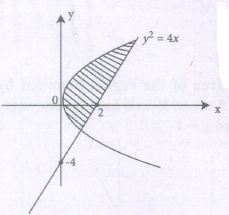
y2 = 4x and 2x = 4 + y ⇒ 4x = 8 + 2y
y2 = 8+2y ⇒ y2-2y-8 = 0
(y-4)(y+2) = 0
y = -2, 4.
Required area \(=\int _{ -2 }^{ 4 }{ ({ x }_{ 1 }-{ x }_{ 2 })dy } \)
\(=\int _{ -2 }^{ 4 }{ \left( \frac { y+4 }{ 2 } -\frac { { y }^{ 2 } }{ 4 } \right) dy } \)
Where x1 is the line x2 is the parabola
\(=\int _{ -2 }^{ 4 }{ \frac { y+4 }{ 2 } dy } -\frac { 1 }{ 4 } \int _{ -2 }^{ 4 }{ { y }^{ 2 }dy } \)
\(=\frac { 1 }{ 2 } { \left[ \frac { { y }^{ 2 } }{ 2 } +4y \right] }_{ -2 }^{ 4 }-\frac { 1 }{ 4 } { \left[ \frac { { y }^{ 3 } }{ 3 } \right] }_{ -2 }^{ 4 }\\ \)
\(=\frac { 1 }{ 2 } \left[ \left( \frac { 16 }{ 2 } +16 \right) -\left( \frac { 4 }{ 2 } -8 \right) \right] -\frac { 1 }{ 4 } \left[ \frac { 64 }{ 3 } +\frac { 8 }{ 3 } \right] \)
\(=\frac { 1 }{ 2 } \left[ 24+6 \right] -\frac { 1 }{ 4 } \left[ \frac { 64+8 }{ 3 } \right] \)
\(=\frac { 1 }{ 2 } (30)-\frac { 1 }{ 4 } \left( \frac { 72 }{ 3 } \right) \)
\(=15-\frac { 1 }{ 4 } (24)=15-6\)
= 9 sq.units.
2.
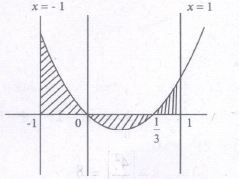
y = 3x2 - x is an open upward parabola and meets the X-axis at x = 0, x = \(\frac{1}{3}\) when y = 0
∴ The required area is the combination of 3 pies
\(A=\int _{ 1 }^{ 0 }{ ydx+ } \int _{ 0 }^{ \frac { 1 }{ 3 } }{ -ydy } +\int _{ \frac { 1 }{ 3 } }^{ 1 }{ dy } \) [Since the second area lies below the X-axis]
\(A=\int _{ -1 }^{ 0 }{ ({ 3x }^{ 2 }-x)dx+\int _{ 0 }^{ \frac { 1 }{ 3 } }{ \left( x-3{ x }^{ 2 } \right) dx+ } } \int _{ \frac { 1 }{ 3 } }^{ 1 }{ ({ 3x }^{ 2 }-x)dx } \)
\(={ \left[ \frac { { 3x }^{ 3 } }{ 3 } -\frac { { x }^{ 2 } }{ 2 } \right] }_{ -1 }^{ 0 }+{ \left[ \frac { { x }^{ 2 } }{ x } -\frac { { 3x }^{ 3 } }{ 3 } \right] }_{ 0 }^{ \frac { 1 }{ 3 } }+{ \left[ \frac { { 3x }^{ 3 } }{ 3 } -\frac { { x }^{ 2 } }{ 2 } \right] }_{ \frac { 1 }{ 3 } }^{ 1 }\\ \)
\(=0-\left( -1-\frac { 1 }{ 2 } \right) +\left( \frac { 1 }{ 18 } -\frac { 1 }{ 27 } \right) -0+\left( 1-\frac { 1 }{ 2 } \right) -\left( \frac { 1 }{ 27 } -\frac { 1 }{ 18 } \right) \)
\(=\frac { 3 }{ 2 } +\frac { 1 }{ 18 } -\frac { 1 }{ 27 } +\frac { 1 }{ 2 } -\frac { 1 }{ 27 } +\frac { 1 }{ 18 } \)
\(=\left( \frac { 3 }{ 2 } +\frac { 1 }{ 2 } \right) +\left( \frac { 1 }{ 18 } +\frac { 1 }{ 18 } \right) -\left( \frac { 1 }{ 27 } +\frac { 1 }{ 27 } \right) \)
\(=2+\frac { 2 }{ 18 } -\frac { 2 }{ 27 } =2+\frac { 1 }{ 9 } -\frac { 2 }{ 27 } =\frac { 54+3-2 }{ 27 } \)
\(A=\frac { 55 }{ 27 } \) sq.units.
3.
Given C'(x) = 2 + 3e3x
\(\Rightarrow \int { C'(x) } =\int { (2+{ 3e }^{ 3x }) } dx\)
\(\Rightarrow C(x)=2x+\frac { { 3e }^{ 3x } }{ 3 } +k\)
\(\Rightarrow C(x)=2x+{ e }^{ 3x }+k\)
Since the fixed cost is Rs. 500, when x = 0, C = 500
\(\Rightarrow 500=0+{ e }^{ 0 }+k\quad [\because { e }^{ 0 }=1]\)
⇒ 500-1 = k ⇒ = 499
∴ C(x) = 2x + e3x+499
Average cost dunction \(AC=\frac { C }{ x } \)
\(AC=\frac { 2x+{ e }^{ 3x }+499 }{ x } \)
\(=2+\frac { { e }^{ 3x } }{ x } +\frac { 499 }{ x } \)
4.
Given' R'(x) = 7 + e-0.05x
Total revenue from sale of 100 units is
\(R=\int _{ 0 }^{ 100 }{ (7+{ e }^{ -0.05x })dx } \)
\(={ \left[ 7x+\frac { { e }^{ -0.05x } }{ -0.05 } \right] }_{ 0 }^{ 100 }\)
\(=700-\frac { 100 }{ 5 } ({ e }^{ -5 }-{ e }^{ 0 })\left[ 0.05=\frac { 5 }{ 100 } \right] \)
= 700-20(0.0067-1)[∵e0=1]
= 700-0.134
= 719.866
Since the revenue is given in thousands,
Total revenue = 719.866 x 1000
= Rs. 7,19,866
5.
Given \(C'(x)=20+\frac { x }{ 20 } \)
\(\Rightarrow \int { C'(x)dx= } \int { \left( 20+\frac { x }{ 20 } \right) dx } \)
\(C(x)=20x+\frac { { x }^{ 2 } }{ 40 } +{ k }_{ 1 }\)
Given when x = 0, C = 200
⇒ k1 = 200
\(\therefore C(x)=20x+\frac { { x }^{ 2 } }{ 40 } +200\quad ---(1)\)
Also, R'(x) = 30
\(R(x)=\int { 30dx } +{ k }_{ 2 }=30x+{ k }_{ 2 }\)
When x = 0 R = 0 ⇒ K2 = 0
∴ R(x) = 30x ----(2)
Profit = Total revenue - total cost
\(=30x-20x-\frac { { x }^{ 2 } }{ 40 } -200\)
\(\therefore P=10x-\frac { { x }^{ 2 } }{ 40 } -200---(3)\)
\(\frac { dp }{ dx } =10-\frac { 2x }{ 40 } =10-\frac { x }{ 20 } \)
\(\frac { dp }{ dx } =0\)
\(\Rightarrow 10-\frac { x }{ 20 } =0\)
\(\Rightarrow 10=\frac { x }{ 20 } \Rightarrow x=200\)
\(\frac { d^{ 2 }p }{ { dx }^{ 2 } } =-\frac { 1 }{ 20 } <0\)
∴ Profit is maximum when x= 200
∴ maximum profit \(P=10(200)-\frac { { (200) }^{ 2 } }{ 40 } -200[From(3)]\)
P = 2000 -1000 - 200
2000 - 1200
P = Rs .800.
Hence, the maximum profit is Rs. 800.

12th Standard Syllabus & Materials
12th Standard
TN 12th Computer Applications களப்பெயர் முறைமை (DNS) Sample Question Papers Study Material - QB365 Set A
NEW12th Standard
TN 12th Computer Applications வலையமைப்பு எடுத்துக்காட்டுகள் மற்றும் நெறிமுறைகள் Sample Question Papers Study Material - QB365 Set A
NEW12th Standard
TN 12th Computer Applications கணினி வலையமைப்பு ஓர் அறிமுகம் Sample Question Papers Study Material - QB365 Set A
NEW12th Standard
TN 12th Computer Applications PHP-உடன் MySQL-ஐ இணைத்தல் Sample Question Papers Study Material - QB365 Set A



Tamilnadu Stateboard 12th Standard Subjects

Maths

Chemistry

Physics

Biology

Computer Science
Business Maths and Statistics

Economics

Commerce

Accountancy

History

Computer Applications
Biology
Computer Technology
Computer Applications
Computer Science
Business Maths and Statistics
Commerce
Economics
Maths
Chemistry
Physics
Computer Technology
History
Accountancy

Tamil

English

French
Tamilnadu Stateboard Standards


