
 100% FREE ACCESS
12th Standard Syllabus & Materials
12th Standard
TN 12th Maths Applications of Matrices and Determinants Sample Question Papers Study Material - QB365 Set A
NEW12th Standard
TN 12th Computer Applications மின்னணு தரவு பரிமாற்றம் Sample Question Papers Study Material - QB365 Set A
NEW12th Standard
TN 12th Computer Applications மின் - வணிக பாதுகாப்பு அமைப்புகள் Sample Question Papers Study Material - QB365 Set A
NEW12th Standard
TN 12th Computer Applications மின்னணு செலுத்தல் முறைகள் Sample Question Papers Study Material - QB365 Set A
NEW12th Standard
TN 12th Computer Applications மின் - வணிகம் Sample Question Papers Study Material - QB365 Set A
NEW12th Standard
TN 12th Computer Applications திறந்த மூல கருத்துருக்கள் Sample Question Papers Study Material - QB365 Set A

Published on: 01/03/2021
12th Standard English Medium Business Maths Syllabus Five Mark Important Questions - 2021(Public Exam )
Download Tamil Nadu 12th Standard Business Maths and Statistics question papers, model tests, one-mark questions, important questions, and public exam papers in PDF format. Free study materials and answer keys for TN State Board students.
Questions + Answers key
Take MCQ Business Maths and Statistics Test
1.
The probability function of a random variable X is given by
\(p(x)=\left\{\begin{array}{l} \frac{1}{4}, \text { for } x=-2 \\ \frac{1}{4}, \text { for } x=0 \\ \frac{1}{2}, \text { for } x=10 \\ 0, \text { elsewhere } \end{array}\right.\)
Evaluate the following probabilities.
P(0\(\le\)X\(\le\)10)
2.
From the following table obtain a polynomial of degree y in x
| x | 1 | 2 | 3 | 4 | 5 |
| y | 1 | -1 | 1 | -1 | 1 |
3.
Using Lagrange’s interpolation formula find y(10) from the following table:
| x | 5 | 6 | 9 | 11 |
| y | 12 | 13 | 14 | 16 |
4.
Calculate the value of y when x = 7.5 from the table given below
| x | 1 | 2 | 3 | 4 | 5 | 6 | 7 | 8 |
| y | 1 | 8 | 27 | 64 | 125 | 216 | 343 | 512 |
5.
Using Newton’s formula for interpolation estimate the population for the year 1905 from the table:
| Year | 1891 | 1901 | 1911 | 1921 | 1931 |
| Population | 98.752 | 1,32,285 | 1,68,076 | 1,95,690 | 2,46,050 |
6.
Solve cos2 x \(\frac{dy}{dx}\) + y = tan x
7.
The slope of the tangent to a curve at any point (x, y) on it is given by (y3−2yx2)dx + (2xy2−x3)dy = 0 and the curve passes through (1, 2). Find the equation of the curve.
8.
Calculate the cost of living index number for the following data.
| Commodities | Quantity 2005 |
Price | |
| 2005 | 2010 | ||
| A | 10 | 7 | 9 |
| B | 12 | 6 | 8 |
| C | 17 | 10 | 15 |
| D | 19 | 14 | 16 |
| E | 15 | 12 | 17 |
9.
In a distribution 30% of the items are under 50 and 10% are over 86. Find the mean and standard deviation of the distribution.
10.
Derive the mean and variance of binomial distribution.
11.
Suppose the life in hours of a radio tube has the probability density function
\(f(x)=\left\{\begin{array}{l} e^{-\frac{x}{100}}, \text { when } x \geq 100 \\ 0, \quad \text { when } x<100 \end{array}\right.\)
Find the mean of the life of a radio tube.
12.
The price of a machine is Rs. 5,00,000 with an estimated life of 12 years. The estimated salvage value is Rs. 30,000. The machine can be rented at Rs. 72,000 per year. The present value of the rental payment is calculated at 9% interest rate. Find out whether it is advisable to rent the machine.(e−1.08 = 0.3396).
13.
Find the area bounded by the curve y = x2 and the line y = 4
14.
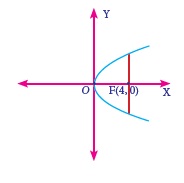
Using integration find the area of the region bounded between the line x = 4 and the parabola y2 = 16x.
15.
Evaluate \(\int { \frac { { 3x }^{ 2 }+6x+1 }{ \left( x+3 \right) \left( { x }^{ 2 }+1 \right) } } dx\)
16.
Solve the equations x + 2y + z = 7, 2x − y + 2z = 4, x + y − 2z = −1 by using Cramer’s rule
17.
Find k if the equations 2x + 3y − z = 5, 3x − y + 4z = 2, x + 7y − 6z = k are consistent.
18.
80% of students who do maths work during one study period, will do the maths work at the next study period. 30% of students who do english work during one study period, will do the english work at the next study period. Initially there were 60 students do maths work and 40 students do english work.
Calculate,
(i) The transition probability matrix
(ii) The number of students who do maths work, english work for the next subsequent 2 study periods.
19.
A total of Rs. 8,500 was invested in three interest earning accounts. The interest rates were 2%, 3% and 6% if the total simple interest for one year was Rs. 380 and the amount, invested at 6% was equal to the sum of the amounts in the other two accounts, then how much was invested in each account? (use Cramer’s rule).
20.
Solve by Cramer’s rule x + y + z = 4, 2x − y + 3z = 1, 3x + 2y − z = 1
21.
An amount of Rs. 5,000/- is to be deposited in three different bonds bearing 6%, 7% and 8% per year respectively. Total annual income is Rs. 358/-. If the income from first two investments is Rs. 70/- more than the income from the third, then find the amount of investment in each bond by rank method.
22.
Investigate for what values of ‘a’ and ‘b’ the following system of equations x + y + z = 6,x + 2y + 3z = 10, x + 2y + az = b have
(i) no solution
(ii) a unique solution
(iii) an infinite number of solutions.
23.
Show that the equations are inconsistent x − 4y + 7z = 14, 3x + 8y − 2z = 13, 7x − 8y + 26z = 5
24.
Evaluate \(\int _{ -1 }^{ 1 }{ x\sqrt { x+1 } } dx\)
25.
Integrate the following with respect x
\(\frac { 3x+2 }{ \left( x-2 \right) \left( x-3 \right) } \)
1.
Given probability function is
\(p(x)=\left\{\begin{array}{l} \frac{1}{4}, \text { for } x=-2 \\ \frac{1}{4}, \text { for } x=0 \\ \frac{1}{2}, \text { for } x=10 \\ 0, \text { elsewhere } \end{array}\right.\)
| X=x | -2 | 0 | 10 |
| P(X=x) | \(\frac{1}{4}\) | \(\frac{1}{4}\) | \(\frac{1}{2}\) |
P(0≤X≤10)=P(X=0)+P(X=10)
\(\frac{1}{4}+\frac{1}{2}=\frac{3}{4}\)
2.
Given
The difference table is
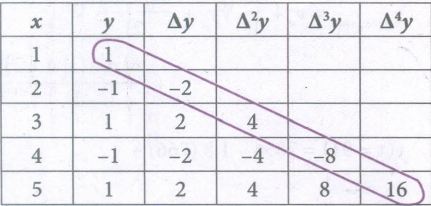
To findy when x = x ⇒ x0+ nh = x ⇒ 1 + n (1) = x ⇒ n = x-1
Newton's forward interpolation formula is
y(x=x) = \(\frac { n }{ 1! } { \triangle y }_{ 0 }+\frac { n(n+1) }{ 2! } { \triangle }^{ 2 }{ y }_{ 0 }+\frac { n(n+1)(n+2) }{ 3! } { \triangle }^{ 3 }{ y }_{ 0 }\)+ .....
y(x=x) = 1 + (x-1)(-2) + \(\frac { (x-1)(x-2) }{ 2 } (4)+\frac { (x-1)(x-2)(x-3) }{ 6 } (-8)+\frac { (x-1)(x-2)(x-3)(x-4) }{ 24 } (16)\)
⇒ y = 1 - 2x + 2(x2 - 3x + 2) - \(\frac{4}{3}\) (x - 1) (x - 2) (x - 3) + \(\frac{2}{3}\) (x - 1) (x - 2) (x - 3) (x -4)
⇒ y = 3 - 2x + 2x2 - 6x + 4 - \(\frac{4}{3}\) [(x2 - 3x + 2) (x- 3)] + \(\frac{2}{3}\) [(x2 - 3x + 2)(x2 - 7x + 12)]
⇒ y = 2x2 - 8x+ 7- \(\frac{4}{3}\) [x3- 3x2+ 2x- 3x2 + 9x- 6] + \(\frac{2}{3}\) [x4 - 3x3 + 2x2 - 7x3 + 21x2 - 14x + 12x2 - 36x + 24]
⇒ y = 2x2-8x+7- \(\frac{4}{3}\) x3 + 4x2 - \(\frac{8}{3}\) x + 4x2 - 12x + 8 + \(\frac { { 12x }^{ 4 } }{ 3 } -\frac { 20 }{ 3 } { x }^{ 3 }+\frac { 70 }{ 3 } { x }^{ 2 }-\frac { 100x }{ 3 } +\frac { 48 }{ 3 } \)
⇒ y = \(\frac{2}{3}\) x4 + x3 \(\left( \frac { -4 }{ 3 } \frac { -20 }{ 3 } \right) \) + x2\(\left( 2+4+4+\frac { 70 }{ 3 } \right) \) + x \(\left( -8-\frac { 8 }{ 3 } -12-\frac { 100 }{ 3 } \right) \) + 31
⇒ y = \(\frac{2}{3}\) x4 - 8x3 + \(\frac{100}{3}\) x2 - 56x + 31 which is the required polynomial.
3.
Here the intervals are unequal. By Lagrange’s interpolation formula we have
x0 = 5, x1 = 6, x2 = 9, x3 = 11
y0 = 12, y1 = 13, y2 = 14, y3 = 16
\(y=f(x)=\frac { \left( x-{ x }_{ 1 } \right) \left( x-{ x }_{ 2 } \right) \left( x-{ x }_{ 3 } \right) }{ \left( { x }_{ 0 }-{ x }_{ 1 } \right) \left( x_{ 0 }-{ x }_{ 2 } \right) \left( { x }_{ 0 }-{ x }_{ 3 } \right) } \times { y }_{ 0 }+\frac { \left( x-{ x }_{ 0 } \right) \left( x-{ x }_{ 2 } \right) \left( x-{ x }_{ 3 } \right) }{ \left( { x }_{ 1 }-{ x }_{ 0 } \right) \left( x_{ 1 }-{ x }_{ 2 } \right) \left( { x }_{ 1 }-{ x }_{ 3 } \right) } \times { y }_{ 1 }+\frac { \left( x-{ x }_{ 0 } \right) \left( x-{ x }_{ 2 } \right) \left( x-{ x }_{ 3 } \right) }{ \left( { x }_{ 2 }-{ x }_{ 0 } \right) \left( x_{ 2 }-{ x }_{ 1 } \right) \left( { x }_{ 2 }-{ x }_{ 3 } \right) } \times { y }_{ 2 }+\frac { \left( x-{ x }_{ 0 } \right) \left( x-{ x }_{ 2 } \right) \left( x-{ x }_{ 3 } \right) }{ \left( { x }_{ 3 }-{ x }_{ 0 } \right) \left( x_{ 3 }-{ x }_{ 1 } \right) \left( { x }_{ 3 }-{ x }_{ 2 } \right) } \times { y }_{ 3 }\)
\(=\frac { (x-6)(x-9)(x-11) }{ (5-6)(5-6)(5-11) } (12)+\frac { (x-5)(x-9)(x-11) }{ (6-5)(6-9)(6-9) } (13)+\frac { (x-5)(x-6)(x-11) }{ (9-5)(9-6)(9-11) } (14)+\frac { (x-5)(x-6)(x-9) }{ (11-5)(11-6)(11-9) } (16)\)
Put x = 10
\({ y }_{ (10) }=f\left( 10 \right) =\frac { 4(1)(-1) }{ (-1)(-4)(-6) } (12)+\frac { (5)(1)(-1) }{ (1)(-3)(-5) } (13)+\frac { 5(4)(-1) }{ 4(3)(-2) } (14)+\frac { (5)(4)(1) }{ 6(5)(2) } (16)\)}
= \(\frac { 1 }{ 6 } \left( 12 \right) -\frac { 13 }{ 3 } +\frac { 5\left( 14 \right) }{ 3\times 2 } +\frac { 4\times 16 }{ 12 } \)
= 14.6663
4.
Since the required value is at the end of the table, apply backward interpolation formula
| x | y | \(\Delta y\) | \(\Delta ^{ 2 }y\) | \(\Delta ^{ 2 }y\) | \(\Delta ^{ 4 }y\) |
| 1 | 1 | ||||
| 7 | |||||
| 2 | 8 | 12 | |||
| 19 | 6 | ||||
| 3 | 27 | 18 | 0 | ||
| 37 | 6 | ||||
| 4 | 64 | 24 | 0 | ||
| 61 | 6 | ||||
| 5 | 125 | 30 | 0 | ||
| 91 | 6 | ||||
| 6 | 216 | 36 | 0 | ||
| 127 | 6 | ||||
| 7 | 343 | 42 | |||
| 169 | |||||
| 8 | 512 |
.\({ y }_{ \left( x={ x }_{ 0 }+nh \right) }={ y }_{ 0 }+\frac { n }{ n! } \Delta { y }_{ 0 }+\frac { n(n-1) }{ 2! } { \Delta }^{ 2 }{ y }_{ 0 }+\frac { n(n-)(n-2) }{ 3! } { \Delta }^{ 3 }{ y }_{ 0 }+...\)
To find y at x = 7.5
\(\therefore\) xn + nh = 7.5, xn = 8, h = 1 \(\Rightarrow\) n = –0.5
\({ y }_{ (x=7.5) }=512+\frac { -0.5 }{ 1! } 169+\frac { 0.5(-0.5+10 }{ 2! } 42+\frac { -0.5(-0.5+1)(-0.5+2) }{ 3! } 6\)
= 421.88
5.
To find the population for the year 1905 (i.e) the value of y at x = 1905
Since the value of y is required near the beginning of the table, we use the Newton’s forward interpolation formula.
\({ y }_{ \left( x={ x }_{ 0 }+nh \right) }={ y }_{ 0 }+\cfrac { n }{ n! } \Delta { y }_{ 0 }+\cfrac { n(n-1) }{ 2! } { \Delta }^{ 2 }{ y }_{ 0 }+\cfrac { n(n-)(n-2) }{ 3! } { \Delta }^{ 3 }{ y }_{ 0 } + ...\)
To find y at x = 1905
\(\therefore\) x0+nh = 1905 , x0 = 1891, h = 10
1891+n(10) = 1905 \(\Rightarrow\) n = 1.4
| x | y | \(\Delta y\) | \(\Delta ^{ 2 }y\) | \(\Delta ^{ 3 }y\) | \(\Delta ^{ 4 }y\) |
|---|---|---|---|---|---|
| 1891 | 98,752 | ||||
| 33,533 | |||||
| 1901 | 1,32,285 | 2,258 | |||
| 35,791 | –10,435 | ||||
| 1911 | 1,68,076 | -8,177 | 41,376 | ||
| 27,614 | |||||
| 1921 | 1,95,690 | 30,941 | |||
| 22,764 | |||||
| 50,360 | |||||
| 1931 | 2,46,050 |
y(x=1905) = \(98,752+(1.4)(33533)+\frac { (1.4)(0.4) }{ 2 } (2258)+\frac { (1.4)(0.4)(-0.6) }{ 6 } (-10435)+\frac { (1.4)(0.6)(-0.6)(-1.6) }{ 24 } (41358)\)
= 98,752 + 46946.2 + 632.4 + 584.36 + 1389.63
= 1,48,304.43
= 1,48,304
6.
The given equation can be written as \(\frac { dy }{ dx } +\frac { 1 }{ { cos }^{ 2 }x } y=\frac { tanx }{ { cos }^{ 2 }x } \)
\(\frac { dy }{ dx } \) + y sec2x = tan x sec2x
It is of the form \(\frac{dy}{dx}\) + Py + Q
Here P = sec2x,Q = tanx sec2x
ഽPdx = ഽsec2 x dx = tanx
I.F = eഽpdx = etan x
The required solution is y(I.F) = ഽQ(I.F)dx + c
yetan x = ഽtan x sec2xetan xdx + c
Put tan x = t
Then sec2 xdx = dt
∴ yetan x = ഽtet dt + c
= ഽtd(et) + c
= tet − et + c
= tanx etan x−etan x+ c
yetan x = etan x(tan x − 1) + c
7.
Given (y3−2yx2)dx + (2xy2−x3)dy = 0
(y3−2yx2)dx = - (2xy2−x3)dy
(y3−2yx2)dx = - (x3-2xy2)dy
⇒ \(\frac { dy }{ dx } =\frac { { y }^{ 3 }-2yx^{ 2 } }{ { x }^{ 3 }-2xy^{ 2 } } \)
Since the numerator and denominator are homogeneous functions of degree 3,
put y = vx and \(\frac { dy }{ dx } =v+x\frac { dv }{ dx } \)

⇒ \(v+x\frac { dv }{ dx } =\frac { { v }^{ 3 }-2v }{ 1-2v^{ 2 } } \)
⇒ \(x\frac { dv }{ dx } =\frac { { v }^{ 3 }-2v }{ 1-2v^{ 2 } } -v=\frac { { v }^{ 3 }-2v-v(1-2v^{ 2 }) }{ 1-2v^{ 2 } } \)
⇒ \(x\frac { dv }{ dx } =\frac { { v }^{ 3 }-2v-v+2v^{ 3 } }{ 1-2v^{ 2 } } =\frac { { v }^{ 3 }+2v^{ 3 }-3v }{ 1-2v^{ 2 } } \)
= \(\frac { 3v^{ 3 }-3v }{ 1-2v^{ 2 } } \)
Separating the variables we get,
\(\frac { 1-2v^{ 2 } }{ 3v^{ 3- }3v } dv=\frac { dx }{ x } \)
⇒ \(\frac { 1-2v^{ 2 } }{ { v }^{ 3 }-v } dv=3\frac { dx }{ x } \)
\(\frac { 1-2v^{ 2 } }{ { v }^{ 3 }-v } =\frac { 1-2v^{ 2 } }{ v({ v }^{ 3 }-1) } \)
= \(\frac { 1-2v^{ 2 } }{ v(v+1)(v-1) } \)
= \(\frac { A }{ v } +\frac { B }{ v+1 } +\frac { C }{ v-1 } \)
1-2v2 = A(v+1)(v-1)+Bv(v-1)+Cv(v+1)
put v = 1 ⇒ -1 = 2c ⇒ c = -\(\frac { 1 }{ 2 } \)
put v = -1 ⇒ -1 = -B = -\(\frac { 1 }{ 2 } \)
put v = -1 ⇒ -1 = -B(-2)
⇒ -1 = 2B ⇒ B = -\(\frac { 1 }{ 2 } \)
put v = 0 ⇒ 1 = -A + 0 + 0
⇒ A = -1
⇒ \(\int { \left( \frac { -1 }{ v } \frac { -\frac { 1 }{ 2 } }{ v+1 } \frac { -\frac { 1 }{ 2 } }{ v-1 } \right) } dv=3\int { \frac { dx }{ x } } \)
⇒ -log v -\(\frac { 1 }{ 2 } \)log(v+1) -\(\frac { 1 }{ 2 } \)log(v-1)
= 3log x + log c
⇒ -\(\frac { 1 }{ 2 } \)log(v-1) = 3log x + log c
⇒ log v+\(\frac { 1 }{ 2 } \)log(v+1)+\(\frac { 1 }{ 2 } \)log(v-1)
= -3log x + log c
⇒ log v.\(\sqrt { v+1 } \sqrt { v-1 } =log\left( \frac { 1 }{ x^{ 3 } } \right) \).c
⇒ v\(\sqrt { v^{ 2 }-1 } =\frac { c }{ { x }^{ 3 } } \)
Replace v by \(\frac { y }{ x } \) we get,
\(\frac { y }{ x } \sqrt { \frac { { y }^{ 2 } }{ x^{ 2 } } -1 } =\frac { c }{ { x }^{ 3 } } \)
⇒ \(\frac { y }{ x } \sqrt { \frac { { y }^{ 2 }-{ x }^{ 2 } }{ x } } =\frac { c }{ { x }^{ 3 } } \)
⇒ \(\sqrt { { y }^{ 2 }-x^{ 2 } } =\frac { c }{ x } \Rightarrow \sqrt { { y }^{ 2 }-x^{ 2 } } \)= c (1)
Since the curve passes through (1, 2) we get
(1) (2) \(\sqrt { 4-1 } =c\Rightarrow c=2\sqrt { 3 } \)
Substituting c = \(2\sqrt { 3 } \) in (1) we get
\(xy\sqrt { { y }^{ 2 }-x^{ 2 } } =2\sqrt { 3 } \).
8.
| Commodities | Quantity 2005(Q0) |
Price | P1Q0 | P0Q0 | |
| 2005 (P0) |
2010 (P1) |
||||
| A | 10 | 7 | 9 | 90 | 70 |
| B | 12 | 6 | 8 | 96 | 72 |
| C | 17 | 10 | 15 | 255 | 170 |
| D | 19 | 14 | 16 | 304 | 266 |
| E | 15 | 12 | 17 | 255 | 180 |
| Total | 1000 | 758 | |||
Cost of Living Index Number
= \(\frac { \sum { { p }_{ 1 }{ q }_{ 0 } } }{ \sum { { p }_{ 0 }{ q }_{ 0 } } } \times 100=\frac { 1000 }{ 758 } \times 100=131.926 \)
9.
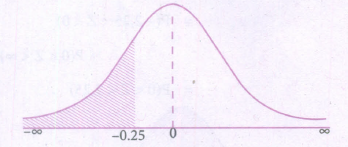
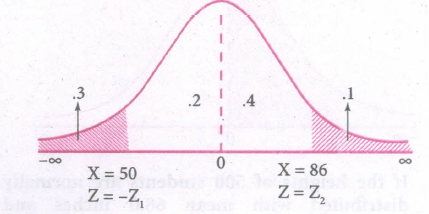
Plot the variable X = 50 on the left side and
X = 86 on the right side of the curve.
Given P( -∞< Z1 < -Z1) = 0.3
⇒ P(-Z1 < Z < Z1) = 0.2 [∵ 0.5 - 0.3 = 0.2]
⇒ P(0 < Z < Z1) = 0.2 [By symmetry]
⇒ Z1 = -0.52 [From the normal distribution table 'and it lies on the negative side]
⇒ -0.52 = \(\frac { X-\mu }{ \sigma } \) ⇒ -0.52 σ = 50-μ
⇒ 50-μ = -0.52 σ ....(1)
Also given P(Z2
⇒ Z2 = 1.28 (from the table)
⇒ 1.28 =\(\frac { 86-\mu }{ \sigma } \)
⇒ 86-μ = 1.28 σ ...(2)
Substituting σ = 20 in (2) we get,
86-μ = (1.28)(20)
86-μ = 25.6
μ = 86-25.6
μ = 60.4
Hence, the mean is 60.4 and standard deviation is 20.
10.
The mean of the binomial distribution
Ex = \(\overset { n }{ \underset { x=0 }{ \Sigma } } x.p(x)=\overset { n }{ \underset { x=0 }{ \Sigma } } \left( \begin{matrix} n \\ x \end{matrix} \right) { p }^{ x }q^{ n-x }\)
= \(p.\overset { n }{ \underset { x=0 }{ \Sigma } } x.\left( \begin{matrix} n \\ x \end{matrix} \right) { p }^{ x-1 }q^{ n-x }\)
[Take p common]
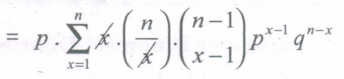
= \(np.\overset { n }{ \underset { x=1 }{ \Sigma } } \left( \begin{matrix} n-1 \\ x-1 \end{matrix} \right) { p }^{ x-1 }q^{ n-x }\)
= np (q +p)n-1 [using binomial theorem]
(x+a)n = \({ x }^{ n }+{ n }_{ { C }_{ 1 } }{ x }^{ n-1 }{ a }^{ 1 }+...+{ a }^{ n }\)
= np(1)n-1 [∵ p+q=1]
= np
∴ Mean = E(x) = np..(1)
Now, E(X2) =\(\overset { n }{ \underset { x=0 }{ \Sigma } } { x }^{ 2 }.\left( \begin{matrix} n \\ x \end{matrix} \right) { p }^{ x }q^{ n-x }\)
=\(\overset { n }{ \underset { x=0 }{ \Sigma } } \{ x(x-1)+x\} \left( \begin{matrix} n \\ x \end{matrix} \right) { p }^{ x }q^{ n-x }\)
=\(\overset { n }{ \underset { x=0 }{ \Sigma } } x(x-1).\left( \begin{matrix} n \\ x \end{matrix} \right) { p }^{ x }q^{ n-x }+{ \Sigma }_{ x }.\left( \begin{matrix} n \\ x \end{matrix} \right) { p }^{ x }q^{ n-x }\)
=\(\overset { n }{ \underset { x=2 }{ \Sigma } } x(x-1)\frac { n(n-1) }{ x(x-1) } \left( \begin{matrix} n-2 \\ n-2 \end{matrix} \right) { p }^{ x-2 }{ q }^{ n-x }\)+\(\Sigma x\left( \begin{matrix} n \\ x \end{matrix} \right) { p }^{ x }q^{ n-x }\)
= \(n(n-1){ p }^{ 2 }\left\{ \Sigma \left( \begin{matrix} n-2 \\ n-2 \end{matrix} \right) { p }^{ x-2 }{ q }^{ n-x } \right\} \) +np (using (1))
= n(n-1)p2 (q+p)n-2 + np
[using binomial theory]
= n(n-1)p2 (1) + np ∴ p+ q = 1
= n(n-1)p2+ np .... (2)
Variance = E(X2) - [E(X)]2
= n(n-1)p2+np-(np)2
[From (1) & (2)]

= np (1-p) = npq [ ∵ p+q = 1⇒ q = 1-p]
∴ Mean = np and variance = npq
11.
We know that, the expected random variable
\(E(X)=\int _{ -\infty }^{ \infty }{ xf(x) } dx\)
\(=\int _{ 100 }^{ \infty }{ { xe }^{ -\frac { x }{ 100 } }dx } \)
\(=\left\{ { \left[ x\left( \frac { { e }^{ \frac { x }{ 100 } } }{ -\frac { 1 }{ 100 } } \right) \right] }_{ 100 }^{ \infty }-\int _{ 100 }^{ \infty }{ \left( \frac { { e }^{ \frac { x }{ 100 } } }{ -\frac { 1 }{ 100 } } \right) dx } \right\} (\because \int { udv=uv-\int { vdu } } )\)
\(=\left[ \left( 10000 \right) \left( { e }^{ -1 } \right) +\left( 10000 \right) \left( { e }^{ -1 } \right) \right] \)
\(=\left[ \left( 10000 \right) \left( 0.3679 \right) +\left( 10000 \right) (0.3679) \right] \)
= 7358 hours
Therefore, the mean life of a radio tube is 7,358 hours.
12.
The present value of payment for t year = \(\int _{ 0 }^{ t }{ { 72000e }^{ -0.09t } } dt\)
Present value of 12 years = \(\int _{ 0 }^{ t }{ { 72000e }^{ -0.09t } } dt\)
= 72000\({ \left[ \frac { { e }^{ -0.09t } }{ { -0.09 } } \right] }_{ 0 }^{ \\ 12 }\)
= \(\frac { 72000 }{ -0.09 } \left[ { e }^{ -0.09(12) }-{ e }^{ 0 } \right] \)
= \(-8,00,000[{ e }^{ -1.08 }-{ e }^{ 0 }]\)
= −8,00,000 [0.3396 −1]
= 5,28,320
Cost of the machine = 5,00,000 − 30,000
= 4,70,000
Hence it not advisable to rent the machine
It is better to buy the machine.
13.
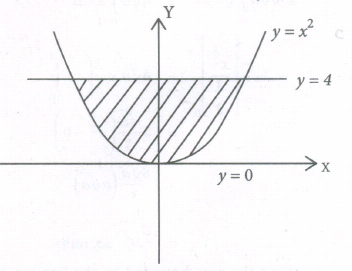
Since y = x2 is symmetric
about Y-axis, the required
Area = \(2\int _{ 0 }^{ 4 }{ x\quad dy } \)
When \(y={ x }^{ 2 }\Rightarrow x=\sqrt { y } \)
∴ Area \(=2\int _{ 0 }^{ 4 }{ \sqrt { y } dy } \)
\(=2\int _{ 0 }^{ 4 }{ { y }^{ \frac { 1 }{ 2 } }dy } \)
\(=2\times \frac { 2 }{ 2 } { \left[ { y }^{ \frac { 3 }{ 2 } } \right] }_{ 0 }^{ 4 }\)
\(=\frac { 4 }{ 3 } \left[ { 4 }^{ \frac { 3 }{ 2 } }-{ 0 }^{ \frac { 3 }{ 2 } } \right] \)
\(=\frac { 4 }{ 3 } \left[ { 4 }^{ \frac { 3 }{ 2 } } \right] \)
\(=\frac { 4 }{ 3 } \times { ({ 2 }^{ 2 }) }^{ \frac { 3 }{ 2 } }=\frac { 4 }{ 3 } \times { 2 }^{ 3 }\)
\(A=\frac { 4 }{ 3 } \times 8=\frac { 32 }{ 3 } \) sq.units
14.
The equation y2 = 16x represents a parabola (Open rightward)
Required Area = 2\(\int _{ a }^{ b }{ y } dx\)
\(=2\int _{ 0 }^{ 4 }{ \sqrt { 16x } } \ dx\)
\(=8\int _{ 0 }^{ 4 }{ { x }^{ \frac { 1 }{ 2 } } } dx=8{ \left[ { \frac { { x }^{ { \frac { 3 }{ 2 } } } }{ \frac { 3 }{ 2 } } } \right] }_{ 0 }^{ 4 }=\frac { 16 }{ 3 } \left( { \left( 4 \right) }^{ \frac { 3 }{ 2 } } \right) =\frac { 128 }{ 3 } \) sq.units
15.
\(\int { \frac { { 3x }^{ 2 }+6x+1 }{ \left( x+3 \right) \left( { x }^{ 2 }+1 \right) } } dx =\int { \left[ \frac { 1 }{ \left( x+3 \right) } \frac { 2x }{ \left( { x }^{ 2 }+1 \right) } \right] } dx\)
\(\int { \frac { dx }{ \left( x+3 \right) } +\int { \frac { 2x }{ \left( { x }^{ 2 }+1 \right) } } } dx\)
\(=\log\left| x+3 \right| +\log\left| { x }^{ 2 }+1 \right| +c\)
\(=\log\left| \left( x+3 \right) \left( { x }^{ 2 }+1 \right) \right| +c\)
\(=\log\left| { x }^{ 3 }+{ 3x }^{ 2 }+x+3 \right| +c\)
[ By partial fractions,
\(\frac { { 3x }^{ 2 }+6x+1 }{ \left( x+3 \right) \left( { x }^{ 2 }+1 \right) } =\frac { A }{ \left( x+3 \right) } +\frac { Bx+C }{ \left( { x }^{ 2 }+1 \right) } \Rightarrow \frac { { 3x }^{ 2 }+6x+1 }{ \left( x+3 \right) \left( { x }^{ 2 }+1 \right) } =\frac { 1 }{ \left( x+3 \right) } +\frac { 2x }{ \left( { x }^{ 2 }+1 \right) } \)
16.
\(\Delta =\left| \begin{matrix} 1 & 2 & 1 \\ 2 & -1 & 2 \\ 1 & 1 & -2 \end{matrix} \right| \)
= \(1\left| \begin{matrix} -1 & 2 \\ 1 & -2 \end{matrix} \right| -2\left| \begin{matrix} 2 & 2 \\ 1 & -2 \end{matrix} \right| +1\left| \begin{matrix} 2 & -1 \\ 1 & 1 \end{matrix} \right| \)
= 1(2 -2) - 2(-4 -2) + 1(2 + 1)
= 1(0)-2(-6)+1(3)
= 12 + 3 = 15\(\neq \)0.
Since \(\Delta \neq 0\) Cramer's rule can be applied and thesystem is consistent with unique solution.
\({ \Delta }x=\left| \begin{matrix} 7 & 2 & 1 \\ 4 & -1 & 2 \\ -1 & 1 & -2 \end{matrix} \right| \)
= \(7\left| \begin{matrix} -1 & 2 \\ 1 & -2 \end{matrix} \right| -2\left| \begin{matrix} 4 & 2 \\ -1 & -2 \end{matrix} \right| +1\left| \begin{matrix} 4 & -1 \\ -1 & 1 \end{matrix} \right| \)
= 7 (2 -2) -2 (-8 + 2) + 1 (4 - 1)
= 7 (0) - 2(-6) + 1(3)
= 12 + 3 = 15
\(\Delta y=\left| \begin{matrix} 1 & 7 & 1 \\ 2 & 4 & 2 \\ 1 & -1 & -2 \end{matrix} \right| \)
= \(1\left| \begin{matrix} 4 & 2 \\ -1 & -2 \end{matrix} \right| -7\left| \begin{matrix} 2 & 2 \\ 1 & -2 \end{matrix} \right| +1\left| \begin{matrix} 2 & 4 \\ 1 & -1 \end{matrix} \right| \)
= 1 (- 8 + 2) -7(-4 -2) + 1(-2 -4)
= 1 (-6) -7 (-6) + 1 (-6)
= - 6 + 42 - 6 = 30
\(\Delta z=\left| \begin{matrix} 1 & 2 & 7 \\ 2 & -1 & 4 \\ 1 & 1 & -1 \end{matrix} \right| \)
= \(1\left| \begin{matrix} -1 & 4 \\ 1 & -1 \end{matrix} \right| -2\left| \begin{matrix} 2 & 4 \\ 1 & -1 \end{matrix} \right| +7\left| \begin{matrix} 2 & -1 \\ 1 & 1 \end{matrix} \right| \)
= 1 (1 - 4) - 2(- 2 - 4) + 7(2 + 1)
= 1(-3)-2(-6)+7(3)
= - 3 + 12 + 21 = 30
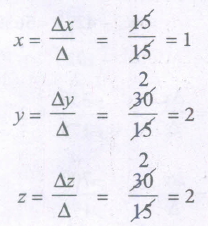
\(\therefore\) Solution set is {1, 2, 2}
17.
Given non-homogeneous equations are
2x + 3y - z = 5, 3x - y + 4z = 2, x + 7y - 6z = k
| Augmented matrix | Elementary Transformation |
|---|---|
| \(\left( \begin{matrix} 2 & 3 & -1 \\ 3 & -1 & 4 \\ 1 & 7 & -6 \end{matrix}\begin{matrix} 5 \\ 2 \\ k \end{matrix} \right) \) | |
| \(\left( \begin{matrix} 1 & 7 & -6 \\ 3 & -1 & 4 \\ 2 & 3 & -1 \end{matrix}\begin{matrix} k \\ 2 \\ 5 \end{matrix} \right) \) | \({ R }_{ 1 }\leftrightarrow { R }_{ 3 }\) |
| \(\left( \begin{matrix} 1 & 7 & -6 \\ 0 & -22 & 22 \\ 0 & -11 & 11 \end{matrix}\begin{matrix} k \\ 2-3k \\ 5-2k \end{matrix} \right) \) | \({ R }_{ 2 }\rightarrow { R }_{ 2 }-3{ R }_{ 1 }\) |
| \(\left( \begin{matrix} 1 & 7 & -6 \\ 0 & -22 & 22 \\ 0 & 0 & 0 \end{matrix}\begin{matrix} k \\ 2-3k \\ 2(5-2k)-(2-3k) \end{matrix} \right) \) | \({ R }_{ 2 }\rightarrow { R }_{ 2 }-3{ R }_{ 1 }\) \({ R }_{ 3 }\rightarrow { R }_{ 3 }-2{ R }_{ 1 }\) |
| \(\left( \begin{matrix} 1 & 7 & -6 \\ 0 & -22 & 22 \\ 0 & 0 & 0 \end{matrix}\begin{matrix} k \\ 2-3k \\ 10-4k-2+3k \end{matrix} \right) \) | \({ R }_{ 3 }\rightarrow 2{ R }_{ 3 }-{ R }_{ 2 }\) |
| \(\left( \begin{matrix} -1 & 7 & -6 \\ 0 & -22 & 22 \\ 0 & 0 & 0 \end{matrix}\begin{matrix} k \\ 2-3k \\ 8-k \end{matrix} \right) \) |
Here \(\rho (A)=2\)
Since the given system is consistent, \(\rho \)(A, B) must be equal to 2.
This can happen only when
8 - k = 0 \(\Rightarrow\) k = 8
18.
(i) Transition probability matrix T = \(_{ E }^{ M }\left( \begin{matrix} \overset { M }{ 0.8 } & \overset { E }{ 0.2 } \\ 0.7 & 0.3 \end{matrix} \right) \)
After one study period, \(\left( \overset { M }{ 60\quad } \overset { E }{ 40 } \right) \) \(_{ E }^{ M }\left( \begin{matrix} \overset { M }{ 0.8 } & \overset { E }{ 0.2 } \\ 0.7 & 0.3 \end{matrix} \right) \) =\(\left( \overset { M }{ 76\quad } \overset { E }{ 24 } \right) \)
So in the very next study period, there will be 76 students do maths work and 24 students do the English work.
After two study periods,
\(\left( \overset { M }{ 76\quad } \overset { E }{ 24 } \right) \) \(_{ E }^{ M }\left( \begin{matrix} \overset { M }{ 0.8 } & \overset { E }{ 0.2 } \\ 0.7 & 0.3 \end{matrix} \right) \)
= (60.8+16.8 15.2+7.2)
= (77.6 22.4)
After two study periods there will be 78 (approx) students do maths work and 22 (approx) students do English work.
19.
Let the amount invested in the rate of 2%, 3% and 6% be Rs. x, Rs. y and Rs. z respectively
By the given data,
x+ y+z = 8500
\(\cfrac { 2x }{ 100 } +\cfrac { 3y }{ 100 } +\cfrac { 6z }{ 100 } =380\)
\(\Rightarrow \cfrac { 2x+3y+6z }{ 100 } =380\)
\(\because Interest=\cfrac { PNR }{ 100 } =\cfrac { x\times 1\times 2 }{ 100 } =\cfrac { 2x }{ 100 } \)
\(\Rightarrow 2x+3y+6z=38000\)
Also,z = x+y
x+y-z =0
\(\Delta =\left| \begin{matrix} 1 & 1 & 1 \\ 2 & 3 & 6 \\ 1 & 1 & -1 \end{matrix} \right| \)
\(1\left| \begin{matrix} 3 & 6 \\ 1 & -1 \end{matrix} \right| -1\left| \begin{matrix} 2 & 6 \\ 1 & -1 \end{matrix} \right| +1\left| \begin{matrix} 2 & 3 \\ 1 & 1 \end{matrix} \right| \)
= 1(-3 - 6) - 1(-2 -6) + 1 (2 - 3)
= 1(-9) - 1 (-8) + 1(-1)
= -9 + 8 - 1 = 2 \(\neq \) 0
Since \(\Delta \neq 0\),Cramer's rule can be applied and the system is consistent with unique solution
\({ \Delta x }=\left| \begin{matrix} 8500 & 1 & 1 \\ 38000 & 3 & 6 \\ 0 & 1 & -1 \end{matrix} \right| \)
= \(8500\left| \begin{matrix} 3 & 6 \\ 1 & -1 \end{matrix} \right| -1\left| \begin{matrix} 38000 & 6 \\ 1 & -1 \end{matrix} \right| +1\left| \begin{matrix} 38000 & 3 \\ 0 & 1 \end{matrix} \right| \)
= 8500 (- 3 - 6) - 1(-38000 -0) + 1(38000 - 0)
= 8500(-9) - 1(-38000) + 1(38000)
= - 76500 + 38000 + 38000
= -500
\(\Delta y=\left| \begin{matrix} 1 & 8500 & 1 \\ 2 & 38000 & 6 \\ 1 & 0 & -1 \end{matrix} \right| \)
= \(1\left| \begin{matrix} 38000 & 6 \\ 0 & -1 \end{matrix} \right| -8500\left| \begin{matrix} 2 & 6 \\ 1 & -1 \end{matrix} \right| +1\left| \begin{matrix} 2 & 38000 \\ 1 & 0 \end{matrix} \right| \)
= 1 (-38000 - 0) - 8500 (-2 -6) + 1(0 - 38000)
= - 38000 - 8500 (-8) - 38000
= - 38000 + 68000 - 38000
= - 8000
\(\Delta z=\left| \begin{matrix} 1 & 1 & 8500 \\ 2 & 3 & 38000 \\ 1 & 1 & 0 \end{matrix} \right| \)
= \(1\left| \begin{matrix} 38000 & 6 \\ 0 & -1 \end{matrix} \right| -1\left| \begin{matrix} 2 & 38000 \\ 1 & 0 \end{matrix} \right| +8500\left| \begin{matrix} 2 & 3 \\ 1 & 1 \end{matrix} \right| \)
= 1 (0 - 38000) - 1(0 -38000) +85000 (2 - 3)
= - 38000 + 38000 + 8500 (-1)
= - 8500
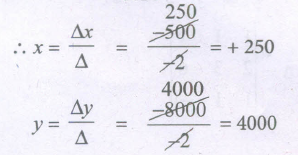
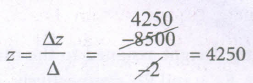
Hence, the amount invested in the three accounts are Rs. 250, Rs. 4000 and Rs. 4250 respectively.
20.
Here \(\triangle =\left| \begin{matrix} 1 & 1 & 1 \\ 2 & -1 & 3 \\ 3 & 2 & -1 \end{matrix} \right| =13\neq 0\)
\(\therefore \) We can apply Cramer’s Rule and the system is consistent and it has unique solution.
\({ \triangle }_{ x }=\left| \begin{matrix} 1 & 1 & 1 \\ 2 & -1 & 3 \\ 3 & 2 & -1 \end{matrix} \right| =-13\)
\( { \triangle }_{ y }=\left| \begin{matrix} 1 & 4 & 1 \\ 2 & 1 & 3 \\ 3 & 1 & -1 \end{matrix} \right| =39\)
\( { \triangle }_{ z }=\left| \begin{matrix} 1 & 1 & 4 \\ 2 & -1 & 1 \\ 3 & 2 & 1 \end{matrix} \right| =26\)
\(\therefore \) By Cramer’s rule
\(x=\frac { { \triangle }x }{ { \triangle } } =\frac { -13 }{ 13 } =-1\)
\( y=\frac { { \triangle }y }{ { \triangle } } =\frac { 39 }{ 13 } =3\)
\( z=\frac { { \triangle }z }{ { \triangle } } =\frac { 26 }{ 13 } =2\)
\(\therefore \) The solution is (x, y, z) = (−1, 3, 2)
21.
Let the amount of investment in each bond be
Rs. x, Rs. y, Rs. z respectively.
Given x + y + z = 5000 ..(1)
Also \(\cfrac { 6x }{ 100 } +\cfrac { 7y }{ 100 } +\cfrac { 8z }{ 100 } =358\)
∴ Interes \(= \cfrac { PNR }{ 100 } =\cfrac { x\times 1\times 6 }{ 100 } =\cfrac { 6x }{ 100 } \)
\(\Rightarrow \cfrac { 6x+7y+8z }{ 100 } =358\)
\(\Rightarrow 6x+7y++8z=35800\)
Given that \(\cfrac { 6x }{ 100 } +\cfrac { 7y }{ 100 } =70+\cfrac { 8z }{ 100 } \)
\(\Rightarrow 6x+7y=7008z\)
\(\Rightarrow 6x+7y-8z=7000\)
The matrix equation corresponding to the given system is
\(\left( \begin{matrix} 1 & 1 & 1 \\ 6 & 7 & 8 \\ 6 & 7 & -8 \end{matrix} \right) \left( \begin{matrix} x \\ y \\ z \end{matrix} \right) =\left( \begin{matrix} 5000 \\ 35800 \\ 7000 \end{matrix} \right) \)
| Augmented matrix [A,B] | Elementary Transformation |
|---|---|
| \(\left( \begin{matrix} 1 & 1 & 1 \\ 6 & 7 & 8 \\ 6 & 7 & -8 \end{matrix}\begin{matrix} 5000 \\ 35800 \\ 7000 \end{matrix} \right) \) | |
| \(\left( \begin{matrix} 1 & 1 & 1 \\ 0 & 1 & 2 \\ 0 & 1 & -14 \end{matrix}\begin{matrix} 5000 \\ 5800 \\ -2300 \end{matrix} \right) \) | \(\ { R }_{ 2 }\rightarrow { R }_{ 2 }-6{ R }_{ 1 }\) \({ { R }_{ 3 }\rightarrow { R }_{ 3 }-{ 6R }_{ 1 } }\) |
| \(\left( \begin{matrix} 1 & 1 & 1 \\ 0 & 1 & 2 \\ 0 & 0 & -16 \end{matrix}\begin{matrix} 5000 \\ 5800 \\ -28800 \end{matrix} \right) \) | \({ R }_{ 3 }\rightarrow { R }_{ 3 }-{ R }_{ 2 }\) |
The last equivalent matrix is in echelon form and ρ(A) = ρ([A,B]) = 3 = Number of unknowns
Thus, the given system is consistent with unique solution. To find the solution, let us rewrite the above echelon form into the matrix form
\(\left( \begin{matrix} 1 & 1 & 1 \\ 0 & 1 & 2 \\ 0 & 0 & -16 \end{matrix} \right) \left( \begin{matrix} x \\ y \\ z \end{matrix} \right) =\left( \begin{matrix} 5000 \\ 5800 \\ -28800 \end{matrix} \right) \)
\(\Rightarrow x+y+z=5000\) ...(1)
\(\Rightarrow y+2z=5800\) ..(2)
\(\Rightarrow -16z=-28800\) ...(3)
\((3)\Rightarrow -16z=-28800\)
\(\Rightarrow z=\cfrac { 28800 }{ -16 } =1800\)
Substituting z = 1800 in (2) we get,
y + 2(1800) = 5800
\(\Rightarrow\) y + 3600 = 5800
\(\Rightarrow\) y=5800-3600
\(\Rightarrow\) y = 2200
Substituting y = 2200 and z = 1800 in (1) we get
\(\Rightarrow\) x + 2200 + 1800 = 5000
\(\Rightarrow\)x + 4000 = 5000
\(\Rightarrow\)x = 5000 - 4000
\(\Rightarrow\)x = 1000
Hence, the amount of investment in each bond is Rs. 1000, Rs. 2200 and Rs. 1800 respectively
22.
The matrix equation corresponding to the given system is
\(\left( \begin{matrix} 1 & 1 & 1 \\ 1 & 2 & 3 \\ 1 & 2 & a \end{matrix} \right) \left( \begin{matrix} X \\ Y \\ Z \end{matrix} \right) =\left( \begin{matrix} 6 \\ 10 \\ b \end{matrix} \right) \)
AX = B
| Augmented matrix [A,B] | Elementary Transformation |
| \(\left( \begin{matrix} 1 & 1 & 1 \\ 1 & 2 & 3 \\ 1 & 2 & a \end{matrix}\begin{matrix} 6 \\ 10 \\ b \end{matrix} \right) \) \(\sim \left( \begin{matrix} 1 & 1 & 1 \\ 0 & 1 & 2 \\ 0 & 1 & a-1 \end{matrix}\begin{matrix} 6 \\ 4 \\ b-6 \end{matrix} \right) \) \(\sim \left( \begin{matrix} 1 & 1 & 1 \\ 0 & 1 & 2 \\ 0 & 0 & a-3 \end{matrix}\begin{matrix} 6 \\ 4 \\ b-10 \end{matrix} \right) \) |
\({ R }_{ 2 }\rightarrow { R }_{ 2 }-{ R }_{ 1 }\) \({ R }_{ 3 }\rightarrow { R }_{ 3 }-{ R }_{ 1 }\) |
Case (i) For no solution:
The system possesses no solution only when \(\rho (A)\neq ([A,B])\) which is possible only when a−3 = 0 and b −10 \(\neq \) 0.
Hence for a = 3, b \(\neq \) 10, the system possesses no solution.
Case (ii) For a unique solution:
The system possesses a unique solution only when \(\rho (A)= ([A,B])\)=number of unknowns.
i.e when \(\rho (A)=\rho ([A,B])\) = 3
Which is possible only when a−3 \(\neq \) 0 and b may be any real number as we can observe .
Hence for a \(\neq \) and b \(\in \) R, the system possesses a unique solution.
Case (iii) For an infinite number of solutions:
The system possesses an infinite number of solutions only when
\(\rho (A)=\rho ([A,B])\)
Hence for a = 3, b = 10, the system possesses infinite number of solutions.
23.
The matrix equation corresponding to the given system is
\(\left( \begin{matrix} 1 & -4 & 7 \\ 3 & 8 & -2 \\ 7 & -8 & 26 \end{matrix} \right) \left( \begin{matrix} X \\ Y \\ Z \end{matrix} \right) =\left( \begin{matrix} 14 \\ 13 \\ 5 \end{matrix} \right) \)
AX = B
| Augmented matrix [A,B] | Elementary Transformation |
| \(\left( \begin{matrix} 1 & -4 & 7 \\ 3 & 8 & -2 \\ 7 & -8 & 26 \end{matrix}\begin{matrix} 14 \\ 13 \\ 5 \end{matrix} \right) \) \(\sim \left( \begin{matrix} 1 & -4 & 7 \\ 0 & 20 & -23 \\ 0 & 20 & -23 \end{matrix}\begin{matrix} 14 \\ -29 \\ -93 \end{matrix} \right) \) \(\sim \left( \begin{matrix} 1 & -4 & 7 \\ 0 & 20 & -23 \\ 0 & 0 & 0 \end{matrix}\begin{matrix} 14 \\ -29 \\ 64 \end{matrix} \right) \) |
|
| \(\rho (A)=2,\rho ([A,B])=3\) |
The last equivalent matrix is in the echelon form. [A, B] has 3 non-zero rows and [A] has 2 non-zero rows.
\(\therefore \rho ([A,B])=3\),\(\rho (A)=2,\)
\(\rho (A)\neq ([A,B])\)
The system is inconsistent and has no solution.
24.
\(\int _{ -1 }^{ 1 }{ x\sqrt { x+1 } } dx=\int _{ 0 }^{ 2 }{ (t-1)\sqrt { t } dt } \)
\(=\int _{ 0 }^{ 2 }{ \left( { t }^{ \frac { 3 }{ 2 } }-{ t }^{ \frac { 1 }{ 2 } } \right) } dt\)
\(={ \left[ \frac { { 2t }^{ \frac { 5 }{ 2 } } }{ 5 } -\frac { { 2t }^{ \frac { 3 }{ 2 } } }{ 3 } \right] }_{ 0 }^{ 2 }\)
\(=\frac { 8\sqrt { 2 } }{ 5 } -\frac { 4\sqrt { 2 } }{ 3 } \)
\(=\frac { 4\sqrt { 2 } }{ 15 } \)
| Take t = x +1 dt = dx and |
||
| x | -1 | 1 |
| t | 0 | 2 |
25.
\(\int { \frac { \left( 3x+2 \right) dx }{ \left( x-2 \right) \left( x-3 \right) } } \)
\(\frac { 3x+2 }{ \left( x-2 \right) \left( x-3 \right) } =\frac { A }{ x-2 } +\frac { B }{ x-3 } \)
⇒ 3x+2 = A (x-3)+B(x-2)
Put x = 3
9+2 = B(1) ⇒ B = 11
Put x = 2
8 = A(-1) ⇒ A = -8
\(\frac { 3x+2 }{ \left( x-2 \right) \left( x-3 \right) } =\frac { -8 }{ x-2 } +\frac { 11 }{ x-3 } \)
\(=\int { \left( \frac { -8 }{ x-2 } +\frac { 11 }{ x-3 } \right) } dx\)
\(=-8\log { \left| x-2 \right| } +11\log { \left| x-3 \right| } +c\)
\(=-11\log { \left| x-3 \right| } -8\log { \left| x-2 \right| } +c\)

12th Standard Syllabus & Materials
12th Standard
TN 12th Computer Applications வலையமைப்பு வடமிடல் Sample Question Papers Study Material - QB365 Set A
NEW12th Standard
TN 12th Computer Applications களப்பெயர் முறைமை (DNS) Sample Question Papers Study Material - QB365 Set A
NEW12th Standard
TN 12th Computer Applications வலையமைப்பு எடுத்துக்காட்டுகள் மற்றும் நெறிமுறைகள் Sample Question Papers Study Material - QB365 Set A
NEW12th Standard
TN 12th Computer Applications கணினி வலையமைப்பு ஓர் அறிமுகம் Sample Question Papers Study Material - QB365 Set A



Tamilnadu Stateboard 12th Standard Subjects

Maths

Chemistry

Physics

Biology

Computer Science
Business Maths and Statistics

Economics

Commerce

Accountancy

History

Computer Applications
Biology
Computer Technology
Computer Applications
Computer Science
Business Maths and Statistics
Commerce
Economics
Maths
Chemistry
Physics
Computer Technology
History
Accountancy

Tamil

English

French
Tamilnadu Stateboard Standards
